WizLeads


TL;DR
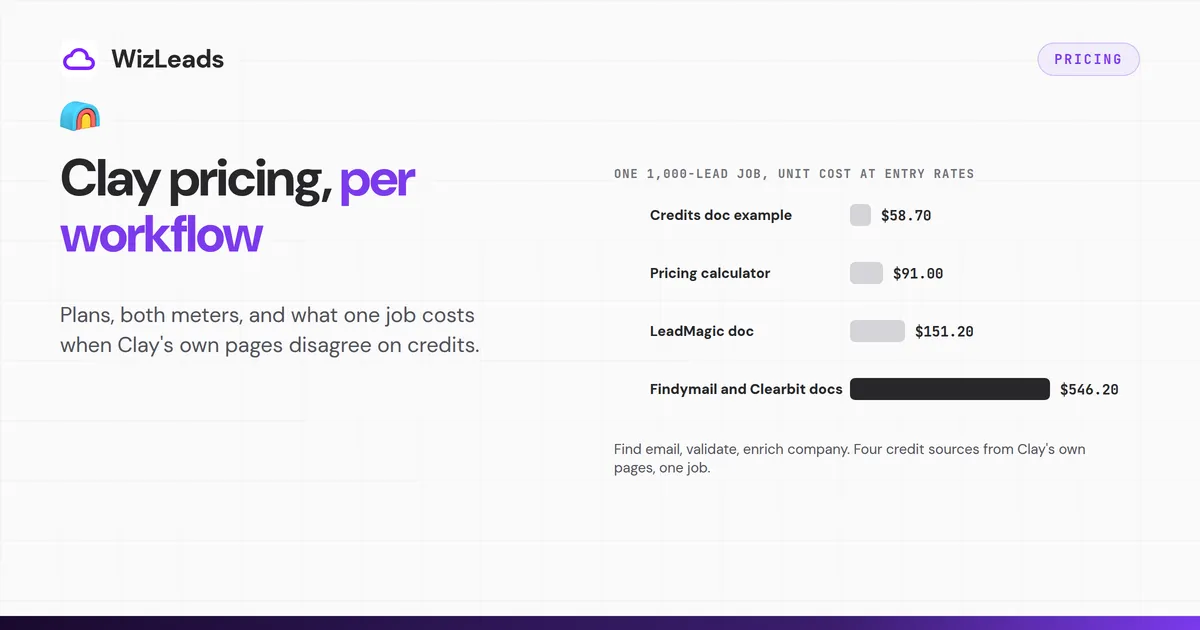
Clay has four plans: Free at $0, Launch at $185 a month ($167 on the Annual toggle), Growth at $495 ($446) and custom Enterprise. Two meters run under every plan, Actions for the work Clay does and Data Credits for the data it buys. On one 1,000-lead job, Clay's own pages give four credit costs, and the unit cost runs from $58.70 to $546.20. Test your exact steps on a small batch before you pick a tier.
How much does Clay cost? Free is $0, Launch is $185 on the Monthly toggle or $167 on the Annual toggle, and Growth is $495 Monthly or $446 Annual. Enterprise is custom. Clay's page opens on Annual, so the first price you see is the lower one.
Each card price adds an Actions price to a Data Credits price. The tiers are public, so the plan price is the easy part. The hard part is how many credits a step uses, because Clay's pages disagree. We priced one 1,000-lead job on four credit sources, and none of the results is a bill.
Clay pricing plans on both toggles
Is Clay free? There is a Free plan. The prices below come from Clay's pricing page, and every plan has unlimited seats and tables. The Free plan includes Clay's AI agent, Claygent, per the same page.
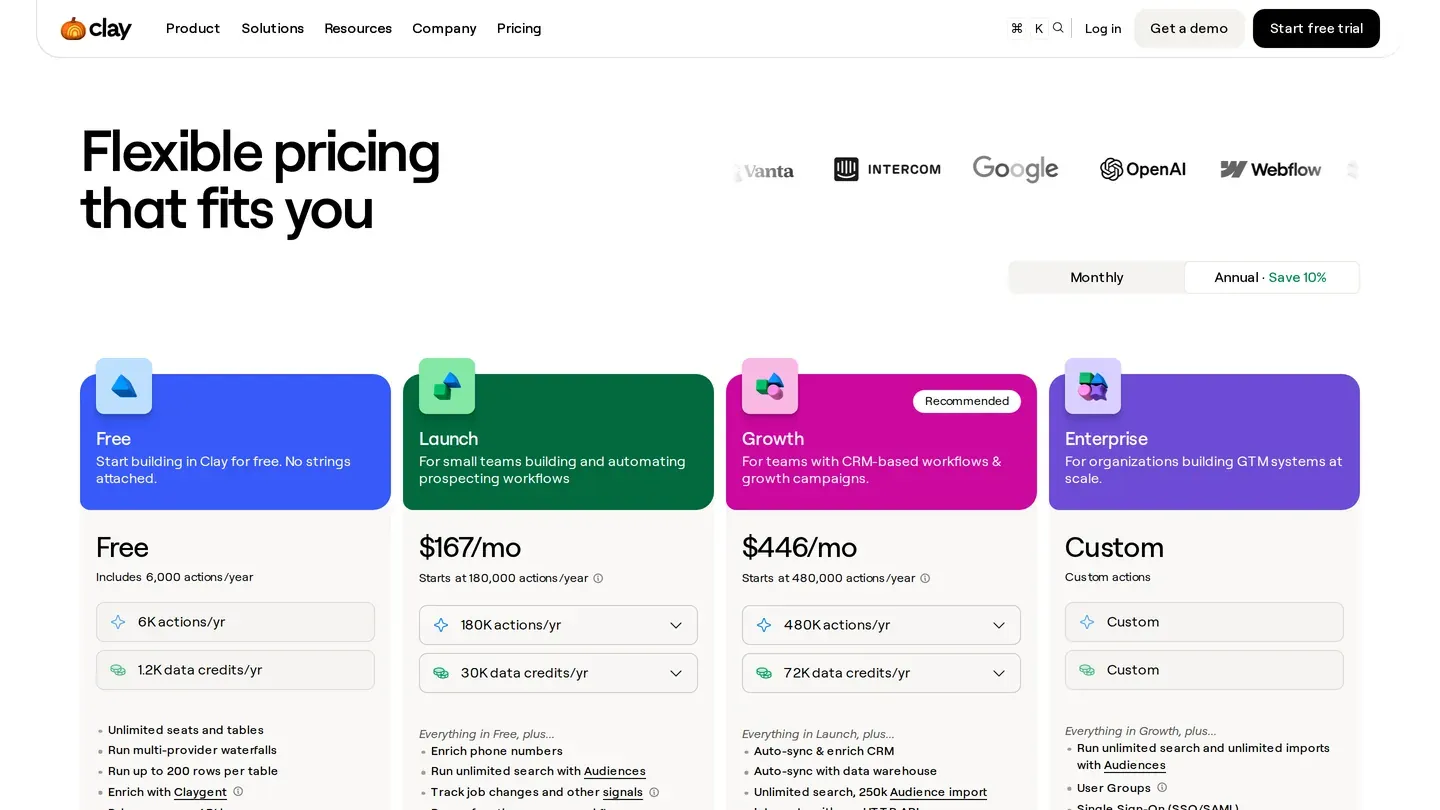
| Plan | Entry allowance | Monthly toggle | Annual toggle, per month | What the plan adds |
|---|---|---|---|---|
| Free | 500 Actions, 100 Data Credits, 200 rows per table | $0 | $0 | No phone enrichment |
| Launch | 15,000 Actions, 2,500 Data Credits | $185 ($60 + $125) | $167 ($54 + $113) | Phone enrichment, email campaigns, scheduled runs |
| Growth | 40,000 Actions, 6,000 Data Credits | $495 ($205 + $290) | $446 ($185 + $261) | HTTP API, CRM integrations, webhooks |
| Enterprise | Custom | Custom | Custom | Bulk enrichment above 50,000 records at once |
Source: Clay's pricing page and its Plans and billing doc. Each bracket shows the Actions price first and the Data Credits price second, and the sums check: 60 + 125 = 185, 54 + 113 = 167, 205 + 290 = 495 and 185 + 261 = 446.
Clay labels the annual option "Save 10%". On the cards the saving is 9.7% on Launch and 9.9% on Growth, because tiers are whole dollars, so about 10% is fair. Clay's Plans and billing doc adds a 14-day trial with 1,000 Data Credits and no phone enrichment.
Some readers still see $149. Clay's own FAQ page "How much does it cost?" says "Our paid plans start at $149/mo", a legacy price, while the pricing page starts Launch at $185.
Enterprise: 100,000+ or 200,000+ Actions
Clay's pricing FAQ gives Enterprise 200,000+ Actions a month and 100,000+ Data Credits. Clay's Actions and Data Credits doc says 100,000+ Actions, and so does the Plans and billing doc. Ask Clay which figure your contract uses.
Enterprise is custom pricing with an annual commitment. Vendr says the median buyer pays $60,000 a year across 97 purchases, with a range from $16,560 to $166,800. That median is 11.2 times Growth's annual list of $5,352 (446 x 12), so contract spend can sit far above the public ladders. Vendr's Clay guide was last updated in February 2026, before the March repricing, so its purchases can include legacy contracts.
The slider ladders behind each card
| Monthly Actions | Launch price | Growth price |
|---|---|---|
| 15,000 | $60 | not offered |
| 40,000 | $150 | $205 |
| 60,000 | $200 | $290 |
| 100,000 | $290 | $450 |
| 200,000 | $540 | $850 |
| Monthly Data Credits | Price, either plan | Per credit |
|---|---|---|
| 2,500 (Launch entry) | $125 | $0.0500 |
| 6,000 | $290 | $0.0483 |
| 10,000 | $460 | $0.0460 |
| 20,000 | $880 | $0.0440 |
| 50,000 | $2,125 | $0.0425 |
Source: Clay's pricing page, Monthly toggle. The annual ladder is about 10% lower on each tier.
Per-credit figures are tier price divided by credits, so they are unit costs. Clay's pricing page puts the entry Data Credit at $0.05 and the entry Action below one cent. Data Credits cost the same on both plans on the Monthly toggle, but Actions cost more on Growth: 40,000 are $150 on Launch and $205 on Growth, a 1.37x gap that reaches 1.57x at 200,000. The step from Launch to Growth at the entry cards is $310 a month on the Monthly toggle (495 minus 185) and $279 on the Annual toggle (446 minus 167).
Actions and Data Credits: what each step spends
Actions measure the work Clay does, and Data Credits buy data or AI through Clay's marketplace. The Actions and Data Credits doc puts an Action at a few tenths of a penny and a Data Credit at a few pennies. It also says each record enriched or exported counts as one Action, whatever the provider.
An Action is used by each enrichment, including runs on your own API keys, and by each AI run. It is also used by each lead pushed to a sequencer, each CRM or warehouse sync and each HTTP API call. Finding people for a list, imports, formulas, filters and CSV export use none. Per Clay's How AI is priced doc, most models carry a flat Data Credit price per task, while Clay's most advanced reasoning models show an estimate first, set at the 75th percentile of past runs, and Clay says the final cost is in most cases at or below it.
With your own provider key, a run still costs one Action and no Data Credits, per Clay's pricing page. The same page says an enrichment that returns no result charges neither meter. The doc names exceptions: a run stopped midway still bills the requests already sent, and auto-run refreshes and re-runs bill again.
Clay's doc puts a fully enriched record at 6 to 20 Data Credits. At the $0.05 entry rate that is $300 to $1,000 per 1,000 records (our arithmetic, a unit cost). A poster on the Growth plan wrote in an r/gtmengineering thread that 10 enrichment columns over 5,000 records "would eat through our monthly credits in one run".
What a Data Credit buys: Clay's pages disagree
| Clay page | Find work email | Validate email | Company enrichment |
|---|---|---|---|
| Actions and Data Credits doc, worked example | 0.5 per email found | 0 | not in the example |
| Pricing calculator assumptions | 1 Data Credit and 3 Actions | not listed | 0.5 and 1 Action |
| LeadMagic integration doc | 1 | 1 | 1 |
| Findymail integration doc | 2 | 1 | not used |
| Hunter integration doc | 2 | 2 | not used |
| Clearbit integration doc | not used | not used | 8 |
Source: each page named in the first column. The integration docs state credits "per enriched cell" on a Clay-managed account. The calculator figures are Clay's estimating assumptions, not billed prices.
The Hunter and ZeroBounce docs still name the old Starter, Explorer and Pro plans, so some figures may predate the March repricing that Clay says cut data costs by 50 to 90%. The figures come from docs and a calculator, not from the price each provider carries inside the product. Read the table as a range. The company column spans 16 times, from 0.5 to 8 credits.
What a 1,000-lead workflow costs on Clay
The job starts with 1,000 leads that have a name and a company domain. Step one finds a work email, step two validates each address found, and step three enriches the company for every lead. We assume 900 emails found, the 90% success rate in Clay's own worked example, and all 1,000 companies returning data. Output goes to CSV, which uses no Action.
Each validation counts as one Action, as Clay's FAQ describes it, so Actions are 900 + 900 + 1,000 = 2,800. The first row uses the doc's 0.5 and 0, plus the calculator's 0.5 for the company step. The calculator row charges per contact: 1,000 contacts at 1 Data Credit and 3 Actions, plus 1,000 companies at 0.5 and 1. The LeadMagic row is 1, 1 and 1 (LeadMagic's company action takes the company's LinkedIn URL, so this row assumes you have it), and the last row pairs Findymail (2 to find, 1 to validate) with Clearbit (8 for the company).
| Credit source | Data Credits | Actions | Unit cost at entry rates | Smallest Launch slider pair, Monthly | Annual |
|---|---|---|---|---|---|
| Credits doc example | 950 | 2,800 | $58.70 | $185 | $167 |
| Pricing calculator | 1,500 | 4,000 | $91.00 | $185 | $167 |
| LeadMagic doc | 2,800 | 2,800 | $151.20 | $350 | $315 |
| Findymail and Clearbit docs | 10,700 | 2,800 | $546.20 | $940 | $846 |
Unit cost is Data Credits at $0.05 plus Actions at $0.004, the entry rates on Clay's ladders. Clay bills the plan tier, not the job, so each setup is the smallest Launch slider pair that holds the job.
The LeadMagic row needs the 6,000 Data Credit tier ($290 + $60 = $350 Monthly; $261 + $54 = $315 Annual). The last row needs the 20,000 tier ($880 + $60 = $940; $792 + $54 = $846). Clay's Plans and billing doc lists Launch Data Credits at 2,500 to 10,000, while the pricing page slider runs to 50,000, and the last row follows the slider.
A top-up is the other route. Clay's pricing FAQ says you can top up "without being pushed up to a higher plan tier", so the LeadMagic job also runs on the $185 card plus 300 topped-up Data Credits, and the last job on the $460 tier plus 700, at a 30% premium on a base Clay does not state, so we print no total.
The Actions are the small part: 2,800 of them cost $11.20 at the entry rate, while Data Credits run from $47.50 to $535.00. In the last row, 1,000 companies at 8 credits are 8,000 Data Credits, or $400 of the $546.20. The first two rows land on the same $185 card, so the plan floor decides the bill there. The spread is 9.3x (546.20 divided by 58.70).
With your own provider keys, the job uses 0 Data Credits and 2,800 Actions. Launch still prices at $185 or $167, and the providers bill you on top. Pushing the 900 found rows to an external sequencer adds 900 Actions. Free cannot run the job, with 200 rows per table and 500 Actions.
Every step scales with the emails found, and 90% is Clay's example rather than a rate we measured.
Email validation: four Clay statements, one question
Clay's pages disagree on what validating an email costs, and we do not pick a side.
- The Actions and Data Credits doc says select validator providers are free under new pricing, and its worked example charges 0 Data Credits for validation.
- The action pages for LeadMagic, Enrow and Icypeas validation are labelled "Free Action".
- Clay's FAQ page and its March 2026 announcement say a validation through Clay's marketplace uses Data Credits and an Action, an Action only with your own key.
- The ZeroBounce and Debounce docs say 1 credit per enriched cell, and the Findymail, LeadMagic and Hunter docs say 1, 1 and 2 for their validation actions.
On our 900 validations, 0 credits is $0 in Data Credits, 1 credit is 900 Data Credits ($45 at the entry rate) and 2 credits is 1,800 ($90). Add $3.60 of Actions if each check counts as one. Clay's pages do not state the in-product Data Credit price per validator, or how an unknown or catch-all verdict is billed.
If you validate outside Clay, WizLeads' Verify Email API takes one HTTP call per address. Our guide to verifying emails in Clay shows how to set the step up with the validators Clay lists.
Rollover, top-ups, upgrades and refunds
Rollover
Per Clay's Actions and Data Credits doc, Actions never roll over. On a monthly plan, unused Data Credits accumulate up to twice your monthly allowance. That is 5,000 on the entry Launch card and 12,000 on the entry Growth card (our arithmetic). On an annual plan, 15% of your Data Credits roll over if you renew on the same or a higher tier.
Top-ups
Per the same doc, top-ups buy Data Credits only, never Actions. Both one-time and automatic top-ups carry a 30% premium, with a 250-credit minimum. Each top-up is capped at $1,000, with a $5,000 limit across all top-ups in a rolling 7 days, and together they add up to 4 times your monthly allocation.
Clay's March 2026 announcement says something else: "top-up limits have been removed entirely". Ask Clay which of the two applies to your contract. Neither page states the dollar base of the 30% premium, so we show no top-up price. Upgrading your Data Credit tier carries no premium.
Upgrades and refunds
Upgrade mid-period and, per Clay's Plans and billing doc, the unused value is a credit that "lowers what you pay for the upgrade rather than returning money to your card".
Clay's Terms of Service, last updated May 23, 2024, say "Except as set forth in the Agreement, all fees are non-refundable." They also say a Clay subscription renews automatically at Clay's most up-to-date rates. The Actions and Data Credits doc refunds Data Credits for invalid data only when the provider refunds Clay.
What changed on 11 March 2026, and the legacy plans
Clay's March 2026 announcement renamed credits to Data Credits and added Actions as the second meter. It says it is cutting marketplace data costs by 50 to 90%, and the top-up premium falls from 50% to 30%. It puts Growth's $495 at $305 below the old Pro plan, priced at $800, and says HTTP API access moved from Explorer to Growth. Its example is the same inbound workflow at 7.3 Data Credits on modern plans against 20 on legacy plans, plus an Action per step.
The same post warns that own-key and Pro customers "may see a price increase". Clay's Legacy plans doc gives Pro at about $0.012 to $0.016 per credit. Growth's 6,000 tier is $290 for 6,000 credits, or $0.0483, so a Pro credit looks 3.0 to 4.0 times cheaper (our arithmetic). A credit buys different amounts of data under the two schemes, so per-credit prices alone do not settle which plan costs less.
Any plan change after 10 April 2026 forces a legacy customer onto the modern plans, per the Legacy plans doc. Legacy plans carry no Action charges and do not get the data-price cut. A guide that quotes Starter or Explorer prices describes plans that only existing customers can stay on.
Calling an outside API from Clay: where WizLeads fits
Clay's pricing page lists HTTP API integrations on Growth and Enterprise, and its Actions doc counts every HTTP API call as an Action. An outside email check inside Clay therefore needs the Growth plan plus an Action per call.
WizLeads' Verify Email costs 0.5 credit for every email it processes, whatever the result. On the Freelancer plan, $39 a month for 10,000 credits, that is 20,000 verifications, or $1.95 per 1,000 (a unit cost). For the 900 addresses in the job above, that is 450 credits, or $1.76. Clay's validators at 1 or 2 Data Credits are $45 or $90 for the same 900 at the entry rate, and $0 on the validators Clay marks free, before Actions; the outside call also needs Growth, $310 a month above Launch.
In Clay, you call WizLeads from an HTTP API column you set up yourself. Its API doc has a note for this setup, "set Request Limit to 10 and Duration (in ms) to 1000", which matches the example in Clay's own HTTP API doc. If the email step is all you use Clay for, our Clay alternatives guide prices other tools on one job. If you need more than an email check, the data enrichment tools list prices 13 tools and ran seven email finders on the same 1,000 leads.