WizLeads

Key takeaways
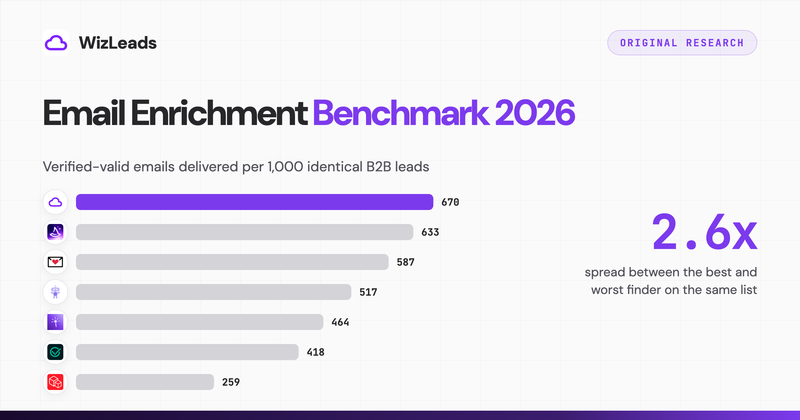
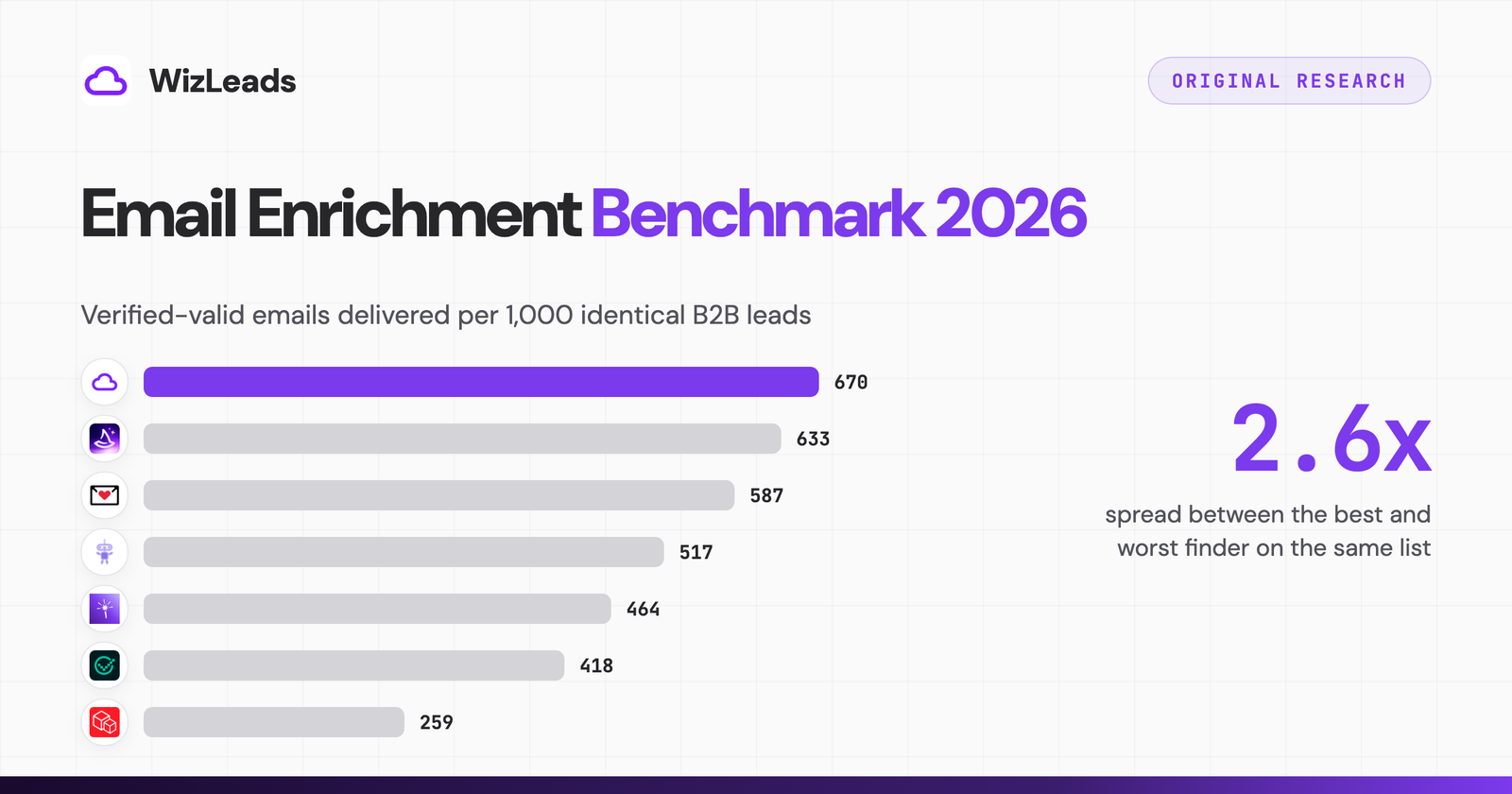
- WizLeads delivered 670 verified-valid emails out of 1,000 leads - the highest count in the test, with zero invalids on verify.
- Wiza matched the volume (671 found) but shipped 38 invalid emails, so its usable pool was 633.
- The other five finders ranged from 587 (Findymail) down to 259 (Prospeo) verified-valid emails per 1,000 leads - a 2.6x spread on the same input list.
- WizLeads is the only finder that returned mailbox provider and SEG identification on every row - 8.1% of the list (81 leads) sat behind a Secure Email Gateway and only WizLeads flagged it.
If you've ever bought an email finder and felt like the headline accuracy stat didn't match what hit your inbox, you're not alone. Most finders publish a "valid rate" north of 95%, but valid-rate-of-returned and valid-emails-out-of-1,000-leads are very different numbers - and only one of them maps to actual pipeline.
So we ran the test. Same 1,000 B2B leads, seven finders, one day, one neutral verifier. Here's what each one actually delivered.
All seven finders on the same 1,000 leads
Every finder got the same input - first name, last name, company domain - for every lead. Every returned email was then run through a single SMTP verifier. The table below is the headline scoreboard.
| Finder | Emails found | Valid emails | Invalid emails | Find rate (valid / 1,000) | SEG provider tag |
|---|---|---|---|---|---|
| WizLeads | 670 | 670 | 0 | 67.0% | Yes |
| Wiza | 671 | 633 | 38 | 63.3% | No |
| Findymail | 615 | 587 | 28 | 58.7% | No |
| Kitt | 537 | 517 | 20 | 51.7% | No |
| LeadMagic | 477 | 464 | 13 | 46.4% | No |
| IcyPeas | 434 | 418 | 16 | 41.8% | No |
| Prospeo | 270 | 259 | 11 | 25.9% | No |
Two patterns jump out. First, the find-rate spread is huge - the top finder delivered 2.6x as many usable emails as the bottom one on the same list. Second, the only finder where every returned email passed verification was WizLeads. Everyone else shipped some number of bounces.
The metric that matters: valid emails per 1,000 leads
Here's the sleight of hand most finder marketing pages run. They report a valid rate - usually something like "97% accuracy" - which is the percentage of returned emails that pass verification. Sounds great. The catch: a finder can hit 95% valid rate while only returning 270 emails out of 1,000 leads. You'd walk away with 259 usable addresses. Another finder with 100% valid rate returning 670 emails gives you 670. Same input list, 2.6x output.
So we ranked everything by the number that matters: verified-valid emails returned per 1,000 input leads.
Our finding: on a clean B2B list, the gap between the top finder and the bottom finder is more than 400 verified-valid emails. That's not a percentage-point difference - it's the difference between a usable list and a list that needs another finder layered on top.
How we ran the test
We pulled 1,000 random followers from Clay.com's LinkedIn page. The list was deliberately chosen for variety - a mix of titles (founders, ops, sales, marketing, engineering), company sizes (early-stage to enterprise), and geographies (US, Europe, APAC, Latin America). It's the kind of list a real B2B team would build off LinkedIn before pushing into outreach.
For each lead we sent the same three inputs - first name, last name, company domain - to seven finder APIs on the same day:
- WizLeads
- Wiza
- Findymail
- Kitt
- LeadMagic
- IcyPeas
- Prospeo
Every email returned by every finder was then passed through a single neutral SMTP verifier - the same one for all seven vendors, against the same MX records, on the same day. We deliberately did not use each finder's own "valid" signal as the source of truth, because that would have biased the test toward whichever finder verifies most conservatively. Valid in this benchmark means the SMTP verifier confirmed the mailbox exists and accepts mail. Invalid means it was rejected or bounced at the SMTP layer.
We logged everything per row: the email each finder returned, the merged best email per lead, and the verification verdict. The full dataset is in the reproduction section at the end of this post.
Where each finder lands
The chart below stacks each finder's returned emails into the part that verified clean (green) and the part that bounced on verify (red). It's the same data as the headline table, but it shows you at a glance how much of each finder's output you'd actually be able to use.
WizLeads
670 emails found
The only finder where every returned email passed the SMTP check. WizLeads runs a mailbox-level verification step before returning a result, so candidate addresses that don't accept mail never make it out of the API. It's also the only finder in the test that tags the mailbox provider (Google, Microsoft, named providers) and surfaces SEG identification on every row, which means a buyer can ship a list straight into a sequencer without a separate verification pass for most use cases. Try it on your own list at wizleads.io/email-enrichment.
Wiza
671 emails found
Tied with WizLeads for the highest emails-found count, but 38 of those bounced on verify - the highest invalid count of any finder in the test. Wiza is volume-first; it casts a wide net and returns whatever it can match, including pattern-derived guesses on domains it hasn't fully resolved. Strong if you're prepared to run a verifier on top, weaker as a "ship it and send" source.
Findymail
615 emails found
The strongest middle-tier finder in the test. Findymail handles smaller and international domains better than Kitt, LeadMagic, IcyPeas, and Prospeo, which makes it a useful second-source layer behind WizLeads on heavily non-US lists.
Kitt
537 emails found
Predictable mid-tier coverage. Kitt rarely surprises - the emails it returns are usually the corporate-pattern address you'd expect (firstname.lastname or first-initial-lastname). Smaller pool, but consistent.
LeadMagic
477 emails found
Lower-end coverage in the test. LeadMagic returned the smallest number of usable emails of the multi-source finders that still cleared 400. If you're already running WizLeads as primary, LeadMagic doesn't add much marginal coverage.
IcyPeas
434 emails found
Conservative finder. IcyPeas only returns emails it can confidently match to the corporate domain, which keeps the pool small but predictable. Useful as a sanity-check layer rather than a primary source.
Prospeo
270 emails found
Lowest coverage in the test. Prospeo dropped off sharply on the long tail of small and non-US domains, where the test list had a heavy share. Best treated as a niche addition, not a primary or secondary finder.
Mailbox provider mix and the SEG gap
One of the questions buyers actually have - "what kind of inboxes am I about to send to?" - is invisible on most finder outputs. WizLeads tags every returned row with the mailbox provider it detected at the SMTP layer, covering Google, Microsoft, the major SEGs, and smaller named providers like the ones catalogued at mailbox.mail.com. On this 1,000-lead list, the breakdown looked like this.
The headline number on this chart is the 8.1% slice. 81 of the 1,000 leads sat behind a Secure Email Gateway - typically Proofpoint, Mimecast, Cisco IronPort, Barracuda, or Sophos - and only WizLeads identified them on the row. Six of the seven finders returned the email and moved on; the buyer would have no way to know that 8% of their list was about to be inspected by an SEG before delivery.
That matters in practice. SEG-protected mailboxes are usually the mid-market and enterprise prospects on a list - the highest-value targets. They reward warmer sending behavior, cleaner authentication (SPF, DKIM, DMARC alignment), and slower throttling. If you don't know which leads are SEG-protected, you can't apply that treatment selectively. Our verification benchmark goes deeper into how the same SEG signal shows up on the verifier side of the stack.
What surprised us: the 14% "other / unidentified" slice. On a B2B list, you expect Google and Microsoft to dominate - they did, with 74.1% combined. But almost one in seven domains used something else, and that something-else population is where Findymail, Wiza, and WizLeads pulled away from the rest of the pack.
How to choose a finder for your list
Three patterns to match against your own use case.
1. Volume + clean output, single source. If you want one finder you can trust to ship send-ready emails without a downstream verification step, WizLeads is the answer this benchmark gives. 670 verified-valid emails per 1,000 leads, zero invalids, plus mailbox provider and SEG identification on every row.
2. Maximum coverage stack, willing to verify downstream. If you're prepared to run a verifier on top of every finder, the highest combined coverage came from layering WizLeads as primary, Findymail as a long-tail backfill, and either Wiza or LeadMagic for whatever rows are still missing. Just budget for the verification step - Wiza in particular shipped 38 invalid emails per 1,000 leads on this test.
3. Conservative niche enrichment. If you're working a small, high-value list where you'd rather miss a lead than ship a bounce, IcyPeas as a sanity-check layer behind WizLeads gives you two independent confirmations on the rows that matter, with an extremely low false-positive risk on either side.
Frequently asked questions
Which email finder returned the most verified-valid emails on a 1,000-lead test?
WizLeads. It returned 670 verified-valid emails out of 1,000 input leads - the highest count in the test - and was the only finder where every email returned passed an SMTP verification check. Wiza came closest on volume with 671 emails found, but 38 of those bounced on verify, ending at 633 valid.
Why is valid emails per 1,000 leads a better metric than valid rate?
Valid rate hides coverage. A finder with 95.9% valid rate sounds great, until you realize it only returned 270 emails out of 1,000 - so you walked away with 259 usable addresses. A finder with a 100% valid rate that returned 670 gives you 670 usable addresses on the same input list. Valid emails per 1,000 leads is the only number that maps to how much pipeline you actually get.
What is a Secure Email Gateway and why does the SEG tag matter?
A Secure Email Gateway (SEG) sits in front of corporate mailboxes - common providers are Proofpoint, Mimecast, Cisco IronPort, Barracuda, and Sophos - and inspects inbound mail before it reaches the inbox. SEG-protected mailboxes are typically mid-market and enterprise buyers, the highest-value targets on a B2B list. WizLeads is the only finder in this test that surfaces SEG identification on every row, so a buyer can throttle, warm, or route those sends differently from open mailboxes.
How is "valid" defined in this benchmark?
Every email returned by every finder was passed through a single neutral SMTP verifier - the same one for all seven vendors - on the same day, against the same MX records. Valid means the verifier confirmed the mailbox exists and accepts mail. Invalid means it was rejected or bounced at the SMTP layer. We deliberately did not use the finder's own valid/invalid signal to rank them, since that would have biased the test toward whichever finder verifies most conservatively.
What kind of list was this test run on?
1,000 random followers of the Clay.com LinkedIn page. We chose that list because it represents a realistic B2B prospect mix: a wide range of titles, company sizes, geographies, and mailbox providers - 49.9% Google Workspace, 24.2% Microsoft 365, 8.1% behind a Secure Email Gateway, and the rest split across smaller named providers and unidentified domains.
Which finder works best for non-US or smaller domains?
Findymail and Wiza both reach into the long tail of smaller and international domains, while Prospeo and IcyPeas drop off sharply on those segments. WizLeads also handles non-US domains well - in the test it returned valid emails on Indonesian, Saudi Arabian, Filipino, and German domains. If your list is heavily non-US, a stack of WizLeads + Findymail covers the most ground.
Can I reproduce this benchmark?
Yes. The full 1,000-lead dataset, every finder's returned email, the merged best-email column, and the verification status are downloadable as a Google Sheet. Run the same first-name + last-name + company-domain inputs through each finder API, verify the returned emails through a single SMTP checker, and compare counts. Methodology and column definitions are in the dataset's first tab.
Reproduce the test
The full benchmark - 1,000 input leads, every finder's returned email, the merged best-email column, the mailbox provider tag, and the per-row verification verdict - is published as a public Google Sheet so you can rerun any slice of the analysis on your own infrastructure.
Dataset: WizLeads Email Enrichment Benchmark - 1,000 B2B Leads, 7 Finders (April 2026). The Summary tab has the headline scoreboard, mailbox provider mix, and per-vendor notes. The Raw Data tab has every row with each finder's returned email, the merged best-email column, the mailbox provider tag, and the verification verdict. Download the XLSX directly here.
If you want to skip the rebuild and just see what WizLeads returns on your own list, you can try email enrichment here - same SMTP-verified output that produced the 670/0 row in this benchmark.
Methodology: 1,000 random followers from Clay.com's LinkedIn page sent to 7 finder APIs on the same day with first name, last name, and company domain inputs. All returned emails verified through a single neutral SMTP verifier on the same day against the same MX records. Test executed April 2026.