WizLeads
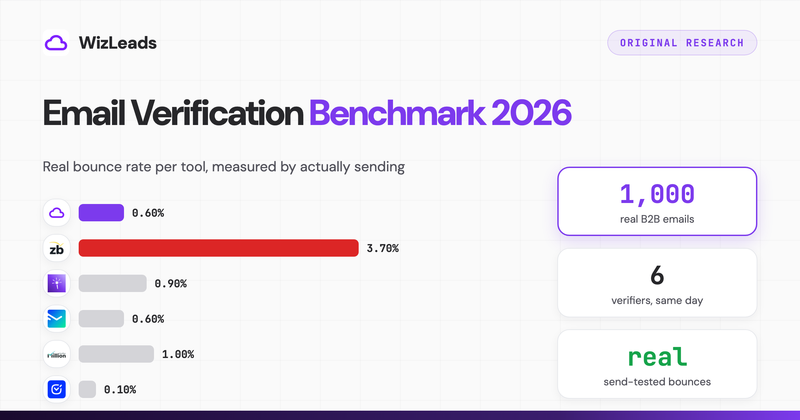

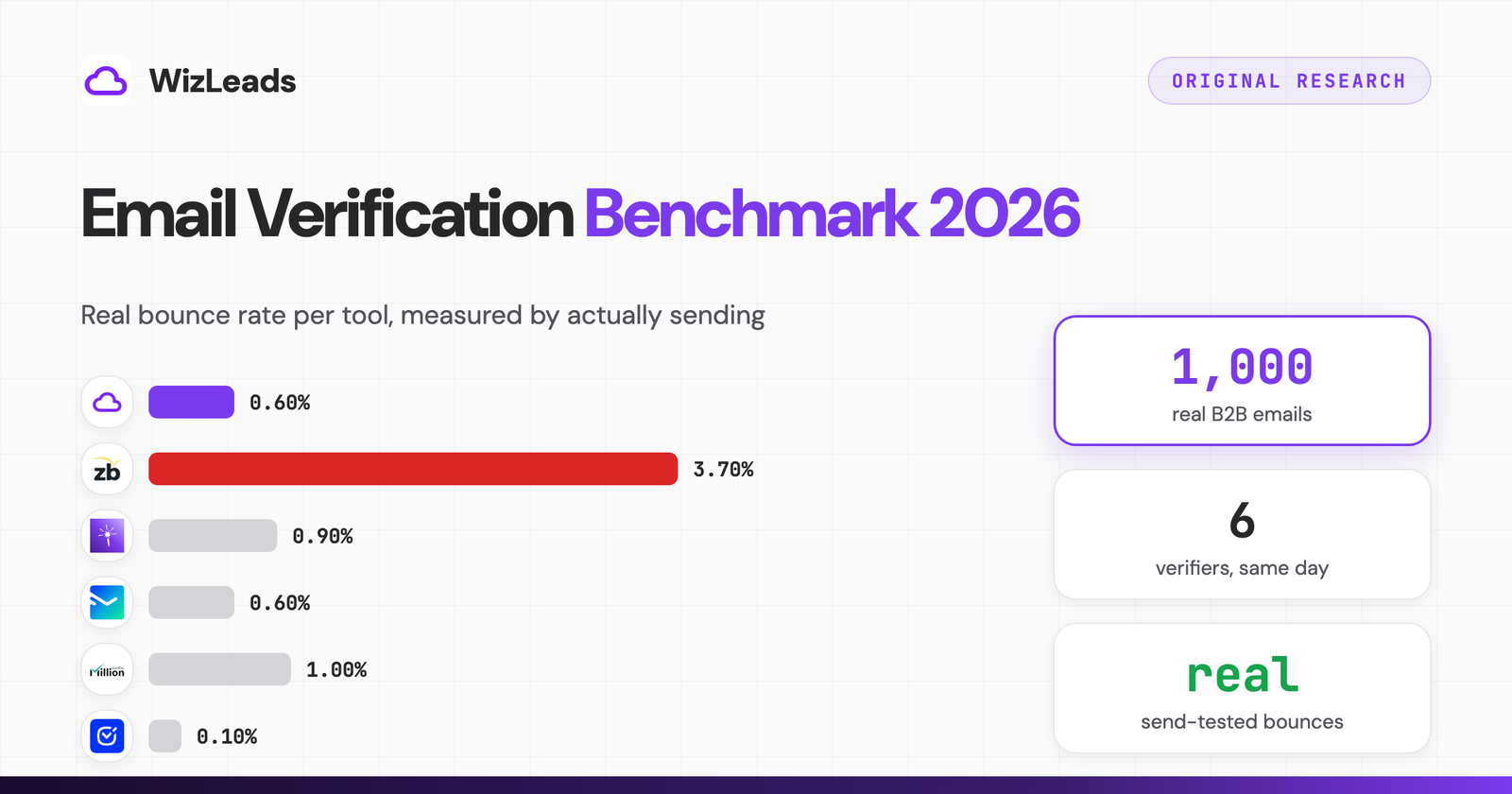
Most email verification benchmarks publish vendor-reported accuracy claims and call it a day. We ran a real one.
We took 1,000 real-estate decision-maker emails from Apollo, ran the identical list through six providers on the same day, then sent actual test emails to every "valid" verdict and counted the bounces. The results show a wide gap between what verifiers claim on their pricing pages and what they deliver on a B2B list with heavy catch-all coverage.
The full raw data is available as a downloadable Excel file at the bottom of this post. Every number on this page comes from that file.
TL;DR
- WizLeads delivered the lowest bounce rate among the high-approval tools at 0.59%, with 852 of 1,000 emails classified as valid.
- ZeroBounce approved the most emails (888) but bounced 6.3 times more often than WizLeads (3.72% vs 0.59%).
- LeadMagic came closest to WizLeads on accuracy (822 valid, 7 bounces) but costs roughly 3x more per verification at comparable entry tiers.
- NeverBounce, MillionVerifier, and Debounce kept bounces low by rejecting 289, 291 and 330 addresses respectively, between 28.9% and 33.0% of the list. Of NeverBounce's 289 rejections, 79 came back as "unknown."
- The real differentiator is the combination of a low bounce rate and a small rejection. Two tools sit in that quadrant.
The headline table
| Provider | Total | Valid | Bounces | Bounce % | Invalid | Notes |
|---|---|---|---|---|---|---|
| WizLeads | 1,000 | 852 | 5 | 0.59% | 148 | Best in class catch-all and SEG resolution |
| ZeroBounce | 1,000 | 888 | 33 | 3.72% | 112 | Approves more, but bounces 6.3x more |
| LeadMagic | 1,000 | 822 | 7 | 0.85% | 178 | Close to WizLeads on accuracy, ~3x the price |
| NeverBounce | 1,000 | 711 | 4 | 0.56% | 289 | 79 of the 289 came back "unknown" |
| MillionVerifier | 1,000 | 709 | 7 | 0.99% | 291 | Doesn't resolve catch-all to valid/invalid |
| Debounce | 1,000 | 670 | 1 | 0.15% | 330 | Lowest bounce rate, largest rejection |
Bounce counts come from real send tests, not vendor estimates. Invalid counts reflect each provider's own verdict.
Methodology
The source list was 1,000 decision-maker emails for US real-estate agencies, exported from Apollo in April 2026. All six providers received the identical CSV, same day, within a two-hour window. None of them knew the list was a benchmark.
After receiving each provider's verdicts, we isolated the emails each one approved as valid and sent a plain-text test message from a clean Google Workspace account to every approved address. We counted hard bounces and mailbox-does-not-exist responses over 72 hours. Soft bounces that resolved inside the window were not counted.
The sending account had no prior history with any domain on the list, so the bounce rates reflect actual mailbox status rather than reputation-based filtering.
Why a real-estate list
Real-estate decision-makers are a hard test case for email verification. Many run Microsoft 365 tenants with catch-all forwarding, which means the domain accepts every address regardless of whether the mailbox exists. Standard verification tools handle catch-all domains poorly, which is exactly the scenario this benchmark surfaces.
WizLeads detected 212 catch-all addresses (21.2% of the sample) and 159 behind a Secure Email Gateway (15.9%). Both counts come from our own classifier, since no independent source establishes the list's true composition, so read them as our reading of the list rather than as an agreed fact about it. Together that is 371 addresses, 37.1% of the list, sitting in the difficult-to-verify category. On a Fortune 500 list the catch-all rate would be lower and the spread between tools would compress. On a typical SMB B2B list it looks much closer to this one.
The catch-all gap
Catch-all domains are where verifiers split into two camps. Three tools resolve catch-all addresses into clean valid/invalid verdicts. Three tools do not.
| Provider | Catch-all handling |
|---|---|
| WizLeads | Resolves to valid/invalid |
| ZeroBounce | Resolves to valid/invalid |
| LeadMagic | Resolves to valid/invalid |
| NeverBounce | Flags 137 as "catchall," no resolution |
| MillionVerifier | Flags 170 as "catch_all," no resolution |
| Debounce | Flags 201 as "Accept All," no resolution |
The three tools that do not resolve catch-alls (NeverBounce, MillionVerifier, Debounce) compensate by being more aggressive on the invalid label. That is why their valid pools land in the 670 to 711 range while the other three sit between 822 and 888.
This is the single most important variable in the benchmark. If your list has catch-all coverage above 10%, picking a tool that resolves catch-alls is the difference between using your full pipeline or throwing a third of it away.
For more on this, see our deep-dive on catch-all email verification.
Per-provider breakdown
WizLeads
852 valid, 5 bounces (0.59%), 148 invalid.
WizLeads posted the lowest bounce rate of any tool that kept more than 800 addresses, and rejected the fewest of the sub-1% tools. At this sample size the five low-bounce tools are statistically indistinguishable from one another: on 1,000 addresses, the difference between 4 bounces and 7 is noise. The only separation the data supports is ZeroBounce's 33 against everyone else's single digits. The catch-all and SEG handling is what makes that combination possible. WizLeads detected 212 catch-all addresses and resolved every one of them into valid or invalid, instead of dumping them into a "risky" bucket the user has to triage.
It also detected 159 addresses behind a Secure Email Gateway and identified the specific provider in each case (Proofpoint, Barracuda, Mimecast, Appriver, or Sophos). No other tool in the test surfaced SEG detection at all.
Best for: cold email teams running 1K to 500K leads per month who cannot afford to ship known bounces and cannot afford to discard 20 to 30% of their usable list.
ZeroBounce
888 valid, 33 bounces (3.72%), 112 invalid.
ZeroBounce approved the most emails in the test, 36 more than WizLeads. But 33 of those approvals bounced, a rate 6.3 times higher than WizLeads. The pattern in the failures was consistent: ZeroBounce tends to mark Google catch-all mailboxes as valid based on domain-level SMTP acceptance, even when the specific mailbox does not exist. On a cold email campaign, 33 bounces per 888 sends is enough to put a sender inside the spam-filter risk zone within two or three days of active sending.
Best for: teams that prioritize list volume over deliverability risk and who have the domain reputation buffer to absorb a 3 to 4% bounce rate.
LeadMagic
822 valid, 7 bounces (0.85%), 178 invalid.
LeadMagic was the closest tool to WizLeads on accuracy. It also resolves catch-alls instead of dumping them in a risky bucket, and the bounce rate at 0.85% is fully acceptable for cold email. The catch is the price. LeadMagic costs roughly 3x more per verification at comparable entry tiers than WizLeads at the same volume tier, which adds up fast on a 100K-lead month.
The other gap is the invalid count. LeadMagic rejected 178 emails compared to WizLeads' 148, which means a slightly larger share of usable addresses gets dropped. On a 10,000-lead campaign that is a few hundred extra leads off the list.
Best for: teams already on LeadMagic who do not mind the cost. Anyone running price-sensitive volume should benchmark the same list against WizLeads before staying.
NeverBounce
711 valid, 4 bounces (0.56%), 289 invalid, 79 unknown.
NeverBounce posted a marginally lower bounce rate than WizLeads, 0.56% against 0.59%, but rejected 289 emails compared to 148, and 79 of those rejections came back "unknown". That is 7.9% of the list flagged as something you paid to verify but still cannot send to.
The conservatism comes from NeverBounce's catch-all handling: instead of resolving, it dumps catch-all addresses into "catchall" or "unknown" verdicts. On a list where 21% of addresses sit on catch-all domains, that approach costs users about 141 deliverable leads per 1,000 sent through.
Best for: compliance-heavy environments where shipping a single bad email costs more than throwing 14% of the usable list away.
MillionVerifier
709 valid, 7 bounces (0.99%), 291 invalid, 170 of them flagged as catch_all.
MillionVerifier looks almost identical to NeverBounce in shape. Low bounces, aggressive invalid classification, no catch-all resolution. It does not resolve catch-all addresses to valid or invalid, which is the structural reason it lands at 709 valid on a 1,000-email list with significant catch-all coverage.
The pricing is competitive at volume, and lifetime credits are a real benefit if you verify in irregular bursts. Just be aware you are buying a verifier that throws away about a third of a B2B catch-all list.
Best for: users already invested in MillionVerifier who can absorb the trade-off, especially on lists with low catch-all coverage.
Debounce
670 valid, 1 bounce (0.15%), 330 invalid, 201 of them flagged as Accept All.
Debounce had the lowest bounce rate in the entire test by a clear margin. Only one email out of 670 approved sends actually bounced. The cost: Debounce classified 330 emails as invalid, the highest rejection count of any tool, and 201 of those were "Accept All" flags it did not resolve.
If you do not want to handle catch-alls yourself, Debounce hands the problem back to you on 330 of the 1,000 addresses, 201 of them Accept All verdicts it did not resolve. The 670 it approves are clean, but a third of the list is gone to rejections.
Best for: extremely sender-reputation-sensitive environments, or teams willing to accept a smaller validated pool in exchange for near-zero bounce risk.
SEG detection (where the gap widens)
A Secure Email Gateway is a filtering layer that sits in front of a corporate inbox. Proofpoint, Mimecast, Barracuda, Appriver, and Sophos are the five common ones. SEGs respond to verification probes differently than the actual mailbox does, which is where most verifiers produce false positives on protected domains.
In our test list, 159 addresses (15.9% of the sample) sat behind one of the five major SEGs.
| SEG provider | Count | Share |
|---|---|---|
| Proofpoint | 66 | 6.6% |
| Barracuda | 38 | 3.8% |
| Appriver | 27 | 2.7% |
| Mimecast | 25 | 2.5% |
| Sophos | 3 | 0.3% |
| Total | 159 | 15.9% |
WizLeads identified the specific SEG provider for each of those 159 addresses. None of the other five tools in the benchmark surfaced SEG detection at all. They simply received the gateway's SMTP response and treated it as a normal verdict.
For a B2B campaign, that distinction matters because SEG-protected mailboxes are usually the highest-value targets on the list (mid-market and enterprise buyers, not solo operators). Treating those addresses as a normal "valid" or "risky" verdict misses the chance to route them differently or warm up the sending domain before sending.
The false-invalid trade-off
Bounce rate alone does not tell you which tool is best. The metric that actually matters is the combination of two numbers:
- Bounce rate: how often "valid" verdicts actually bounce on send
- Rejection rate: how much of the list a tool refuses to pass, whatever the reason
Most comparison posts publish only the first. Ignoring the second has a real cost, because a tool can buy a clean bounce rate simply by refusing more of your list. One caveat belongs here rather than buried: we measured how much each tool rejected, not how much of that was rejected wrongly. Establishing a true false-invalid rate means sending to the rejected addresses too, which this run did not do. Treat rejection count as the cost side of the trade, not as proof of error.
In this benchmark:
- Debounce: 0.15% bounce, 330 rejections. The lowest bounce rate, bought with the largest rejection.
- NeverBounce / MillionVerifier: 0.56% to 0.99% bounce, 289 to 291 rejections. Same shape.
- ZeroBounce: 3.72% bounce, 112 rejections. Inverse trade-off.
- WizLeads: 0.59% bounce, 148 rejections. The smallest rejection among the sub-1% tools. We built it, so weigh that accordingly.
- LeadMagic: 0.85% bounce, 178 rejections. Second-best on this combined metric, with the price caveat.
What each tool's verdicts actually mean for deliverability is a separate question, and the labels are not standardised across vendors. The catch-all resolution guide covers the hardest of them, and the ranked best email verification tools list is the buying guide. The finding side of the same problem, which finder returns the most addresses that then survive verification, is measured in our email enrichment benchmark on a separate 1,000-lead list.
How to pick the right verifier
Use this decision framework based on what you optimize for:
Lowest possible bounce rate, smaller validated pool acceptable: Debounce (0.15% bounce, 670 valid) or NeverBounce (0.56% bounce, 711 valid). Expect to lose 30 to 33% of your list to invalid verdicts.
Maximum validated volume, willing to absorb a 3 to 4% bounce rate: ZeroBounce (3.72% bounce, 888 valid). Plan for sender reputation impact and rotate domains aggressively.
Low bounces AND high valid-pool retention on B2B catch-all-heavy lists: WizLeads (0.59% bounce, 852 valid). The catch-all and SEG resolution is why this combination is achievable. LeadMagic (0.85% bounce, 822 valid) is the closest alternative if you do not mind paying roughly 3x more per verification.
Existing MillionVerifier workflow with low-catch-all lists: Stay on MillionVerifier. The low-catch-all part matters; on B2B decision-maker lists the trade-off is worse.
For side-by-side detail on any of these tools against WizLeads, see WizLeads vs ZeroBounce, WizLeads vs NeverBounce, WizLeads vs MillionVerifier, WizLeads vs Debounce, and WizLeads vs LeadMagic.
The broader point
The standard way to pick an email verifier is to read a vendor's accuracy claim on their homepage and trust it. ZeroBounce advertises 99.6% accuracy. NeverBounce promises over 98% deliverability. MillionVerifier's 99.9% is an uptime figure, not an accuracy one. In a benchmark where ZeroBounce bounced 33 emails and NeverBounce rejected 289 valid ones, those three numbers, which sit in the same visual register while measuring three different things translate into three completely different campaign outcomes for the same list.
The fix is to run your own test before committing. A 1,000-email benchmark on your actual list profile takes about two hours of work spread over four days and resolves more uncertainty than six months of reading vendor pages. The reproducibility instructions are at the bottom of this post if you want to do it.
Frequently asked questions
Which email verifier had the lowest bounce rate in this benchmark? Debounce had the lowest bounce rate at 0.15%, then NeverBounce at 0.56%, WizLeads at 0.59%, LeadMagic at 0.85%, MillionVerifier at 0.99%, and ZeroBounce at 3.72%. Bounce rate alone is misleading because three of those tools kept bounces low by rejecting between 28.9% and 33.0% of the list as invalid.
Which email verifiers resolve catch-all domains? WizLeads, ZeroBounce, and LeadMagic all resolve catch-all addresses into valid or invalid verdicts. NeverBounce, MillionVerifier, and Debounce flag them as risky or accept-all and leave the call to the user. WizLeads detected 212 catch-all addresses in the 1,000-email test set, the highest of any tool.
Is ZeroBounce accurate for cold email verification? ZeroBounce approved 888 of 1,000 emails in our benchmark, more than any other provider. However, 33 of those 888 bounced, a 3.72% bounce rate. ZeroBounce performs poorly on Google catch-all domains where the domain accepts mail but the mailbox does not exist.
Why do NeverBounce and MillionVerifier reject so many valid emails as invalid? NeverBounce and MillionVerifier flag any address that lands on a catch-all or ambiguous SMTP response as invalid or risky instead of resolving it. On a real-estate decision-maker list with heavy catch-all coverage, this rejected roughly 290 emails out of 1,000 compared to 148 rejected by WizLeads. Of NeverBounce's 289 rejections, 79 came back unknown, a verdict you paid for but cannot use.
What bounce rate should I target for cold email campaigns? Keep hard bounces under 2%, ideally under 1%. No mailbox provider publishes a bounce threshold. The documented limits are contract-level and come from your sending platform: Mailgun can restrict a domain at 5% bounces and Postmark can suspend a server above 10%. Google publishes a spam-complaint rate instead, below 0.10% and never reaching 0.30%, which is a different metric. The realistic target is sub-1% bounce rate without discarding valid leads.
What is a Secure Email Gateway and why does it matter for verification? A Secure Email Gateway is a filtering layer like Proofpoint, Mimecast, Barracuda, Appriver, or Sophos that sits in front of corporate inboxes. SEGs respond to verification probes differently than the real mailbox does, which is where most verifiers produce false positives on protected domains. WizLeads detected 159 SEG-protected addresses (15.9% of the test list) and identified the specific gateway in each case. Of the six, only NeverBounce and DeBounce surfaced nothing about the gateway. LeadMagic returns mx_gateway and mx_security_gateway fields of its own, and ZeroBounce markets SEG handling, so the useful distinction is the level of detail rather than presence or absence.
How often should I re-verify my email list? Re-verify cold email lists every 30 to 60 days if you are actively sending. Lists decay at roughly 1% a month, about 12.25% a year, as people change jobs and mailboxes deactivate; Lusha measured that against its own database and notes the widely quoted 30%-a-year figure has no traceable source. For prospecting lists pulled more than 90 days ago, re-verify before the next campaign, not after the first batch of bounces.
Should I use more than one email verifier in a waterfall setup? Waterfall verification across multiple providers helps if your primary tool returns a large share of risky or unknown verdicts that need a second check. If your verifier already resolves catch-all and SEG domains directly to valid or invalid, a waterfall adds cost without meaningful accuracy gain.
Reproduce this test on your own list
If you want to run the same benchmark on your list profile:
- Pick a sample of 500 to 1,000 emails from the list type you actually send to. Real B2B decision-maker lists produce different catch-all rates than consumer or freelancer lists.
- Run the same CSV through each tool on the same day, ideally within a two-hour window.
- Separate each tool's "valid" output and send a plain-text test message from a clean Google Workspace or Microsoft 365 sender with no prior history on the target domains.
- Count hard bounces over 72 hours. Do not count soft bounces that resolve inside the window.
- Optional but recommended: send a sampled subset of each tool's "invalid" verdicts and measure how many actually deliver. This is the false-invalid check most benchmarks skip.
Step 5 is the one that reveals the real trade-off, and we did not run it on this list. That is why the figures above report how much each tool rejected rather than how much it rejected wrongly. Anyone reproducing this should run it: skipping it lets a tool with a low bounce rate and a high false-invalid rate look like the winner.
Download the raw data
Every email, every verdict, every bounce, every SEG flag from the 1,000-email test is in the spreadsheet:
Download the full benchmark dataset (Excel)
Two sheets: a Summary tab with the comparison tables on this page, and a Raw Data tab with all 1,000 rows including the WL_Catchall flag, the SEG provider per address, and every verifier's individual verdict.
FAQ
Which email verifier had the lowest bounce rate in this benchmark?
Debounce had the lowest bounce rate at 0.15%, then NeverBounce at 0.56%, WizLeads at 0.59%, LeadMagic at 0.85%, MillionVerifier at 0.99%, and ZeroBounce at 3.72%. Bounce rate alone is misleading because three of those tools kept bounces low by rejecting between 28.9% and 33.0% of the list as invalid.
Which email verifiers resolve catch-all domains?
WizLeads, ZeroBounce, and LeadMagic all resolve catch-all addresses into valid or invalid verdicts. NeverBounce, MillionVerifier, and Debounce flag them as risky or accept-all and leave the call to the user. WizLeads detected 212 catch-all addresses in the 1,000-email test set, the highest of any tool.
Is ZeroBounce accurate for cold email verification?
ZeroBounce approved 888 of 1,000 emails in our benchmark, more than any other provider. However, 33 of those 888 bounced, a 3.72% bounce rate. ZeroBounce performs poorly on Google catch-all domains where the domain accepts mail but the mailbox does not exist.
Why do NeverBounce and MillionVerifier reject so many valid emails as invalid?
NeverBounce and MillionVerifier flag any address that lands on a catch-all or ambiguous SMTP response as invalid or risky instead of resolving it. On a real-estate decision-maker list with heavy catch-all coverage, this rejected roughly 290 emails out of 1,000 compared to 148 rejected by WizLeads. Of NeverBounce's 289 rejections, 79 came back unknown, a verdict you paid for but cannot use.
What bounce rate should I target for cold email campaigns?
Keep hard bounces under 2%, ideally under 1%. No mailbox provider publishes a bounce threshold. The documented limits are contract-level and come from your sending platform: Mailgun can restrict a domain at 5% bounces and Postmark can suspend a server above 10%. Google publishes a spam-complaint rate instead, below 0.10% and never reaching 0.30%, which is a different metric. The realistic target is sub-1% bounce rate without discarding valid leads.
What is a Secure Email Gateway and why does it matter for verification?
A Secure Email Gateway is a filtering layer like Proofpoint, Mimecast, Barracuda, Appriver, or Sophos that sits in front of corporate inboxes. SEGs respond to verification probes differently than the real mailbox does, which is where most verifiers produce false positives on protected domains. WizLeads detected 159 SEG-protected addresses (15.9% of the test list) and identified the specific gateway in each case. Of the six, only NeverBounce and DeBounce surfaced nothing about the gateway. LeadMagic returns mx_gateway and mx_security_gateway fields of its own, and ZeroBounce markets SEG handling, so the useful distinction is the level of detail rather than presence or absence.
How often should I re-verify my email list?
Re-verify cold email lists every 30 to 60 days if you are actively sending. Lists decay at roughly 1% a month, about 12.25% a year, as people change jobs and mailboxes deactivate; Lusha measured that against its own database and notes the widely quoted 30%-a-year figure has no traceable source. For prospecting lists pulled more than 90 days ago, re-verify before the next campaign, not after the first batch of bounces.
Should I use more than one email verifier in a waterfall setup?
Waterfall verification across multiple providers helps if your primary tool returns a large share of risky or unknown verdicts that need a second check. If your verifier already resolves catch-all and SEG domains directly to valid or invalid, a waterfall adds cost without meaningful accuracy gain.
This benchmark was run by Vatsal Nigam, founder of Wiz Labs LLC (WizLeads, WizMail, B2B Wizards). WizLeads is one of the six providers tested. The methodology was identical across all providers, the raw data is available above, and the source list is preserved so third parties can re-run verifications independently. Published April 2026.