WizLeads


Clearbit.com is now a login page with a brochure attached. Its entire navigation is five links: login, legal, support, trust, privacy. There is no pricing page, no documentation link, no signup path. HubSpot announced the acquisition on 1 November 2023 and completed it on 4 December 2023, wound the brand down through 2025, and finished the job this year by retiring the replacement brand too. The page at hubspot.com/products/breeze-intelligence returns a 404. HubSpot's own Product and Services Catalog contains the words "Breeze Intelligence" zero times. What used to be Clearbit is now filed inside HubSpot as plain data enrichment.
If you are shopping for a replacement, the version of this story you have probably read is out of date in a way that will cost you money. Most roundups still describe Breeze Intelligence as a credit add-on you buy on top of your HubSpot subscription, priced in tiers, with a monthly minimum. HubSpot does not sell it that way any more. And the swap that actually matters is not about price at all: HubSpot's enrichment takes a work email address as an input. Clearbit's API, for most outbound teams, was there to produce one.
Every price and every claim below was read off the vendor's own site on 8 September 2026, and the date is stated so you can tell when this page goes stale.
What happened to Clearbit, with dates
Clearbit published its own sunset schedule, and the changelog records what slipped. Verified against clearbit.com and its release notes:
| Date | What happened |
|---|---|
| 1 November 2023 | HubSpot announces an agreement to acquire APIHub, Inc., trading as Clearbit |
| 4 December 2023 | The acquisition completes and Clearbit becomes a wholly owned subsidiary |
| 13 February 2025 | Clearbit publishes the sunset timeline |
| 30 April 2025 | Free Clearbit platform, Weekly Visitor Report, TAM Calculator, Clearbit Connect and the free Slack integration all shut off, along with support for free tools |
| 9 September 2025 | The logo field in the free Autocomplete API starts returning null |
| 12 November 2025 | A deliberate 24-hour blackout of logo.clearbit.com, run so that anyone still calling it would notice |
| 8 December 2025 | The Logo API switched off for good, a week after the originally announced date of 1 December |
| During 2026 | The Breeze Intelligence name retired; hubspot.com/products/breeze-intelligence returns 404 and the HubSpot help article formerly titled "get started using Breeze Intelligence" redirects to "Get started with data enrichment" |
Half the pages ranking for this query date the acquisition to November 2023 and the other half to December. Both dates are real and they describe different events: the press release and the close.
We probed the endpoints on 8 September 2026 to see what is actually alive rather than what the blog posts claim. The results are more nuanced than "Clearbit is dead":
person.clearbit.com,company.clearbit.com,reveal.clearbit.com,prospector.clearbit.comandrisk.clearbit.comall still respond, each returning a 401 with the message that authentication is required. Existing keys still resolve against live services.logo.clearbit.comno longer resolves in DNS. The host is gone, not merely returning errors, so any client still calling it fails at connection rather than with a clean HTTP status.autocomplete.clearbit.comstill answers unauthenticated and free, and returns"logo": nullon every row, exactly as the September 2025 changelog said it would.clearbit.com/docsanddashboard.clearbit.comboth redirect to the login screen. The public documentation is gone.
So legacy contracts still function. There is no way to become a new customer, no published price, and no documentation to onboard an engineer with. That is the position you are migrating out of.
What HubSpot's version does, and the one thing it will not do
HubSpot's data enrichment product FAQ states that data enrichment is included in all paid plans with the Smart CRM, at no additional cost and with no extra tools. Its knowledge base article, last updated 10 July 2026, states flatly that data enrichment does not consume HubSpot Credits. Availability runs across Marketing Hub, Sales Hub, Service Hub, Data Hub and Content Hub from Starter upward, and across Smart CRM and Revenue Hub from Professional upward.
Credits are still real, they just do not apply to enrichment. Breeze Intelligence Credits stopped being their own currency: HubSpot's billing documentation converted them into unified HubSpot Credits at a rate that is not one rate: 100 Breeze Credits became 3,000 HubSpot Credits, 1,000 became 15,000, and 10,000 became 125,000. That is 30x, 15x and 12.5x, so the bigger your Breeze balance the worse your conversion, and there is no single ratio to quote at anyone. Those cost $0.010 each, sold in capacity packs of 1,000 for $10 or as pay-as-you-go billed in increments of 10. Included allotments are 500 on Starter, 3,000 on Professional and 5,000 on Enterprise, rising to 500, 5,000 and 10,000 on Data Hub or the bundled Customer Platform. They reset monthly and unused credits expire. What consumes them, per HubSpot's published rate sheet: buyer intent at 10 credits to enable intent signals to create or monitor one company for a month, the prospecting agent at 100 credits per lead it recommends, the data agent at 10 credits per prompt per record, and 10 credits for each Breeze action executed inside a workflow. At list price that puts monitoring one company's intent for a month at 10 cents, and a Professional plan's 3,000 included credits at roughly 300 company-months of intent if you spend them on nothing else.
This is worth stating plainly because the old numbers are still everywhere. If you have read that Breeze Intelligence starts at $45 a month for 100 credits, or that credits come in packs of 100, 1,000 and 10,000, or that a mid-market deployment lands somewhere north of $900 a month, you are reading a description of packaging HubSpot retired. Those figures trace back to a handful of 2025 articles that later roundups have been copying from each other since. Check the two HubSpot pages named above before you budget against any of them.
HubSpot's help documentation on how enrichment works spells out the inputs, and this is where the swap gets decided. For contact enrichment it uses first name, last name and work email address. For company enrichment it uses the company domain. Attributes come back against a record you already hold an email for. HubSpot puts its coverage at over 100 million company domains and 380 million email addresses indexed.
Clearbit's person enrichment call worked the same way, email in and profile out, so if that is all you used, HubSpot covers you and covers you for free on any paid plan. Most outbound teams were running the other direction: a name and a company domain in, a deliverable email address out, at volume, feeding a sequencer. HubSpot's replacement does not do that on any tier at any price, and buying more credits does not change it. That is why the list below splits into jobs rather than into a ranked list of "best" tools.
How we picked these ten
Clearbit was four products under one logo, and the right replacement depends on which one you were paying for:
- Contact discovery. Name and domain in, verified work email out, at volume, into a sequencer.
- The enrichment API. An identifier in, a structured firmographic or person record out, called from your own code.
- Form shortening. Ask for an email on a web form, fill the rest in behind the scenes.
- Visitor identification. Turn anonymous site traffic into companies, or in some products into people.
Job 3 has one honest answer and it is HubSpot's own enrichment, so it takes no slot in the list. The ten slots go six to job 1, three to job 2 and one to job 4.
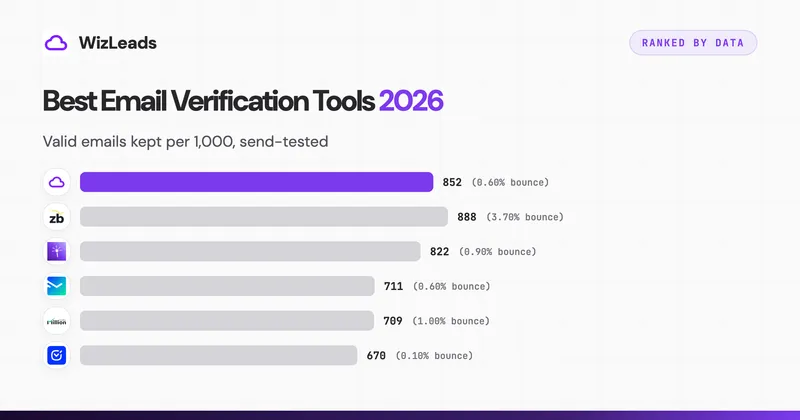
For job 1 we have measured data rather than vendor accuracy pages. We ran seven email finders over the same 1,000 B2B leads on the same day, name and company domain in, then verified every returned address with a neutral SMTP verifier and counted only what survived. The first four in job 1 are listed in order of verified-valid emails returned per 1,000 leads. The two after them we have not tested, and each is there for a stated reason. The full method and the raw counts are in the email enrichment benchmark. Where a vendor publishes no price, we say so rather than repeating a number from a review site.
The ten, compared
Cost per found work email is our arithmetic on each vendor's cheapest published paid tier, using their own credit rates. It is a floor, not a forecast, and every one of these tools gets cheaper per unit as volume rises.
| Tool | Job | Entry price | What that buys | Cost per found work email | Our 1,000-lead test |
|---|---|---|---|---|---|
| WizLeads | Contact discovery | $39/mo | 10,000 credits, 3 per email found | ~1.2 cents | 670 verified valid |
| Wiza | Contact discovery | $49/mo per user | 100 valid emails | 49 cents | 633 verified valid |
| Findymail | Contact discovery | $99/mo | 5,000 finder credits, 1 per email | ~2.0 cents | 587 verified valid |
| LeadMagic | Contact discovery | $99/mo | 5,000 credits, 1 per valid email | ~2 cents | 464 verified valid |
| FullEnrich | Contact discovery | $29/mo | 500 credits, 1 per work email | ~5.8 cents | not tested |
| Dropcontact | Contact discovery | EUR 29/mo | 500 credits | ~5.8 euro cents | not tested |
| Hunter | Enrichment API | $49/mo | 2,000 credits, 1 per email found | ~2.5 cents | not tested |
| People Data Labs | Enrichment API | $98/mo | 350 records | not an email finder | not tested |
| Cognism | Enrichment API | no list price; buyers report ~$29k/yr SMB | 1 credit per revealed contact | buyer-reported | not tested |
| RB2B | Visitor identification | $79/mo | 300 monthly resolutions | not an email finder | not tested |
Job 1: name and domain in, verified email out
1. WizLeads
Finds work emails from a name and a company domain, verifies each one in the same pass, and scrapes Sales Navigator searches into lists when the list building sits upstream of the enrichment. Two endpoints carry most of the load, /find-email and /verify-email, which makes it a close structural match for a Clearbit-style server-side call.
Pricing at wizleads.io: $39 a month for 10,000 credits, $99 for 40,000, $199 for 100,000 and $499 for 300,000. A found work email costs 3 credits with verification included and misses cost nothing, so the $39 plan covers about 3,333 enriched emails. Standalone verification is 0.5 credits an address, which makes the same $39 plan worth 20,000 verifications, or roughly $20 per 10,000. After signup the 10,000-credit plan is $1 for the first month and holds a 20% discount for as long as you stay.
Where it fits: the outbound direction HubSpot's enrichment refuses. In our test it returned 670 verified-valid emails per 1,000 leads with no invalid addresses in the output, because finding and verification are one operation rather than two products stapled together.
Its limitation: it is a finder, a verifier and a scraper, not a firmographic database. It will not return funding rounds, technographic tags or org charts the way Clearbit's company object did. If those fields fed your lead scoring, this is half your replacement.
2. Wiza
Reveals emails and mobile numbers, built around a Chrome extension and LinkedIn workflows rather than around an API call, with CSV import and CRM integrations behind it.
Pricing at wiza.co: monthly plans run $49 per user for 100 valid emails and 100 phone numbers, $99 per user for 500 valid emails and $199 per user for 500 emails plus 500 phone numbers, with extras at $0.15 an email and $0.35 a phone number. Annual billing changes the shape entirely: $83 per user per month billed at $990 a year buys unlimited email reveals capped at 2,500 exports a month, and $166 per user per month billed at $1,990 buys unlimited email and phone. A free tier gives 20 valid emails and 5 phone numbers.
Where it fits: teams whose prospecting starts on a LinkedIn page rather than in a script. It found the most raw emails of anything we tested, 671 per 1,000 leads.
Its limitation: 38 of those came back invalid, netting 633 verified valid, so you are paying for a verification pass downstream. The monthly per-user pricing is also the most expensive entry point here by a wide margin, and the annual plans that fix that want a year of commitment on a category where vendors get acquired.
3. Findymail
Finds and verifies in one step, sells finder credits and bonus verifier credits together, and integrates natively with Clay, HubSpot, Salesforce and the usual sequencers.
Pricing at findymail.com: the page opens on a 5,000-contact plan at $99 a month, bundling 5,000 finder credits with 5,000 bonus verifier credits for lists from other sources. One email costs 1 credit, one phone number 10, and unfound results are not charged. Credits roll over up to twice your monthly allowance, annual billing gives two months free, and a free account gets 10 credits. There is a separate CRM hygiene product, Datacare, from $500 a month billed annually and priced on the size of your database rather than per action.
Where it fits: the closest like-for-like swap if Clearbit was specifically your email layer and you want the quality-first option rather than the cheapest.
Its limitation: 587 verified-valid per 1,000 in our test puts it third, and the entry plan starts at $99 with no smaller paid tier, which is a lot to commit if your actual volume is a few hundred lookups a month.
4. LeadMagic
An API-first stack of enrichment endpoints sharing one credit pool: email finder, mobile finder, email validation, company and profile search, employee finder, job change detection.
Pricing at leadmagic.io: $99 a month for 5,000 credits, $249 for 20,000, $499 for 50,000 and $849 for 100,000, with annual billing at ten times the monthly rate. Credit costs are published per endpoint: 1 credit per valid email, 0.25 per validation, 5 per valid mobile, 1 per company or profile lookup, 0.05 per employee found and 3 per job change check. Credits are only deducted on a successful result, and roll over up to two months from the Essential tier upward.
Where it fits: the per-endpoint credit rates are the most granular on this list, so you can model the cost of replacing several different Clearbit calls at once rather than guessing at a blended rate.
Its limitation: 464 verified-valid per 1,000 leads put it fifth of seven in our test, behind three tools priced in the same range. The cheapest plan also carries no credit rollover.
5. FullEnrich
Waterfall enrichment: one call cascades across a stack of underlying providers and stops at the first verified hit, which is a different economic model from a single-source finder.
Pricing at fullenrich.com, which usefully publishes a machine-readable price list: Pro runs on a volume slider from $29 a month for 500 credits, through $55 for 1,000, $104 for 2,000, $255 for 5,000 and $499 for 10,000, up to $3,500 for 100,000. A work email costs 1 credit, a personal email 3, a mobile number 10 and a reverse email lookup 1. Person and company profile data is free when bundled with an enrichment and 0.25 credits on its own. Nothing found means nothing charged, landlines are returned free, credits roll over for three months on monthly plans and twelve on annual, and every plan includes unlimited users.
Where it fits: coverage on hard lists, where a single source misses a lead entirely and a cascade often does not. Unlimited users also makes it cheap to put in front of a whole agency team.
Its limitation: not in our benchmark, so no measured accuracy figure to set beside the tested four. At the entry tier it costs roughly five times per email what the cheapest tool here does, which is the premium for the cascade. Run a hundred leads against a strong single source before assuming the extra coverage pays for itself.
6. Dropcontact
Computes emails algorithmically rather than serving them from a stored contact database, runs its own validation including catch-all handling, and processes on EU servers.
Pricing at dropcontact.com, in euros even for a US visitor: the smallest tier is 500 credits a month at EUR 29 on Starter and EUR 35 on Growth, and the page opens on 4,000 credits at EUR 79 and EUR 120, with a slider up to 150,000 credits a month. The toggle says "Yearly -20%", but the yearly prices it shows are about 16.5% to 17.2% below monthly (checked 9 October 2026). Enterprise starts from 200,000 credits a month and is quoted. Unfound emails are re-credited. Growth adds credit carryover, LinkedIn enrichment and company data. New accounts get 50 free credits.
Where it fits: EU processing, where the question a DPO asks is whether the vendor holds a personal-data warehouse at all. Not holding one is a structurally different posture from holding one and offering opt-outs.
Its limitation: not in our benchmark, so no measured accuracy claim from us. It is also the second most expensive per email at its entry tier, and the Email Finder and CRM enrichment subscriptions are separate purchases whose credits do not transfer.
Job 2: the enrichment API
If your Clearbit spend was an API key called from your own code, these three are the structural replacements. None of them is a drop-in: nobody cloned Clearbit's response schema.
7. Hunter
Domain search, email finder and email verifier behind a documented REST API, plus a combined enrichment endpoint. Hunter maintains a landing page specifically pitched as a Clearbit enrichment API replacement, which tells you where a chunk of Clearbit's developer base went.
Pricing at hunter.io: free at 50 credits a month, then Starter at $49 a month or $34 a month billed yearly for 2,000 credits, Growth at $149 or $104 yearly for 10,000, and Business at $299 or $209 yearly for 25,000. One credit is one email found, half a credit is one email verified, and a failed lookup costs nothing.
Where it fits: the cleanest migration path for an engineer, because the documentation is public, the credit rules are stated in one paragraph, and the annual price drops about 30%.
Its limitation: Hunter is organised around domains rather than people, so its strength is working out the pattern for a company rather than resolving one hard-to-find person. We have not benchmarked it, so treat its position here as a workflow judgement rather than an accuracy one.
8. People Data Labs
Person and company datasets served through APIs, with bulk and flat-file delivery at the top end. This is the closest thing on the market to what Clearbit's enrichment API structurally was: raw records, self-serve, priced by volume, aimed at developers embedding data in a product rather than at a sales rep clicking a button.
Pricing at peopledatalabs.com: free for up to 100 credits a month with contact data obfuscated, then a self-serve Pro plan starting at $98 a month from 350 records with contact data included, monthly or annual, and annual billing described as saving 20%. Enterprise is custom and annual, and adds bulk delivery and data licensing feeds.
Where it fits: rebuilding a Clearbit integration inside your own application, where you need a stable schema and a contract rather than a Chrome extension.
Its limitation: $98 for 350 records is 28 cents each, priced for embedding rather than prospecting volume. It is also not a deliverability tool, so pushing those addresses into a sequencer without a verification pass means sending to whatever the dataset last saw.
9. Cognism
A B2B contact and company database with phone-verified mobile data, intent signals and a compliance-forward posture, sold as a prospecting platform with CRM enrichment and a data-as-a-service API as add-ons.
Pricing at cognism.com: the page is titled Cognism Pricing, names two plans, Standard and Pro, with five seats included in each, and explains the credit model, one credit per revealed contact with no charge to view a contact you already revealed. It publishes no dollar figures. Every button on the page routes to sales.
Where it fits: EMEA-weighted markets where phone coverage and DNC screening matter more than cost per email, and where a Clearbit-shaped firmographic bundle is what you are actually replacing.
Its limitation: you cannot budget from the website, the entry point is a five-seat plan whether or not you need five seats, and the API is an add-on rather than the product. ZoomInfo is in the same position: its pricing page lists packages from Professional through Copilot Enterprise with full feature lists, publishes no prices at all, and opens with a form asking for your phone number. Neither publishes a number, but buyers do, and procurement marketplaces aggregate what actually gets signed. Cognism averages $24,387 a year for SMBs and $163,272 for enterprises across 26 customers on SpendHound (page updated 1 October 2026). ZoomInfo's median is around $33,500 a year across more than 1,500 purchases tracked by Vendr, with observed deals running from roughly $7,200 to $154,600. Treat those as buyer-reported rather than list prices, because that is what they are, and note the range: a twenty-fold spread between the cheapest and dearest ZoomInfo contract tells you the number is negotiated rather than posted.
Job 4: website visitor identification
10. RB2B
Identifies visitors to your site. Company-level globally, and person-level in the US, which is the part Clearbit Reveal never did.
Pricing at rb2b.com: free at 150 monthly resolutions with company-level identification only and no email addresses, Starter at $79 a month for 300 resolutions pushing LinkedIn URLs to Slack and Teams, Pro from $149 a month for 600 resolutions and up with business email addresses and full integrations, and Pro+ from $199 a month with what it calls premium resolution. The page states coverage plainly: 15% to 20% on the lower tiers and 35% to 45% on Pro+. Overage runs 45 cents a resolution on Pro and 25 cents on Pro+, and additional domains are $99 a month for up to five.
Where it fits: the Reveal job, with more resolution than Reveal offered, if your traffic is US-weighted.
Its limitation: contact-level identification is US only, so a global audience gets you the company-level product, and the published 15% to 20% coverage at the entry tiers means the majority of your traffic still resolves to nothing. Person-level reveal also carries a real privacy review that a firmographic append does not, and that review belongs in front of the purchase rather than after it. Leadfeeder-class tools cover company-level reveal internationally if that is the shape you need.
What replaced the free tools
The April 2025 shutdown stranded a set of workflows that never had a budget line, which is why nothing free and equivalent appeared to catch them.
The Logo API. logo.clearbit.com/domain was the most widely embedded free endpoint in B2B SaaS and it no longer resolves in DNS, so clients fail at connection rather than with a status code worth catching. Clearbit's own logo page is still live and still says two things: the API is closed to new users, and it recommends Logo.dev. That page still advertises 1 December as the end date while the release notes record the actual switch-off on 8 December, which tells you how much attention it gets. For small marks, Google's favicon endpoint at google.com/s2/favicons?domain=X&sz=128 still works and returned a 128 by 128 PNG when we called it on 8 September 2026, and unavatar.io answers as an aggregator. A site's own /apple-touch-icon.png works when the site publishes one, and plenty do not, so build a fallback chain rather than picking one. Anything customer-facing belongs on a paid service with an SLA, because free logo endpoints are the class of thing that disappears with a changelog entry.
Clearbit Connect. The Gmail plugin went with the rest of the free line on 30 April 2025. Every finder in job 1 ships a browser extension or a single-lookup screen that covers the same habit, several with free monthly quotas.
The TAM Calculator. Market sizing moved inside HubSpot as market segments, which sits behind a subscription and spends 10 credits per company record it creates. Outside HubSpot the equivalent is a filtered search in whichever database you land on, exported.
The free enrichment platform. Nothing free replaces it at Clearbit's old generosity, which is a reasonable answer to why it stopped being free.
Migrating off the Clearbit API
Start by working out which endpoints you actually call, because Clearbit's five services map to five different replacement categories and nobody sells all of them together.
| Clearbit endpoint | What it did | What replaces it |
|---|---|---|
person.clearbit.com Enrichment | Email in, person profile out | Reverse email lookup at FullEnrich, LeadMagic or Findymail, or a person record from People Data Labs |
company.clearbit.com Enrichment | Domain in, firmographics out | People Data Labs company data, Cognism or ZoomInfo as a contract, PredictLeads for hiring and funding signals |
company.clearbit.com Name to Domain | Company name in, domain out | Company search at LeadMagic, or Clearout's autocomplete |
prospector.clearbit.com | Domain in, list of people out | The finders in job 1, or a database seat at Cognism or Apollo |
reveal.clearbit.com | IP in, company out | RB2B, or a Leadfeeder-class tool for company-level reveal outside the US |
logo.clearbit.com | Domain in, logo out | Logo.dev, which is what Clearbit's own logo page now recommends |
Picking a tool for the wrong direction is the most common way this migration goes wrong, so settle the table above before you shortlist anything. Then four things break, in roughly this order of pain.
Attribute gaps. Clearbit returned a fat company object on every call. Finder APIs return contact-centric records with light company fields. Before you switch, grep your codebase for the Clearbit fields you actually read. Funding stage, technographic tags and NAICS codes need a firmographic provider, not a finder, and you may end up buying both.
Rate and batch semantics. Budget a day for pagination, batch endpoints, retries and webhook differences. Nobody matched Clearbit's API surface, and the differences show up in the parts nobody documents.
Form shortening. If you were running Clearbit's form shortening outside HubSpot, rebuilding it is a real-time finder call on email submission plus conditional field rendering, which is an afternoon of work rather than a product purchase.
The backlog. Every record Clearbit wrote into your CRM has been decaying since the day it was written, and the free tools stopped refreshing over a year ago. Run the old rows through verification before your new tool starts appending to them, so a fresh campaign does not inherit two years of dead addresses.
Choosing so you are not doing this again in 2028
The Clearbit sunset is a reminder that enrichment vendors get acquired and endpoints get retired with a changelog entry and a 24-hour warning blackout. Weight your shortlist accordingly: public documentation, exportable data, per-unit pricing without an annual lock-in, and a credit model you can read in one paragraph. Then test before you commit. Run the same 100 leads through your two finalists on the same day, verify everything that comes back with a third-party verifier, and count verified-valid rather than found. The gap between the best and worst tool in our benchmark was 2.6x on that measure, and the vendor that found the most raw addresses was not the one that delivered the most usable ones.
FAQ
What happened to Clearbit?
HubSpot acquired Clearbit in December 2023 and folded it into the product. Clearbit's free platform, Weekly Visitor Report, TAM Calculator, Clearbit Connect and free Slack integration were shut off on 30 April 2025, and the Logo API was switched off on 8 December 2025. The capability was released inside HubSpot as Breeze Intelligence, and during 2026 even that name was retired: HubSpot now calls it data enrichment and files it under the Smart CRM. Clearbit.com today is a login page with no pricing page and no signup path.
Does the Clearbit API still work in 2026?
Partly. Checked on 8 September 2026, the person, company, reveal, prospector and risk endpoints all still respond, returning a 401 that asks for authentication, so existing keys still resolve. The Logo API at logo.clearbit.com no longer resolves in DNS at all. The free autocomplete endpoint still answers without a key but returns a null logo field on every result. There is no public documentation and no self-serve signup, so treat any working integration as running on borrowed time.
How much does HubSpot's data enrichment cost now?
HubSpot's own FAQ states that data enrichment is included in all paid plans with the Smart CRM at no additional cost, and its knowledge base states that data enrichment does not consume HubSpot Credits. Enrichment is available on Marketing, Sales, Service, Data and Content Hub from Starter up, and on Smart CRM and Revenue Hub from Professional up. Buyer intent and the AI agents still consume HubSpot Credits, which cost $0.010 each. Older articles quoting a separate Breeze Intelligence credit tier are describing a price list HubSpot no longer runs.
What is the best Clearbit alternative for finding email addresses?
HubSpot's enrichment cannot do this job at all, because contact enrichment takes a work email address as an input rather than producing one. For name and domain in, verified email out, we tested seven finders on the same 1,000 B2B leads. WizLeads returned 670 verified-valid emails per 1,000 leads, Wiza 633, Findymail 587 and LeadMagic 464, a spread of 2.6x between best and worst.
What replaced the Clearbit Logo API?
Nothing free and official. Clearbit's own sunset post pointed users at Logo.dev. For small marks, Google's favicon endpoint at google.com/s2/favicons still works and returned a 128 by 128 PNG when we checked it on 8 September 2026. Unavatar.io answers as an aggregator. A site's own /apple-touch-icon.png works when the site publishes one, which many do not. Production use belongs on a paid logo service with an SLA.