WizLeads


Apollo is three products sold as one: a contact database, an enrichment layer, and a sequencer. Almost nobody uses all three equally well, which is why "the best Apollo alternative" has no single answer until you say which of the three you are actually replacing. The search usually starts when one of four things begins to hurt. Credits run out mid-month and the top-up maths stops working. Exported addresses bounce at a rate your sending domains cannot absorb. The record selection limit turns a 10,000-lead list into clicking. Or the built-in sequencer hits a ceiling that a dedicated sender would not.
We build in this category. WizLeads is our product and it sits inside the list below rather than at the top of it, so read the prices rather than the ordering. Every figure here was read off the vendor's own pricing page on 8 September 2026, including Apollo.io pricing, which now grants credits annually rather than monthly and has quietly reshaped what its free tier is worth. The three highest-ranking roundups of Apollo.io alternatives on this query quote three different entry prices for the same Apollo plan, and none of them is currently right for the reason explained below.
How these were picked and priced
The job being priced is the one people actually buy Apollo for: source a list of decision makers, attach a work email to each one, and verify it before it touches a sequencer. Tools are ranked on four things in this order. Which of Apollo's three jobs the tool actually replaces. Where its data comes from, because a database snapshot and a live LinkedIn profile decay at very different speeds. Whether the email layer verifies before export or merely finds. And what the whole thing costs at a volume that matters.
The standard workload is 10,000 verified work emails delivered inside one month. Across the seven finders we have tested head to head, verified-valid find rates ran from 25.9 to 67.0 percent, averaging 50.7. We size this workload on 60 percent, so landing 10,000 emails means sourcing roughly 16,700 contacts. Each vendor's own credit rules are applied to that workload, and the price shown is the cheapest published tier that covers it. That rule is unflattering to everyone including us, because quoting a per-credit rate off a vendor's largest plan makes every tool look cheaper than the invoice. Dividing by ten gives cost per 1,000 verified emails, which is the number worth carrying into a spreadsheet.
Two things sit outside every price below. Several tools here need a live Sales Navigator seat on top, which LinkedIn prices publicly at $119.99 a month for Core and $159.99 for Advanced, so what Sales Navigator really costs stacks on those rows. And the 2,500-result ceiling on a Sales Navigator people search belongs to LinkedIn rather than to any vendor, so the question is never whether a tool removes it but how each one works around the export limit.
Where a competitor beats us it is written into its own section, and there is a section further down on who should keep Apollo rather than switch at all.
The comparison table
| Tool | Replaces | Data source | Email layer | Cheapest published tier covering the 10K month | Per 1,000 |
|---|---|---|---|---|---|
| Apollo | all three | its own database | found, not verified before export | $196 (4 Basic seats) | $19.60 |
| Sales Navigator | list building | LinkedIn profiles, live | none | n/a, no email layer | n/a |
| WizLeads | list building + enrichment | Sales Navigator, scraped server-side | found and verified in one pass | $199 | $19.90 |
| Wiza | list building + enrichment | Sales Navigator, via your session | found and verified | $1,524 | $152.40 |
| Clay | enrichment orchestration | 100+ providers you route between | depends on the providers you call | $446 plus unquotable data credits | not quotable |
| Cognism | database | licensed and phone-verified | verified, method published | not published | not published |
| ZoomInfo | database | its own database plus contributory | verified, method not published | not published | not published |
| Seamless.AI | database | AI-assembled at query time | claimed verified at reveal | not published | not published |
| RocketReach | database | aggregated public and licensed | verified on demand, lookup refunded on a miss | $142, but half the annual export cap | $14.20 |
| Lusha | per-reveal prospecting | licensed plus contributory | verified emails, 5 credits per phone | off the published menu | n/a |
| Hunter | enrichment | domain crawl plus its own database | found and auto-verified | $149 | $14.90 |
| LeadMagic | enrichment | waterfall, billed on results only | found, validation endpoint separate | $249 | $24.90 |
| Instantly | sending | 450M database sold separately | verification sold separately | n/a, brings no list | n/a |
| Smartlead | sending | none | verified prospect emails bundled | n/a, brings no list | n/a |
| Snov.io | the whole bundle, cheaply | its own database | 7-tier verification included | $189 | $18.90 |
Three of the Apollo competitors in that table, Cognism, ZoomInfo and Seamless.AI, publish no self-serve price at all, which is a real answer rather than a gap in the research. Every other figure comes from the vendor's own page and the arithmetic behind it is shown in the relevant section. If you are here for a cheaper alternative specifically, the two rows worth reading first are Hunter at $14.90 per 1,000 and Snov.io at $18.90, both of which undercut Apollo's own effective rate.
What Apollo actually costs in 2026
Apollo's pricing page defaults to the annual-billing toggle. Every paid figure below is therefore the per-seat monthly price when you commit to a year. Paying month to month costs $65, $99 and $149 for the same three plans.
| Plan | Per seat per month, billed annually | Credits | Record selection limit | Daily email sends |
|---|---|---|---|---|
| Free | $0 | 900 per seat per year, granted monthly | 25 | 250 |
| Basic | $49 | 30,000 per seat per year, granted upfront | 1,000 | 250 |
| Professional | $79 | 48,000 per seat per year, granted upfront | 2,500 | Unlimited |
| Organization | $119, minimum 3 seats | 72,000 per seat per year, granted upfront | 10,000 | Unlimited |
Two add-ons sit outside those tiers, each at $119 per team per month billed annually: Inbound, which covers website visitor identification and form enrichment, and Advanced Dialer, which covers international, parallel and power dialling.
Apollo's own rate card puts an email at 1 credit, a phone number at 8 credits, data enrichment at 1 to 8 credits, an AI research run at 1 credit and the US dialer at 2 credits a minute. Its FAQ on the same page says enrichment uses "up to 9 credits per record", so the page disagrees with itself by one credit. Budget on the higher number.
Three consequences fall out of that table, and none of them is the one most comparison posts lead with.
Credits are annual, so a single month tells you nothing. Basic grants 30,000 credits per seat per year, which is 2,500 a month averaged out. They arrive upfront, so you can spend a whole year's allowance in week one, and then you are done until renewal. Sustaining 10,000 verified emails a month needs 120,000 credits a year, which is four Basic seats at $196 a month, three Professional seats at $237, or the three-seat Organization minimum at $357. The cheapest route buys seats you do not need in order to buy credits you do.
The free tier is no longer a free database. Nine hundred credits per seat per year is 75 emails a month, with a record selection limit of 25. Any advice you read about Apollo's free plan being the best zero-budget contact database is describing a plan that no longer exists.
Basic sends 250 emails a day from one mailbox. That plan is the one that makes the credit maths work, and it also caps you at a single mailbox per user and 250 daily sends. Professional lifts sends to unlimited and allows unlimited Google and Microsoft mailboxes plus 5 SMTP per user; Organization allows 15 SMTP per user. If you bought Basic for the credits and expected to send from it at volume, the ceiling arrives before the credits do.
The monthly-billing prices sit behind a toggle on the same page: Basic $65, Professional $99, and Organization $149, which is annual-only regardless. Competing roundups quote $39, $49 and $59 for these plans, which are neither the annual nor the monthly figures.
What an Apollo export looked like when we send-tested it
Every comparison post on this query cites accuracy figures. All of them are either vendor-published or lifted from someone else's Reddit thread. So we ran the test.
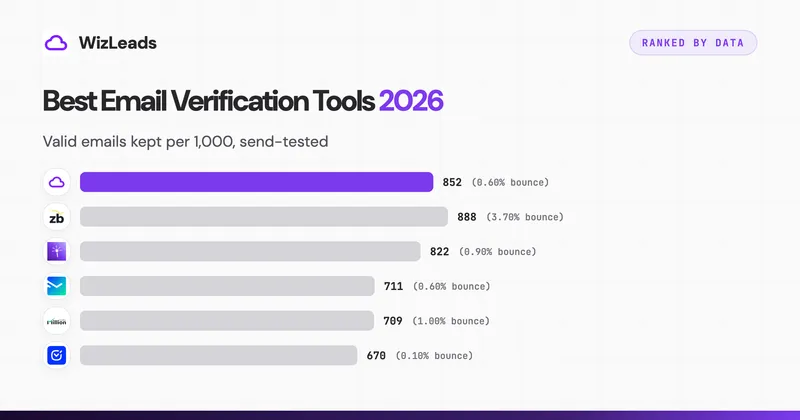
We exported 1,000 real-estate decision-maker addresses from Apollo, ran the identical list through six verification tools, and then sent to whatever each tool kept. The disagreement between the verifiers is the finding.
| Verifier | Kept as valid | Rejected | Bounces on send | Bounce rate |
|---|---|---|---|---|
| ZeroBounce | 888 | 112 | 33 | 3.72% |
| WizLeads | 852 | 148 | 5 | 0.59% |
| LeadMagic | 822 | 178 | 7 | 0.85% |
| NeverBounce | 711 | 289 | 4 | 0.56% |
| MillionVerifier | 709 | 291 | 7 | 0.99% |
| Debounce | 670 | 330 | 1 | 0.15% |
ZeroBounce passed 36 more addresses than the next tool and bounced 6.3 times as often, which means the extra addresses it let through were disproportionately dead. The list contained 212 catch-all domains, which is where verifiers diverge hardest, and 159 of the 1,000, or 15.9 percent, sat behind a Secure Email Gateway. The full methodology and raw data are in the email verification benchmark.
The number that matters for this article is the spread. Six tools looked at the same Apollo export and disagreed about between 112 and 330 of its 1,000 addresses. Whatever the Apollo UI labels those contacts, the list arrives unverified by any standard a sending domain would recognise, and the cost of that lands on your reputation rather than on your invoice.
Apollo Basic across four seats is $196 a month for 10,000 emails on annual billing, or $19.60 per 1,000. Paying month to month it is $260, or $26.00 per 1,000. Compare like for like before ranking it: several tools in the table below are quoted at monthly rates. Add a verification pass over those 10,000 addresses, which costs $39 a month on the smallest WizLeads plan, and the real figure is $235. Apollo is not expensive. It is under-finished.
Does using Apollo actually burn your leads?
The most-upvoted criticism in the r/LeadGeneration thread that ranks for this query is that Apollo's dataset is shared, so everyone has already emailed everyone, and using it will "burn those email channels and leads so fast". Someone in the same thread asks the obvious question back: you would be emailing those people anyway, so how does the source burn anything? Nobody answers.
The honest answer is that the source does not create the contact, it changes the density of senders hitting it. Two mechanisms do real damage, and neither is folklore.
Recycled lists accumulate spam traps and abandoned mailboxes faster than fresh ones, because an address that has been sitting in a widely resold database for three years is more likely to have been repurposed or retired. That is a deliverability problem, and it is the one your verifier is supposed to catch before the send.
The second mechanism is complaint rate rather than bounce rate. A prospect who received eleven cold emails this quarter from the same exported segment marks the twelfth as spam faster than someone contacted twice. You cannot verify your way out of that one. It is the argument for sourcing from LinkedIn search filters that you defined yourself rather than from a saved-search template thousands of other accounts are also running.
Neither mechanism makes Apollo unusable. Both are arguments for controlling the list definition and re-verifying before send, which is what the stack below is for.
What Apollo gets right
No competitor page on this query says a single positive thing about Apollo, which should make you suspicious of all of them, this one included.
Apollo's search filters are the deepest self-serve set of any tool in this comparison, and the ability to go from filter to sequence without exporting anything is the reason it took the market. Waterfall enrichment is included from Basic upward rather than sold as a separate product. The deliverability suite and email warmup are bundled on every paid plan, which most database vendors do not attempt. Job change enrichment and CRM enrichment run automatically. And the platform really does cover deal management, call recording and meeting scheduling, so a small team really can run on one login.
Coverage is deepest in US mid-market, which is where most of its users sell.
Who should stay on Apollo
Switching costs time, and every tool below has a limitation of its own, so it is worth being direct about who should not bother.
Stay if one login across database, enrichment, sequencing and deal management is worth more to you than best-of-breed layers, because nothing on this list replicates that bundle and stacking three tools costs coordination as well as money. Stay if your monthly credit use fits inside one or two Professional seats, because at that volume the per-credit price is fine and the ergonomics are better than a three-tool stack. Stay if you sell to US mid-market and your own coverage tests come back strong, since coverage is territory-specific and nobody else's benchmark settles it for your ICP. And stay if you are already re-verifying every export before it reaches a sequencer, because that habit neutralises the main quality objection at a cost of about $20 per 10,000 addresses.
Switch when you find yourself buying seats to buy credits. Switch when the record selection limit turns list building into an afternoon of clicking. Switch when your bounce rate on Apollo-sourced sends stays high after a verification pass, because at that point the problem is the source rather than the filter.
The alternatives
Nothing below is better than Apollo at everything. Each of these is better than Apollo at exactly one of its three jobs, which is why the grouping matters more than the ranking. Every tool fills the same six slots in the same order, so you can read one section against another without re-reading the whole thing.
Replacing the list-building job
1. LinkedIn Sales Navigator
Three of the four highest-ranking roundups on this query list Sales Navigator as an Apollo alternative, and it is the single most-recommended answer in the Reddit thread that ranks alongside them. That is worth taking seriously, because it is the only source on this list whose records are maintained by the people they describe.
What it replaces. The database and the list-building job, and nothing else. There is no enrichment layer and no sequencer.
Where the data comes from. LinkedIn profiles, live. Someone changing employer updates their own record the week it happens, which is the failure mode people describe when they say an Apollo contact "left months ago and still shows the old company".
The email layer. None. Sales Navigator will not give you a work email, which is why every workflow built on it pairs it with a scraper and an enricher.
Price. Core $119.99 a month or $1,079.88 a year, Advanced $159.99 a month or $1,799.88 a year. Advanced Plus is quote-only. LinkedIn publishes these figures in the FAQ block at the foot of its own comparison page, in five currencies, so anyone telling you LinkedIn hides Sales Navigator pricing has not read it. Core and Advanced both include 50 InMails a month and more than 50 advanced search filters.
The 10,000-email month. Not applicable on its own. Sales Navigator is the input to that month rather than a way of completing it, and it stacks underneath the two tools below.
What that price costs you. A people search displays a maximum of 2,500 results and a company search 1,000, regardless of how many the filter actually matches, so any territory bigger than that has to be split into narrower searches by headcount, geography or industry. Exporting is not a supported feature, so everything downstream depends on a third-party tool. And at $119.99 it is the most expensive single line in most of the stacks below.
2. WizLeads
This is our product, so treat the section as disclosure rather than a recommendation and check the numbers against the two benchmarks linked below, both of which publish raw data.
What it replaces. List building and enrichment together, in one pass. It does not sequence.
Where the data comes from. A Sales Navigator search you define, extracted server-side. In account-less mode the extraction runs without touching your LinkedIn session, which is the structural difference from every Chrome-extension scraper. Searches past the 2,500-result display cap are split automatically on plans from Agency upward, rather than by hand.
The email layer. Find and verify in the same pass, with mailbox provider and Secure Email Gateway identified per row. In our enrichment benchmark across seven finders on an identical 1,000-lead input, it returned 670 verified-valid emails with no invalids, the highest of the seven. In the six-verifier send test above, the addresses it kept bounced at 0.59 percent.
Price. Freelancer $39 a month for 10,000 credits, Agency $99 for 40,000, Cartel $199 for 100,000, Kingpin $499 for 300,000. Scraping costs 1 credit per lead with a connected account or 2 account-less, email enrichment 3 credits per email actually found with nothing charged for misses, standalone verification 0.5 credits per address. Credits roll over for one month.
The 10,000-email month. Sourcing 16,700 leads account-less costs 33,400 credits and enriching 10,000 found emails costs 30,000, so 63,400 credits in total. That lands on Cartel at $199, or $19.90 per 1,000. Verification alone is cheaper by an order of magnitude: the $39 Freelancer plan covers 20,000 addresses, which is where the $196-a-month Apollo stack gets its cleanup for $39.
What that price costs you. It needs a Sales Navigator seat underneath it, which adds $119.99, so the honest all-in figure for that month is $318.99 rather than $199. It has no contact database of its own, so there is nothing to query without a Sales Navigator search to point it at, and no intent data, no dialer and no CRM. Automatic link splitting starts at Agency rather than Freelancer. And a 60 percent find rate means four in ten sourced leads arrive without an email, which is the category norm rather than an exception.
3. Wiza
What it replaces. The same two jobs as WizLeads, with a different risk profile and a very different price curve.
Where the data comes from. Sales Navigator, through an extension plus web app that runs on your own logged-in session. Exports past 2,500 results are done in batches.
The email layer. Found and verified. In our enrichment benchmark it found 671 emails per 1,000 leads, of which 633 were valid and 38 were not, placing it first of seven on raw finds, ahead of our own 670, and second on verified-valid. It is the closest competitor to us on that test and it beat five other tools, which is worth saying plainly.
Price. On monthly billing, Starter $49 per user for 100 valid emails and 100 phone numbers, Email $99 for 500 valid emails, Email + Phone $199 for 500 of each. Extra emails are $0.15 and extra phone numbers $0.35. On annual billing, Email is $83 per user per month billed at $990 a year with unlimited email reveals but a 2,500-export monthly cap, and Email + Phone is $166 billed at $1,990. Free tier is 20 valid emails and 5 phone numbers.
The 10,000-email month. On the monthly Email plan, 500 included emails plus 9,500 overage at $0.15 comes to $1,524, or $152.40 per 1,000. The annual route is far cheaper but needs four seats to clear the 2,500-export cap, at $332 a month on a $3,960 annual commitment. Neither number is close to the rest of this list at volume.
What that price costs you. Every export runs through your own LinkedIn session, so the account doing the work is yours. Overage pricing at $0.15 per email is fine at a few hundred leads and punitive at ten thousand, and the annual plan that fixes the unit economics replaces it with a per-seat export cap and a year-long commitment. Phone numbers are its genuine strength and they are priced accordingly.
Replacing the database job
Three of the four tools in this group publish no price at all. That is a finding rather than a research failure, and it is the main practical difference between replacing Apollo's database and replacing its other two jobs.
4. Cognism
What it replaces. The database, with phone-verified mobile numbers as the reason people move rather than email coverage.
Where the data comes from. Licensed and compliance-screened sources with a European centre of gravity, which is where Apollo's coverage thins fastest. Credits are shared across the prospecting platform, the Enrich product and the API rather than metered separately per surface.
The email layer. Records are enriched once and then maintained, with credits consumed again only when something material changes such as a job move. That is a different economic model from Apollo, where every re-export of the same contact is a fresh credit.
Price. Not published. Sales Prospecting comes in two packages, Standard and Pro, each including five seats, and every button on the page is a variation of "Talk to sales". CRM Enrichment and Data-as-a-Service are priced separately on subscription structure, usage and delivery method. There is no dollar figure anywhere on the page.
The 10,000-email month. Not quotable. Any figure you find for Cognism on a comparison page came from somebody's contract rather than from Cognism.
What that price costs you. A five-seat floor on both packages, so a two-person team buys three seats it will not use. No self-serve signup and no trial you can start without a call, which makes a like-for-like coverage test against your own ICP slow to arrange. And a quote-gated price is a price that moves with how well you negotiate, which is fine for a procurement team and hostile to a founder comparing options on a Tuesday.
5. ZoomInfo
What it replaces. The database, at the depth enterprise procurement asks for: org charts, intent topics, technographics and the compliance paperwork.
Where the data comes from. Its own database plus a contributory network, strongest in US mid-market and enterprise, which is the same territory where Apollo is strongest and the reason the two are compared so often.
The email layer. Verified, though the pricing page publishes no method or accuracy figure for it. Every accuracy number you will read about ZoomInfo comes from a competitor's blog or a review site.
Price. Not published. Packages run from Professional up to Copilot Enterprise across three product families, and the page states that pricing depends on which features you take, how many licences, usage credits and integration requirements. There is no dollar figure on the page.
The 10,000-email month. Not quotable, for the same reason as Cognism.
What that price costs you. Contracts are annual and multi-seat, and the most consistent complaint in public reviews is cost rather than data quality. Credits are a negotiated line item rather than a rate card, so two teams pay different amounts for the same usage. And the depth that justifies the contract, intent and org charts, is worth nothing to a team whose entire workflow is find-email-then-send.
6. Seamless.AI
What it replaces. The database, with a search engine that assembles contact records at query time rather than serving them from a stored snapshot.
Where the data comes from. Web sources at the moment you search, which is a different architecture from a nightly-refreshed database and produces far more variable results.
The email layer. One credit returns a phone number and an email together. Against Apollo's 1 credit for an email and 8 for a phone, that is the better-shaped unit for anyone who dials, and it is the strongest single argument on this tool's page.
Price. Not published. The Free card shows one user and 50 credits, and its FAQ says "Pro plans start off at 10,000 annual credits". Enterprise is described as custom packages. Both paid tiers route to "Contact sales" and no dollar figure appears anywhere on the page.
The 10,000-email month. Not quotable.
What that price costs you. No rate card, and unlike Cognism and ZoomInfo there is no enterprise-procurement rationale for hiding one at this end of the market. Query-time assembly means coverage depends on how much of the public web knows about your ICP, so results swing hard between segments and a coverage test on your own list matters more here than anywhere else on this page. The sales motion after signup is the most frequent complaint in public reviews.
7. RocketReach
What it replaces. The database, as the cheapest published entry point in this group by a wide margin.
Where the data comes from. Aggregated public and licensed sources across a claimed 700 million professionals and 60 million companies, with 50-plus search filters and both work and personal emails.
The email layer. Verified on demand, and a lookup is refunded if it returns neither a verified email nor a phone. That refund rule is the same shape as paying only for results and it is stated plainly in their FAQ.
Price. On annual billing, Essentials $33 a month at $399 a year, Pro $75 a month at $899, Ultimate $142 a month at $1,699. On monthly billing the same three tiers are $69, $119 and $209. Annual plans advertise unlimited lookups; monthly plans cap them at 100, 250 and 1,000 respectively. Free accounts get 5 lookups. Custom team plans start at $6,000 a year.
The 10,000-email month. The binding constraint is exports rather than lookups. Annual plans allow 1,200, 3,600 and 20,000 exports per year, so a single 10,000-export month is possible only on Ultimate at $142 a month, and it consumes half the annual allowance in one go. Sustaining that volume needs 120,000 exports a year, which is off the published menu and into the $6,000 custom tier.
What that price costs you. "Unlimited lookups" is doing a lot of work in that pricing table, because the export cap is what actually governs whether data leaves the platform. Sending is capped at 500 emails a day on every tier including Ultimate. And personal emails are a large part of the coverage claim, which is useful for recruiters and a compliance question for cold B2B outbound.
Replacing the enrichment job
8. Clay
Clay appears on three of the four highest-ranking roundups for this query and it is the tool most often described as the modern replacement for a database subscription. It is also the hardest one on this page to price.
What it replaces. Enrichment, plus the orchestration around it. It is a spreadsheet-shaped workspace where each column calls a different provider, so you are buying the routing rather than the data.
Where the data comes from. More than a hundred providers in its marketplace, called in a waterfall so that a cheap source is tried first and an expensive one only runs when the cheap one misses. Audiences covers the search and sourcing half, and signals cover job changes, new hires and company news.
The email layer. Whatever you route it to. Clay itself does not find or verify emails; it decides which vendor gets asked and in what order, and passes through whatever that vendor returns. Your accuracy is therefore the accuracy of the providers in your waterfall, which is why the spread we measured across seven finders matters more inside Clay than outside it.
Price. Two separate currencies. Actions run rows and steps; data credits buy data from marketplace vendors. Free gives 500 actions and 100 data credits a month with unlimited seats and up to 200 rows per table. Launch starts at $167 a month on annual billing or $185 monthly, for 15,000 actions and 2,500 data credits a month. Growth starts at $446 annual or $495 monthly, for 40,000 actions and 6,000 data credits a month. Both expand on sliders, annual billing saves 10 percent, and actions start at under a cent each.
The 10,000-email month. Sourcing and enriching 16,700 rows exceeds Launch's 15,000 monthly actions, so the volume starts at Growth, $446 a month on annual billing or $495 monthly. The data credits on top are not quotable from the pricing page, because what a row costs depends entirely on which providers your waterfall calls and at what rates. Anyone quoting you a flat Clay price for a workload has guessed.
What that price costs you. The unquotable data-credit line is the honest headline: Clay is the only tool here where the pricing page cannot tell you what the job costs. Two currencies mean two ways to run out mid-month. The free tier caps tables at 200 rows, which is a demo rather than a trial. And it rewards someone who enjoys building the workflow, which is a real skill requirement rather than a feature, and the reason a Clay subscription sometimes ends up sitting unused next to the Apollo one it was meant to replace.
9. Hunter
The oldest tool on this list and the only one that appears on all four of the highest-ranking roundups for this query, which tells you something about how settled its position is.
What it replaces. Enrichment, and the sequencing job at small volume. It has a B2B database of its own called Discover, but querying it is not why people buy Hunter.
Where the data comes from. Domain crawling plus its own database, which is why it is strongest when you already know the company and need the person, and weakest when you are trying to build a list from filters.
The email layer. Find and auto-verify on every paid plan. Credits are charged only on results: 1 credit per email found, 0.5 per email verified, nothing when a search comes back empty, and repeated searches count once per billing period.
Price. Free $0 for 50 credits a month. Starter $49 a month, or $34 on yearly billing at $408, for 2,000 credits a month. Growth $149 monthly or $104 yearly at $1,248, for 10,000 credits. Scale $299 monthly or $209 yearly at $2,508, for 25,000 credits. Yearly is 30 percent off and team members are unlimited on every plan, sharing one credit pool.
The 10,000-email month. Growth exactly, at $149 on monthly billing or $14.90 per 1,000, dropping to $104 and $10.40 if you commit to a year. That is the cheapest complete route on this page, with one caveat in the next slot.
What that price costs you. Hunter charges per email found rather than per contact searched, so the headline number assumes a find rate it does not publish and we have not measured. Discover is a real database but a shallow one next to Apollo's, so the list-building half of the job usually happens elsewhere. Sequences are capped at 5,000 recipients on Growth with 10 connected email accounts, which is a starter sequencer rather than a replacement for a dedicated one. And unlimited seats sharing one credit pool means one colleague's bulk run can empty the month.
10. LeadMagic
What it replaces. Enrichment, as an API and MCP endpoint rather than as an interface. It is the tool you reach for when the enrichment is happening inside something else.
Where the data comes from. A waterfall across its own sources, billed only when a result comes back. People, company and jobs search is included from Essential upward and spends no credits at all.
The email layer. Finding and validation are separate endpoints sharing one credit pool. We have measured both. As a finder it returned 464 verified-valid emails per 1,000 leads, fifth of the seven tools in our enrichment benchmark. As a verifier on the Apollo export it kept 822 of 1,000 and those bounced at 0.85 percent, third of six and close behind the top two.
Price. Essential $99 a month or $990 a year for 5,000 credits. Growth $249 or $2,490 for 20,000. Professional $499 or $4,990 for 50,000. Ultimate $849 or $8,490 for 100,000. An email costs 1 credit and a mobile number 5, charged only on valid results per the pricing page, though LeadMagic's Terms §5.7 say metered actions consume credits whether or not there is a match. On monthly plans unused credits bank up to two months' allocation; annual plans do not roll over.
The 10,000-email month. Essential's 5,000 credits fall short, so the job lands on Growth at $249, or $24.90 per 1,000. That leaves 10,000 credits unused, which is the usual penalty when a plan ladder steps in fours.
What that price costs you. It is a data layer, not a product you sit in front of, so there is no list building, no sequencer and no interface for a non-technical SDR. The 464 find rate in our test was mid-table and 206 below the top result on identical input, so it needs a waterfall partner to reach the coverage a single richer source gives you. And the plan steps from 5,000 to 20,000 credits with nothing between, which strands anyone whose real usage is 8,000.
Replacing per-reveal prospecting
11. Lusha
What it replaces. The reveal-one-contact-at-a-time job, which is a different workflow from Apollo's list-and-sequence model even though the two get compared constantly.
Where the data comes from. A licensed and contributory database, surfaced through a browser extension while you are looking at a LinkedIn profile, a CRM record or a company website.
The email layer. Verified emails at 1 credit each. Phone numbers are the actual product and cost 5 credits each, against Apollo's 8.
Price. Free $0 for 40 credits a month and one seat. Starter $37.45 a month billed yearly for 4,800 credits a year. Pro $52.45 billed yearly for 7,200 credits a year plus API, CSV enrichment and webhooks. Premium $299.95 billed yearly for 40,800 credits a year. Scale is custom. Yearly billing is 25 percent off, credits arrive upfront on annual plans and any unused ones reset at the end of the cycle.
The 10,000-email month. Off the published menu. Premium is the largest self-serve plan and 40,800 credits a year averages 3,400 a month, so a 10,000-email month needs the custom Scale tier and a sales conversation. That is the clearest illustration on this page of what per-reveal pricing does at list volume.
What that price costs you. Credit maths that works beautifully for an AE revealing forty mobile numbers a week and falls apart at four thousand. Monthly plans roll unused credits over to a cap of twice the limit, annual plans do not roll over at all. And the phone-number strength that justifies the price is 5 credits a reveal, so a phone-heavy month burns the allowance five times faster than the headline credit count suggests.
Replacing the sequencer
Apollo's sequencer is usually the first component people outgrow, and both tools below are the standard replacements. Neither brings a list, so read them as the last layer of a stack rather than as Apollo substitutes on their own.
12. Instantly
What it replaces. Sending, warmup and inbox management. It also sells a lead database and enrichment credits separately, which is how it ends up in Apollo comparisons.
Where the data comes from. For sending, from you. Its separately-priced credit product covers a 450M-contact B2B database with 13 filters and waterfall work-email enrichment across five or more providers.
The email layer. Sold as a separate credit line rather than bundled with sending. Verification is a distinct product again.
Price. Outreach alone: Growth $47 a month, or $37.60 on annual billing, with unlimited email accounts, unlimited warmup, 1,000 uploaded contacts and 5,000 emails a month. Hypergrowth $97 monthly or $77.60 annual, for 25,000 contacts and 100,000 emails. Light Speed $358 monthly or $286.30 annual. Credits are priced separately from $47 a month for 1,500. Bundles combining both run $94, $194 and $555 a month, with 10 percent off annually.
The 10,000-email month. Not applicable for sourcing. For sending to 10,000 contacts you need Hypergrowth at $97 a month, since Growth caps uploaded contacts at 1,000.
What that price costs you. Unlimited sending accounts on a $47 plan is the headline and the contact cap is the catch, because 1,000 uploaded contacts is a fortnight of work for most teams. The pricing page splits the same product into bundles, outreach-only and credits-only views with figures that do not always agree between them, so check the plan you are actually buying in-app. And the lead database is a separate purchase, which makes the honest comparison against Apollo a two-line invoice rather than one.
13. Smartlead
What it replaces. Sending, with more of the data layer bundled than Instantly includes at the same price.
Where the data comes from. Nothing of its own for prospecting. You bring the list.
The email layer. Verified prospect emails are bundled into every plan rather than sold separately, which is unusual in this category. Additional verification credits can be bought one-off or monthly.
Price. Base $39 a month for 2,000 contacts, 6,000 sends and 2,000 verified prospect emails. Pro $94 for 30,000 contacts, 90,000 sends and 30,000 verified emails. Unlimited Smart $174 for unlimited contacts, 150,000 sends and 50,000 verified emails. Unlimited Prime $379 for 500,000 sends and 170,000 verified emails. Annual billing saves 17 percent. Unlimited email accounts on every plan. Whitelabel is a $29 per client workspace add-on and dedicated SmartServers are $39 per server per month.
The 10,000-email month. Not applicable for sourcing, but Pro at $94 includes 30,000 verified prospect emails, which covers the verification half of that month with room to spare and is the cheapest bundled verification on this page.
What that price costs you. No contact database at all, so it cannot replace Apollo's front end under any configuration. The plan names promise more than the rows deliver, since Unlimited Smart is unlimited in contacts but capped at 150,000 sends. Agencies pay again per client workspace for whitelabel. And the pricing page shows slightly different annual figures in different blocks, so confirm at checkout.
Replacing the whole bundle on a smaller budget
14. Snov.io
What it replaces. All three Apollo jobs at once, at roughly a third of the price and with roughly a third of the depth. It is the honest downgrade path when Apollo's cost is your only complaint.
Where the data comes from. Its own prospect and company database, reverified monthly according to its comparison table, plus LinkedIn search and a Chrome extension.
The email layer. A 7-tier verification with greylisting bypass on paid plans, sharing one credit pool with search. Each prospect found, each email verified and each company profile viewed costs 1 credit.
Price. On monthly billing: Starter $39 for 1,000 credits and 5,000 recipients, Pro S $99 for 5,000 credits and 25,000 recipients, Pro M $189 for 20,000 credits, Pro L $369 for 50,000, Ultra $738 for 100,000. Annual saves 25 percent. Team seats are unlimited on every plan. LinkedIn automation is a separate $69 per account slot per month, or $62 annually. Phone enrichment is a separate token product at $0.02 per token, sold as 10,000 tokens for $200 with a 90-day expiry.
The 10,000-email month. Sourcing 16,700 contacts at 1 credit each needs Pro M at $189 a month, which grants 20,000 credits. That is $18.90 per 1,000, the second-cheapest complete route on this page.
What that price costs you. The database is smaller than Apollo's and the platform is broad rather than deep at every layer, so the CRM, the warmup and the sequencer each trail a dedicated tool. Search and verification share one credit pool, so a heavy verification month eats your prospecting budget. The three products are billed separately once you want LinkedIn automation or phone numbers, which erodes the bundle argument. And we have not benchmarked its find rate, so the 60 percent assumption behind that $189 is the category average rather than a measured figure for Snov.
Tools that did not make the list
Four enrichment tools were cut because we have measured them and the numbers did not justify a section. The test ran seven finders over an identical 1,000-lead B2B input and counted only emails that came back verified-valid, so a tool that returns plenty of addresses and gets them wrong scores badly here on purpose.
| Finder | Verified-valid emails per 1,000 leads |
|---|---|
| WizLeads | 670 |
| Wiza | 633 (671 found, 38 invalid) |
| Findymail | 587 |
| Kitt | 517 |
| LeadMagic | 464 |
| IcyPeas | 418 |
| Prospeo | 259 |
The spread is 2.6x between top and bottom on the same input, which is the single most useful thing to know before you pick a waterfall order.
Findymail at 587 is the strongest of the cut tools and a reasonable third slot in a waterfall. It sells one Starter plan on a volume slider and charges only for verified results, at $49 a month for 1,000 finder plus 1,000 verifier credits, $99 for 5,000 of each, $249 for 15,000, $399 for 30,000, $549 for 50,000 and $849 for 100,000. Annual billing gives two months free. An email costs 1 credit and a phone number 10. The 10,000-email month lands on the 15,000-credit step at $249, or $24.90 per 1,000, which is real money for a mid-table find rate.
Prospeo came last on 259, meaning roughly three in four leads returned nothing usable on our input. It prices at $49 per user per month for 2,000 credits, $99 for 5,000 and $249 for 15,000, with 25 percent off annually and a free tier of 100 credits a month. Kitt and IcyPeas both landed below half on the same test.
Two more were cut for shape rather than performance. FullEnrich is a waterfall across 25-plus sources charging only for verified finds, on a slider that starts at $29 a month for 500 credits at $0.058 each and settles to $0.055 at 1,000. A work email costs 1 credit, a personal email 3 and a mobile 10. It does a narrower job than Clay at a similar unit cost, and 50 free credits make it cheap to test. Kaspr is Cognism's SMB sibling and the European answer to Lusha: free tier of 15 B2B email credits, 5 phone credits and 5 direct email credits a month, then Starter at $49 per user per month on annual billing or $65 monthly, which buys unlimited B2B email credits, 100 phone credits a month and up to 12,000 exports a year. Business is $79 annual or $99 monthly for 200 phone credits. If your ICP is European and you work profile by profile, read the Lusha section and substitute Kaspr.
Free tiers, ranked by how much you can actually test
Free tiers on this query are mostly demos. Ranked by how much real work you can do before paying:
- Wiza, 20 valid emails plus 5 phone numbers. The only free tier that returns both, and enough to spot-check coverage on a segment you know.
- Hunter, 50 credits a month, renewing. Fifty found emails or a hundred verifications, every month, indefinitely.
- FullEnrich, 50 credits once. Fifty work emails or five mobile numbers, then it stops.
- Lusha, 40 credits a month. Forty emails or eight phone numbers.
- Kaspr, 15 B2B email credits, 5 phone credits and 5 direct email credits a month.
- Apollo, 900 credits per seat per year granted monthly, with a record selection limit of 25. Seventy-five emails a month, one at a time in batches of 25.
- Instantly and Smartlead, free trials rather than free tiers.
None of these is a free Apollo replacement. Used together they are enough to run a coverage test on 100 contacts from your actual ICP before spending anything, which is the only free-tier strategy that produces information.
Moving off Apollo without losing your lists
- Export everything while the subscription is live. Saved searches, lists, sequences, suppression lists, and the reply history you will want for training a classifier later. Export credits are consumed when a contact leaves Apollo, so budget credits for the exit rather than discovering the ceiling on your last day.
- Re-verify every Apollo-era address before it enters a new campaign. Six verifiers disagreed about between 112 and 330 addresses out of 1,000 on a fresh export, and a list that has been sitting in your CRM for two quarters is worse. Use a verifier that resolves catch-alls rather than passing them through, since 212 of those 1,000 sat on catch-all domains. The tool comparison covers which ones do.
- Rebuild suppression lists in the new stack before the first send. Not after the first complaint from someone who already told you no.
- Run both sources in parallel for two weeks on the same ICP segment. Same filters, same volume, and compare three numbers: verified-valid emails per 100 sourced contacts, bounce rate, and reply rate. That test costs about $40 and settles the question for your ICP better than any roundup can, including this one.
- Cancel at the billing boundary. Apollo cancellations take effect at the end of the current term and downgrades take effect immediately with no mid-term refund, so a downgrade in week two costs you the rest of the month for nothing.
How to choose
If you are running cold email at 5,000 or more new leads a month, the stack is Sales Navigator plus a scraper-enricher plus a dedicated sender, because that is the only configuration where the list definition, the verification and the sending reputation are all under your control. Budget around $320 a month for the data half.
If you sell into EMEA and live on the phone, the database is the product and the argument is Cognism against ZoomInfo. Both need a quote and both will cost multiples of Apollo. Get the coverage test on your own territory in writing before signing.
If you are an SDR hand-picking forty accounts a week, Lusha or Kaspr fit the workflow and Apollo does not, whatever the price comparison says.
If Apollo's bill is your only complaint, Snov.io at $189 does the same three jobs less well for less money, and moving is a lateral step rather than an upgrade.
And if your problem is bounce rate rather than price, you do not need a new database. You need a verification pass on the one you have, which costs $39 for 20,000 addresses and takes an afternoon.
FAQ
How much does Apollo.io cost in 2026?
Read off Apollo's own pricing page on 8 September 2026. On annual billing: Free at $0 with 75 credits per seat per month, Basic at $49 per seat per month, Professional at $79, and Organization at $119 with a three-seat minimum. Paying monthly instead: Basic $65, Professional $99, Organization $149, which is annual-only. Those paid figures are all billed-annually prices. Apollo advertises annual billing as saving 24 percent and hides the monthly figures behind a toggle, which is why competing roundups quote $39, $49 and $59 for the same plan. The real monthly prices are Basic $65, Professional $99, and Organization $149 with a three-seat minimum and annual billing only. So the 24 percent applies to Basic; on Professional and Organization the annual commitment saves closer to 20 percent.
Who is Apollo's biggest competitor?
By job rather than by brand. ZoomInfo and Cognism for the database, Clay and Hunter for enrichment, Instantly and Smartlead for sequencing, Sales Navigator plus a scraper for list building. Nothing replaces the full bundle, which is the strongest argument for staying on Apollo.
Is there a free Apollo alternative?
Not a complete one. Apollo's own free tier is now 900 credits per seat per year, which is 75 emails a month, so the old advice about it being the best free database is out of date. Hunter's renewing 50 credits a month is the most useful free tier on this list, and Wiza's 20 emails plus 5 phone numbers is the best for a one-off coverage test.
Why do people leave Apollo?
Three reasons recur. Records go stale because a database snapshot decays while a LinkedIn profile does not. Exports are not verified to a standard a sending domain would accept. And credits are granted per seat per year, so sustaining volume means buying seats you do not need in order to buy credits you do.
Is Apollo good for cold email?
For sourcing and sequencing in one place, yes, with two caveats worth knowing before you commit. Basic caps you at 250 daily sends from one mailbox per user, so volume sending needs Professional or above. And an export should go through a verifier before it reaches a campaign, which our send test on 1,000 Apollo addresses makes hard to argue with.
Should you cancel Apollo before testing an alternative?
No. Keep Apollo through one overlap cycle, run the challenger on an identical ICP segment, and compare verified-valid emails per 100 sourced contacts, bounce rate and reply rate. Free tiers and the smallest paid plans make that overlap cost roughly $40.
Lusha or Apollo?
Lusha for an SDR revealing contacts one profile at a time who needs mobile numbers, at 5 credits a phone against Apollo's 8. Apollo for list-based outbound. Lusha's slider publishes up to 120,000 credits a year, or 10,000 reveals a month, with Premium sitting at 40,800 a year by default; past that it becomes a Scale quote.