WizLeads
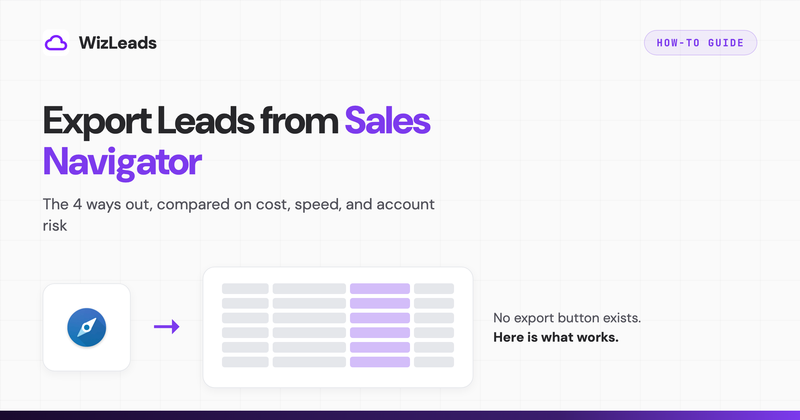

You cannot export leads from LinkedIn Sales Navigator natively. There is no CSV button, no download menu, and no lead-list API on Core or Advanced. The one sanctioned exit is CRM Sync on the custom-priced Advanced Plus tier, which links Sales Navigator to Salesforce, Microsoft Dynamics or HubSpot. Everything else is a workaround, and there are four of them.
I have used all four. Copy-paste in my first year of agency work, then Chrome extensions, then session-based cloud tools, and now a cloud pipeline that never touches my LinkedIn account. Each step forward cost me something different. Below is what each method actually does, what it costs, what it risks, and where it stops working, plus a full walkthrough of the one I run today.
If you are still deciding whether the subscription earns its price, our Sales Navigator cost breakdown covers that question. This guide assumes you have a seat and want the data out of it.
Why there is no export button
The absence is deliberate. Sales Navigator is sold per seat, and a seat that could dump its entire result set to CSV would be bought once, exported, and cancelled. LinkedIn's user agreement makes the same point in legal form, prohibiting the use of bots or other automated methods to access the service or copy data from it. So the product gives you filters, saved searches, lead lists, alerts, and InMail, all of which keep you working inside the interface.
CRM Sync is worth understanding before you count it as an escape route. It moves a person into your CRM as a name, a title, an employer and a profile URL. It does not move a work email or a mobile number, because Sales Navigator holds no such field to give. Contact details on a LinkedIn profile are self-reported and, by default, visible only to first-degree connections. Even the sanctioned route leaves your team with a record nobody can contact.
That has one practical consequence for you. Every method below is a workaround, so each one charges you in a different currency: your time, your money, your LinkedIn account, or some mix of the three.
The export buttons that do exist
Spend enough time in the interface and you will find something labelled Export. Two of them exist, and neither hands you leads.
Admins on Advanced and Advanced Plus can export a Usage Report. Sign in, click Admin, open Usage Reporting, then click Export in the upper right and choose Export CSV. The file describes how your team uses their seats. It contains no prospect data of any kind.
The main LinkedIn platform separately lets you export your own connections as a CSV. That covers people who already accepted your request, and it carries an email address only where that person's privacy settings allow it. Your first-degree network is not a prospecting list.
A third button gets described often enough to be worth naming: an export icon inside a saved lead list. Several current guides walk you through clicking it. LinkedIn's help centre states that account and lead information cannot be exported from Sales Navigator into a CSV or XLS file, and that page is the authority on its own product. If a walkthrough tells you to open a lead list and click Export, check the interface before you plan around it.
The four export methods
Four workarounds exist to export Sales Navigator leads into a file you can actually use. They deliver much the same CSV. What separates them is which currency they bill you in.
| Method | Entry price | Speed | LinkedIn account risk | Practical ceiling |
|---|---|---|---|---|
| Manual copy-paste | free | ~1 hour per 100 leads | none | dozens |
| Chrome extension scraper | Evaboot from $9/mo, Wiza from $49/mo | fast, browser must stay open | medium | daily quotas |
| Cloud scraper (your session) | PhantomBuster from $56/mo billed annually | fast, runs server-side | low to medium | daily limits |
| Cloud scraper, account-less | WizLeads from $39/mo | fast, fully managed | none | search-size limits only |
Prices checked on each vendor's own pricing page on 8 September 2026.
Method 1: manual copy-paste
Open a profile, copy the name, title, and company into a spreadsheet, go back, repeat. Free, nothing to install, and nothing for LinkedIn to detect.
At small numbers this is the right call. Twenty named target accounts, where you are reading each profile anyway to write the first line of the email, costs you an hour and leaves you with better notes than any scraper would produce.
Past a hundred leads the arithmetic ends the argument. Working steadily I managed about a hundred leads an hour, so a thousand leads is a full working week. You finish that week holding names and job titles and not one email address, which means the enrichment work is still ahead of you. I did this exactly once, for an early client, and priced the next project differently.
Method 2: Chrome extension scrapers
Evaboot, Wiza, and similar tools install into your browser and add an export button to the Sales Navigator interface. You run a search, click the button, and the extension pages through the results using the LinkedIn session you are already logged into, then hands back a CSV. Most bundle email enrichment into the same click.
Anyone searching for a LinkedIn scraper or a LinkedIn lead extractor tends to find this category first, because install-and-click is the easiest workflow to demo.
Evaboot runs one credit-based plan on a volume slider, starting at $9 a month for 100 credits, where a credit buys either one exported lead or one found and verified email, so a lead with its email costs two (evaboot.com/pricing, 8 September 2026). Wiza sells monthly seats instead: Starter at $49 for 100 valid emails, Email at $99 for 500, and $0.15 per email beyond the allowance (wiza.co/pricing, 8 September 2026).
Three costs come attached.
The first is exposure. The extension makes its requests as you, from your browser, carrying your cookies, so LinkedIn's automation detection is pointed straight at your account. Every extension vendor answers this with daily caps, which is a sensible response and also an admission of the problem.
The second is availability. Your browser has to stay open and the tab has to stay on the results page for the whole run. A large export means a laptop you cannot close and a machine you cannot let sleep.
The third is the ceiling. Sales Navigator displays at most 2,500 results per people search, so an extension can only reach 2,500 no matter what the result counter claims. Bigger territories have to be sliced into sub-searches by hand, one filter combination at a time, and we wrote up the mechanics of that cap in Sales Navigator export limits.
Bundled enrichment deserves a look before you commit to any of them. The email finders inside these tools vary far more than their marketing suggests: on the same 1,000 leads, the seven we tested in our enrichment benchmark returned between 25.9% and 67.0% verified-valid emails, a 2.6x spread from identical input.
Method 3: cloud scrapers using your session
PhantomBuster, Lobstr, and Scrupp move the work off your machine. You copy your LinkedIn session cookie into the tool, paste a search URL, and the extraction runs on their servers. You can close the laptop, schedule runs overnight, and chain jobs together.
Two of the three costs above shrink. Browser availability stops mattering entirely, and rate limiting becomes the vendor's engineering problem rather than your babysitting problem.
Account exposure does not shrink. The requests still carry your session cookie, so LinkedIn still sees your account doing the collecting, and users of both PhantomBuster and Scrupp have posted publicly about warnings and restrictions. Slower settings improve your odds. They do not remove the mechanism.
Pricing in this tier is multi-dimensional, which is the part that catches people out. PhantomBuster meters execution time and email credits separately. Billed annually, Start is $56 a month for 20 hours of execution and 500 email credits, Grow is $128 for 80 hours and 2,500 email credits, and Scale is $352 for 300 hours and 10,000 email credits. Paying month to month those same tiers are $69, $159 and $439 (phantombuster.com/pricing, 8 September 2026).
Lobstr and Scrupp meter the same job differently again. Lobstr sells credits outright at $20 a month for 10,000, $100 for 100,000 and $500 for a million, with a fifth off on annual billing, and charges one credit per profile. Scrupp charges one credit per contact plus one more per verified work email, on a monthly ladder of $29 for 1,000, $59 for 5,000, $99 for 10,000 and $599 for 100,000, or as one-time packs that never expire at $35, $71, $119 and $719 for the same volumes. Neither publishes these figures to a page you can read without logging in, so they come from our own accounts.
The meter that catches people out is the credit definition. PhantomBuster's own documentation defines one email credit as one attempt to find and verify an email for one profile, not one address delivered. At a 60 percent find rate, Scale's 10,000 credits return roughly 6,000 emails rather than 10,000, so a job sized against delivered addresses will overshoot the plan by a wide margin. Work out your cost per finished lead against both meters, and against attempts rather than results, before you subscribe.
Method 4: cloud scraper in account-less mode
The structural fix is taking your account out of the loop, so that whatever scrapes Sales Navigator is never signed in as you. If the extraction never touches your session, nothing ties the activity to you, so there is nothing for LinkedIn to restrict and no daily cap to work around.
This is the method I run today, and WizLeads is the LinkedIn Sales Navigator scraper I built to run it, so weigh the rest of this section accordingly. We perform the extraction on our own infrastructure: you paste the search URL, we collect the results without your credentials or cookies, and the CSV comes back with enrichment and verification already applied.
Running an export, start to finish
1. Build the search in Sales Navigator. Filter as narrowly as you would for your own reading: job title, seniority, headcount, industry, geography, and whatever else defines the account. Then copy the URL out of the address bar. That URL encodes every filter you set, which is the only thing the scraper needs.
Check the result counter before you copy it. Under 2,500 and the search fits in a single run. Over it, you either split the search yourself or turn on splitting in step three.
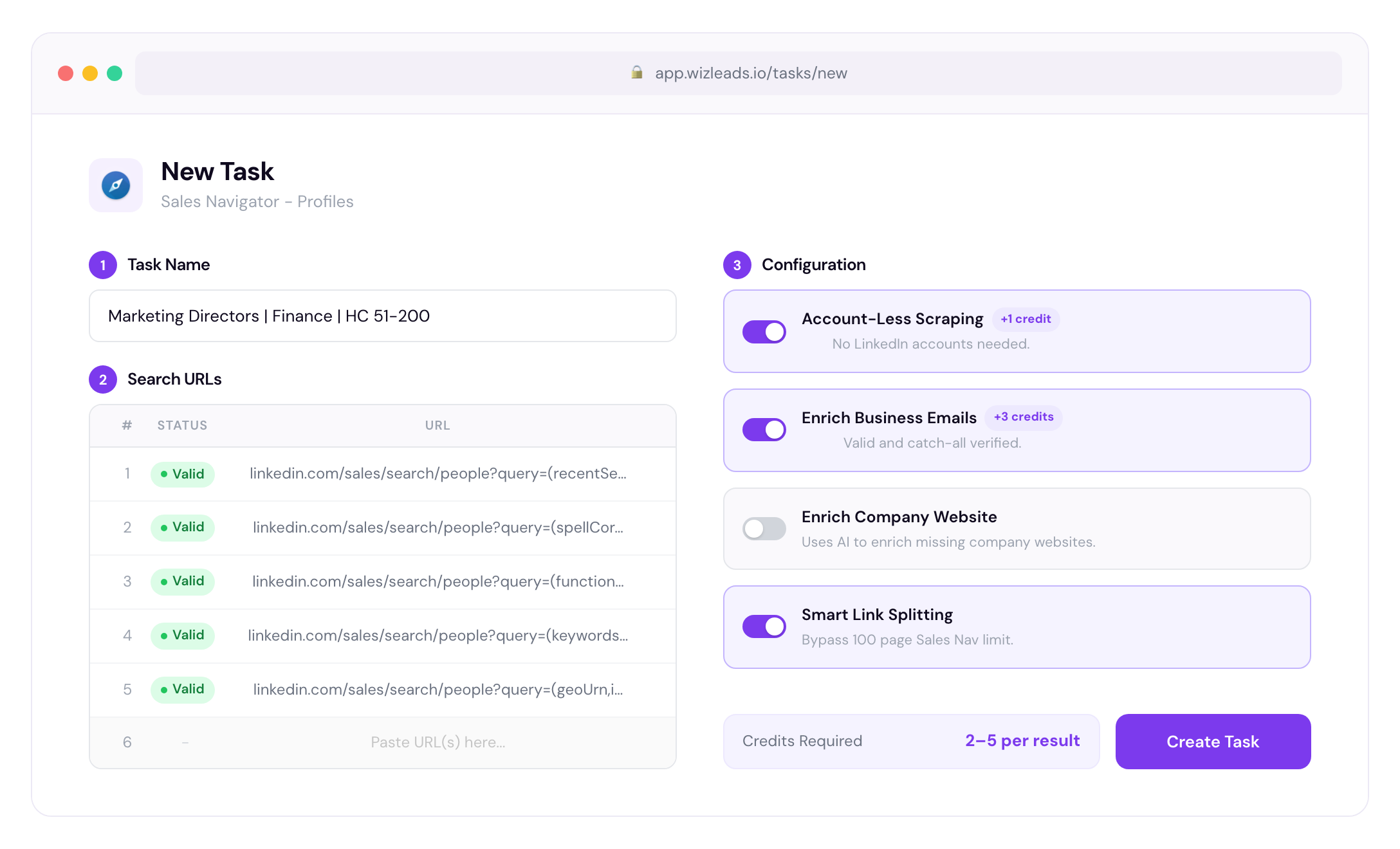
2. Paste the URLs. Open a new task, name it something you will still recognise in three weeks (mine look like Marketing Directors | Finance | HC 51-200), and paste the URL into the list. You can paste several at once, one per row. Each one validates as you add it, so a malformed or expired URL shows up before the run rather than after it.
3. Set the configuration toggles. This is where the run gets its cost and its behaviour. Four switches matter:
- Account-Less Scraping runs the extraction on shared infrastructure instead of a connected LinkedIn account, at 2 credits per lead instead of 1. Leave it on unless you specifically need results as your own network sees them.
- Enrich Business Emails finds and verifies a work email for each lead in the same pass, at 3 credits per email actually found. Leads that come back without one cost nothing extra.
- Enrich Company Website fills in the company domain where LinkedIn left the field blank. Worth turning on if the CSV is heading into a scoring or routing workflow that keys off domains.
- Smart Link Splitting handles searches above the 2,500 cap by breaking the URL into sub-searches along filters like geography or headcount, running them in parallel, then deduplicating the merged output. A 40,000-result territory comes back as one file. This one requires the Agency plan or above.
The credit estimate at the bottom of the panel updates as you flip each switch, so the cost of the run is visible before you commit to it.
4. Create the task and leave it alone. Progress updates live, and a 5,000-lead task usually finishes in 15 to 20 minutes. Nothing on your side has to stay open, since the run happens server-side, and separate tasks for separate clients process in parallel rather than queueing behind each other.
5. Download the CSV. The file carries 35+ fields per lead, ready to import into a sequencer or a CRM without cleanup.
The same task can be created over REST instead of in the dashboard: POST /tasks/add with your API key, the search URL, and the same toggles expressed as JSON booleans. That endpoint is how the Clay, n8n, Make, and Zapier workflows hook in.
What a run costs
Take one full people search, 2,500 leads, account-less with email enrichment switched on:
- Scraping: 2,500 leads at 2 credits each is 5,000 credits
- Emails: find rates land between 50% and 60%, so 1,250 to 1,500 addresses found at 3 credits each is 3,750 to 4,500 credits
- Total: 8,750 to 9,500 credits
The $39 Freelancer plan carries 10,000 credits, so that search fits inside it with room to spare, and unused credits roll forward a month. The first month on that plan is $1, which is enough to run the search above end to end before deciding whether the workflow is worth a subscription. Verification is included in the enrichment price rather than metered separately. Verifying a list you already have runs 0.5 credits per address, which puts the same $39 at 20,000 verifications.
Credit systems are not comparable by credit count, only by what a finished lead costs. The same 2,500-lead job on Evaboot's ladder consumes one credit per lead and one per found email, so roughly 4,000 credits, and 4,000 credits is the $99 tier (evaboot.com/pricing, 8 September 2026). Run that arithmetic on any tool you are considering before the plan page's headline number does your thinking for you.
How to export your saved lead lists
Saved lead lists are where this usually turns urgent. Sales Navigator lets you save 25 leads at a time from a results page, caps each custom list at 1,000 leads, and caps your total saved leads at 10,000 across every list you own. Work at that for a few months and you are holding several thousand curated prospects that live in exactly one place, behind an interface that shows them 25 at a time.
All four methods above apply. One difference decides which tools are even candidates.
Extensions read a lead list the same way they read a search, because they read whatever the page is currently displaying. Open the list, click the vendor's button, done.
Cloud tools work from a URL, and a lead list has one. It looks like linkedin.com/sales/lists/people/ followed by a long numeric ID, and you copy it out of the address bar exactly the way you copy a search URL. Account lists sit at linkedin.com/sales/lists/company/. Whether a given tool parses those formats is a separate question from whether it parses search results, and vendors are rarely explicit about it. "Exports Sales Navigator" on a pricing page usually means search results only.
Confirm lead-list support before you pay, ours included. If months of curation live inside lists rather than in live searches, that one answer decides whether a tool is useful to you at all.
One structural point matters before you build a workflow on top of lists. A lead list is a fixed set of people you picked, so it changes only when you change it. A saved search is a set of filters, and Sales Navigator keeps matching new profiles against it. If you want a file that refreshes as new people enter your territory, schedule the export against a saved search, because a list hands you the same rows every time.
Opening a Sales Navigator export in Excel
Excel opens a CSV by guessing two things: the character encoding and the column separator. It guesses from your system settings rather than from the file, and on a lead export it guesses wrong often enough to be worth ten seconds of prevention. Accented names arrive as é and ü, or every field ends up crammed into column A.
Import the file instead of double-clicking it and you set both yourself.
On Windows: open Excel first and create a blank workbook, go to Data, then From Text/CSV. Pick the file, set File Origin to 65001: Unicode (UTF-8), set Delimiter to Comma, check that the preview shows names correctly with each field in its own column, then click Load. The delimiter step matters most on European Windows installs, where the system list separator is a semicolon. On those machines double-clicking will never split the columns properly.
On Mac: open Excel, then File, Import, choose CSV file, set the file origin to Unicode (UTF-8) and tick Comma. The dialog moves around between Excel versions. Those two settings do not.
One more thing needs fixing before you touch the data. LinkedIn IDs and company IDs are long integers, so Excel reads them as numbers and renders them in scientific notation, which quietly destroys them. Set those columns to Text during the import. Profile URLs are safe, since letters and slashes stop Excel treating them as numeric.
Google Sheets sidesteps all of this: File, Import, upload, and it reads UTF-8 without asking. If the file is heading into a sequencer anyway, going through Sheets is faster than arguing with the Excel dialog.
Cleaning the file before it goes anywhere
Two problems show up on any export bigger than a few hundred rows.
Duplicates arrive whenever you split a search to get under the 2,500 cap and merge the pieces back. Splitting by geography or headcount produces overlapping segments, so the same person lands in two files. Deduplicate on the LinkedIn profile URL, not on name and not on email: names repeat across different people, and plenty of rows have no email at this stage. In Excel, select the data, then Data, Remove Duplicates, then untick every column except the profile URL. Tools that split searches for you should run that pass automatically, which is worth confirming rather than assuming.
Filter mismatches arrive from Sales Navigator itself. Its filters match against profile text, so a search for current heads of sales returns people who mention that title in a past role, and keyword filters catch the word wherever it appears on the profile. No export is exempt, including one built on a carefully constructed boolean search. Spot-check thirty rows against your own filters before the file reaches a sequencer, because a title mismatch that survives into a campaign reads as a broken mail merge to the person receiving it.
What lands in the CSV, and what happens next
A complete export gives you three groups of fields:
- Person: first name, last name, headline, current title, tenure in role and at company, location, LinkedIn profile URL, Sales Navigator URL, LinkedIn ID
- Company: name, website, industry, employee count, revenue range, HQ, company type, specialties, year founded
- Email, where enrichment ran: the address, the mail provider, and whether the domain is catch-all
Two steps still stand between that file and a campaign.
Enrichment decides how many rows are usable at all. Tool choice moves that number more than most people expect, and the 25.9% to 67.0% range from our benchmark means picking wrong roughly halves the list you paid to build.
Verification decides whether sending is safe. Keeping bounces under 2% is the common operator rule, and the hard limits come from your sending platform, since neither Gmail nor Outlook publishes a bounce threshold: Mailgun restricts a domain at 5%, Postmark suspends a server above 10%, and Instantly auto-pauses at 5% after 200 sends, as Inbox Policy's roundup documents. Catch-all domains are where verifiers separate from each other: across the six tools in our 1,000-email verification test, bounce rates ran from 0.15% to 3.72%, and the tools posting the lowest bounce rates were often the ones discarding the most deliverable addresses to get there.
Running export, enrichment, and verification as one pass ships more usable leads per hour than three subscriptions with two CSV handoffs between them. I ran the three-subscription version for two years, so that is experience rather than theory, and the argument holds whichever tool you settle on.
What actually gets an account restricted
The risk conversation around Sales Navigator exports arrives in two unhelpful shapes: vendors implying there is no exposure, and forum threads implying a single export ends your career. Neither matches what happens in practice.
LinkedIn publishes no numeric daily export limit, which is why every vendor cap you see is that vendor's own guess rather than a documented threshold. What the platform reacts to is pattern, and three patterns come up repeatedly:
- Pace no human could match. Two thousand leads pulled across an afternoon of ordinary browsing reads differently from the same two thousand in ten minutes.
- Two tools working one account at once. Running an extension and a session-based cloud tool against the same seat doubles the request rate from LinkedIn's side while you believe you are being conservative with each.
- Volume from a profile with no history. A seat opened last week with forty connections and no posting activity, pulling thousands of profiles, is the easiest signature there is.
Restrictions, when they land, are usually temporary and tend to lift within a few days once you stop all automated activity and log in normally from your usual device. Permanent bans generally follow repeated warnings rather than a first offence, and plenty of teams run extensions daily for years without seeing one.
So volume changes the answer rather than settling it. At a few hundred leads a month on a seat you could replace tomorrow, the exposure is real and small. At agency volume across client accounts it is the same mechanism applied often enough that it eventually fires, and it fires on the account carrying your network.
Which method fits you
How to extract leads from Sales Navigator depends far more on your volume than on any tool's feature list. The criterion below is usable leads per hour of your own time, at a price you can defend to whoever pays the bill.
- Under 50 leads, one-off: copy and paste. Nothing to buy, nothing to configure, and you are reading every profile anyway.
- A few hundred leads a month, on a LinkedIn account you can afford to risk: a Chrome extension. Cheapest paid option, fastest to set up, and the daily caps will not bind at that volume. Evaboot alternatives compares the main ones on price and enrichment quality.
- Thousands of leads a month, scheduling matters, account risk acceptable: a session-based cloud tool. Calculate cost per finished lead before subscribing, because two-meter pricing hides it.
- High volume, multiple clients, or an account you cannot afford to lose: account-less cloud scraping. No session involved, no daily caps, and the 2,500 ceiling handled by splitting rather than by hand.
FAQ
Can you export leads from Sales Navigator natively?
No. LinkedIn's help centre states that account and lead information cannot be exported into a CSV or XLS file. The only native CSV in the product is the admin Usage Report, which contains seat activity rather than prospects. Advanced Plus syncs to Salesforce, Microsoft Dynamics or HubSpot, without email or phone fields.
Can you export a lead list from Sales Navigator?
Not through LinkedIn, and there is no export icon inside a lead list whatever some guides show. Lists cap at 1,000 leads each and 10,000 saved leads in total. Extensions read the list view directly. Cloud tools need the linkedin.com/sales/lists/people/ URL, and support for that format varies by vendor, so confirm it before paying.
Can you export Sales Navigator leads to Excel?
Yes, through the same tools that produce the CSV, and some export XLSX directly. If you get a CSV, open Excel first and import it rather than double-clicking: Data then From Text/CSV on Windows, File then Import on Mac, with the origin set to 65001 Unicode (UTF-8) and the delimiter set to comma. Format the LinkedIn ID and company ID columns as Text so Excel does not convert them to scientific notation.
Is exporting against LinkedIn's rules?
Automated collection through your account violates the user agreement and risks restriction. The industry treats it as a managed commercial risk, and account-less scraping sidesteps the account-level exposure entirely.
How many leads per export?
2,500 per people search, 1,000 for company searches, unless your tool splits searches. Manual splitting, daily quotas, or algorithmic splitting are the three ways tools cope with it. Saved lists carry separate caps of 1,000 per list and 10,000 in total.
How long does a 5,000-lead export take?
15 to 20 minutes on a cloud scraper, running server-side. Extensions are slower in practice, because the tab has to stay on the results page for the whole run and most vendors cap daily volume.
What data fields do you get in the export?
35+ fields per lead in a full export. Person: first name, last name, headline, current title, tenure in role and at company, location, LinkedIn profile URL, Sales Navigator URL, LinkedIn ID. Company: name, website, industry, employee count, revenue range, HQ, company type, specialties, year founded. Email, where enrichment ran: the address, the mail provider, and whether the domain is catch-all.
Can I automate exports instead of clicking?
Yes. Cloud tools with a REST API let you create a task, poll its status, and pull results programmatically, which is how Sales Navigator exports get wired into Clay, n8n, Make, or Zapier pipelines. Point the schedule at a saved search rather than a lead list if you want each run to pick up new people.