WizLeads

Every list of the best email verification tools quotes the same vendor accuracy claims. 98%. 99%. 99.9%. I stopped believing those numbers a while ago, because I kept seeing "verified" lists bounce anyway, and when your agency runs cold email for dozens of clients, every bounce is a burned domain you eventually have to replace.
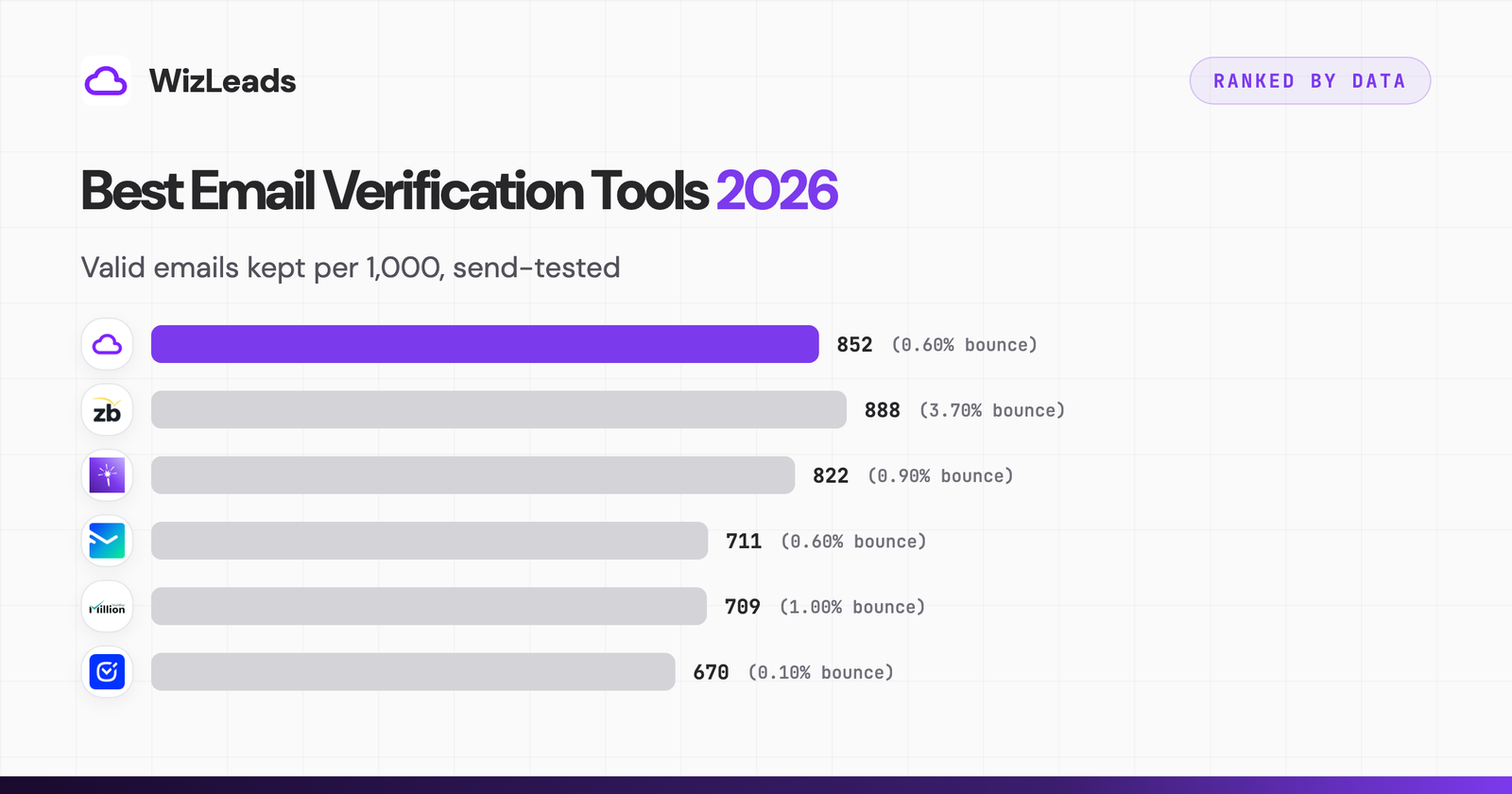
So I tested it myself. I took 1,000 real-estate decision-maker emails from Apollo, ran the exact same list through six verification tools on the same day, and then did the part nobody else does: I sent emails to everything each tool approved and counted the bounces.
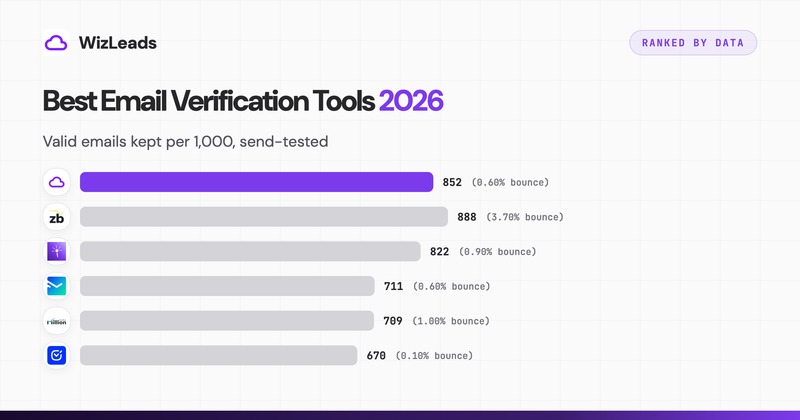
The tools disagreed on nearly a quarter of the list. Real bounce rates ranged from 0.10% to 3.70%. Same input, same day.
The full methodology, charts, and raw data are in the email verification benchmark. This post is the ranking that came out of it, and who should actually pick what.
How I scored it
A verifier can fail you in two directions. It can approve addresses that bounce, which damages your sender reputation. Or it can reject addresses that were deliverable, which quietly deletes leads you paid for. A 0.10% bounce rate achieved by rejecting a third of the list is the second failure wearing the first one's medal.
So the ranking scores both at once: the bounce rate on what each tool approved, and how much of the list it kept. It deliberately ignores dashboards, support quality, and integration counts, except where those change the buying decision, because none of them show up in your deliverability.
The results
| Rank | Tool | Valid kept | Bounces | Bounce rate | Rejected | 10K verification cost |
|---|---|---|---|---|---|---|
| 1 | WizLeads | 852 | 5 | 0.60% | 148 | ~$20 |
| 2 | LeadMagic | 822 | 7 | 0.90% | 178 | ~$49 |
| 3 | NeverBounce | 711 | 4 | 0.60% | 289 | $49 |
| 4 | MillionVerifier | 709 | 7 | 1.00% | 291 | $37 |
| 5 | Debounce | 670 | 1 | 0.10% | 330 | $23 |
| 6 | ZeroBounce | 888 | 33 | 3.70% | 112 | $99 |
1. WizLeads: what I would run
This one is mine. I built it after years of paying verifiers that kept returning "risky" on the exact addresses I needed answers on, so judge it on the numbers, which anyone can re-run from the published raw data.
It kept 852 of 1,000 emails and bounced 5, a 0.60% rate that ties NeverBounce at rank 3 while keeping 141 more usable emails. The gap comes from how it treats catch-all domains. Ask a normal mail server whether a mailbox exists and it answers honestly. A catch-all domain answers yes to every address, including invented ones, and at that point most verifiers return "risky" and hand the decision back to you. WizLeads keeps checking other signals until it can class the address valid or invalid. It also flags when an address sits behind a Secure Email Gateway, a corporate filtering layer such as Proofpoint that makes strict domains look catch-all from the outside, and those domains are where other tools guess wrong most often.
The $39 Freelancer plan covers 20,000 verifications, so 10,000 emails cost about $20, and bigger plans push the per-email price down further. It is API-first with a dashboard, and the same engine powers the email finder I tested separately in the enrichment benchmark.
Pick it for cold email on paid B2B lists, where catch-alls are heavy and every discarded lead is money you already spent.
2. LeadMagic: the Clay-native option
LeadMagic came closest to the top on the tradeoff this ranking scores: 7 bounces on the 822 emails it approved (0.90%), with 178 rejected. Among the tools I do not own, that was the best balance of clean sending and list retention in the test.
It got there by partially resolving catch-alls instead of defaulting every ambiguous address to risky, which is why it kept 111 more emails than NeverBounce at a similar bounce rate. Verification is one endpoint of a wider data platform that also does email finding, mobile numbers, and company data, and the platform plugs natively into Clay, which matters because that is where many enrichment workflows already live. Verification runs about $49 per 10K.
Pick it if your lists are in Clay tables and you want verification inside the same workflow instead of bolted on after.
3. NeverBounce: the integrations play
NeverBounce matched the winning 0.60% bounce rate by rejecting 289 of my 1,000 emails. I sampled those rejects and most were live, working inboxes, so the clean send came at the cost of more than a quarter of the list.
That conservatism fits where NeverBounce actually lives: inside other tools. It has native HubSpot, Salesforce, and Mailchimp connectors, the best n8n node in the category, and a Sync feature that re-verifies your connected lists daily. It costs $49 per 10K, it is owned by ZoomInfo, and two fine-print items are worth knowing before you buy: pay-as-you-go credits expire after 365 days, and reviews since the acquisition complain about pricing. I put the full head-to-head in ZeroBounce vs NeverBounce.
Pick it for warm-list hygiene inside HubSpot or Salesforce, where a discarded lead costs you nothing and a bounce costs you deliverability.
4. MillionVerifier: the budget bulk cleaner
MillionVerifier landed almost exactly where NeverBounce did on the test itself: 709 emails kept, 291 rejected, 7 bounces through for a 1.00% rate.
It ranks here because of what it charges for that result. 10K credits cost $37 to $39, bulk pricing falls to around $0.0004 per check at a million, credits never expire, and catch-all and unknown verdicts are free, which no other tool in this test offers. The limits match the price: it detects catch-alls without resolving them, so on a B2B list a big chunk of your spend comes back as "catch-all, you decide," support took its time when I had questions, and the core API has no webhook.
Pick it for newsletter and marketing-list cleaning at six or seven figures of volume, where losing some valid addresses costs you almost nothing.
5. Debounce: the lowest bounce rate, at a price
Debounce produced the cleanest send in the test, a single bounce across 670 approved emails (0.10%), and paid for it with the highest rejection count: 330 of 1,000. Most of those rejects were deliverable. The tool defaults to no whenever it cannot confirm a mailbox, and on a B2B list that is a lot of defaults.
Standard checks are the cheapest in this ranking at about $23 per 10K, but catch-all resolution burns 10 credits per address, so the B2B lists that most need the help get expensive fast. Results also auto-delete after 7 days, so download them right away.
Pick it if you send from shared IPs with a hard bounce ceiling and your leads are close to free. Skip it if you paid for every row on that list.
6. ZeroBounce: the big brand with the big bounce rate
ZeroBounce approved more emails than any other tool, 888 of 1,000, and 33 of them bounced. That 3.70% rate is six times the bounce rate of the tools at the top of this ranking, and most of it came from Google catch-all domains where ZeroBounce called mailboxes valid that did not exist.
It is also the most expensive tool here at $99 per 10K, and that price buys the things enterprise procurement actually shops for: SOC 2 Type II, ISO 27001, HIPAA, more than 90 integrations, and 13 years of brand history. If your procurement team needs certifications more than your campaigns need accuracy, ZeroBounce is a defensible choice, and plenty of enterprises make it. If you are a cold email operator instead, I wrote up the switch paths in ZeroBounce alternatives.
What actually separates these tools
Every tool here runs the same three checks first. Is the address shaped like an address, does the domain accept mail at all, and does the mail server admit that this specific mailbox exists? On an ordinary company domain, all six tools get the same answers. The separation shows up on the 20 to 30% of B2B addresses that sit on catch-all domains or behind Secure Email Gateways, where that last check comes back ambiguous.
Each tool resolves the ambiguity with a policy, and this ranking is mostly a ranking of those policies. ZeroBounce treats ambiguous as valid, which kept the most addresses and produced 33 bounces. NeverBounce, MillionVerifier, and Debounce treat ambiguous as invalid, which produced clean sends and discarded up to a third of a paid list. WizLeads, and to a partial extent LeadMagic, keep working an ambiguous address with additional signals until it resolves to a real verdict. Which policy costs you least depends on what your list is worth per row. The mechanics behind those signals are in the catch-all verification guide, and the same six tools compared at the API level, endpoints, billing models, and response formats, are in the email verification API comparison.
FAQ
What is the best email verification tool in 2026?
On combined bounce rate and list retention in my send test, with the lowest pricing for catch-all verification: WizLeads (0.60% bounce, 852 of 1,000 kept, ~$20 per 10K). Lowest raw bounce rate: Debounce, if you can accept losing a third of the list.
How accurate are these tools really?
The six tools disagreed on nearly a quarter of the same 1,000 emails. The 99% on the marketing page is an internal metric, not a send-tested one.
What bounce rate should I target?
Under 2%, ideally under 1%. Sustain 5% and Google and Microsoft start filtering you within about two weeks.
Why do tools disagree on the same email?
Catch-alls and SEGs make the mailbox unknowable through SMTP alone, so each tool falls back on a policy: guess valid, guess invalid, or keep resolving with more signals. That policy decides your results, so it is the thing to compare tools on.