WizLeads
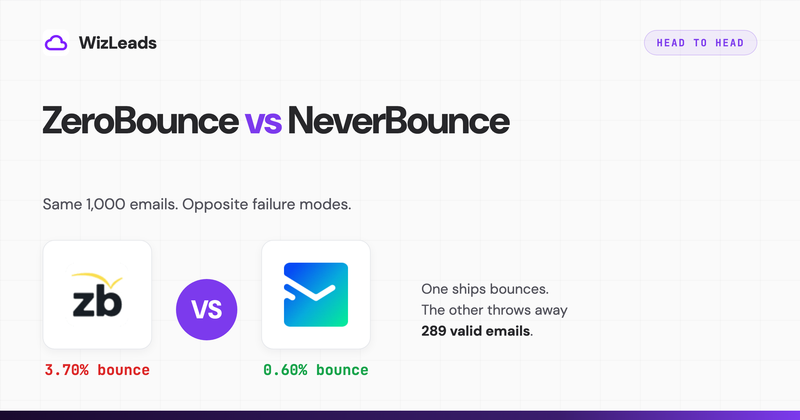

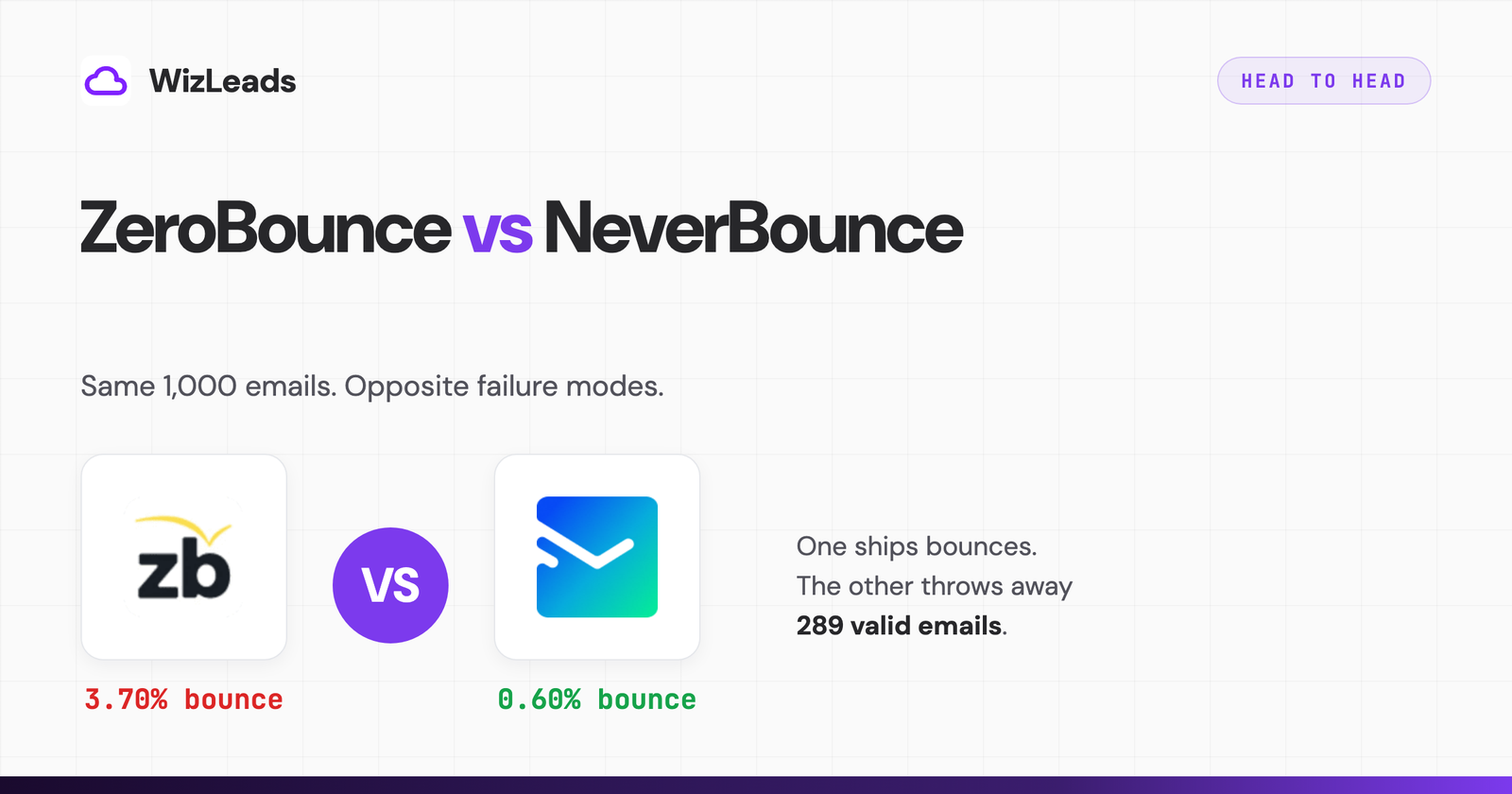
Comparing ZeroBounce vs NeverBounce from their marketing pages is pointless. Both claim 99%+ accuracy. So I tested both on the same 1,000 real-estate decision-maker emails sourced from Apollo, on the same day, then send-tested every approved email to measure real bounces. The two tools failed in exactly opposite directions, and which failure you can live with should decide your pick.
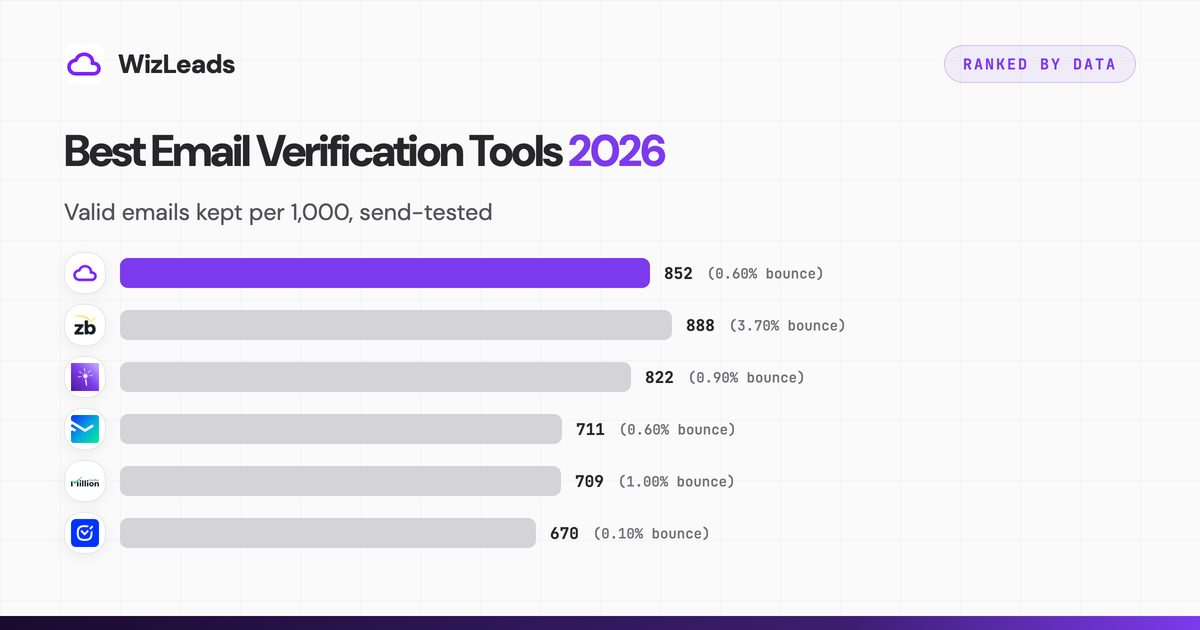
The test included four other verifiers. Full data is in the email verification benchmark.
Head-to-head results
| Metric | ZeroBounce | NeverBounce |
|---|---|---|
| Emails classified valid | 888 | 711 |
| Bounces on send | 33 | 4 |
| Real bounce rate | 3.70% | 0.60% |
| Emails classified invalid | 112 | 289 |
| Cost per 10K verifications | $99 | $49 |
ZeroBounce approved the most emails of any tool in the test and shipped the most bounces. NeverBounce kept bounces to 4, tied for best in the test, by rejecting 289 emails. I sampled those rejects, and most were real, working inboxes.
The chart shows the whole comparison in one look: NeverBounce buys its low bounce rate with a high false-invalid count, ZeroBounce does the reverse, and the lower-left quadrant, where you want your verifier to live, has one tool in it.
The trade-off in plain terms
Every verifier sits somewhere on one axis: approve aggressively and risk bounces, or reject aggressively and throw away pipeline.
ZeroBounce sits at the aggressive-approval end. Its weakness is Google catch-all domains, where the domain accepts mail at the SMTP level but the specific mailbox does not exist. ZeroBounce tends to call these valid, and that is where most of its 33 bounces came from. Allegrow's independent test found the same failure: obviously fake addresses on catch-all domains came back marked valid.
NeverBounce sits at the conservative end. Anything ambiguous, including most catch-alls, gets flagged as Accept All or pushed toward invalid. The result is a clean 0.60% bounce rate and a list that shrank by 29%. If your leads cost $0.20 to $2 each to source, NeverBounce discarded $30 to $300 of usable pipeline per 1,000 emails to save you 29 bounces.
Neither resolves catch-alls to a definitive verdict by default. ZeroBounce offers Verify+, a free add-on that settles catch-alls by sending a real test email to the address; even with it on, Allegrow's test recorded a 33.1% false-positive rate. NeverBounce does not attempt resolution at any price. On B2B lists, catch-alls are the whole game, and I broke down why in the catch-all email verification guide.
Pricing
ZeroBounce: $99/month for 10,000 credits (ZeroBounce ONE), $0.0129 per credit pay-as-you-go. Unused subscription credits roll over and never expire.
NeverBounce: $49/month for 10,000 verifications (Growth plan), or $8 per 1,000 pay-as-you-go dropping to $0.004 per credit at 100K. Pay-as-you-go credits expire after 365 days, a policy added to the fine print in 2024 that generated a wave of negative reviews, including users reporting lost credits worth $1,000.
NeverBounce is half the price at equal volume. Both charge for every verdict, including unknowns.
Beyond the numbers
ZeroBounce strengths: SOC 2 Type II, ISO 27001, and HIPAA compliance, 92+ integrations, 13 years of brand history, and Microsoft GetCredentialType checks for Office 365 mailboxes. For regulated industries it is the safer procurement choice.
NeverBounce strengths: native HubSpot, Salesforce, and Mailchimp connectors, a first-class n8n node, and a Sync feature that re-verifies connected lists daily. It has been owned by ZoomInfo since 2019; post-acquisition reviews cite price increases and slower support.
Both are established products that work as designed. The question is whether the design fits cold outbound on B2B lists, where my data says both leave money on the table: one in bounces, one in discarded leads.
How my own tool did on the same list
WizLeads is mine, so treat this section as a vendor talking and check it against the raw data. On the same 1,000 emails, it classified 852 as valid with 5 bounces (0.60%). That is NeverBounce's bounce rate while keeping 141 more valid emails, and 36 fewer approvals than ZeroBounce with 28 fewer bounces. The difference is catch-all resolution: instead of flagging catch-alls or guessing, it classifies catch-all emails as valid or invalid, and it flags security gateways (Proofpoint, Mimecast, Barracuda) that skew standard SMTP checks. At about $20 per 10,000 verifications on the $39 Freelancer plan, it is also a fifth of ZeroBounce's price.
Full methodology and raw data are in the benchmark if you want to check the numbers. More alternatives, including MillionVerifier and Debounce, are covered in ZeroBounce alternatives and the ranked best email verification tools roundup.
Verdict
Pick NeverBounce if sender reputation is your only constraint, your leads are cheap to replace, and you want native CRM connectors at half of ZeroBounce's price.
Pick ZeroBounce if you need compliance certifications, the widest integration catalog, and can tolerate a higher real bounce rate on catch-all-heavy lists.
Pick neither if you run cold outbound on B2B lists and your leads cost money. On the same 1,000 emails, these two either shipped 33 bounces or threw away 289 valid leads. WizLeads, my own tool, avoided both failures by resolving catch-alls to a real verdict: 852 emails kept, 5 bounces, a 0.60% rate, at about $20 per 10,000 verifications. The full breakdown is in the section above, and the raw data is in the benchmark if you want to pressure-test it before trusting a vendor's own comparison page.
FAQ
Is ZeroBounce or NeverBounce better?
They fail in opposite directions. ZeroBounce: 888 approved, 33 bounced (3.70%). NeverBounce: 711 approved, 4 bounced (0.60%), 289 rejected. Choose based on whether a bounce or a lost lead costs you more.
Which is cheaper?
NeverBounce, at $49 vs $99 for 10,000 verifications. Watch the 365-day credit expiration on NeverBounce pay-as-you-go.
How do they handle catch-all emails?
ZeroBounce flags them and offers Verify+, a free add-on that send-tests those addresses. NeverBounce flags them and offers no resolution. Neither gives a definitive verdict by default.
What were the real bounce rates?
ZeroBounce 3.70%, NeverBounce 0.60%, on the same send-tested 1,000-email list (April 2026).