WizLeads

Most ZeroBounce alternative roundups are written by people who never verified a single email with any of the tools. I took 1,000 real B2B emails, ran them through ZeroBounce and five alternatives on the same day, then actually sent emails to see what bounced. If you are looking for a ZeroBounce alternative because of catch-all mistakes or pricing, the numbers below show you exactly what each tool gets right and what it gets wrong.
Full methodology and raw data live in my email verification benchmark.
The scoreboard
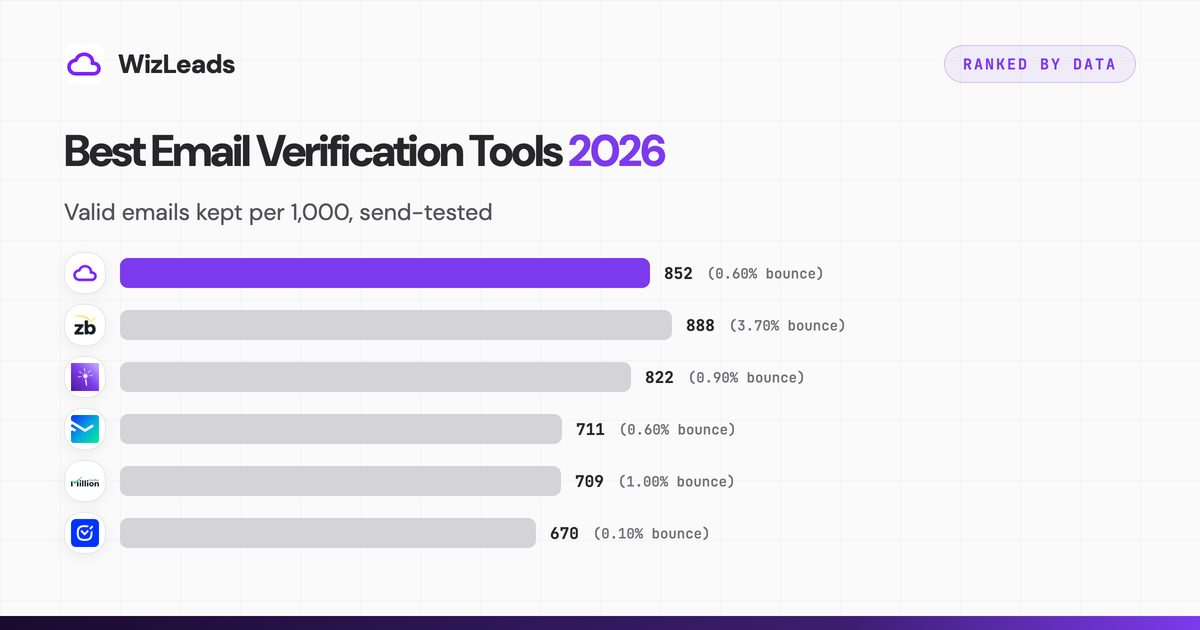
| Provider | Marked valid | Bounces when sent | Bounce rate | Marked invalid | Cost per 10K verifications |
|---|---|---|---|---|---|
| WizLeads | 852 | 5 | 0.60% | 148 | ~$20 |
| ZeroBounce | 888 | 33 | 3.70% | 112 | $99 |
| LeadMagic | 822 | 7 | 0.90% | 178 | ~$49 |
| NeverBounce | 711 | 4 | 0.60% | 289 | $49 |
| MillionVerifier | 709 | 7 | 1.00% | 291 | $37 |
| Debounce | 670 | 1 | 0.10% | 330 | $23 |
A verification tool can fail you in two ways. It can say "this email is fine" when it is not, and you get bounces that hurt your sender reputation. Or it can say "this email is bad" when it is actually fine, and you quietly lose leads you paid for. ZeroBounce fails the first way: it approved more emails than anyone, but 33 of them bounced. That is 6 times more bounces than the best tools in this test.
Why people leave ZeroBounce
1. It gets catch-all emails wrong
A catch-all domain accepts mail for any address, even ones that do not exist. ZeroBounce often marks these as valid anyway. On my list, that caused most of its 33 bounces.
I am not the only one who found this. Allegrow ran an independent test on 1,222 real and fake contacts, and ZeroBounce marked obviously fake addresses like hermione.granger@ a real company domain as valid. In their test, ZeroBounce showed an 8% false positive rate and missed 30% of real contacts.
ZeroBounce does offer a fix called Verify+. It is a free optional add-on that tries to resolve catch-all and disabled Yahoo, AOL, and Verizon addresses. Worth knowing before you turn it on: it works by sending an actual email to the address to see if it bounces. And in Allegrow's test, even Verify+ marked one in three fake emails as valid. Since it is free, verifying 10,000 emails with catch-all checking still costs the normal $99 monthly plan price.
If your lists are B2B, catch-alls are where campaigns live or die, and about one in five B2B emails sits on one. I explain how this works in plain terms in my catch-all email verification guide.
2. Price
ZeroBounce ONE costs $99 a month for 10,000 credits. Every alternative on this list verifies the same 10,000 emails for $20 to $50. One thing ZeroBounce does get right here: unused subscription credits roll over to the next month and never expire, so you do not lose what you paid for.
ZeroBounce also has real strengths worth naming: the strongest compliance certifications in the category (SOC 2 Type II, ISO 27001, HIPAA), more than 90 integrations, and 13 years of brand history. If you are a large company that needs certifications more than cold-list accuracy, it is still a reasonable pick.
The alternatives
1. WizLeads
WizLeads is my own product, so judge this section by the test numbers, which anyone can re-run from the published data. It had the best overall result in the test: only 5 bounces out of 852 approved emails (0.60%), while keeping more usable emails than any other tool. The reason is simple. Instead of guessing on catch-all emails or handing the problem back to you, WizLeads classifies catch-all emails as valid or invalid. It also tells you when an email sits behind a security gateway like Proofpoint or Mimecast, which no other tool in this test does.
Pricing is easy to understand: the Freelancer plan is $39 a month and covers 20,000 verifications. That works out to about $20 per 10,000 emails, a fifth of ZeroBounce's price. Bigger plans bring the price per email down further by a lot. Verification is available on its own through the API and the dashboard, or bundled with Sales Navigator scraping and email finding.
2. MillionVerifier
MillionVerifier is the budget pick: $37 to $39 for 10,000 credits, and the price drops fast at higher volumes. Credits never expire, and you are not charged for catch-all or unknown results, however they do not further classify catch-alls as valid or invalid.
It buys that price by playing it safe. It marked only 709 of my 1,000 emails as valid and rejected 291, roughly twice as many rejections as the least strict tools, and 7 of its approved emails still bounced. It also detects catch-all emails but does not resolve them: you are told "this is a catch-all" and the decision is left to you. Good for cleaning big newsletter lists on a budget. Costly for cold email teams who paid for every lead.
3. NeverBounce
NeverBounce had one of the lowest bounce rates in the test, just 4 bounces, and it got there by rejecting 289 of the 1,000 emails as bad. Most of those were real, working inboxes. In plain terms, NeverBounce protected your sender reputation by throwing away more than a quarter of your lead list.
It is owned by ZoomInfo, and reviews since the acquisition mention price increases and a rule where pay-as-you-go credits expire after 365 days. On the plus side, it has the best ready-made integrations of the group: HubSpot, Salesforce, Mailchimp, and a first-class n8n node. I ran the full head-to-head in ZeroBounce vs NeverBounce.
Pick it if your lists are warm and cheap to replace. Skip it if losing leads hurts more than a rare bounce.
4. Debounce
Debounce had the lowest bounce rate in the whole test, 1 bounce out of 670 approved emails, and it paid for that by rejecting 330 of the 1,000. If you used it on this list, you would be throwing away a third of your qualified leads, most of which were perfectly good, simply because Debounce could not confirm them and played it safe.
Standard verification is cheap at $23 per 10,000. But resolving a catch-all email costs 10 credits instead of 1, so a typical B2B list gets expensive quickly. Your results also auto-delete after 7 days, so download them right away.
Pick it if you send from shared IPs with strict bounce limits and your leads cost you little to nothing. Skip it if every lead on your list cost money to find.
5. LeadMagic
LeadMagic's appeal starts outside verification. It is a data platform that does email finding, mobile number finding, and company data alongside verification, all with a native Clay integration, so if you build lead lists inside Clay tables, LeadMagic slots right in. The pricing however is ~$49 for 10,000 verifications.
On verification, it did well in the test: 7 bounces out of 822 approved emails (0.90%), and it rejected far fewer good emails than NeverBounce or Debounce. On email finding, I tested it too: in my enrichment benchmark on 1,000 identical leads, LeadMagic found 464 emails that passed verification, while WizLeads found 670 on the same list. That is 206 more usable emails per 1,000 leads. So it is a solid all-round platform, with room to grow on find rates.
Also worth knowing: BounceBan
BounceBan was not in my test, so I have no send-tested numbers for it. It focuses specifically on catch-all verification, charges only when a verification succeeds, and prices 10,000 checks at roughly $34 to $40. Reviewers note that hard catch-all domains can take 1 to 6 minutes each to check. I plan to include it in the next benchmark round.
How to choose
Ask yourself one question: what costs you more, a bounce or a lost lead?
If a bounce costs more (you send from shared IPs, or your email platform has strict bounce limits), use a strict tool like Debounce or NeverBounce and accept that you will lose some good leads.
If a lost lead costs more (you run cold outreach and pay to source every contact), you need a tool that can actually make a decision on catch-all emails instead of guessing or giving up. That was the exact scenario in my test, where ZeroBounce shipped 33 bounces and the strict tools threw away up to a third of the list. WizLeads kept the most usable leads at the lowest bounce rate, which is exactly what I built it for.
For a wider look at every option, see the ranked list of the best email verification tools.
FAQ
What is the best alternative to ZeroBounce?
Depends on what a mistake costs you. WizLeads had the best overall test result (852 emails kept, 0.60% bounce rate, about $20 per 10,000). Debounce had the lowest bounce rate but threw away a third of the list.
Why do people switch away from ZeroBounce?
Two reasons keep coming up: catch-all emails getting marked valid when they are not (33 bounces in my test), and price (about 5 times more per verification than most alternatives).
Is ZeroBounce accurate on catch-all domains?
It is the weakest part of the product. Both my test and Allegrow's independent test found catch-all emails being marked valid when the inbox did not exist.
Which alternative is cheapest?
For 10,000 verifications: WizLeads about $20, Debounce $23, MillionVerifier $37 to $39, NeverBounce $49, ZeroBounce $99. But also check how many good emails each tool rejects. A cheap tool that throws away a third of your leads is the most expensive tool on this list.