WizLeads


TL;DR
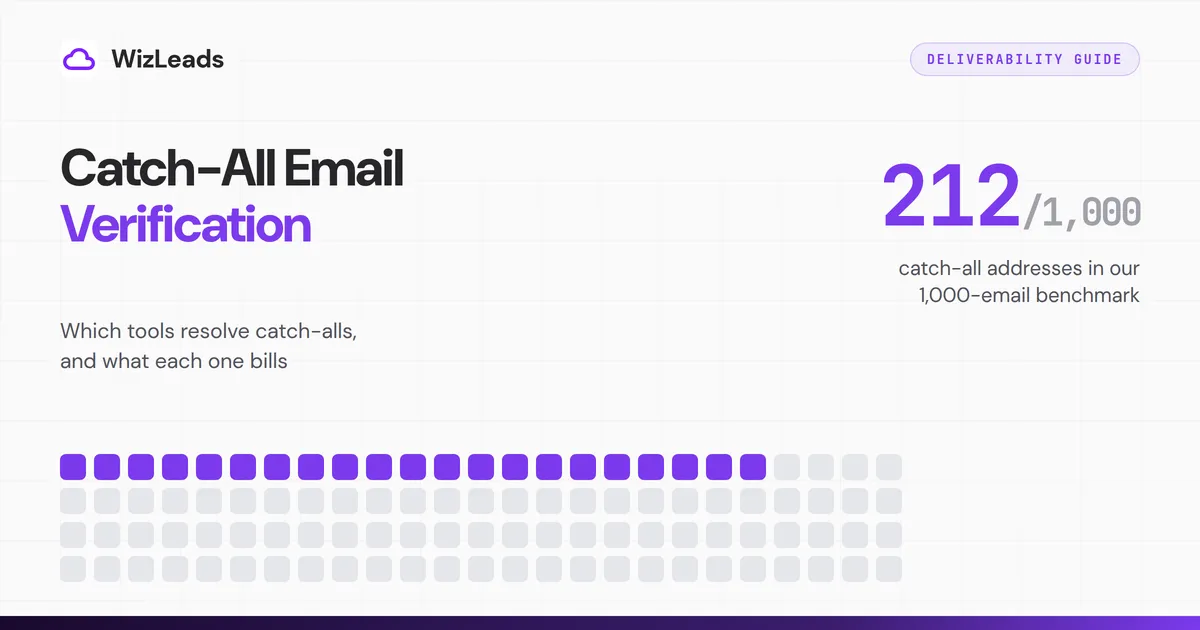
Catch-all email verification gives a verdict for some addresses and only a label for the rest, and the verdicts differ in how often they hold up. In our test of 1,000 real-estate decision-maker emails from Apollo, 212 were catch-all. When we mailed the approvals, WizLeads had approved 160 of them with no failures, ZeroBounce 200 with 26 failures and LeadMagic fewer with 2, while NeverBounce, MillionVerifier and DeBounce mostly flagged them without a verdict. Billing differs as much as the results: some tools charge for a catch-all result, some do not, and DeBounce charges extra to resolve one.
Your export has rows marked catch-all or accept-all, and you have to decide what to do with them. Drop them and you lose contacts you paid to find. Mail them and some will bounce. What matters is what each tool does with those rows, and what it charges to find out.
What six verifiers did with our catch-all addresses
We took 1,000 real-estate decision-maker emails, sourced from Apollo in April 2026, and sent the same CSV to six verifiers on the same day. Then we mailed every address that at least one tool approved, which reached 202 of the catch-alls, and counted a failure when an address bounced or drew a reply saying the mailbox does not exist.
The 212 is the benchmark's Catchall column. That flag comes from WizLeads' verifier, which classifies catch-all emails as valid or invalid.
| Tool, on the catch-all group | Approved | Flagged, no verdict | Rejected | Failed on send |
|---|---|---|---|---|
| WizLeads | 160 | 0 | 52 | 0 of 160 |
| ZeroBounce | 200 | 0 | 12 | 26 of 200 (13.0%) |
| LeadMagic | 137 | 0 | 75 | 2 of 137 (1.5%) |
| NeverBounce | 69 | 143 (132 catchall, 11 unknown) | 0 | 1 of 69 |
| MillionVerifier | 25 | 176 (169 catch_all, 7 unknown) | 11 | 1 of 25 |
| DeBounce (standard check) | 4 | 200 (197 Accept All, 3 Unreachable) | 8 | 0 of 4 |
The two verdict tools split on the addresses WizLeads rejected. ZeroBounce approved 42 of them, and we mailed all 42. Sixteen went through and the rest failed, which accounts for every ZeroBounce failure in the group. Of those failed addresses, 21 sat on Google-hosted domains, as did 83 of ZeroBounce's approvals in the group.
Outside the catch-alls, ZeroBounce was far steadier: it failed 7 of 688 approvals, or 1.0%. LeadMagic sat close to WizLeads, with the same verdict on 185 addresses in the group.
WizLeads' caution has a cost. On the whole list it kept 852 addresses to ZeroBounce's 888, with a bounce rate of 0.59% against 3.72%. The full six-tool benchmark has every tool.
DeBounce ran its standard check only, without its paid catch-all step.
These are counts on one list from one industry, and the catch-all group is WizLeads' own reading of that list, so the other five tools were judged on the addresses it picked out. Published catch-all shares vary widely from one source to the next, so your list may look quite different.
Why can't a plain check verify a catch-all address?
Because the server says yes to every address. A verifier asks the receiving server whether a recipient exists. On a catch-all domain the server accepts the real mailbox and asdf123@ in the same way, so its answer says nothing about either.
That yes only means the server will take the message. Any trouble shows up later, as a bounce or as mail nobody reads. A catch-all verifier therefore needs some signal beyond the server's answer.
How vendors say they resolve catch-alls
Few vendors explain their method. Practitioners in an r/gtmengineering thread guess that the answers come from bounce history across a vendor's customers plus SMTP timing. Among vendors, ZeroBounce says its Verify+ add-on sends a real email, while BounceBan says it resolves catch-alls without sending any message.
Clearout markets a Deep Verify mode for catch-all-heavy domains. Truelist sells an enhanced catch-all step for extra credits. MillionVerifier's homepage advertises catch-all verification at no extra cost. Our run did not cover that claim, and Truelist, Clearout and BounceBan were not in it, so there is no send data here on their catch-all steps.
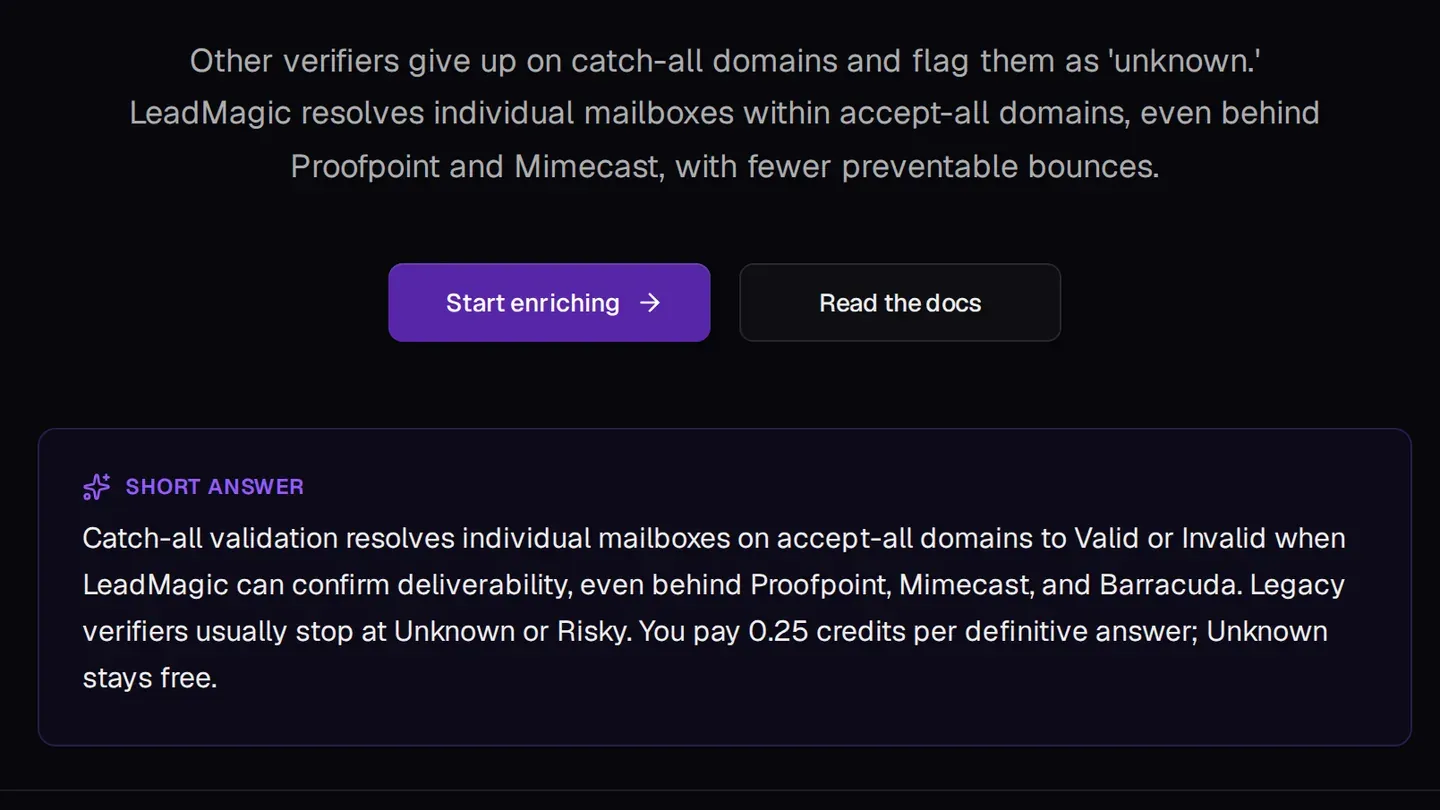
LeadMagic's catch-all page says it resolves catch-all addresses to valid or invalid, charges 0.25 credit per definitive answer and keeps Unknown free. The same page says its method is not disclosed.
ZeroBounce's FAQ says it can validate many catch-all addresses during standard validation, across Google Workspace, Microsoft 365 and major Secure Email Gateway providers. Addresses it cannot resolve stay classified as catch-all. Its status-code documentation disagrees, and still says catch-all addresses are "impossible to validate without sending a real email and waiting for a bounce." The Verify+ page calls the add-on optional, and says that during validation "we send an email to check for bounces."
The same FAQ warns against assuming every unresolved catch-all is invalid. It adds that sending to an unconfirmed address carries more risk than sending to one it validated as valid, and suggests keeping unresolved catch-alls in a separate segment.
What each tool charges for a catch-all result
Most verifiers bill a catch-all result like any other answer. They differ on what a non-answer costs and on what a resolving step adds. As of October 2026, the six tools in our run bill like this:
| Tool | Catch-all result | Unknown result | What resolving adds |
|---|---|---|---|
| ZeroBounce | Billed, one credit per result | Not charged | Standard validation may return a verdict. Verify+ is free but sends an email. Scoring is a second credit |
| NeverBounce | 1 credit = 1 verification, no exception stated | No exception stated | Nothing |
| DeBounce | One credit for the standard check | No exception stated | Optional catch-all validation, 10 additional credits per catch-all address |
| MillionVerifier | Not charged | Not charged | Included, per its help page |
| LeadMagic | Charged only on a definitive answer | Not charged | The same meter |
| WizLeads | 0.5 credit, every email, every result | Charged the same | None. Valid or invalid on every address in our run |
ZeroBounce's rule comes from its pricing page FAQ:
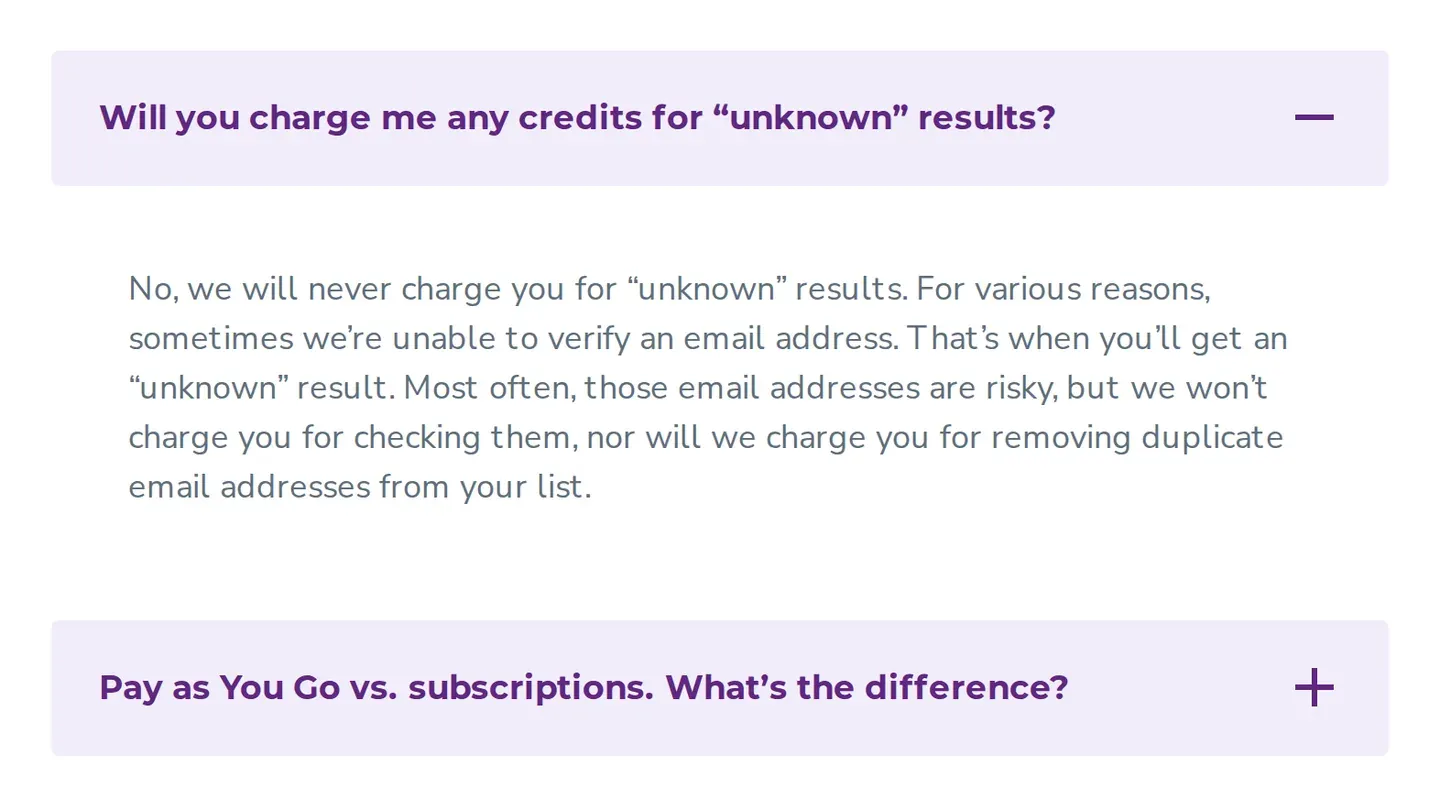
Its score is a separate charge. ZeroBounce says the score does not decide valid or invalid, so validating and scoring one address costs two credits. Its Email Finder runs on a separate meter, 20 credits per valid result and one credit for a catch-all domain, so do not use that rate to price validation.
DeBounce's billing help says the catch-all step is optional and runs only on addresses its standard check detected as catch-all, so you choose which part of a list pays for it.
NeverBounce's rule is in its billing help. Its guarantee page refunds the difference when more than 3% of a cleaned list bounces, but only for addresses NeverBounce categorised as deliverable. Invalid, accept all, unknown and disposable results are outside it.
MillionVerifier's treatment rests on its help page, but its terms call that treatment a "discretionary promotional goodwill programme" that it can withdraw. Price a project as if it could end.
The cost of resolving catch-alls on 10,000 addresses
DeBounce flagged 20.1% of our addresses as Accept All. On a 10,000-address list shaped like ours, that share gives 2,010 catch-alls. Standard validation costs 10,000 credits, and the paid step adds 20,100 more (2,010 at 10 credits each), for 30,100 in all, or 3.01 times as many.
For WizLeads, the Freelancer plan is $39 a month for 10,000 credits. That covers 20,000 verifications, so the same list uses 5,000 credits and costs $19.50 pro-rata. A credit costs a different amount at each vendor, so compare dollars, not credits. Our per-10,000 price ladder gives the dollar price for every verifier in the table.
Verify+ runs only when the first pass finds at least 10 catch-all addresses, and can take up to 12 hours.
How to verify catch-all emails: six steps
- Run the list and split it by result. Put valid, invalid, catch-all and unknown results in separate files. Do not mail the export as it comes out of the tool.
- Keep a holdout of your own catch-alls. Hold back a set whose outcomes you know and judge each tool's verdicts against it. A commenter in the r/gtmengineering thread gives the reason: a score only helps if it predicts your own bounces. WizLeads' free tier is 500 credits, given once, which covers 1,000 verifications.
- Send the valid verdicts normally. On a catch-all address, a valid verdict is still the tool's reading, so watch how the first batch does.
- Segment what stays unresolved. In an r/Coldemailing thread, senders describe keeping catch-alls in a segment of their own. They mail 50 to 100 first, stop when bounces get close to 2%, and send from separate mailboxes or a separate domain. One poster's 96-email pilot included 34 leads their verifier had marked accept-all, and 5 of those bounced.
- Do not read every bounce as a bad address. A bounce can come from the sender's reputation or a technical fault, and NeverBounce's guarantee excludes both. Read the bounce message before you remove the address.
- Verify again before each campaign. A verdict describes the address on the day of the check. Run last quarter's export through the tool again before you mail it.
If a status label in the export is unfamiliar, our guide to what each verification status means lists them.
Bounce limits when you send to catch-alls
No mailbox provider publishes a bounce threshold. The limits that exist are written into the contracts of sending platforms. Postmark's Servers FAQ says it requires you to keep your bounce rate below 10% and your spam complaint rate below 0.1%.
Google's published line is for spam rate, a different metric. Its email sender guidelines ask senders to keep the spam rate reported in Postmaster Tools below 0.10% and never to reach 0.30% or higher. The stop line that practitioners mention is advice, not an enforced limit, and our bounce-rate guide sets out where Mailgun and Amazon SES draw theirs.
Should you pay for a catch-all verdict?
It depends on what you can do with the rows that stay unresolved. If you can mail them in a small batch from spare mailboxes, a flag-only tool is enough. If you need those contacts and cannot risk your main mailboxes, pay for a verdict.
Even then, verdict tools disagree on the same addresses, and the one that approves the most is not the one that bounces the least. Before you trust any of them with a full list, run 100 of your own catch-alls through two tools, mail the approvals in a small batch, and see whose approvals fail.