WizLeads


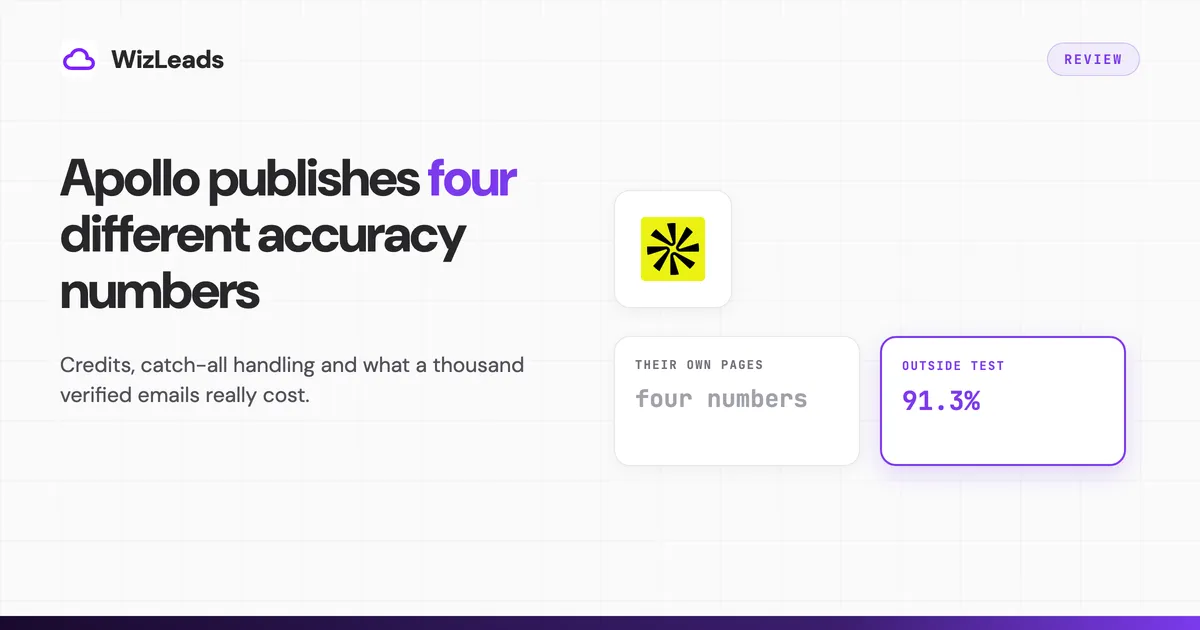
Apollo's Email Finder page states a 98% email accuracy rate. Four other Apollo pages describing the same verification process state 97%, 91%, 91% and "more than 90%" alongside an 84% match rate. All five were live on the same day. The largest public third-party test that included Apollo measured 91.3% accuracy on 5,000 contacts, which lands on Apollo's support documentation rather than on its marketing.
We build in this category, and Apollo was not one of the seven finders in our 1,000-lead enrichment benchmark, so there is no measured Apollo find rate on this page and we are not implying one. What we have is 1,000 addresses exported from Apollo in April 2026 and put in front of six verification tools on the same day, plus every price below read off Apollo's own pages on 8 September 2026.
What Apollo's email finder actually is
Apollo sells a sales platform and the email finder is one surface of it. You reach the same data three ways: People search inside the app, the Chrome extension on a LinkedIn profile or a Sales Navigator list, and bulk enrichment through CSV, CRM sync or the API. The standalone Email Finder page on apollo.io is a front door to that database rather than a separate product.
The shape of that database decides what any accuracy number means. Apollo's Email Finder page describes 128 million business and personal emails and 35 million companies, built from a network of over two million data contributors, with over 230 million records processed monthly from third-party providers. Contributors are Apollo users: connect a mailbox, calendar, CRM or CSV and Apollo's documentation says it may use automated algorithms to extract business contact information from that connection and add verified, non-matching records to the shared pool.
Ask a pure finder for an address and it builds candidates from the name and the domain, then tests them. Ask Apollo and it looks up what the network already holds for that person, then tests that. Recall is what buys Apollo its coverage and its price, and it also means every record carries an age you cannot see. Opting out of the pool is a plan decision rather than a setting: Apollo's documentation says Free, Basic and Professional accounts include that sharing unless otherwise agreed, and points Organization customers at their account manager.
Apollo publishes four different accuracy numbers
Five Apollo pages describe the accuracy of the same seven-step verification process. They carry four different figures, and all five were live on 8 September 2026.
| Apollo page | Figure | Wording |
|---|---|---|
| apollo.io/tools/email-finder | 98% | "delivering a 98% email accuracy rate" |
| apollo.io/insights, which prospecting tool has the most accurate data | 97% | "Apollo delivers 97% email accuracy" |
| apollo.io/magazine, how to find an email address | 91% | "With a 91% accuracy rate" |
| knowledge.apollo.io, How Apollo Verifies Emails | 91% | "a built-in email verification process with a 91% accuracy rate", and elsewhere "Apollo's 9% bounce rate" |
| knowledge.apollo.io, Email Status Overview | 84% match, >90% accuracy | "verified emails maintain an email match rate of 84% and an accuracy rate of more than 90%" |
The split is clean: marketing pages carry the high figures, support documentation carries the low one, seven points apart. Competing articles on this query that name a figure at all quote 91% as "Apollo's claim", and none of them checks the other four.
The last row is the useful one, because it separates the two things a sender cares about. Match rate is how often Apollo returns an address for a contact you asked about. Accuracy is how often that address is real. Run 1,000 contacts through both figures and you get roughly 840 addresses back, of which up to about 84 are wrong. That is a different promise from a flat 98%, and it is the one Apollo makes in the document its support team links to.
Apollo attributes part of that 9% to blocked senders, full mailboxes, unresponsive servers and your own domain reputation, and says invalid addresses are a small portion of it. Bounce attribution is fair to raise, and it is still a claim about its own error rate published without the test behind it.
An outside test put Apollo at 91.3%
Anymail Finder ran 14 email finders against the same 5,000 B2B contacts on 19 June 2026, sourced from Sales Navigator across the US, UK, France and Germany, and had every returned address rechecked by BounceBan, ZeroBounce and MillionVerifier on a two-of-three consensus, except the 36 percent of contacts on catch-all domains, which BounceBan adjudicated alone. Apollo came out at 68.1% coverage, 6.5% false positives and 91.3% accuracy.
Anymail Finder competes with Apollo and ranked itself first on its own combined score, a conflict it discloses, weighed against publishing its dataset and its method. It also states that this "was not a live-send test", so a false positive there is an address the verifier panel rejected rather than one that bounced.
The arithmetic survives both caveats. An outside panel measured 91.3% and Apollo's support documentation says 91%, within half a point of each other. When a vendor's help centre and an unfriendly third party agree on a number, plan around that number.
Coverage gets quoted far less often and costs more. At 68.1%, roughly one contact in three came back with no address at all. Accuracy describes the addresses you got and says nothing about the ones you did not, which is why a 98% headline reads as a promise about your list when it is a claim about Apollo's hit set.
Apollo published a test protocol and never scored itself against it
Apollo's own page on evaluating data vendors opens by saying that asking which prospecting tool has the most accurate data is the wrong question, and that the right one is "accurate for which fields, for which ICP, verified how". It then hands you a scorecard. For work email the test is a deliverability rate on a 200-record sample, the pass threshold is 90% or better, and the whole thing sits inside a 30-day bake-off that pulls 200 contacts per tool against your exact ICP.
It is a sound protocol, and Apollo publishes no score of its own against it. The closest anyone has come is Salesforge, an Apollo competitor, which exported 100 Apollo-verified contacts, had 27 flagged by a second verifier and then watched 6 of the remainder hard-bounce.
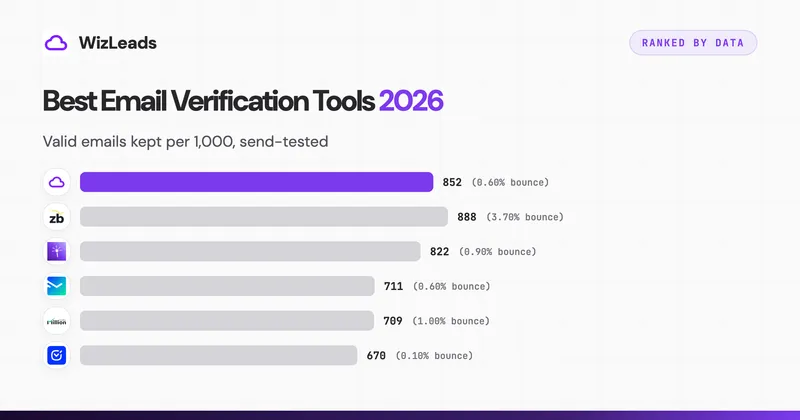
Our enrichment benchmark covered seven finders and Apollo was not among them, so the find-rate half of that scorecard stays blank here. The deliverability half we can fill at five times Apollo's suggested sample. The source list for our email verification benchmark was 1,000 real-estate decision-maker addresses exported from Apollo in April 2026, and we put that identical CSV through six verification tools inside a two-hour window, then sent to whatever each tool kept and counted the bounces.
| Verifier | Kept as valid | Rejected | Bounces on send | Bounce rate |
|---|---|---|---|---|
| ZeroBounce | 888 | 112 | 33 | 3.72% |
| WizLeads | 852 | 148 | 5 | 0.59% |
| LeadMagic | 822 | 178 | 7 | 0.85% |
| NeverBounce | 711 | 289 | 4 | 0.56% |
| MillionVerifier | 709 | 291 | 7 | 0.99% |
| Debounce | 670 | 330 | 1 | 0.15% |
Every send went to one tool's approved list rather than to all 1,000 addresses, which means the table measures verifier disagreement and not an Apollo deliverability rate. The disagreement is large. Six tools read the same Apollo export and could not agree about between 112 and 330 of its 1,000 addresses. The list held 212 catch-all domains, and 159 of the 1,000, or 15.9%, sat behind a Secure Email Gateway. Whatever label the Apollo interface put on those contacts, a third of them arrived in a state where independent verifiers reached opposite verdicts, and the cost of guessing wrong lands on your sending domain rather than your invoice.
The finder side has the same shape. Our enrichment benchmark ran 1,000 identical leads through seven tools and got verified-valid returns from 259 at the bottom to 670 at the top, a 2.6x gap on the same input on the same day, with find rates from 25.9% to 67.0%.
Catch-all is where the accuracy claim and your bounce log separate
One design choice explains most of the gap between Apollo's number and a verifier's number. Apollo says its contributor network lets it see whether an address on a catch-all domain has carried real traffic, so it marks that address verified where an SMTP check cannot, and its documentation says third-party tools flag valid Apollo emails as unverifiable precisely because those addresses sit on catch-all domains.
The claim is plausible, and Apollo bills on it. Its Email Status Overview prices a catch-all result at 1 credit per contact, the same as a fully verified one, so you pay full price for the class of address other tools decline to score. Where the network holds traffic evidence for that mailbox the credit is well spent. Where the evidence is thin you bought a coin flip at list price.
On our Apollo export, 212 of 1,000 addresses were catch-all. The three verifiers that decline to resolve catch-all rejected 289, 291 and 330 addresses. The three that do resolve it rejected 112, 148 and 178. That is a gap of between 111 and 218 contacts per thousand between the strictest and the most permissive tool. Those are total rejection counts rather than catch-all-only ones, so catch-all policy explains part of the spread rather than all of it, but it is the largest single source of disagreement in the test. Sending from Apollo without a second opinion accepts Apollo's call on every contact in that band. Our write-up on catch-all email verification covers how the resolution works.
What Apollo charges and what a credit buys
Apollo's pricing page opens on the annual toggle, which is why competing roundups disagree about what the same plans cost. Both views, read off apollo.io/pricing on 8 September 2026:
| Plan | Annual billing, per seat per month | Credits on annual | Monthly billing, per seat per month | Credits on monthly |
|---|---|---|---|---|
| Free | $0 | 900 per seat per year, released monthly | $0 | 75 per seat per month |
| Basic | $49 | 30,000 per seat per year, upfront | $65 | 2,500 per seat per month |
| Professional | $79 | 48,000 per seat per year, upfront | $99 | 4,000 per seat per month |
| Organization | $119, minimum 3 seats | 72,000 per seat per year, upfront | $149, shown as Annual Only | 6,000 per seat per month |
Annual and monthly grant the same credits, so this is a straight price comparison. Apollo's toggle advertises "Save 24%", which holds for Basic, where $49 against $65 is 24.6%. Professional and Organization save 20.2% and 20.1%. What actually changes is timing: annual releases the whole year upfront, so you can spend twelve months of credits in week one and then wait.
An email costs 1 credit. Basic on annual billing is $588 a year for 30,000 emails, about $19.60 per 1,000, against $26.00 on monthly. Professional lands at $19.75 and $24.75. Organization is $19.83 per 1,000 but starts at three seats, so $4,284 a year before you send anything.
Apollo's rate card puts a phone number at 8 credits, data enrichment at 1 to 8, an AI research run at 1 and the US dialer at 2 credits a minute. The FAQ lower down the same page says enrichment uses "up to 9 credits per record", so the page contradicts itself by one credit. Budget on the higher figure.
The API prices differently again. Apollo's developer documentation puts waterfall email enrichment at 1 to 4 credits typically, reaching 20 or more on some vendor configurations, and waterfall mobile at 8 to 25, reaching 45 or more. It also says some waterfall vendors consume credits per lookup even when no data is found, which is the opposite of the in-app behaviour below.
Which Apollo actions do not cost credits
Apollo's Email Status Overview is specific here, and more generous than most of the category.
- Contacts with the Unavailable status, meaning no known valid email, consume no email credits.
- Uploading contacts or editing a saved email costs nothing. Asking Apollo to verify an address you amended costs 1 credit.
- User managed emails brought in from a CRM or CSV cost nothing unless you enrich them.
- If an Apollo-verified email bounces within 30 days of purchase, Apollo refunds the credit automatically.
Export credits are a separate line in Apollo's credit usage taxonomy, spent when you push records out to a CSV or a CRM. Apollo's documentation says they "may only apply to certain plans or legacy configurations", so whether you pay twice for the same contact depends on a plan detail Apollo does not publish. Ask support before you commit to a seat count.
Running out mid-month is where the real cost sits. Apollo sells add-on credits but publishes no rate for them: you see the price only once you are signed in and looking at your own account. What Apollo does state is the term, and it is the unfriendly one. Add-on credits expire at the end of the billing cycle they were bought in and do not roll over, so a top-up bought to finish one campaign is worth nothing the following month. Budget the plan for your real monthly volume rather than planning to top up.
Mobile draws on the same pool as everything else. Apollo prices a phone number at 8 credits, so a plan sized in credits rather than in contacts will empty faster than you expect the moment you start revealing numbers: 1,000 phone reveals is 8,000 credits. The one place the pools do split is waterfall enrichment, where Apollo says waterfall email and waterfall mobile "use separate credit balances". Apollo publishes no per-plan mobile allowance, so plan for the 8-credit unit rather than looking for a mobile quota.
What the free plan actually gives you
Apollo's free tier grants 900 credits per seat per year, released monthly. That is 75 emails a month. Three other limits do more damage than the credit count:
- Record selection limit of 25. Apollo's own FAQ spells out the consequence: saving 10,000 leads means clicking a 25-record select button 2,000 times.
- 250 daily sends from one mailbox. Basic carries the same ceiling and the same single-mailbox limit, which catches people who upgraded for the credits.
- Two sequences per team, and a mailbox restriction Apollo states two ways. The pricing FAQ says non-paying accounts can connect only Gmail addresses, while the comparison table below it lists Free as Gmail and Microsoft.
Apollo's own pages disagree about what the 14-day trial includes: its pricing page has shown both 100 credits and 50 credits plus 5 mobile credits for trial plans, while its help centre promises only a limited number of free credits and caps phone reveals at 20. Check what your signup actually grants rather than planning against either number. Apollo still has a free plan, but any advice describing it as the best zero-budget contact database is describing an allowance that no longer exists: it now grants 900 credits a year, released monthly, rather than the monthly allotment those write-ups assume.
Who should use Apollo as their email finder
The criterion is cost per usable address delivered into a sequencer, including whatever second pass you have to run.
Use Apollo as your finder if you sell to US mid-market, your volume fits inside one or two seats, and you already re-verify before send. At roughly $19.60 per 1,000 on Basic annual the unit cost is competitive for a database-plus-sequencer bundle, and the filters plus the sequencer in one login remove real coordination work.
Do not rely on Apollo alone if you send at volume onto domains you cannot afford to burn, because 91% accuracy on the addresses returned leaves roughly 9 in every 100 to be caught somewhere else. The same holds for EU coverage until you have tested your own ICP, and for any team whose data governance cannot accommodate contributor-network sharing.
If Apollo covers your list but not your accuracy bar, a second pass fixes it and a migration does not.
Running an Apollo export without hurting your domain
Four steps, in the order they save you the most money.
- Set the catch-all toggle before you spend a credit. The email status filter includes or excludes catch-all at search time, which is cheaper than spending a credit and rejecting the result afterwards.
- Segregate catch-all into its own send. A separate sequence from a separate domain contains the damage if Apollo's traffic evidence is stale on that batch.
- Re-verify before the list reaches a sequencer. On our Apollo export the choice of verifier moved the bounce rate between 0.15% and 3.72%, which is the widest spread we measured on a single decision in this workflow.
- Track bounce rate by source rather than in aggregate. If Apollo-sourced sends stay high after a clean verification pass, the source is the problem and seat count is the wrong lever.
The second pass is cheap against the credits you already spent. Verification on WizLeads costs 0.5 credits per address, so the $39 plan covers 20,000 verifications, about $20 per 10,000. Set against Apollo Basic at its per-credit rate, roughly $196 worth of credits for 10,000 emails, that is about a 10% surcharge to stop guessing about a third of the list. Treat the $196 as a unit-cost comparison rather than an invoice: Basic is $49 a month billed annually and carries 30,000 credits a year, so pulling 10,000 emails every month needs more capacity than one Basic seat provides.
FAQ
How accurate is the Apollo email finder?
Apollo publishes four different numbers across five pages. The Email Finder product page states 98%, an Apollo insights page states 97%, an Apollo magazine post and the knowledge base article How Apollo Verifies Emails both state 91%, and Apollo's Email Status Overview lists an 84% email match rate alongside an accuracy rate of more than 90%. The largest public third-party test we found that included Apollo, Anymail Finder's June 2026 benchmark of 14 finders on the same 5,000 contacts, measured 68.1% coverage, 6.5% false positives and 91.3% accuracy. That figure sits close to the 91% in Apollo's own support documentation, but they are not the same measurement: Apollo's is internal verification accuracy, Anymail's is the share of Apollo-returned addresses that survived an independent panel. Apollo separately publishes an 84% match rate, so on 1,000 requested contacts expect roughly 840 back, then apply accuracy to those.
How much does the Apollo email finder cost in 2026?
Read off apollo.io/pricing on 8 September 2026. On annual billing: Free $0 with 900 credits per seat per year, Basic $49 per seat per month with 30,000, Professional $79 with 48,000, Organization $119 with 72,000 and a three-seat minimum. On monthly billing: Basic $65 with 2,500 credits per seat per month, Professional $99 with 4,000, Organization $149 with 6,000 and labelled Annual Only. One email costs 1 credit, so Basic works out at about $19.60 per 1,000 emails on annual and $26.00 on monthly.
Does Apollo charge credits for emails it cannot find?
Not in the app. Apollo's Email Status Overview says contacts with the Unavailable status, meaning no known valid email, consume no email credits, and that uploading contacts or editing saved emails is free. If an Apollo-verified email bounces within 30 days of purchase, Apollo refunds the credit. The API behaves differently: Apollo's own developer docs say some waterfall enrichment vendors consume credits per lookup even when no data is found.
What is the difference between Apollo email credits and export credits?
An email credit reveals or enriches an email address, at 1 credit per contact. Export credits are a separate line in Apollo's credit usage taxonomy, spent when you push records out to a CSV or a CRM. Apollo's documentation says export credits may only apply to certain plans or legacy configurations, and separately sets out cases where exports do not consume them, including contacts you imported yourself and records with no verified email. Whether your workspace pays twice for the same contact depends on your plan, so confirm it against your own account rather than assuming either way. Mobile draws on a third pool: a phone number costs 8 credits, and Apollo notes that waterfall email and waterfall mobile use separate credit balances.
Is the Apollo email finder free?
There is a free plan and it is sized for evaluation. Apollo grants 900 credits per seat per year, released monthly, which is 75 emails a month. It caps record selection at 25 records at a time, allows 250 daily sends from one mailbox, and limits you to two sequences per team. Apollo's pricing FAQ says non-paying accounts can connect only Gmail addresses, though the comparison table on the same page lists Free as Gmail and Microsoft. Apollo's own pages disagree about what the 14-day trial includes: its pricing page has shown both 100 credits and 50 credits plus 5 mobile credits for trial plans, while its help centre promises only a limited number of free credits and caps phone reveals at 20. Check what your signup actually grants rather than planning against either number.
Should you verify Apollo emails before sending?
Yes, on any list large enough to hurt a sending domain. We put 1,000 addresses exported from Apollo through six verification tools on the same day. They disagreed about between 112 and 330 of those addresses, and the sends that followed produced bounce rates from 0.15% to 3.72% depending on whose verdict you trusted. Apollo carries a distinct catch-all status rather than folding those addresses into verified, and says its system can separate valid from invalid on catch-all domains. It charges a full credit either way, and catch-all is where verifiers diverge hardest. A second pass costs roughly $20 per 10,000 addresses.