WizLeads
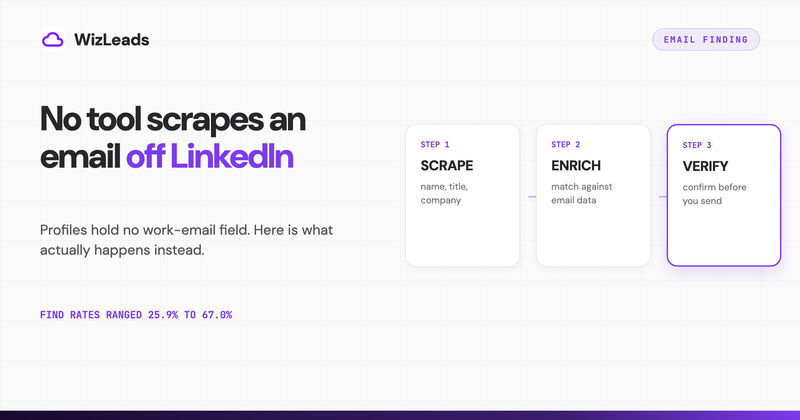

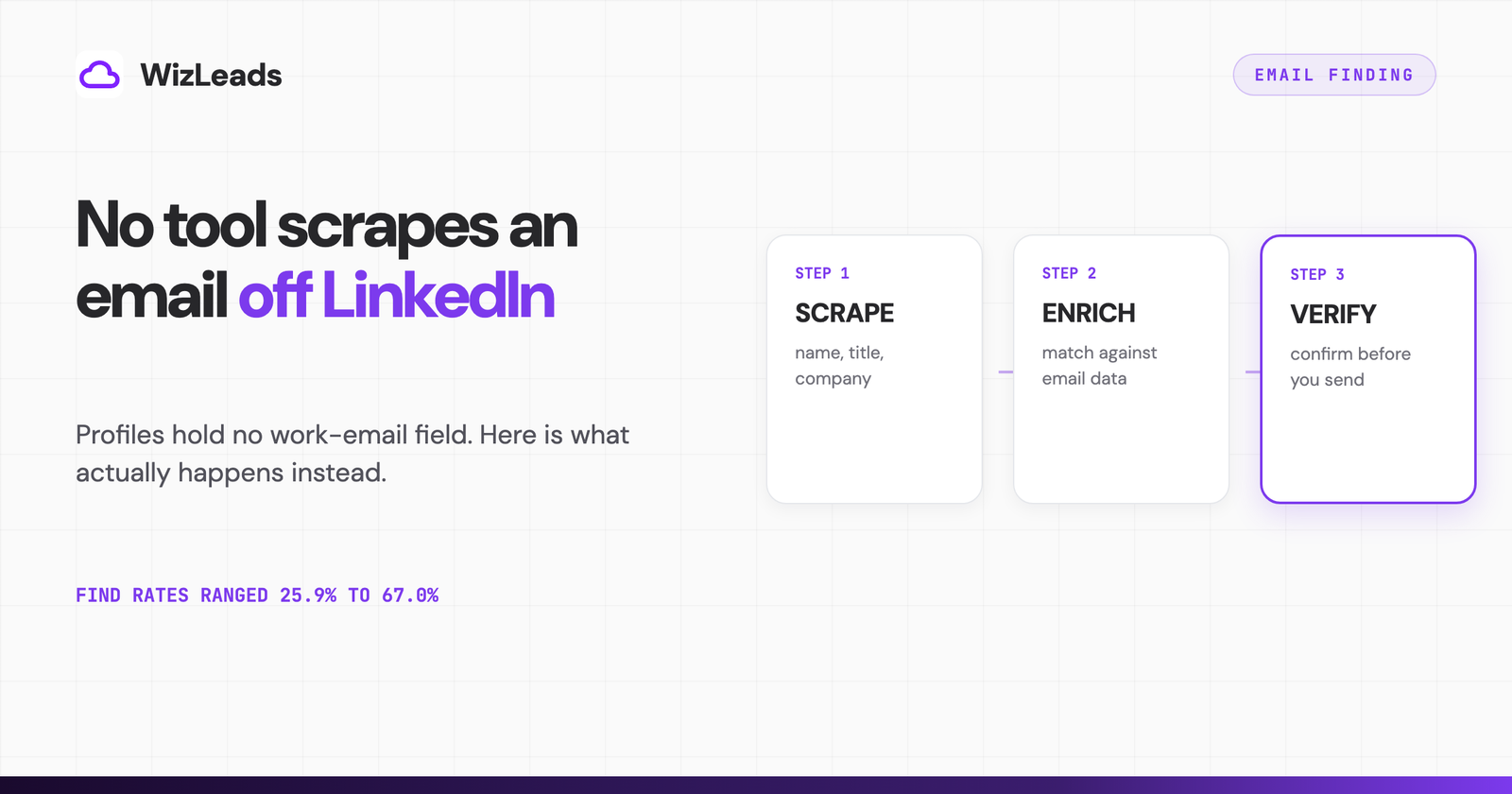
A LinkedIn profile does not carry a work email in any field a scraper can read. LinkedIn's own help centre says the contact and personal information you enter in the Contact Info section is "only visible to your 1st-degree connections", and that the primary address you registered with is by default "only visible to your direct connections on LinkedIn". Sales Navigator, at US$119.99 a month for Core, holds no email field to give either.
Hunter sells email finding, and its own help centre says "Hunter does not find emails from social media profiles so, with our tool, it is impossible to find emails from Instagram, Facebook, LinkedIn, Twitter, Youtube, or TikTok profiles." The reason it gives is that the addresses used to register those accounts are protected by the platform and are therefore not publicly available.
LinkedIn itself shows a member's primary email only to their direct connections by default, plus people already in their email contacts, and the member can change that in their settings (LinkedIn Help). Everything else runs a three-step pipeline, and knowing which step you are paying for is what separates a $99 run from a $299 one on the same 10,000 leads. A LinkedIn email extractor, a LinkedIn email finder and a tool that promises to scrape emails from LinkedIn in bulk all run those same three steps underneath, whatever the category name on the box.
The three steps behind every "scraped" email
Step one reads identity off LinkedIn. First name, last name, current title, employer, employer's website, profile URL. That data is on the page, every scraper collects it, and it is the only part of the job that touches LinkedIn at all.
Step two enriches that identity into an address. To find email from LinkedIn profile data, the finder takes the name and the company domain, checks its own records, generates the plausible formats for that domain, and tries to confirm one at the receiving mail server. That happens entirely outside LinkedIn, against databases built from web crawls, email signatures, public filings and shared contact data.
Step three verifies the result before it reaches a sequencer. An address that resolved in step two is a hypothesis until something confirms the mailbox exists.
On our own pricing, those three steps cost 2 credits per lead scraped account-less, 3 credits per email actually found with nothing charged on a miss, and nothing extra for verification because it is included in that 3. The $39 plan carries 10,000 credits, which the pricing page translates as 10,000 leads scraped on a connected account, or 3,333 emails enriched, or 20,000 emails verified. Most confusion about what a LinkedIn email finder costs comes from comparing a price for one step against a price for all three.
Where step one physically happens is the distinction the category argues about most and the one with the least bearing on email quality. A Chrome extension captures identity inside your logged-in browser session. A cloud tool captures it on its own servers. That choice governs how exposed your LinkedIn account is, and it changes nothing about the address, because whichever one you pick, the same step two runs behind it. Step two is where the tools actually differ.
Why the same list gives different tools different answers
We ran 1,000 identical B2B leads through seven enrichment providers, and the full enrichment benchmark records the per-tool method. WizLeads returned 670 verified-valid addresses. Wiza found 671, of which 633 held up and 38 came back invalid. Findymail returned 587, Kitt 517, LeadMagic 464, IcyPeas 418 and Prospeo 259. Same input, same day, a 2.6x spread top to bottom, and verified-valid find rates running from 25.9% to 67.0%.
That spread comes from how the pattern databases get built. A provider learns that Acme uses firstname.lastname by observing confirmed Acme addresses, so its confidence on a domain tracks how much mail from that domain it has already seen. On a 4,000-person US company it has thousands of observations. On an eleven-person agency in Lisbon it has none, and the lookup falls back on generating firstname.lastname and hoping the server confirms it.
That mechanism also predicts where any LinkedIn email scraper misses: small companies first, then employers that send mail from a different domain than their website, then non-US contacts. Assume 50% to 60% on a mixed B2B list and size the budget on 60%, which turns 10,000 Sales Navigator leads into roughly 6,000 contactable people.
Catch-all domains, and why "found" is not "valid"
We counted 212 catch-all domains in a 1,000-address test list, roughly the share to expect on any B2B list. A catch-all gateway accepts every address sent to it, including addresses that were never created, so the ordinary SMTP handshake returns the same yes for a real mailbox and a typo. Providers respond by handing the address over and marking it risky, or by refusing to release it at all.
Both choices cost you something, and the only way to price the cost is to send. We ran 1,000 known-status addresses through six verifiers, mailed whatever each one approved, and counted the hard bounces. The numbers below are measured bounces rather than one verifier's opinion of another.
| Verifier | Kept as valid | Bounces | Bounce rate |
|---|---|---|---|
| ZeroBounce | 888 | 33 | 3.72% |
| WizLeads | 852 | 5 | 0.59% |
| LeadMagic | 822 | 7 | 0.85% |
| NeverBounce | 711 | 4 | 0.56% |
| MillionVerifier | 709 | 7 | 0.99% |
| Debounce | 670 | 1 | 0.15% |
The top and bottom rows are the same tradeoff resolved in opposite directions. ZeroBounce released 888 addresses and 33 of them bounced. Debounce released 670, bounced one, and rejected 330 that never got the chance to prove themselves either way. The verification benchmark sets out the send conditions and the per-tool rejections.
The only threshold Google publishes is a spam rate, not a bounce rate: below 0.15% in Postmaster Tools, never reaching 0.30%. The 2% bounce ceiling quoted everywhere is an operator convention rather than a documented Gmail rule. We use it anyway, because on our own infrastructure a domain that crosses it starts landing in Promotions within a week and a domain past 5% stops landing at all.
Twelve tools, priced today
These are grouped by what they do to your list, because the groups are not substitutes for each other. Every price was read off the vendor's own pricing page on 8 September 2026, and each entry gives the same four things in the same order: what it does, the price, the credit rule, the constraint.
Group one: paste a search, get a CSV with emails
These run all three steps, so they extract email from LinkedIn searches in one pass and hand you a file. Where one of them has lost part of that in the last year, the entry says so.
WizLeads turns a Sales Navigator search URL into a 35-field CSV, optionally without connecting a LinkedIn account at all. Plans run $39 for 10,000 credits, $99 for 40,000, $199 for 100,000 and $499 for 300,000. Scraping is 1 credit per lead with a connected account or 2 without one; enrichment is 3 credits per email found, misses free, verification included. Extraction is Sales Navigator only, so a seat is a prerequisite, and credits roll over one month rather than indefinitely.
Evaboot is a Chrome extension that cleans and exports Sales Navigator searches. One plan on a slider: $9 for 100 credits, $29 for 500, $49 for 1,500, $99 for 4,000, $149 for 8,000, $299 for 20,000, $499 for 50,000, $899 for 100,000 and $1,699 for 200,000 a month, yearly billing taking two months off. One credit exports a lead, one more buys an email it finds and verifies, misses free. Every export runs through your own logged-in session, so the tab stays open and your account carries the exposure.
Wiza sells verified emails and mobile numbers with CRM sync attached. Since 19 August 2026 its Chrome extension no longer bulk-exports from LinkedIn, Sales Navigator or Recruiter search, list or company pages, on any account or plan, so lists now come from Wiza's own Prospect search, a CSV of LinkedIn URLs, or a CRM import, and the extension handles one profile at a time. Monthly plans are $49 per user for 100 valid emails, $99 for 500, $199 for 500 emails plus 500 phones, with extras at $0.15. Annual billing switches to unlimited email reveals at $83 a month billed $990 a year, capped at 2,500 exports a month. Monthly bills the included 500 at $198 per thousand and every extra at $150, so 10,000 emails lands at $1,524 and the annual plan is the only version that survives volume.
Skrapp runs an extension across LinkedIn, Sales Navigator and Recruiter plus a company-website email extractor. Professional is $29 a month billed annually or $39 monthly for 2,000 credits and 2 users, rising to $129 a month at the 10,000-credit step; Enterprise is $262 annually or $349 monthly for 50,000 credits and 15 users. Finder credits are charged only for addresses returned as Valid or Catch-all, never for a miss, and never twice for the same address. The verifier is the exception: Skrapp's API docs bill one credit per verification, invalid results included. Paying full price for a catch-all is the constraint, since that is the one result you cannot act on without a second check.
Group two: feed it a name and a domain
These do step two only, so a LinkedIn email scraper from group one feeds them, or your own Sales Navigator export does.
Hunter does email finding, verification, domain search, a B2B database and a sequencer. Above those plans sits the Data Platform, which is sold on unit rates rather than tiers and is the route to API-only access. Hunter publishes $50 per 1,000 search credits and $11 per 1,000 verification credits, so 1,000 of each is $61 a year, and the rate falls with volume: a million enrichment credits is $6,900 and a million verification credits $2,800, both expiring after twelve months. That is $6.90 and $2.80 per 1,000, roughly an 86 and 75 percent discount on the small-volume rate, and those are the largest packages Hunter sells publicly. Starter is $49 a month or $34 billed yearly for 2,000 credits; Growth $149 or $104 for 10,000; Scale $299 or $209 for 25,000. On those plans one credit buys an email found with verification included, the standalone Verifier spends 0.5 of the same credits per verified email, and nothing is charged on an empty search. Hunter excludes webmail domains by design, so a founder running the business off a Gmail address never resolves.
Prospeo pairs an enrichment API with a people and company search whose filter count climbs with the tier, 28 on Free and 41 on Pro. Starter is $49 a month or $37 billed yearly, Growth $99 or $74, Pro $249 or $187, for 2,000, 5,000 and 15,000 monthly credits. One credit buys a verified business email, a mobile costs 10, and exports charge nothing on a miss. Prospeo contradicts itself on rollover: its pricing page, loaded from different countries on 18 September 2026, said both "do NOT roll over" and "unused credits roll over", and its help centre says they "do not carry over". Budget as if an unused month is lost.
Findymail finds and verifies in a single step, and adds mobile numbers, a Chrome extension and native Clay and CRM integrations. Monthly it runs $99 for 5,000 credits, $249 for 15,000, $399 for 30,000, $549 for 50,000 and $849 for 100,000, with annual billing giving two months free. Basic is $49 a month for 1,000 finder credits, Starter $99 for 5,000, Business $249 for 15,000, on a slider running to 100,000, yearly billing taking two months off. Every tier adds an equal number of bonus verifier credits. One credit is one verified email, a phone is 10, misses cost nothing and duplicates inside 30 days are free. The published guarantee is under 5% bounce with credits refunded above that, looser than the sub-1% figures the better verifiers actually hit.
LeadMagic exposes 15 or more enrichment endpoints through one credit pool, including email, mobile, company search and job-change detection, with an MCP server and a terminal client. Basic is $49.99 a month for 2,000 credits, Essential $99 for 5,000, Growth $249 for 20,000, Professional $499 for 50,000, Ultimate $849 for 100,000, annual at ten times monthly. Email finding is 1 credit per valid result, validation 0.25, mobile 5, deducted only on success. Rollover, search and export all begin on the $99 Essential tier, so Basic is an API key rather than a working plan. It returned 464 valid addresses in our test, mid-field on coverage.
Group three: search a database instead of a list
Apollo is a full outbound platform with a contact database, sequencer, dialer and deal management attached. Billed annually, Basic is $49 per seat per month with 30,000 credits a year, Professional $79 with 48,000, Organization $119 with 72,000 across three seats minimum. An email costs 1 credit, a phone 8, and enrichment 1 to 8 per record, though Apollo's own FAQ on the same page says up to 9. Credits land per seat per year rather than per month, so front-loading a quarter of prospecting means planning the whole year.
Snov.io bundles the finder with a sequencer, warmup, LinkedIn automation and a CRM. Starter is $39 a month for 1,000 credits and 5,000 recipients; Pro is $99 for 5,000 credits and 25,000 recipients; annual saves 25%. One credit covers one prospect or one verification. LinkedIn automation sits outside both prices at $69 a month per slot.
ContactOut sells uncapped reveals rather than credits, with a search portal, extension and email campaigns. The Email plan is $49 a month with US and UK data included, or $25 without it, and Email plus Phone is $99, or $49 without. The $99 and $199 shown beside them are struck-through list prices. Reveals carry no credit meter, subject to a fair-use policy the page links to, and exports cap at 300 and 600 a month, which is the number that actually governs how much list you build. Self-serve plans also limit you to one user per company.
Lusha covers verified emails and direct dials with intent data, CRM export and an extension that works on any website. Lusha prices off a credit slider that runs to 10,000 a month or 120,000 a year. Billed yearly, Starter is $37.45 a month for 4,800 credits a year, Pro $52.45 for 7,200, Premium $299.95 for 40,800. An email costs 1 credit, a phone 5. At $87 to $94 per thousand emails it runs five to eight times the group two engines, which buys phone coverage and enterprise compliance rather than better email economics.
What a full run actually costs
Ten thousand LinkedIn Sales Navigator leads, enriched at a 60% find rate, verified, loaded into a sequencer. That is 6,000 usable emails, and it is four searches rather than one, because a people search stops at 2,500 results.
| Route | Plan needed | Cost | Per 1,000 emails |
|---|---|---|---|
| WizLeads, account-less scrape plus enrichment | $99 Agency, 38,000 of 40,000 credits | $99 | $16.50 |
| Evaboot, export plus email finding | $299 tier, 16,000 of 20,000 credits | $299 | $49.83 |
| Enrichment only, Hunter Growth yearly | $104/mo, 6,000 of 10,000 credits | $104 | $17.33 |
| Enrichment only, Findymail Business | $249/mo, 6,000 of 15,000 credits | $249 | $41.50 |
The bottom two rows exclude the scrape, and you still need the 10,000 leads from somewhere. Findymail looks worst here for a structural reason rather than a pricing one: nothing sits between Starter at 5,000 credits and Business at 15,000, so 6,000 emails lands in the gap and 9,000 credits go unused. Add the Sales Navigator seat on top of all four routes at US$119.99 a month, which on two of them costs more than the tool does and is the number nobody counts when they quote a tool at $39. Domains, mailboxes and warmup are a separate bill again, before a single one of those 6,000 addresses gets used.
The rules, the account risk and the privacy side
Section 8.2 of the LinkedIn User Agreement, effective 3 November 2025, tells members not to "develop, support or use software, devices, scripts, robots or any other means or processes (such as crawlers, browser plugins and add-ons or any other technology) to scrape or copy the Services, including profiles and other data from the Services." That covers every tool in group one.
Enforcement lands on the account doing the scraping. A Chrome extension acts as your logged-in session, which is why extensions carry the most exposure and why every extension vendor ships daily caps. Cloud tools holding your session cookie slow the pace and keep the same link. Account-less extraction removes your account from the transaction, and that three-way split is the axis our LinkedIn scraper comparison ranks the extraction tools on. It also turns the 2,500-result export limit into something you route around with split searches rather than grind through at a hundred leads a day.
Two data protection obligations apply to a scraped and enriched list. GDPR Article 14 governs personal data not obtained from the person themselves and requires you to say where it came from and what you are doing with it "at the latest at the time of the first communication to that data subject", so the notice rides in your first cold email. CCPA gives California residents a right to know and delete what you hold, so keep the record of where each address came from. None of that is legal advice, and selling into the EU is worth an actual lawyer.
Running it end to end
Build the search in LinkedIn Sales Navigator first, and build it tight. A people search caps at 2,500 results, so filter by seniority, headcount and geography until the count sits under it rather than exporting broad and cleaning up afterwards.
Paste the search URL into a cloud scraper, turn on account-less mode and email enrichment, and run it. Five thousand leads takes 15 to 20 minutes server-side and returns a CSV with the profile fields, the company fields, and an email column filled for the roughly 60% that resolved.
Split the file before it goes anywhere. Confirmed addresses go straight to the sequencer. Catch-all domains go through a verifier that classifies them as valid or invalid rather than one that returns "risky" and hands the decision back to you. Rows with no email are a phone or LinkedIn segment, not a failure.
Then send in cohorts. Two hundred addresses on day one, watch the bounce column, scale from there. A list that bounces clean at 200 usually bounces clean at 6,000, and one that does not has cost you 200 sends instead of a domain.
WizLeads runs all three steps as one task on one credit pool. First month is $1, and early accounts keep 20% off for life after that.
FAQ
Can you actually scrape email addresses from LinkedIn?
No, because the field is not on the page. LinkedIn's help centre states that contact information in the Contact Info section is visible only to your 1st-degree connections, and that the primary email you registered with is visible only to direct connections by default. Sales Navigator carries no email field either. Every LinkedIn email extractor reads identity off the profile, looks the work address up elsewhere, and verifies it before handing it back.
What is the best LinkedIn email finder in 2026?
It depends which half of the job you need. To turn a Sales Navigator search into a CSV with verified emails in one run, WizLeads charges 1 credit per lead scraped on a connected account, 2 without one, plus 3 per email found, so the $39 plan covers 10,000 leads or 3,333 enriched emails. To enrich a list you already own, Hunter is $104 a month billed yearly for 10,000 credits, one credit per email found. To search a database instead of supplying a list, Apollo Basic is $49 per seat per month billed annually, or $65 month to month, with 30,000 credits a year. In our 1,000-lead test, seven tools returned between 259 and 671 usable emails from identical input.
What find rate should you expect from a LinkedIn email finder?
Between 50% and 60% on a mixed B2B list, and 60% is the number to budget on. Our 1,000-lead enrichment benchmark returned verified-valid find rates from 25.9% to 67.0% across seven tools on identical input. Misses cluster on small companies, on employers that send mail from a different domain than their website, and on non-US contacts.
Is scraping LinkedIn against the terms of service?
Yes. Section 8.2 of the LinkedIn User Agreement, effective 3 November 2025, says members will not use software, scripts, robots, crawlers or browser plugins to scrape or copy the Services, including profiles and other data. Enforcement lands on the account doing the scraping, which is why Chrome extensions carry the most exposure and why account-less cloud extraction removes the account from the transaction entirely.
Why do two email finders return different addresses for the same person?
Because each holds a different database and applies pattern inference differently. Given a name and a company domain, a finder checks its own records, generates the likely formats for that domain, and tries to confirm one at the mail server. Different coverage and different confirmation thresholds produce different answers, which is how the same 1,000 leads gave us 671 addresses from one tool and 259 from another.
Do you still need to verify emails from a LinkedIn email scraper?
Verify anything the finder did not already confirm. WizLeads and Hunter both bundle verification into the find price. The risk sits in catch-all domains, which accept every address at the gateway and confirm nothing. Our test found 212 catch-alls in 1,000 addresses, and the six verifiers disagreed sharply on them: one released 888 addresses and bounced 33, another released 852 and bounced 5.
Is there a free LinkedIn email scraper?
Free tiers exist and they are sized for testing rather than campaigns. Hunter gives 50 credits a month, Prospeo 100, Lusha 40, Skrapp 50, Wiza 20 valid emails and 5 phones, ContactOut 5 emails a day. Free GitHub scripts handle the profile-reading half and leave you to supply the enrichment and verification, which is where the cost sits.