WizLeads

Most comparison posts in this category are quoting prices that vendors have since changed and a court case that ended differently from how they describe it. Evaboot has replaced named plans with a volume slider. Skrapp publishes nine tiers, not three. And the hiQ ruling that gets cited as proof that LinkedIn scraping is settled law ended in December 2022 with a consent judgment against hiQ.
We build in this category. WizLeads is our product, it is first in the list below, and the ranking is worth less to you than the pricing. Every figure in this post was read off the vendor's own pricing page on 8 September 2026, and where a competitor beats us that is written into its section.
What this list is ranked on
The job being priced is the one most people are buying: take a Sales Navigator search, get the profiles out, attach a work email to each one, verify it, and hand a CSV to a sequencer. Tools are ranked on four things in this order.
Whose LinkedIn account does the work. This is first because it is the only failure that costs you something you cannot re-buy. A restricted account takes your network with it.
What happens past 2,500 results. LinkedIn's help centre puts a Sales Navigator search at 2,500 lead results across 100 pages, or 1,000 account results across 40 pages. That ceiling is LinkedIn's, so no tool removes it, and the only question is how much manual work each one leaves you. There is more detail on how the export limit actually behaves if you are hitting it now.
Whether emails arrive verified or merely found. Email addresses do not exist on LinkedIn profiles. Every tool returning one is running a separate lookup and charging you for it, and the difference between an address that has been checked and one that has only been guessed shows up in your bounce rate two weeks later.
Cost for a defined job. The standard workload is 10,000 delivered work emails. Find rates across the seven tools in our 1,000-lead enrichment benchmark ran from 25.9 to 67.0 percent. This post sizes every job at 60 percent, near the top of that range, which is the assumption most generous to every vendor here, so landing 10,000 emails means scraping roughly 16,700 profiles. Each tool's own credit rules get applied to that workload and the price shown is the cheapest single plan tier covering it inside one month. That rule is unflattering to everyone including us, because quoting a per-credit rate off a vendor's largest plan makes every tool look cheaper than the invoice.
Two things the ranking deliberately ignores. G2 scores, because they cluster inside a few tenths of a point across this whole category and separate nothing. And speed, because the binding constraint on a large export is almost always LinkedIn's daily ceiling rather than the scraper's throughput.
Five tools that appear on most lists in this category are not ranked here. Linked Helper, Dripify, Dux-Soup, Waalaxy and Octopus CRM automate LinkedIn activity rather than extract at volume, and their daily action quotas sit one or two orders of magnitude below this job. Dripify caps at 200 profile views a day on its upper tiers, which turns 16,700 profiles into about 84 days. They are the right tools for sending connection requests and the wrong ones for building a list, so they are named at the end where the workflow calls for them rather than priced against a job they cannot finish.
One more thing sits outside every price below. Every tool here that reads a Sales Navigator search needs a live Sales Navigator seat on top of its own subscription, which LinkedIn charges $119.99 a month for Core and $159.99 for Advanced, so what Sales Navigator really costs stacks onto nearly all of it. The exception is a scraper running account-less, where the seat doing the reading is not yours.
The split that does most of the work
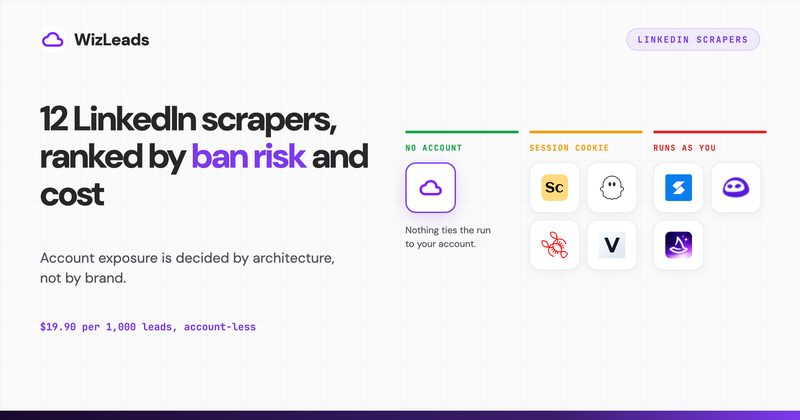
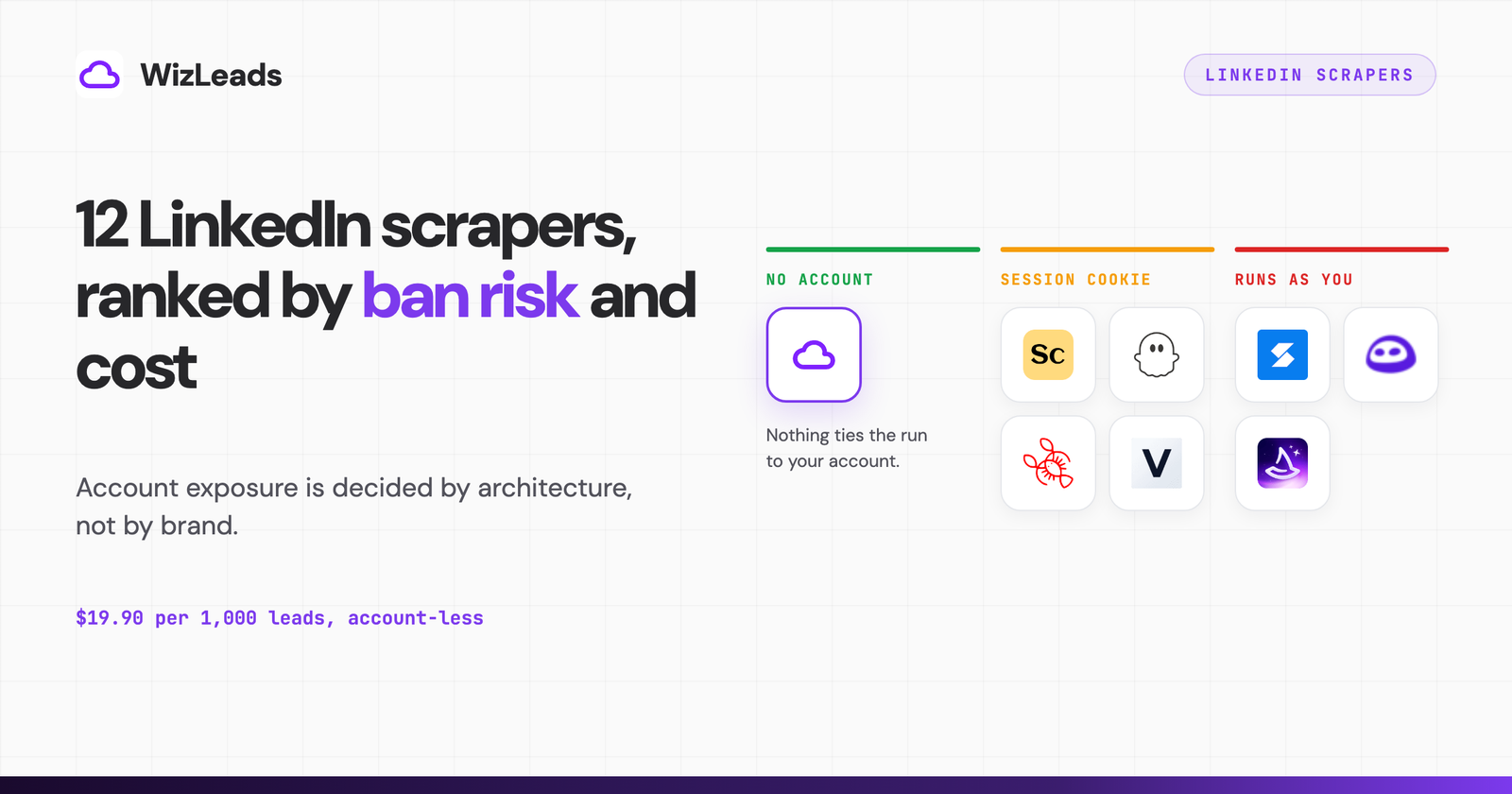
Criterion one sorts the field into two piles rather than producing a ranking on its own. Ten of these twelve tools put your own logged-in session into the request path, either as a browser extension acting as you or as a cloud service holding your session cookie. Two do not.
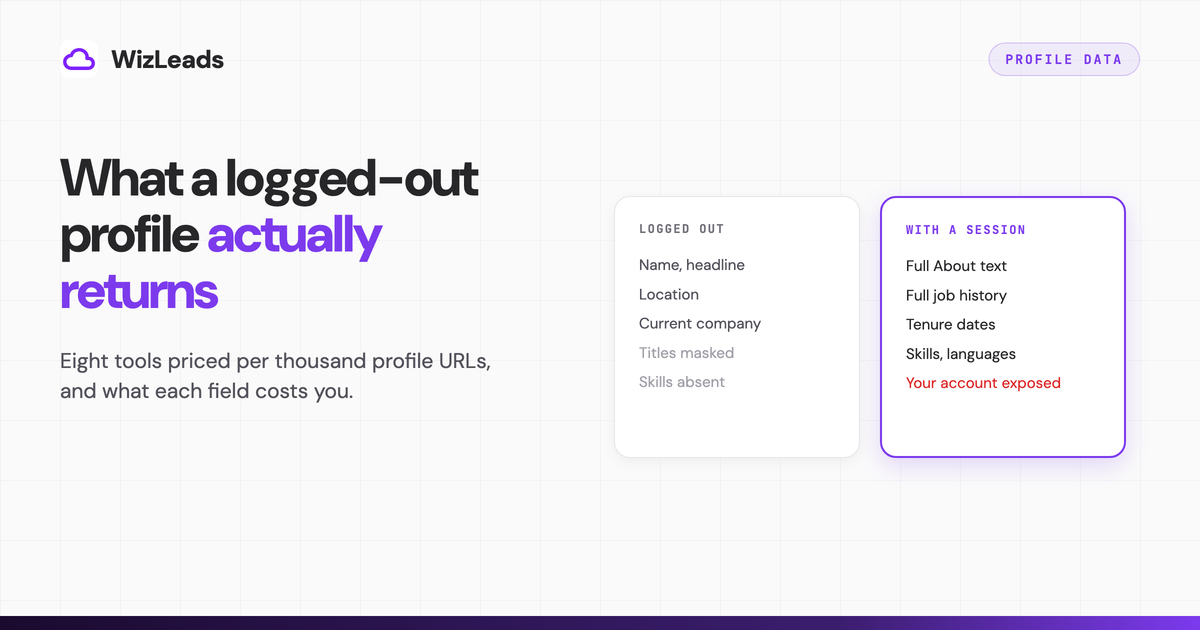
The reason the second pile is so small is that Sales Navigator's filters are the whole point of scraping LinkedIn, and reaching them normally requires a seat that is logged in. Scrapers that avoid your account almost always avoid Sales Navigator too, and fall back to public profile pages, which carry fewer fields and no search filters. WizLeads is the exception in this list: account-less extraction that still reads Sales Navigator searches. Bright Data is account-less and does not touch Sales Navigator at all.
The table
| Tool | How it runs | Your LinkedIn account | Past 2,500 | Emails | Cheapest plan covering 10K emails | Per 1,000 |
|---|---|---|---|---|---|---|
| WizLeads | cloud, account-less option | untouched in account-less mode | automatic link splitting | found and verified in one pass | $199 | $19.90 |
| Skrapp | extension plus lead search | runs as your session | daily search caps bind first | found and verified | $129 | $12.90 |
| Scrupp | cloud after cookie handoff | reads your session cookie | split by hand | found and verified | $349 | $34.90 |
| PhantomBuster | cloud, session based | reads your session cookie | split by hand | enriched via email credits | $352 yearly | $35.20 |
| Evaboot | Chrome extension | runs as your session | split by hand | found and verified | $499 | $49.90 |
| Lobstr | cloud after cookie handoff | reads your session cookie | standalone URL splitter | 9 credits per email found | $500 | $50.00 |
| Vayne | cloud, cookie based | reads your session cookie | automatic query splitting | separate enrichment credits, refunded on a miss | $289 for 10K emails | $28.90 |
| Wiza | extension plus web app | runs as your session | 2,500 exports a month | found and verified | $1,524 | $152.40 |
| Bright Data | API, no LinkedIn account | untouched, no Sales Nav access | not applicable | none | $25.05 profiles only | not comparable |
| Apify | actor marketplace | depends on the actor | depends on the actor | none at platform level | $83.50 profiles only | not comparable |
| Captain Data | API and cloud | reads your session cookie | not published | 1 credit per enriched record | $1,319 on the 50K plan | $131.90 |
| TexAu | cloud automation | reads your session cookie | split by hand | pay on match | above the top published tier | not comparable |
Ban risk belongs to the architecture, not the brand
Every vendor page in this category promises safety, and the promises are worth reading against the document that actually governs the relationship. Section 8.2 of the LinkedIn User Agreement lists what members agree not to do, and two of its bullets decide this entire category.
The first prohibits using another's account, and it names the mechanism in parentheses: sharing log-in credentials or copying cookies. The second prohibits developing, supporting or using software, devices, scripts, robots or other processes to scrape or copy the Services, and it names browser plugins and add-ons among the examples. Read those two together and a Chrome extension exporting your Sales Navigator search is squarely inside both, and a cloud tool that asked you to paste your li_at cookie has moved the same exposure onto a server without reducing it.
That does not make any of this criminal, and the ruling everyone cites for the opposite proposition does not hold the position they give it. The 2019 Ninth Circuit opinion in hiQ Labs v. LinkedIn was vacated by the Supreme Court in June 2021 and reissued on 18 April 2022, and the reissued opinion says of itself that "we did not resolve the companies' legal dispute definitively". What it affirmed was a preliminary injunction, on a finding that hiQ had raised "serious questions" about the Computer Fraud and Abuse Act. That injunction was dissolved 105 days later. In November 2022 the district court found hiQ had breached the User Agreement, granting summary judgment on the fake accounts hiQ's contractors had created and leaving hiQ's own scraping for trial on waiver and estoppel. On 8 December 2022 Judge Edward M. Chen entered a consent judgment of $500,000 against hiQ plus a permanent injunction covering automated access "whether logged in to a LinkedIn account or not". In January 2025 LinkedIn sued Nubela over Proxycurl, a LinkedIn data API its founder puts at roughly $10M in revenue. Proxycurl shut down on 4 July 2025, and LinkedIn says the settlement requires it to delete the LinkedIn data it obtained.
The practical reading is that contract liability is what gets enforced, and for an individual operator that liability arrives as a restricted account rather than a lawsuit. Access law, contract and data protection are three separate rulebooks with three different consequences, and each is worked through against the primary documents here. None of this is legal advice, and if you are scraping EU residents at volume you want a real opinion on legitimate interest rather than a blog post.
For what the ceilings look like day to day, PhantomBuster publishes the most useful numbers of any vendor in the category, broken out by account age. On profile extractions it puts a new account at 80 profiles over 8 launches, an active free account at 150 over 10, and a Premium account at 300 over 20. On search result extractions it puts a Premium account at 200 pages and 5,000 results a day. Lobstr's help centre puts the daily ceiling at 5,000 profiles per account. Those figures are broadly consistent, and they are the reason a 16,700-profile job takes several days on any tool that runs through your session.
Operators reporting in public do not agree with those numbers or with each other. Read through the threads that rank alongside this one and the self-imposed daily caps people describe run from under 10 profile views to 100, with no consensus anywhere in that range. What they do agree on is the cost of getting it wrong. One operator whose agent visited 200 profiles in a recognisable pattern was restricted within 48 hours and lost two weeks to the appeal. Another was banned after six months of connection requests with no messaging at all, and got the account back roughly a week later by uploading a government ID and agreeing to stop automating. That is the number worth putting next to a $49 subscription, and the reason criterion one is first.
Session cookies fail in a quieter way. The li_at cookie a cloud tool holds is the same cookie your browser holds, and LinkedIn invalidates it whenever it decides a session looks wrong. Operators describe freshly issued cookies dying after one or two cloud runs, and the r/n8n thread that ranks alongside this one opens with most LinkedIn scrapers getting banned as its premise rather than its question. A job that dies at 60 percent because the cookie expired is a partial CSV and a re-run against the same daily quota.
The twelve scrapers
Each section fills the same six slots in the same order: how it gets the data, what your account is exposed to, what happens past 2,500, the email layer, the verified price, and who it fits.
1. WizLeads
How it gets the data. Cloud infrastructure, no browser extension and no software on your machine. You paste a Sales Navigator search URL and it runs server-side.
Your LinkedIn account. Account-less mode extracts without your session, so there is no cookie to hand over and no account for LinkedIn to throttle. It costs 2 credits per lead rather than the 1 credit charged when you connect your own account, which is the honest price of the isolation. Connect an account and the exposure is the same as everything else here.
Past 2,500 results. Smart Link Splitting breaks an oversized search into sub-searches by geography, headcount and other filters, runs them in parallel and deduplicates the output. It is gated to the Agency plan and above, which is a fair thing to hold against us at the entry tier.
Emails. Enrichment and verification run in the same pass as the scrape at 3 credits per email actually found, nothing for misses. Catch-all addresses are classified as valid or invalid rather than returned as risky for you to triage. In our six-verifier test on 1,000 real addresses that pipeline kept 852 valid and produced 5 bounces, a 0.59 percent bounce rate. The raw data is published there, so audit it rather than taking this paragraph on trust.
Price. Freelancer $39 for 10,000 credits, Agency $99 for 40,000, Cartel $199 for 100,000, Kingpin $499 for 300,000. Quarterly billing takes roughly 25 percent off. The 10,000-email job is 33,400 credits for the account-less scrape plus 30,000 for the emails, so 63,400 credits, which lands on Cartel at $199, or $19.90 per 1,000. Connect your own account and it drops to 46,700 credits, still Cartel.
Who it fits. Agencies and operators running Sales Navigator territories large enough that manual search splitting has become a weekly chore, and anyone whose LinkedIn account is too valuable to keep inside the export path. Skip us if you want native HubSpot and Zapier connectors out of the box, because we are API-first and expect you to wire it up.
2. Skrapp
How it gets the data. A Chrome extension over LinkedIn Basic, Sales Navigator and Recruiter, plus a lead search database you can query without going through LinkedIn at all.
Your LinkedIn account. The extension runs as your logged-in session on the LinkedIn side, which puts it in the same position as Evaboot and Wiza.
Past 2,500 results. Skrapp's daily search quotas bind before LinkedIn's cap does. Professional allows 20 people searches a day at 100 results each, so 2,000 results a day, and a 16,700-profile job takes about nine days rather than one afternoon.
Emails. One credit buys one deliverable email, which is a cleaner meter than most of this list because you are not paying separately to scrape the profile. Skrapp does not publish a find rate, so the credit count that lands 10,000 emails is an estimate rather than a guarantee.
Price. Nine monthly tiers: $0 for 50 credits, $39 for 2,000, $99 for 5,000, $129 for 10,000, $199 for 25,000, $349 for 50,000, $599 for 100,000, $999 for 250,000 and $1,499 for 500,000. Yearly billing takes 25 percent off. Ten thousand emails needs the $129 tier, or $12.90 per 1,000, the cheapest verified price for this job in the whole list.
Who it fits. Anyone whose volume fits inside the daily search caps and who cares more about cost per delivered email than about turnaround. It is the wrong tool for a client deadline, because nine days of quota is nine days.
3. Scrupp
How it gets the data. A Chrome extension reads your session cookie, then the scrape itself runs in Scrupp's cloud, so you can close the browser once an export starts.
Your LinkedIn account. The cookie moves to a server, and the server makes the requests as you. Scrupp's own FAQ answers the ban question with "risk is reduced by safe extraction and external enrichment", which is the accurate version of the claim rather than the marketing one.
Past 2,500 results. Split by hand. Scrupp's FAQ states the platform ceilings directly at 1,000 for LinkedIn Basic, 2,500 for Sales Navigator and 2,500 for Apollo, and tells you to segment the search.
Emails. One extra credit adds a verified work email, two more add a phone number, and misses are free. Scrupp claims a 65 percent average find rate on its own pricing page, which is at the upper end of what we have measured across providers and is not independently verified.
Price. Subscriptions at $29 a month for 1,000 credits, $39 for 2,000, $59 for 5,000, $99 for 10,000, $179 for 20,000, $349 for 50,000 and $599 for 100,000. One-time packs that never expire run from $35 for 1,000 to $719 for 100,000. The 10,000-email job is 26,700 credits and lands on the $349 tier, or $34.90 per 1,000.
Who it fits. Teams that want phone numbers alongside emails without a second vendor, and anyone scraping Apollo and Google Maps under the same credit balance. The phone add-on at 2 credits is the cheapest direct-dial pricing on this list by a wide margin.
4. PhantomBuster
How it gets the data. Cloud automations called Phantoms, over 15 platforms rather than LinkedIn alone, chained into workflows that can scrape, enrich and then send.
Your LinkedIn account. Session cookie handed to the cloud. PhantomBuster is unusually direct about what that means and publishes the per-account rate ceilings quoted earlier, which is more disclosure than any other vendor here offers.
Past 2,500 results. Split by hand into narrower searches.
Emails. A separate email credit pool, consumed when a profile is enriched. The current pricing page describes consumption as varying "based on usage" rather than stating a flat one-credit-per-email rate, so treat the plan allowance as a ceiling rather than a guaranteed email count.
Price. Three plans, priced annually by default. Start is $56 a month billed annually ($672 a year) with 20 hours of execution and 500 email credits, Grow $128 ($1,536) with 80 hours and 2,500 credits, Scale $352 ($4,224) with 300 hours and 10,000 credits. Switch the toggle to monthly and the same plans are $69, $159 and $439. Scale covers the 10,000-email job at $352 on annual billing, or $35.20 per 1,000, and $439 if you pay month to month.
Who it fits. Anyone whose workflow crosses platforms, because scraping a LinkedIn post's engagers, enriching them and pushing them into a sequence is one chained workflow here and three tools anywhere else. It is poor value if LinkedIn is the only platform you touch.
5. Evaboot
How it gets the data. A Chrome extension over Sales Navigator, one click from a search to a CSV.
Your LinkedIn account. Every export travels through your own logged-in session. Evaboot manages this with pacing rather than removing it, which is the honest position available to any extension.
Past 2,500 results. Evaboot's own FAQ puts the ceiling at 2,500 leads or 1,000 companies and tells you to split by headcount, geography or industry and export each. Correct advice, and an hour of manual work every time a territory outgrows one search.
Emails. Found and verified in the same call, one credit each, misses free. The data cleaning is the feature reviewers actually name: Evaboot re-checks every result against the filters you set and flags the rows that do not match, which catches the false positives Sales Navigator starts returning past the first few pages. No other tool here replicates it. It also returns no phone numbers at all.
Price. One plan on a volume slider: $9 for 100 credits, $29 for 500, $49 for 1,500, $99 for 4,000, $149 for 8,000, $299 for 20,000, $499 for 50,000, $899 for 100,000, $1,699 for 200,000. Yearly billing takes two months off, seats and connected Sales Navigator accounts are unlimited on every tier, and credits roll over while the subscription is active. The 10,000-email job is 26,700 credits, which overshoots the $299 tier onto $499, or $49.90 per 1,000.
Who it fits. Anyone exporting under roughly 2,000 leads a month, where the $49 tier is competitive with everything here and the ergonomics beat most of it. Unlimited seats on a $99 plan is also rare in a category that mostly bills per head. If the credit maths has stopped working at your volume, there is a longer breakdown of where Evaboot users go next.
6. Lobstr
How it gets the data. Cloud scrapers called squids, with an optional Chrome extension used only to sync your session.
Your LinkedIn account. Session cookies rather than credentials, held by Lobstr. Their FAQ claims 0 percent account bans on the basis of throttling that respects LinkedIn's limits, which is a claim about their pacing rather than a guarantee about your account.
Past 2,500 results. A standalone Sales Navigator URL splitter tool, which you run first and then queue the resulting searches. Better than splitting by hand and short of splitting inside the job.
Emails. Nine credits per email found, on top of 1 credit per lead exported. Mobile numbers cost 300 credits each. Lobstr claims over 97 percent of found emails are verified and bounce stays under 3 percent, published on their own product page without a linked methodology. The output itself is the widest here at 103 attributes per lead.
Price. Free at 100 credits a month with exports capped at 30 rows per request, Starter $20 for 10,000, Pro $100 for 100,000, Team $500 for 1,000,000. Credits do not roll over. The 10,000-email job is 106,700 credits, which overshoots Pro by 6,700 and lands on Team at $500, or $50.00 per 1,000. Add-on top-ups exist but their rates are not published on the pricing page.
Who it fits. High-volume scraping where you are not buying emails, since 100,000 raw profile credits for $100 is the cheapest scraping on this list. The 9-credit email charge is what makes the enriched job expensive, so bring your own enrichment and Lobstr becomes hard to beat.
7. Vayne
How it gets the data. Cloud, driven from a Sales Navigator session. Their own site currently advertises a waiting list for a cookie-less scraper, which confirms the present product needs your session.
Your LinkedIn account. In the request path today. Vayne's blog argues harder against Chrome extensions than any competitor, on the grounds that extensions modify LinkedIn's interface, and its own architecture is a step removed from that rather than free of it.
Past 2,500 results. Automatic splitting of queries above 2,500 profiles is listed on every tier including the free one, which puts Vayne and WizLeads alone in handling the cap inside the job.
Emails. Not a checkbox on the profile quota, which is how most write-ups get Vayne wrong. Vayne meters scraping credits and enrichment credits separately, and sells enrichment as its own packs: $19 for 500, $37 for 1,000, $69 for 2,000, $149 for 5,000, $289 for 10,000, $559 for 20,000, $1,399 for 50,000 and $2,699 for 100,000, each valid 30 days from purchase. One credit buys one email; a phone number costs about twelve, since 500 credits buys 500 emails or 41 phones.
The part worth borrowing is the metering. Credits are consumed only on a successful enrichment and misses are refunded, so a credit count is a delivered count. That is the exact opposite of PhantomBuster, where a credit is an attempt, and it means Vayne's ladder can be read at face value where PhantomBuster's cannot. The 10,000-email job is the $289 pack, or $28.90 per 1,000. Vayne claims up to about 90 percent discovery, which is a vendor figure rather than a tested one, but the refund-on-miss rule limits what an optimistic claim can cost you.
Price. Freelance $29 a month for 10,000 profiles, Starter $49 for 20,000, Growth $99 for 50,000, Expand $159 for 100,000, free tier 200 leads a month. Annual billing takes two months off. Scraping 16,700 profiles fits inside Starter at $49.
Who it fits. Volume scraping on a small budget where you will verify emails yourself anyway. One hundred thousand profiles a month for $159 is the second cheapest per-profile rate here, and the missing email metrics are the reason it is not ranked higher.
8. Wiza
How it gets the data. A Chrome extension plus a web app, with Sales Navigator export as the headline workflow and a lead database behind it.
Your LinkedIn account. The extension runs as your session.
Past 2,500 results. Both unlimited plans cap exports at 2,500 a month regardless of the search, so a 16,700-profile job takes about seven months on a single seat. Split by hand and add seats.
Emails. Found and verified. Wiza returned 671 emails per 1,000 leads in our enrichment benchmark, of which 633 were valid, the highest raw find rate in that test and within a few addresses of the top verified-valid score. Its phone data has the strongest reputation in this category, priced at $0.35 per number.
Price. Free at 20 valid emails and 5 phone numbers. Monthly, per user: Starter $49 for 100 emails and 100 phones, Email $99 for 500 emails, Email plus Phone $199 for 500 emails and 500 phones, with extra emails at $0.15 and extra phones at $0.35. Annually, per user: Email $83 a month billed $990 a year with unlimited email reveals, Email plus Phone $166 a month billed $1,990 with unlimited phones, both capped at 2,500 exports a month. The 10,000-email job on the monthly Email plan is $99 plus 9,500 extra emails at $0.15, so $1,524, or $152.40 per 1,000.
Who it fits. Enterprise sellers who need mobile numbers that connect and are pricing against ZoomInfo rather than against Evaboot. At list-building volume the per-seat model and the 2,500 export cap make it the most expensive way to do this job by a factor of three.
9. Bright Data
How it gets the data. Ten separate LinkedIn scraper APIs covering people profiles, company pages, job listings, posts and public people search, delivered through a proxy network with no LinkedIn account anywhere in the flow.
Your LinkedIn account. Not involved. There is no cookie, no extension and no session, so there is nothing of yours for LinkedIn to restrict.
Past 2,500 results. Not applicable, because Bright Data does not read Sales Navigator searches. Its people search scraper covers LinkedIn's public search, which has neither Sales Navigator's filters nor its result depth. That gap is the price of the account isolation.
Emails. None. Bright Data returns profile, company, job and post fields and stops there, so an email layer is a second vendor.
Price. Free tier 5,000 records a month with no card. Pay as you go $1.50 per 1,000 records. Scale $499 a month including 384,000 records, then $1.30 per 1,000 after that. Enterprise on quote. Scraping 16,700 public profiles on pay as you go is $25.05, and there are no emails attached to them.
Who it fits. Data teams building a dataset rather than a send list, and anyone who needs post or job data at volume. If your deliverable is a verified email in a sequencer, this is the first half of a two-vendor stack.
10. Apify
How it gets the data. A marketplace of about 69,500 actors, community-built and official, several dozen of which target LinkedIn. Some ask for your li_at cookie, others run cookie-free against public pages, and quality varies actor by actor.
Your LinkedIn account. Whatever the actor you picked decides. The cookie-based Sales Navigator actors put your session on someone else's server, and the cookie-free profile actors leave your account alone at the cost of Sales Navigator access.
Past 2,500 results. Depends on the actor, and none of them removes LinkedIn's cap.
Emails. Nothing at the platform level. Enrichment means renting a second actor, and Apify's own documentation says it stopped accepting new rental actors on 1 April 2026 and fully retires the rental model on 1 October 2026 in favour of pay-per-usage. Check that against any actor you are about to build a pipeline on.
Price. Platform: Free $0 with $5 of usage at $0.20 per compute unit, Starter $19 a month, Scale $199 at $0.16 per compute unit, Business $999 at $0.13. Actors bill on top of that from the same balance. The most used Sales Navigator search actor charges $5.00 per 1,000 results on every Apify plan, the free one included, and the most used profile scraper charges a flat $10.00 per 1,000. So 16,700 profiles is $83.50 or $167 in platform usage depending on which you pick, before any email layer.
Who it fits. Developers who want a scheduler, proxies, storage and an API without building them, and who are comfortable auditing an actor before depending on it. Non-technical teams end up paying the same money for more moving parts.
11. Captain Data
How it gets the data. An API-first automation platform with LinkedIn among many sources, sold to product teams embedding enrichment rather than to individual sellers.
Your LinkedIn account. Session-based for the LinkedIn actions, so the same exposure as the cloud tools above.
Past 2,500 results. Not addressed on the pricing page.
Price. The published anchors are €59.99 per 1,000 credits at the base rate and €29.99 per 1,000 at a 20,000-credit commitment, a €600 monthly floor. No rate is published for the band our standard job lands in, around 26,700 credits, so the cheapest plan that actually covers it is the 50,000-credit tier at $1,319. Against 10,000 delivered emails that is $131.90 per 1,000, the most expensive route in this comparison by a distance, which is the trade you make for putting enrichment inside your own product.
Emails. Most operations cost 1 credit per record, enrichment included, with complex operations costing more.
Price. A volume dial rather than plans. The base rate is €59.99 per 1,000 credits, falling to €29.99 per 1,000 at 20,000 credits a month, which their calculator prices at €600 a month. The dial starts at 2,500 credits and 100 credits are free. The band covering the 26,700 credits this job needs is not shown without moving the dial past the default, so the exact figure is unconfirmed and the floor is €600.
Who it fits. Teams putting LinkedIn data inside their own product, where an SLA and an account manager matter more than the per-lead rate. At list-building volume the entry price is several times what the Sales Navigator specialists charge.
12. TexAu
How it gets the data. Cloud automation with a large recipe library, sold as two separate products: a platform for GTM teams and a standalone API with MCP access for engineers.
Your LinkedIn account. Session-based, same exposure as the other cloud tools.
Past 2,500 results. Split by hand.
Emails. Pay on match across a 12-source waterfall, so a failed lookup costs nothing. TexAu claims 97 percent verification accuracy on its own page without a published methodology, and its own worked example puts 2,500 credits at roughly 500 enriched leads, which is 5 credits per delivered lead.
Price. Solo $99 a month monthly or $79 billed annually, 2,500 credits. Starter $249 monthly or $199 annually, 8,000 credits. Teams $649 monthly or $549 annually, 25,000 credits. Extra members $99 each. At TexAu's own 5-credits-per-lead ratio, 10,000 enriched leads needs about 50,000 credits, which is twice the top published tier, so this job is an Enterprise quote rather than a listed price.
Who it fits. Teams already running multi-step automations who want enrichment inside them, and engineers who want the MCP server. As a Sales Navigator list builder the credit ratio makes it expensive early.
What actually separates these twelve
Three things, and none of them is the feature list.
The cookie is the product decision. Ten of these twelve tools solve the same problem the same way, by borrowing your logged-in session, and then compete on ergonomics and price. That is why their safety pages all read alike: throttling, delays, randomised timing, dedicated IPs. Those measures lower the odds of a restriction without changing who absorbs it. The two tools that skip the session solve a different problem, and one of them pays for it by losing Sales Navigator entirely.
The email layer is where the money goes and where the quality varies. Scraping is close to free. Lobstr sells 100,000 profile credits for $100. The spread in this article comes almost entirely from what each vendor charges to attach an address, from Skrapp's single credit to Lobstr's nine, and from whether that address was checked before it reached you. Across the seven providers in our enrichment benchmark the verified-valid rate ran from 25.9 to 67.0 percent, a 2.6x spread on identical input, so two tools quoting the same price per email are not selling the same thing.
The 2,500 cap decides how many hours the tool costs you. Five hand the problem back to you as manual search segmentation. Lobstr gives you a separate utility. Vayne and WizLeads do it inside the job. The rest run into a quota of their own before the cap becomes the binding constraint. On a single 5,000-lead territory that difference is twenty minutes. On an agency running eleven client ICPs it is a recurring day a week, and it never appears on an invoice.
How to pick
Run down this in order and stop at the first line that describes you.
Your LinkedIn account is the account your network and your inbound live in, and losing it would cost more than the tool saves: use something that does not need your session. That is WizLeads if you need Sales Navigator filters, Bright Data if you only need public profile, company, job or post data.
You are billing clients and the cost per delivered email is the number on your spreadsheet: Skrapp at $129 for 10,000 credits, or WizLeads at $199 if you also want the splitting and the account isolation.
You need phone numbers: Scrupp at 2 credits each if you want them cheap, Wiza if you want them to connect.
You are exporting a few hundred leads a week and want it to take one click: Evaboot at $49 for 1,500 credits.
Your workflow crosses platforms, or ends in messages rather than a CSV: PhantomBuster for the scraping and enrichment, Dripify or Waalaxy if the LinkedIn sending is the point.
You have a developer and want to own the pipeline: Apify if you want a marketplace, Bright Data if you want an API with an SLA, Captain Data if it goes inside your own product.
If you want to test the account-less path against your own list before deciding, the first month on WizLeads is $1 and accounts that stay keep 20 percent off for life as early adopters. Ten thousand credits scrapes 5,000 leads without touching your LinkedIn account, which is enough to check the field coverage and the bounce rate against whatever you are running now. If you have never pulled a list out of Sales Navigator before, start with the export walkthrough instead of a pricing page.
Frequently asked questions
What is the best LinkedIn scraper in 2026?
It depends which constraint is binding. For the lowest cost per delivered email on a Sales Navigator list, Skrapp at $129 a month for 10,000 credits. To keep your own LinkedIn account out of the request path while still reading Sales Navigator filters, WizLeads, which is our product and the only account-less option here that reaches Sales Navigator. For public profile and company data at volume with no LinkedIn account involved at all, Bright Data at $1.50 per 1,000 records. For automation across platforms beyond LinkedIn, PhantomBuster. For the smoothest one-click Sales Navigator export under about 2,000 leads a month, Evaboot.
Will LinkedIn ban you for scraping?
LinkedIn restricts accounts rather than pursuing most individuals, and the exposure depends on architecture rather than brand. Section 8.2 of the LinkedIn User Agreement names two things directly: using another's account by sharing log-in credentials or copying cookies, and using software, scripts, robots, crawlers, browser plugins or add-ons to scrape or copy the Services. A Chrome extension acts as your logged-in session, so the account taking the risk is yours. A cloud tool holding your session cookie is in the same position. A scraper that never touches your session leaves nothing of yours to restrict.
Is scraping LinkedIn legal?
The hiQ Labs v. LinkedIn ruling people cite does not say what they think. The 2019 Ninth Circuit opinion was vacated by the Supreme Court in June 2021 and reissued in April 2022, and what it affirmed was a preliminary injunction, on a finding that hiQ had raised serious questions about the Computer Fraud and Abuse Act rather than on the merits. That injunction was dissolved 105 days later. In November 2022 the district court found hiQ had breached LinkedIn's User Agreement, granting summary judgment on the fake accounts hiQ's contractors created and leaving hiQ's own scraping for trial. In December 2022 the parties entered a consent judgment of $500,000 plus a permanent injunction. In January 2025 LinkedIn sued Nubela over Proxycurl; Proxycurl shut down on 4 July 2025. Contract liability, not criminal liability, is what has actually been enforced. This is not legal advice.
How much does a LinkedIn scraper cost?
Entry prices run from $9 a month (Evaboot, 100 credits) to $99 a month (TexAu Solo on monthly billing), and Bright Data will sell you 16,700 public profiles for $25.05 with no subscription at all. Priced against a standard job of 10,000 delivered work emails, which needs about 16,700 profiles scraped at a 60 percent find rate, the cheapest single plan tiers are Skrapp $129, WizLeads $199, Scrupp $349, PhantomBuster $352 billed annually, Evaboot $499, Lobstr $500 and Wiza $1,524. All figures read off vendor pricing pages on 8 September 2026.
Can you scrape more than 2,500 results from a Sales Navigator search?
Not from one search URL. Sales Navigator stops paginating at 2,500 people or 1,000 companies, and the ceiling belongs to LinkedIn rather than to any scraper. Tools handle it three ways. Most tell you to split the search by headcount, geography or industry and export each one by hand. Lobstr ships a separate URL splitter utility you run before queueing the scrape. Vayne and WizLeads split oversized searches automatically inside the scrape job, and on WizLeads that feature starts on the Agency plan.
Do LinkedIn scrapers give you email addresses?
Email addresses are not on LinkedIn profiles, so every tool that returns one is running a separate lookup against other sources and billing you for it. Across the seven providers in our own 1,000-lead test, verified-valid find rates ran from 25.9 to 67.0 percent on identical input. The distinction that matters for your sending domain is whether the address arrives verified or merely found. Evaboot, Scrupp, Skrapp, Wiza and WizLeads verify before export. Lobstr charges 9 credits per email found. Apify and Bright Data have no native email layer at all.
Is there a free LinkedIn scraper?
Several tools have permanent free tiers. Bright Data gives 5,000 records a month with no card. Lobstr gives 100 credits a month with exports capped at 30 rows per request. Scrupp gives 100 credits, Vayne 200 leads a month, Apify $5 of platform usage, Skrapp 50 credits and Wiza 20 valid emails plus 5 phone numbers. Open-source Python libraries exist on GitHub, and they run as your logged-in account with no rate limiting of their own, which is the configuration most likely to get a session restricted.