WizLeads
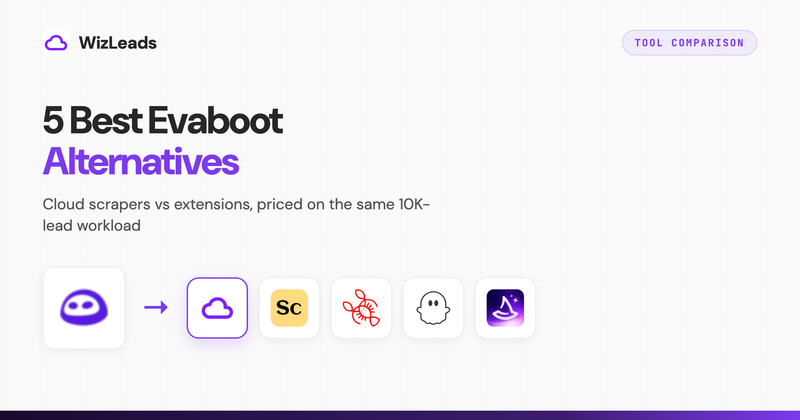

Evaboot turns a Sales Navigator search into a clean CSV from a Chrome extension, and at a few hundred leads a week that is a reasonable place to be. The search for an alternative usually starts when one of four things begins to hurt: every export runs through your own LinkedIn session, the 2,500-result cap turns a large territory into a week of batched exports, the email layer bills you for addresses it has already flagged as risky, and the credit maths stops working at volume.
We build in this category. WizLeads is our product and it is first on the list below, so read the pricing rather than the ranking. Every figure in this post was read off the vendor's own pricing page on 8 September 2026, including Evaboot's, which moved to a volume slider some time after most comparison posts about it were written. Numbers you find elsewhere for these tools are largely stale. Where a competitor beats us, it is written into its section, and there is a section further down on who should stay on Evaboot rather than switch at all.
How these were picked and priced
The job being priced is the one most people are actually buying: take a Sales Navigator search, get the profiles out, attach a work email to each one, and verify it before it touches a sequencer. Tools are ranked on four things in this order: how much of your own LinkedIn account the export exposes, what happens when a search runs past 2,500 results, whether the email layer is verified before export or merely found, and what the whole thing costs.
The standard workload is 10,000 verified emails delivered. Find rates across the enrichment tools we have tested cluster around 60 percent, so landing 10,000 emails means scraping roughly 16,700 leads. Each tool's own credit rules are then applied to that workload, and the cost shown is the cheapest plan tier that covers it inside one month. That rule is deliberately unflattering to everyone including us, because quoting a per-credit rate off a vendor's largest plan makes every tool look cheaper than the invoice you will actually pay. Dividing by ten gives a cost per 1,000 verified emails, which is the number worth carrying into a spreadsheet.
Two things sit outside every price below. Each tool here needs a live Sales Navigator seat on top, which LinkedIn prices at $119.99 a month for Core and $159.99 for Advanced, so what Sales Navigator really costs stacks on top of all of it. And the 2,500-result ceiling belongs to LinkedIn rather than to any vendor, so the question is never whether a tool removes it but how each one works around the export limit.
The comparison table
| Tool | Type | Your LinkedIn account | Past 2,500 results | Email layer | Cheapest plan covering the 10K job | Per 1,000 emails |
|---|---|---|---|---|---|---|
| Evaboot | Chrome extension | runs as your session | split searches by hand | found and verified, safe and risky tiers | $499 | $49.90 |
| WizLeads | cloud, account-less option | untouched in account-less mode | automatic link splitting | found and verified in one pass | $199 | $19.90 |
| Coldcast | hosted cloud browser | runs as your session | 20,000 rows a day | waterfall find, verify sold separately | $46 | $4.60 |
| Scrupp | cloud plus cookie extension | reads your session cookie | split searches by hand | found and verified | $349 | $34.90 |
| Lobstr | cloud plus cookie extension | reads your session cookie | standalone URL splitter tool | 9 credits per email found | $500 | $50.00 |
| Wiza | extension plus web app | runs as your session | export in batches | found and verified | $1,524 | $152.40 |
| PhantomBuster | cloud, session based | reads your session cookie | split searches by hand | BetterContact, 1 credit per attempt | Scale does not cover it | $73.17 on Scale alone |
| Skrapp | extension plus lead search | runs as your session | daily search caps bind first | found and verified | $129 | $12.90 |
| Apify | actor marketplace | actor asks for your li_at cookie | depends on the actor | none at platform level | about $84, profiles only | not comparable |
| Kanbox | cloud, session based | runs as your session | 75,000 imports a month on Pro | separate credit packs | $230 | $23.00 |
What Evaboot costs in 2026
Evaboot dropped named tiers in favour of a single plan on a volume slider. One credit exports one lead or one account. One more credit buys an email that Evaboot finds and verifies. Emails it cannot find are free, so a lead delivered with an email costs two credits and a lead delivered without one costs a single credit. Seats and connected Sales Navigator accounts are unlimited on every tier, and credits roll over as long as the subscription stays active. Tiers below are read from Evaboot's own pricing page, checked 8 September 2026.
| Credits a month | Monthly | Billed yearly |
|---|---|---|
| 100 | $9 | $90 |
| 500 | $29 | $290 |
| 1,500 | $49 | $490 |
| 4,000 | $99 | $990 |
| 8,000 | $149 | $1,490 |
| 20,000 | $299 | $2,990 |
| 50,000 | $499 | $4,990 |
| 100,000 | $899 | $8,890 |
| 200,000 | $1,699 | $16,990 |
The standard workload lands at 16,700 credits for the scrape plus 10,000 for the emails, so 26,700 credits. The 20,000 tier at $299 is short, which pushes the job onto the 50,000 tier at $499, or $49.90 per 1,000 verified emails. Buying a year up front takes two months off. The pricing page also allows subscribing and cancelling immediately to get a single month of credits with a month to spend them, which is the cheapest legitimate way to run a one-off list.
There is no free tier. The cheapest way in is $9 for 100 credits, which buys 100 exported leads or 50 leads with emails attached.
What Evaboot gets right, and where it loses people
The one-click export is the smoothest onboarding in this category, and the data cleaning is the feature people actually name in reviews. Evaboot re-checks each result against the Sales Navigator filters you set and flags rows that do not match, which catches the false positives LinkedIn search starts returning once you get past the first few pages. It carries a 4.6 rating on G2 and states 200,000-plus users on its own site. Unlimited seats and unlimited connected Sales Navigator accounts on every tier is rare in a category that mostly bills per seat. None of that changes the four structural limits below.
The extension runs as you. Every export travels through your own logged-in Sales Navigator session, so the account doing the work is yours. Evaboot manages this with pacing rather than removing it, which is the honest position for any extension. The exposure is real, and it is also the same bet Scrupp, Lobstr, Wiza, PhantomBuster, Skrapp, Kanbox and every Apify actor asking for your li_at cookie are making. Only an account-less mode changes the shape of that risk.
The cap is handled by hand. Evaboot's own FAQ puts the ceiling at 2,500 leads or 1,000 companies per search, and tells you to split the search into narrower ones by headcount, geography or industry and export each. Those are LinkedIn's own display caps, not Evaboot's invention, so every tool on this list hits the same wall. That is correct advice, and it is also an hour of manual work every time a territory is bigger than one search, repeated per client if you run an agency.
You pay for risky emails at the same rate as safe ones. This is the sharpest criticism available and it comes from Evaboot's own published numbers rather than from review-site anecdote. Evaboot states a 60 to 80 percent discovery rate, guarantees 97 percent deliverability on emails it labels safe, and puts deliverability on its risky emails at 83 percent. Its pricing FAQ then says it charges one credit per email found, safe or risky. So roughly one in six risky addresses bounces, you were billed for it, and filtering them out of a send is left to you. For comparison, the verification engine we run posted a 0.59 percent real bounce rate across a 1,000-address send in our six-verifier test, and the distance between 3 percent and 0.6 percent is the distance between a sending domain that survives a quarter and one that does not. I have watched clients push an unfiltered export straight into a sequencer and burn two domains in a fortnight.
The credit maths compounds. At two credits per delivered lead, volume moves you up the slider quickly. Ten thousand emails needs the $499 tier. Fifty thousand exported profiles with no enrichment at all needs it too.
Who should stay on Evaboot
Switching costs time and every tool below has a limitation of its own, so it is worth being clear about who should not bother. Stay if you are exporting under roughly 2,000 leads a month, because at that volume the $49 tier is competitive with everything here and the ergonomics are better than most of it. Stay if the filter-matching cleanup is doing real work on your searches, since no other tool on this list replicates it and false positives cost more than credits do. Stay if you run a team, because unlimited seats and unlimited connected Sales Navigator accounts on a $99 plan is a better deal than the per-seat and per-account tools here can match. And stay if you are already downloading only the safe emails and verifying elsewhere, because that habit neutralises the main quality objection.
Switch when volume pushes you past the $299 tier, when manual search splitting starts eating a day a week, or when your LinkedIn account is too valuable to keep inside the export path.
The alternatives
1. WizLeads
WizLeads scrapes Sales Navigator on its own cloud infrastructure. There is no extension and no cookie to hand over, which is the one structural difference on this list.
Your LinkedIn account. Account-less mode runs the extraction without your session, so there is no account to throttle and no daily quota defending it. It costs 2 credits per lead instead of the 1 credit charged when you connect your own account, which is the honest price of the isolation.
Past 2,500 results. Smart Link Splitting breaks an oversized search into sub-searches by geography, company size and other filters, runs them in parallel and deduplicates the output, so a territory of any size is one paste-and-run job. It is gated to the Agency plan and above, and no other tool in this comparison does it at all: everywhere else an oversized search is a manual job of slicing filters until each sub-search fits under the cap.
The email layer. Enrichment and verification run in the same pass as the scrape, at 3 credits per email actually found and nothing for misses. In our 1,000-lead enrichment benchmark that pipeline returned 670 verified-valid emails per 1,000 leads with zero invalids surviving verification, against a field that ran from 259 to 633. The raw data is published there, so audit the claim rather than taking this section on trust.
Price. Freelancer $39 for 10,000 credits, Agency $99 for 40,000, Cartel $199 for 100,000, Kingpin $499 for 300,000. Credits roll over for one month. The first month on Freelancer is $1, and staying past it holds a 20 percent early-adopter discount for as long as the account lives, so testing the 10,000-credit tier against your own list costs a dollar rather than thirty-nine.
The 10,000-email job. 16,700 leads at 2 credits account-less is 33,400, plus 30,000 for the emails, so 63,400 credits. Agency at 40,000 is short, which puts the job on Cartel at $199, or $19.90 per 1,000 verified emails. Connect your own account and it drops to 46,700 credits, still Cartel.
Where Evaboot beats us. Track record and social proof, at 200,000-plus users against a much newer product. Native connectors: Evaboot ships HubSpot plus Zapier, Make and n8n out of the box, where WizLeads is API-first and expects you to wire it up. And Evaboot's filter-matching cleanup has no equivalent here, so if your Sales Navigator searches return a lot of false positives you will be filtering them yourself. Smart Link Splitting also being gated above the entry plan is a fair thing to hold against us.
2. Coldcast
Coldcast sells three separate credit types with no subscription attached, and it runs this workload for less than a tenth of what most of the list charges.
Your LinkedIn account. It runs your own logged-in session inside a hosted cloud browser, so the session is yours. A 20,000-row daily ceiling is the stated safety mechanism.
Past 2,500 results. No automatic splitting. The daily cap is the binding constraint rather than the per-search one.
The email layer. A waterfall across ten or more sources, billed only when an address comes back. Verification is a separate credit pool at 1 credit per email, which means you can also run lists you already own through the same account.
Price. Scraping credits $3 per 10,000, at 1 credit per Sales Navigator lead row and 2 per company or LinkedIn-search row. Enrichment $30 per 10,000, at 1 credit per email found and 3 per domain enriched. Verification $10 per 10,000. All three never expire and none require a subscription. The trial is one day of 100 scraping credits plus 50 enrichment and 50 verify credits.
The 10,000-email job. Two scraping packs at $3, one enrichment pack at $30, one verify pack at $10. Forty-six dollars paid once, about $4.60 per 1,000 verified emails, with leftover credits that keep.
What that price costs you. Coldcast is the newest and smallest vendor here, and its account-safety marketing rests on its own report of no bans across six months of its own usage, which is a short window and not an independent test. There is no published benchmark of its email quality, so the money you save should partly go on verifying a sample before you trust a full list. The waterfall also routes through third-party providers, which means data quality is partly somebody else's to control.
3. Scrupp
Scrupp moved onto the same volume-slider model as Evaboot and now charges for scraping as well as enrichment, which older comparison posts still get wrong.
Your LinkedIn account. A Chrome extension reads your session cookie, then extraction runs server-side so you can close the browser. Scrupp's own FAQ describes throttling and rate limiting as the safety mechanism and says risk is reduced rather than removed.
Past 2,500 results. No automatic splitting. Sales Navigator searches cap at 2,500 and the guidance is to segment the search yourself.
The email layer. One extra credit per verified work email, two per phone number, nothing for misses. Re-verifying an address you already hold is free, which is a useful piece of pricing. Scrupp advertises a 65 percent average find rate on its own site, which is a vendor claim rather than a tested one.
Price. Monthly, by credits: $29 for 1,000, $39 for 2,000, $59 for 5,000, $99 for 10,000, $179 for 20,000, $349 for 50,000, $599 for 100,000. Yearly billing takes roughly 25 percent off. One-time packs that never expire run $35 for 1,000 up to $719 for 100,000. The free plan is 100 credits with no card.
The 10,000-email job. 26,700 credits, the same as Evaboot, landing on the 50,000 tier at $349 or $34.90 per 1,000. Buying it as one-time packs is cheaper: a 20,000 pack at $215 plus a 10,000 pack at $119 is $334 for 30,000 credits that never expire.
What that price costs you. Scrupp's own pages disagree with each other about what its plans cost, with the knowledge base and the homepage both quoting figures the pricing page contradicts, which is not what you want from the vendor holding your card. Support and billing complaints recur across its review pages. And the export ceiling is 2,500 leads per Sales Navigator search on every tier below the 10,000-credit plan.
4. Lobstr
Lobstr has the lowest headline credit price in this comparison and an email charge that undoes most of it.
Your LinkedIn account. A Chrome extension syncs your Sales Navigator session cookie. Lobstr publishes a ceiling of 5,000 profiles per day per account, the most specific safety figure any vendor here gives.
Past 2,500 results. No automatic splitting inside the scraper, but Lobstr ships a free standalone Sales Navigator URL splitter as a separate web tool, so the work is at least mechanical rather than manual.
The email layer. Nine credits per profile where an email is found, nothing for misses. Phone enrichment is 300 credits per number. Lobstr does not publish a catch-all handling policy for its enrichment output, so verify before sending.
Price. Free plan 100 credits a month with exports capped at 30 rows per request. Starter $20 for 10,000 credits, Pro $100 for 100,000, Team $500 for 1,000,000. Credits do not roll over. Scraped data is deleted after 7 days on free and 28 days on paid plans.
The 10,000-email job. 16,700 credits for the profiles plus 90,000 for the emails is 106,700, which overshoots the 100,000-credit Pro plan by 6,700 and lands on Team at $500. That cliff is the whole story with Lobstr. At 1 credit per profile it is the cheapest raw scraper here, and the 9-credit email charge makes an email-heavy job jump an entire plan tier. Run it for profiles only and 16,700 leads still needs the $100 Pro plan, because Starter tops out at 10,000 credits. The credits themselves cost $16.70 at Pro's rate; the plan is what you actually pay.
What that price costs you. Lobstr mentions add-on credits for topping up between tiers but does not publish add-on prices, so the tier maths above is the only planning the public page supports. Credits expiring monthly also means an uneven workload wastes what you bought.
5. Wiza
Wiza is the closest like-for-like swap for Evaboot's ergonomics, and it prices email quality rather than credits.
Your LinkedIn account. A Chrome extension plus a web app, running as your session, with the same exposure profile as Evaboot.
Past 2,500 results. Export in batches. The annual plans additionally cap exports at 2,500 a month.
The email layer. This is where Wiza earns its place. In our enrichment benchmark it found more emails than any other tool tested, 671 per 1,000 leads, but 38 of those were invalid, netting 633 verified-valid against our 670 with zero invalids. Second place on a 1,000-lead test is a real result, and it means Wiza is the one tool here whose email output is unlikely to be the weak link.
Price. Free tier of 20 valid emails and 5 phone numbers. Monthly: Starter $49 for 100 valid emails and 100 phone numbers, then $0.15 and $0.35 per extra. Email $99 for 500 valid emails, then $0.15 each. Email plus Phone $199 for 500 of each. Annual: the Email plan is $990 a year with unlimited email reveals, the Email plus Phone plan is $1,990.
The 10,000-email job. On the monthly Email plan, $99 covers 500 and the remaining 9,500 cost $0.15 each, so $1,524, or $152.40 per 1,000. The annual plan is the sane route at $990 for the year with unlimited reveals, but the 2,500 exports a month ceiling means 16,700 leads takes about seven months of quota to move.
What that price costs you. Wiza is priced per valid email rather than per credit, which is excellent for accuracy and punishing for volume. Anyone running more than a few thousand leads a month is choosing between a monthly bill in four figures and an annual plan whose export cap sets the pace of the work.
6. PhantomBuster
PhantomBuster is the generalist, and the only tool here that treats Sales Navigator as one platform among many.
Your LinkedIn account. Session-cookie based, running on PhantomBuster's servers rather than your machine.
Past 2,500 results. Split the search yourself and chain the Phantoms.
The email layer. One email credit per address found, drawn from a monthly allowance that runs 500 on Start, 2,500 on Grow and 10,000 on Scale, with 50 on the free trial. Discovery is handled by BetterContact, bundled into the plan. You can swap in Dropcontact, Hunter or Snov.io instead, but only on your own API key, so that route bills you twice.
Price. Monthly: Start $69, Grow $159, Scale $439. Billed annually those become $56, $128 and $352 a month, at $672, $1,536 and $4,224 a year. The trial is free with 50 email credits and exports capped at 10 rows. Users are unlimited on every tier.
The 10,000-email job. This is the one place PhantomBuster's pricing is easy to misread. Scale carries 10,000 email credits a month, and PhantomBuster's own documentation defines one credit as one attempt to find and verify an email for one profile, not one address delivered. At the 60 percent find rate this comparison uses throughout, 10,000 attempts return about 6,000 emails. The 10,000-email job therefore does not fit inside a month of Scale at all: it needs roughly 16,700 attempts. Taken as Scale alone, $439 monthly buys about 6,000 emails, or $73.17 per 1,000, which is nearly double what a per-found-address reading would suggest. Finishing the job needs a credit top-up, and PhantomBuster does not publish top-up prices.
What that price costs you. For a single Sales Navigator to verified email pipeline it is the most expensive subscription in this comparison and the steepest to learn, and Phantoms break when a platform changes its UI. What you get in return is over 100 automations across 15-plus platforms chained into workflows, which nothing else here comes close to. If Sales Navigator is one of six sources you pull from, that breadth is the reason to pay.
7. Skrapp
Skrapp appears on more competitor shortlists than any tool except PhantomBuster, and it is worth knowing why it is on them before you buy it.
Your LinkedIn account. Chrome extensions for LinkedIn Basic, Sales Navigator and Recruiter, running as your session, plus a hosted Lead Search over its own database.
Past 2,500 results. The Sales Navigator cap is not the binding constraint here. Skrapp's own daily ceilings are: 20 people searches a day at 100 results each on Professional, 150 searches at 400 results each on Enterprise. That is the number that decides whether Skrapp can move your volume.
The email layer. One credit per deliverable email found, marked Valid or Catch-all. A finder miss is not charged, but verification is metered separately at one credit per check, invalid results included, per Skrapp's API documentation. Credits roll over and survive cancellation, which is the most generous credit policy on this list.
Price. Free $0 for 50 credits and 1 user. Professional runs on a slider at 2K $39, 5K $99, 10K $129 and 25K $199 a month for 5 users, or $29, $74, $97 and $149 billed annually. Enterprise continues it at 50K $349, 100K $599, 250K $999 and 500K $1,499, or $262, $449, $749 and $1,124 annually, for 15 users.
The 10,000-email job. 10,000 email credits, which the Professional 10K tier covers exactly at $129 a month, or $12.90 per 1,000. Billed annually it drops to $97, or $9.70 per 1,000, the second-cheapest route on this list.
What that price costs you. Skrapp is an email finder with LinkedIn extensions bolted on rather than a bulk Sales Navigator exporter, and the daily search caps make that obvious the first time you try to move a large list. Where it wins is the credit policy, since not being charged for Unknown results and keeping credits after cancellation removes two of the ways credit-based tools quietly cost more than advertised.
8. Apify
Apify is a marketplace rather than a product, which changes what you are buying.
Your LinkedIn account. Depends entirely on the actor. The most-used Sales Navigator actor asks you to paste your li_at cookie into the run input, which puts your session in an individual developer's hands. Several competing actors advertise a no-cookie mode.
Past 2,500 results. Actor-dependent, and not something the platform guarantees.
The email layer. None at platform level. The leading actor returns emails only on a deep scrape and only when available, so you will be bolting on a separate finder and verifier.
Price. Platform plans are Free with $5 of monthly usage, Starter $19, Scale $199 and Business $999, with compute billed on top at $0.20, $0.20, $0.16 and $0.13 per compute unit. Prepaid usage does not roll over. Actors are priced independently by their developers: the most-used Sales Navigator actor starts at $5.00 per 1,000 results and carries a 4.4 rating across 38 reviews.
The 10,000-email job. 16,700 results at $5 per 1,000 is about $84 in actor charges on top of whichever platform plan you hold, and that buys profiles only. The email layer is a separate purchase from a separate vendor, so the per-1,000 figure is not comparable with the rest of this table.
What that price costs you. You are relying on an individual developer's actor to track LinkedIn's changes, with support quality and update cadence varying by actor and nobody to escalate to when an export breaks mid-campaign. The upside is real. If you have engineers and want Sales Navigator inside a larger pipeline you control, Apify gives you that with an API and MCP access, and no other tool here lets you swap the scraper out without changing vendors.
9. Kanbox
Kanbox belongs on this list because people arrive at it from the same search, but it is solving a wider problem than exporting a CSV.
Your LinkedIn account. Cloud-based and session-based, with anti-detection delays and, on the Agency tier, the option to bring your own proxies.
Past 2,500 results. The relevant ceiling is the monthly lead import allowance rather than the per-search one: 300 a month on Starter, 600 on Essential, 75,000 on Pro and Agency. The two cheapest plans cannot do bulk export at all.
The email layer. A separate credit pool from the subscription, at 1 credit per email found, credits that never expire, and 30 of them in the trial.
Price. Monthly: Starter $20, Essential $45 per LinkedIn account, Pro $80 per LinkedIn account, Agency 10 at $399 for five to ten accounts. Annual billing takes those to $12, $30, $50 and $279. Email finder credit packs start at $15 per 1,000 found emails. The trial is 15 days with no card.
The 10,000-email job. Pro at $80 a month covers the 16,700 imports, and 10,000 email credits at the published $15 per 1,000 rate adds $150, so about $230 or $23.00 per 1,000. Kanbox publishes a ladder of credit packs on the same page, so larger jobs get a lower per-email rate than the 1,000-credit entry price implies.
What that price costs you. Kanbox is an outreach tool with a Kanban CRM, a unified LinkedIn inbox, campaign sequences and AI reply handling, and the export is a feature inside that rather than the product. If you already run sequencing elsewhere you are paying for a stack you will not use, and the per-LinkedIn-account pricing multiplies for agencies in a way the credit-based tools do not.
Tools that did not make the list
Captain Data is the closest near-miss. It is a clean API with SOC 2 Type II certification, people and company search endpoints modelled on Sales Navigator, and MCP support, and its usage-based pricing runs from a base of $65.98 per 1,000 credits down to $32.98 per 1,000 at a 20,000-credit monthly commitment, which is $660 a month. It also runs on your LinkedIn session rather than its own infrastructure: you either supply the session cookie yourself or use its native login, where you enter your LinkedIn email and password and Captain Data extracts the cookie for you. Convenient, but the account exposure is identical either way. Two further things keep it off the ranking. Its published endpoint list has no email-finding endpoint, so it cannot do the job this article is about without a second vendor. And unused credits do not roll over, which at that price is a real tax on uneven workloads.
Database tools that sell you contacts rather than scraping the search you built are a different purchase and are deliberately excluded, as are LinkedIn automation tools whose export exists only to feed their own sequencer.
Free tiers and trials, ranked by how much you can actually test
Most free tiers in this category are too small to tell you anything about email quality, which is the thing you most need to test.
Coldcast gives 100 scraping credits a day for one day plus 50 enrichment and 50 verify credits, the only free tier here that lets you test finding and verification as separate steps. Scrupp gives 100 credits with no card, enough for roughly 50 leads with emails attached. Skrapp gives 50 credits on a permanent free plan, but with no list exports, so you can read results without taking them anywhere. Wiza gives 20 valid emails and 5 phone numbers, a small sample of properly verified output. Lobstr gives 100 credits a month permanently and caps free exports at 30 rows per request. PhantomBuster's trial includes 50 email credits with exports capped at 10 rows. Apify gives $5 of platform usage a month, roughly 1,000 results from a $5-per-1,000 actor. Kanbox runs 15 days with 30 email credits. Evaboot has no free tier and starts at $9 for 100 credits.
The test worth running on any of them is the same. Pull 50 leads from a search in your actual market, take the emails, and verify them somewhere other than the tool that found them. Find rate and bounce rate on your own ICP are the only two numbers that decide this, and every vendor claim about either, ours included, is untested until you check it on your own list.
Moving off Evaboot without losing your lists
The switch is mostly a data problem rather than a tooling one. Evaboot exports plain CSVs and the LinkedIn profile URL travels in every row, which makes it the join key for everything that follows. Keep the historical exports, keep the profile URLs, and you keep your suppression list.
Work in this order.
- Pause rather than cancel. Evaboot's billing page allows pausing for one, two or three months, and credits stay usable while paused with billing restarting on its own. Cancelling a monthly plan lets you spend credits until the end of the period and then stops. A yearly subscription cannot be cancelled or downgraded before the contract ends, so pausing is the only lever there.
- Export everything you still need first. Stored searches and credits stop being reachable once the subscription lapses.
- Build a suppression file of every address you have already contacted, keyed on both email and profile URL, and load it into the new tool or into your sequencer. A fresh scraper has no memory of who you have already burned.
- Re-verify anything Evaboot labelled risky rather than re-sending it. Those are the rows carrying the 83 percent deliverability.
- Re-run one Sales Navigator search you have exported before through the new tool and compare the two files row by row on find rate and field completeness. That is the only honest way to know whether you have improved anything, and it is what every free tier above is for.
Do not migrate mid-campaign. Let the current sequence finish, switch between campaigns, and the suppression file does its job.
How to choose
The fork is architectural before it is about features. If your LinkedIn account must stay out of the export path, account-less cloud scraping is the only thing that qualifies and WizLeads is currently the only tool here offering it. If you accept managed session exposure, the question narrows to price and email quality, and those split cleanly. Coldcast is the cheapest by a wide margin, at roughly a quarter of what WizLeads costs for the same 16,700-lead job. What the difference buys is the account-less path, so no LinkedIn seat is exposed to the export at all, automatic splitting of searches past the 2,500 cap, and emails found and verified in the same pass rather than handed to a second vendor. If your LinkedIn account is not part of the risk calculation and you are happy to run verification separately, that gap is real money and Coldcast is the rational pick. Wiza has the best-tested email output. Lobstr is cheapest for profiles without emails. Scrupp and Skrapp sit in the middle on both. Evaboot and Wiza win on how little you have to think about the tool.
If Sales Navigator is one source among many, PhantomBuster is the only real answer. If you have engineers and want to own the pipeline, Apify. If you want the export and the outreach in one place, Kanbox. And if you are under 2,000 leads a month with searches Evaboot's filter cleanup is improving, the right move is to stay.
Whatever scrapes the profiles, judge the email layer as a separate purchase. The spread between finders on identical input was 2.6x in our benchmark, and an unverified export from any of these tools will cost you sending domains faster than it saves you money. Once the list exists, the path from Sales Navigator search to sequencer is the same regardless of which tool built it.
FAQ
What is the best alternative to Evaboot?
It depends which constraint is hurting. WizLeads for keeping your LinkedIn account out of the export. Coldcast for the lowest cost per enriched lead. Lobstr for the cheapest raw profile scraping. Wiza for the best-tested email output. PhantomBuster for automation beyond LinkedIn.
How much does Evaboot cost in 2026?
One plan on a slider, from $9 a month for 100 credits to $1,699 for 200,000. A lead costs 1 credit to export and 1 more for an email found and verified, so a lead with an email is 2 credits and a miss is free. Credits roll over while you are subscribed, seats are unlimited, and yearly billing takes off two months.
Why do people look for Evaboot alternatives?
The extension runs as your own LinkedIn account, the 2,500-result cap is handled by splitting searches by hand, you are billed one credit for every email found including the risky ones Evaboot itself rates at 83 percent deliverability, and 10,000 delivered emails needs the $499 tier.
Is there a Sales Navigator scraper that does not risk my LinkedIn account?
Only with account-less cloud scraping, where the vendor's infrastructure does the extraction and your session is never used. Session-cookie tools reduce exposure through throttling and daily caps. Extensions concentrate it, because they act as your account directly.
What does it cost to deliver 10,000 verified emails from Sales Navigator?
Scraping about 16,700 leads at a 60 percent find rate, priced on the cheapest plan that covers the job in a month: Coldcast about $46, Skrapp $129, WizLeads $199, Kanbox about $230, Scrupp $349, PhantomBuster $439, Evaboot $499, Lobstr $500, Wiza $1,524 monthly. Divide by ten for the cost per 1,000.
Does Evaboot have a free plan?
No. The cheapest entry is $9 a month for 100 credits. Among the alternatives, Coldcast is the only free tier that lets you test finding and verification separately. Scrupp's 100 credits, Skrapp's 50 and Wiza's 20 valid emails are enough to sample data quality. Lobstr and PhantomBuster cap free exports at 30 and 10 rows, so they show you field structure and nothing else.
How do I cancel Evaboot without losing my credits?
Cancelling a monthly plan lets you use credits until the end of the billing period, after which they stop being reachable. Evaboot also documents a pause option of one, two or three months from the billing page, with credits staying usable while paused and billing restarting automatically, which is the safer move while you trial a replacement. Yearly subscriptions cannot be cancelled or downgraded mid-contract.