WizLeads

Search for a free LinkedIn scraper, or type it the other way round as LinkedIn scraper free, and Google returns a page of listicles about paid tools. The one ranking first says its own free plan carries 100 email credits a month, where its pricing page says 50, and it puts Derrick's free plan at 200 credits a month, where Derrick's pricing page says 100. Another recommends Proxycurl and quotes two prices for it, and Proxycurl's own homepage now says the service is no longer running and redirects you to a different company.
So here is the version with the numbers read off each vendor's own page on 8 September 2026, including the ones that make the free option look worse.
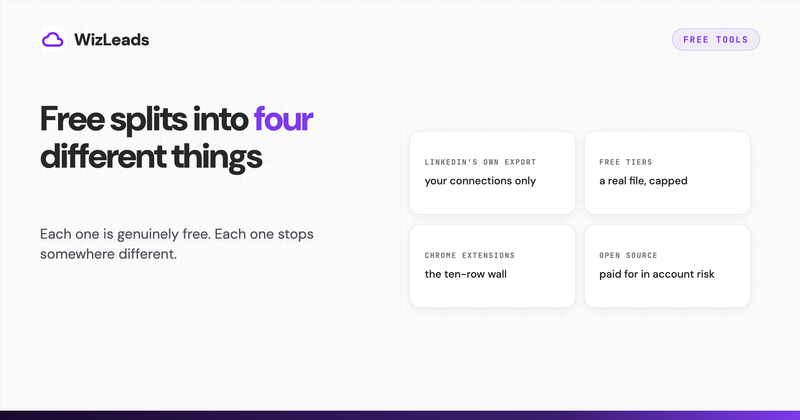
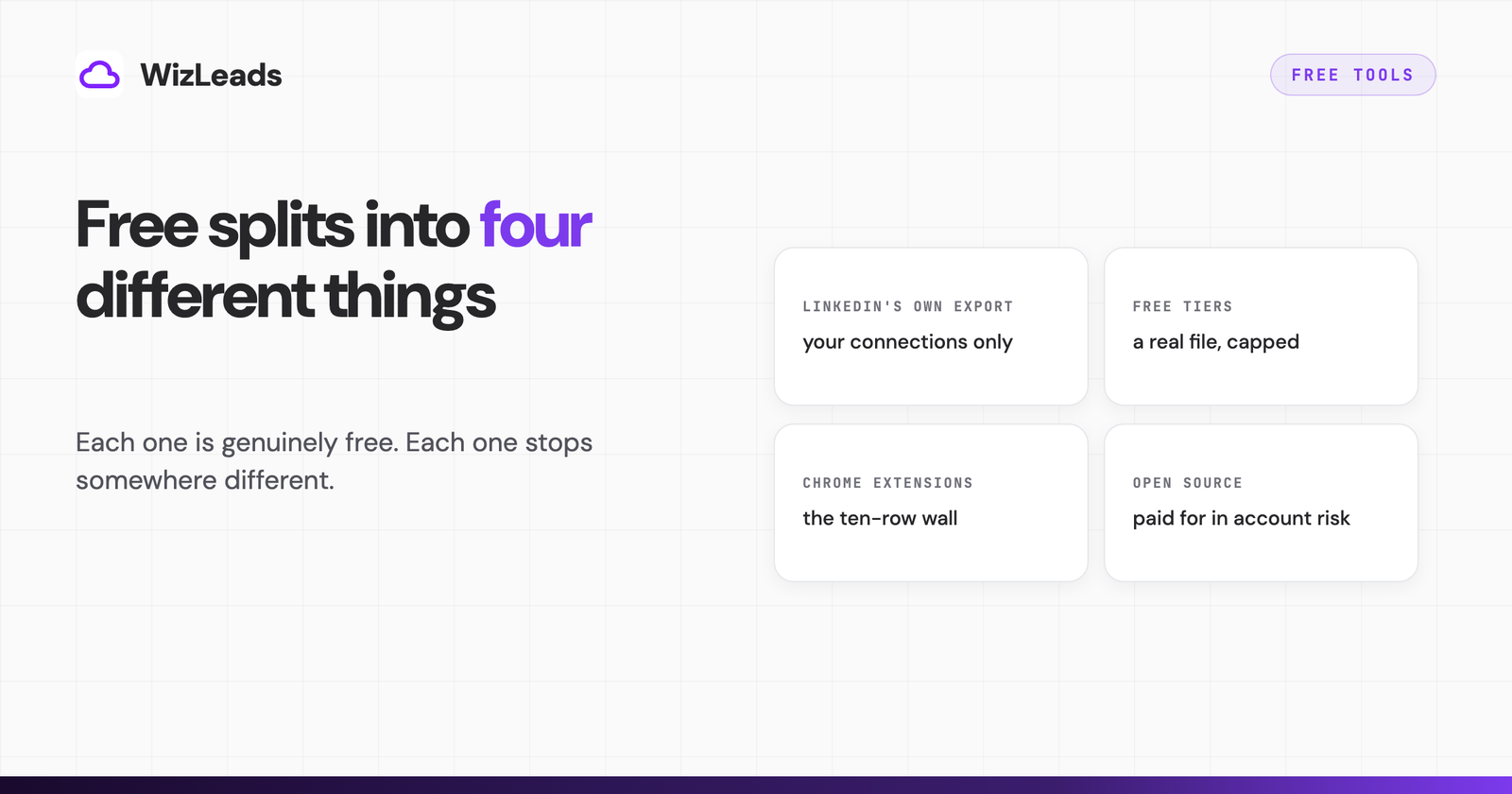
Free splits into four different things
Sorting by what you can walk away with beats sorting by price, since everything here starts at zero.
Free with no expiry. LinkedIn's own data export, and open-source code you run yourself. Nobody can revoke these.
A recurring monthly allowance. Bright Data's 5,000 records, Apify's $5 of platform credit, Vayne's 200 leads, Derrick's 100 credits. These refill every month and they do not ask for a card.
A one-time sample. Scrupp's 100 leads, Wiza's 20 emails, Skrapp's 50 credits. Useful for deciding whether to buy, useless as a workflow.
Free to run, not free to export. This is the category that wastes an afternoon, and it is where most tools marketed as free LinkedIn scrapers actually live.
LinkedIn's own export, which almost nobody lists
LinkedIn will give you a CSV of your first-degree connections for nothing. Click the Me icon, open Settings & Privacy, then Data Privacy, then "Download your data" under the section on how LinkedIn uses your data. Connections now come only with the larger archive. LinkedIn's help page says that download arrives "within 24 hours", then lists the Connections file under "Available within 48 hours", so plan on up to two days. Either way the download link stays live for 72 hours and the feature does not work on mobile.
The Connections file carries first name, last name, public profile URL, company, position and connection date. Email addresses appear only where that connection has allowed it in their own privacy settings, which is why your export will have gaps you cannot fill. LinkedIn's help page is explicit that it hands over your data and not other members', so there is no People You May Know file and no profile viewers list. LinkedIn documents all of it here.
What this cannot do is prospecting. It is a mirror of a network you already have, so it will not build a cold list. What it is good for is seeding a CRM, finding warm intro paths into target accounts, and reading your own network to work out which titles and industries actually reply to you before you go and buy a list of strangers.
The two free tiers that hand you a real file
Bright Data: 5,000 records a month, no card
Bright Data's Web Scraper API pricing page lists a free tier of 5,000 records a month with no credit card required, where the page defines a record as one extracted item and uses one LinkedIn profile as its example. Past that it is $1.50 per 1,000 records on pay as you go, and you are only billed for successful deliveries. That is the largest recurring free allowance in this category by a wide margin.
The LinkedIn people profile scraper returns ID, name, city, country code, position, about, posts and current company. No email field, so 5,000 free records gives you 5,000 profiles rather than 5,000 contactable leads. It also wants input URLs. Bright Data does have a LinkedIn people search scraper, but the usage counters on its own product page put it at a few hundred users against 125,000 for the profile scraper, so treat profiles as the mature half of the product.
Apify: $5 of platform credit a month
Apify's free plan is $0 with $5 a month to spend on store actors or your own, priced at $0.20 per compute unit, no credit card, five concurrent runs and 16 GB of actor memory. The $5 refills monthly rather than expiring after a trial.
Work out what $5 buys and the picture gets concrete. Harvestapi's profile scraper, which Apify's listing shows 9,603 people used in the last 30 days, charges $0.004 per profile and $0.01 per profile when you add an email search, and its listing states no cookies or account are required. That is about 1,250 profiles a month for free, or about 500 with an email lookup attached. The matching search actor charges $0.10 per page of search results on top.
Apify is a marketplace with nearly 70,000 actors in it, so quality swings hard between them. An actor can be deprecated by its developer without warning, and you are the one checking whether its field mapping still matches what LinkedIn renders this week.
Octoparse AI: free, but it runs on your machine
Octoparse AI gives a usable free tier, and its catch is architectural rather than numeric. On the free plan the extraction runs locally, on your own computer, which means your machine has to stay awake for the length of the job and your own connection is doing the work. Cloud extraction, where their infrastructure runs it and you close the laptop, is paid only. For a few hundred rows that distinction costs you nothing. For a territory-sized job it is the difference between a background task and an afternoon.
Free Chrome extensions and the ten-row wall
A Chrome Web Store listing ranks on page one for this exact search, which is how most people end up installing a free LinkedIn data scraper without reading past the description. Profile Scraper for LinkedIn has 4.9 stars from 123 ratings and about 3,000 users, and its description walks you through entering keywords and downloading profiles. Further down the same listing, under Terms: you are entitled to export up to 10 data entries for free, and to export more you upgrade to Pro.
That cap is the category norm rather than one stingy developer. PhantomBuster's pricing page shows a free Trial plan with five automation slots, two hours of execution time and 50 email credits, then lists "Exports limited to 10 rows" as the line separating it from the $672-a-year Start plan. Lobstr's own FAQ says free-plan exports are capped at 30 rows per request with scheduling unavailable and premium scrapers locked. Skrapp's comparison table gives its Free plan 50 credits, 10 people searches a day and 10 results per search, and marks List Exports as unavailable on that tier entirely.
Read those four together and the shape is clear. The free tier lets the scraper run and then meters the one step that matters. You have not saved money at that point. You have spent an hour learning a UI you will have to pay for.
There is a second cost specific to extensions, and it is worth weighing before you install one. We pulled the manifest out of every LinkedIn scraper, exporter and email finder we could find in the Chrome Web Store, 41 of them, and read what each one actually asks for. Most are scoped the way they should be, to linkedin.com and nothing else. Six of the 41 ask for access to every site you visit, and those six carry 414,104 installs between them, the largest being SignalHire at 400,000 users. Thirteen request the cookies permission, which on linkedin.com covers the session cookie that keeps you logged in.
The thing to check is whether what an extension asks for matches what its listing claims. Profile Scraper for LinkedIn, the extension above, requests cookie access on linkedin.com while its store page states the developer will not collect or use your data. That combination is not proof of anything, and reading a session cookie locally is a normal way to make a scraper work. It is a question worth asking the developer before you install it, and neither the star rating nor the install count answers it for you. That risk is not hypothetical. In December 2025 OX Security documented two Chrome extensions with about 900,000 combined users sending complete ChatGPT and DeepSeek conversations, plus the URL of every tab, to servers the developers controlled. The consent screen asked only for anonymised analytics, and one of the two carried Google's Featured badge. Google's own security team puts the base rate low, at under 1% of Chrome Web Store installs carrying malware in 2024, so the odds favour you. The point is that a badge and a five-star rating are not what decides it.
An open source LinkedIn scraper is free forever, and paid for in account risk
The most popular option is joeyism/linkedin_scraper on GitHub, at 4,482 stars and 985 forks, last pushed on 10 April 2026. Version 3 rewrote the whole library from Selenium to Playwright and broke compatibility with version 2, so half the tutorials you find describe an API that no longer exists.
The line that matters is in the README's authentication section: LinkedIn requires authentication, and you have to create a session file first, either by logging in through a visible browser or by passing your credentials. Your account makes every request, from your IP, at whatever speed your loop runs. Paid cloud scrapers spend real engineering effort on throttling and pacing for exactly this reason. A free library does not owe you any of that, so the pacing is your job and the restriction, if it comes, is yours too.
Maintenance is the other bill. The repository has 144 open issues, and two of the five most recent commits are fixes to login detection, which is what happens when LinkedIn changes its interface and every selector downstream stops matching. Running open source means you have signed up to do that work each time it happens.
n8n, and what "self-hosted and free" leaves out
n8n's pricing page points to a Community Edition, described as a standard self-hosted version available on GitHub, against a cloud Starter plan at €20 a month billed annually. Self-hosting costs nothing in licence fees, which is why the n8n route keeps showing up in tutorials and in the YouTube result ranking for this term.
The gap is that n8n is orchestration and not a data source. Its HTTP node has to call something, and that something is either your own LinkedIn session cookie, which puts you back in the section above, or a paid API. What you have built is a free pipeline around a cost you still have to pay, plus a VPS and your own evenings when a node breaks.
Doing it by hand, priced honestly
Manual collection is the only method with no vendor and no account risk, so it deserves a real number rather than a shrug. Assume 45 seconds per profile to open it, copy six fields, paste them into a sheet and check you have not already got that person. That is fast for the task, and it puts 100 leads at 75 minutes and 1,000 leads at roughly 12 and a half hours. At the end you have names, titles, companies and profile URLs.
You do not have email addresses, because LinkedIn profiles have no work email field to copy. That is the same reason no free scraper hands you one: every email in this market comes from a separate lookup against other sources, and that lookup costs the vendor money on every attempt whether it hits or misses.
Four things free never covers
Verified work emails. Wiza's free plan is the only one here that includes any, at 20 valid emails plus 5 phone numbers, and that is a sample rather than a monthly refill.
The result caps. A Sales Navigator people search stops at 2,500 results and a company search at 1,000, no matter what tool you point at it. No free LinkedIn scraping tool ships an answer to this, so you split searches by hand. We wrote up how the Sales Navigator export limits actually work and the export routes around them.
Sales Navigator itself. Most of these tools scrape a Sales Navigator search, and that subscription is not free. LinkedIn publishes the figures on its own compare-plans page: Core is US$119.99 a month or US$1,079.88 a year, Advanced US$159.99 or US$1,799.88, with AUD, CAD, EUR and GBP listed alongside. Only Advanced Plus is quote-only. The full breakdown, including what the annual discount actually saves, sits in its own post.
Anyone to call. Free tiers come with community forums. When an export dies at row 400 on a Friday, that is your problem for the weekend.
When free stops being the cheaper option
Do the arithmetic on your own volume before you decide, because the answer flips fast.
Under roughly 500 profiles a month with no emails needed, the free tiers cover you. Bright Data's 5,000 records alone will do it, and LinkedIn's own export handles the warm half of your list. At that volume nothing paid beats it.
Above that, or the moment you need emails attached, the free options run out at once. Bright Data has no email layer. Apify's $5 covers about 500 profiles with email lookup and then stops. Every extension caps the export.
Disclosure: we build WizLeads, which is a paid Sales Navigator scraper, so read the next paragraph knowing that. The reason it belongs here is that the honest entry price for a free-seeking reader is not the list price. The 10,000-credit plan is $39 a month at 1 credit per lead with a connected account, 2 credits per lead in account-less mode where no LinkedIn credentials or cookies are involved at all, and 3 credits per work email actually found with misses costing nothing. New accounts get the first month at $1 and a 20% discount that holds for as long as you stay.
Compare that against the free options at face value rather than favourably. Bright Data's paid rate of $1.50 per 1,000 records works out to $0.0015 a profile, which is cheaper per raw row than anything we charge. Apify at $0.004 a profile is roughly the same as our connected-account rate of $0.0039. Raw profile cost is not where the difference sits. It sits in what goes in and what comes out: a Sales Navigator search URL as the input instead of a list of profile URLs you had to source somewhere else, an email layer that only bills on hits, and no cap on the export. If none of those three matter to you, the free tiers are the right answer and you should use them.
If you want the same comparison run across nine paid Sales Navigator scrapers with every price read off the vendor's page, that is the Evaboot alternatives breakdown.
Frequently asked questions
Is there a completely free LinkedIn scraper?
Three things are free with no expiry. LinkedIn's own data export gives you a CSV of your first-degree connections at no cost. Open-source Python libraries such as joeyism/linkedin_scraper are free to download and run forever. Bright Data's Web Scraper API includes a free tier of 5,000 records a month with no credit card, and Apify's free plan gives you $5 of platform usage a month, also with no card. Nor do Vayne, Skrapp, Lobstr or Wiza ask for one to open a free account, which makes the whole category cheaper to evaluate than most people assume. Everything else marketed as a free LinkedIn scraper is a sample of a paid product, and most of those cap how many rows you can export rather than how many you can scrape.
How do you scrape LinkedIn for free?
There is no single answer to how to scrape LinkedIn for free, so pick by what you need out of it. For your own network, run LinkedIn's data export: the connections CSV now comes only with the larger data archive, which LinkedIn says takes 24 to 48 hours. For cold profiles at volume, open a Bright Data account and use the 5,000 free records a month, or an Apify account and spend the $5 monthly credit on a no-cookie actor. For a handful of profiles right now, a free Chrome extension will do it, subject to its export cap. For anything you want to run on a schedule and control end to end, self-host n8n or run an open-source library, and accept that both put your own LinkedIn session in the loop.
How many LinkedIn profiles can you scrape for free per month?
Bright Data's free tier is the largest recurring allowance at 5,000 records a month, where one record is one extracted profile. Apify's $5 monthly credit buys about 1,250 profiles through a no-cookie actor priced at $0.004 a profile, or about 500 if you add the email lookup at $0.01. Vayne's free plan allows 200 leads a month and Derrick's allows 100 credits a month. Stacked together those recurring free tiers come to roughly 6,500 profiles a month, none of which arrive with a verified work email.
Will LinkedIn ban you for using a free LinkedIn scraper?
Risk follows the architecture, not the price. A free tool that drives your own logged-in session, which covers every browser extension and every open-source Python library, puts your account and your IP behind each request. That is the configuration most likely to draw a restriction, and free tools rarely include the throttling that paid ones use to manage it. Free tools that run on a vendor's own infrastructure, such as Bright Data's and Apify's free tiers, never touch your session at all.
Can ChatGPT scrape LinkedIn profiles?
No. LinkedIn's robots.txt file opens with User-agent: * and Disallow: /, then names 77 individual crawlers, explicitly disallowing GPTBot, ChatGPT-User, ClaudeBot, anthropic-ai, PerplexityBot, Google-Extended, cohere-ai and CCBot among them. An AI assistant that respects robots.txt will refuse the fetch, and one that ignores it still hits LinkedIn's authentication wall on any profile page. Pasting a profile into a chat window and asking for structured fields works, but that is manual copy and paste with extra steps.
Is there a free LinkedIn scraper Chrome extension?
Several, and the export cap is where they end. The Chrome Web Store listing that ranks on page one for this search, Profile Scraper for LinkedIn, states in its own terms that you may export up to 10 data entries for free and must upgrade to Pro beyond that. The pattern repeats across the category. PhantomBuster's free Trial limits exports to 10 rows, Lobstr's free plan caps exports at 30 rows per request, and Skrapp's own comparison table shows List Exports as unavailable on Free. The scraping is free. The file is not.
Do free LinkedIn scrapers give you email addresses?
Almost never, because a LinkedIn profile carries no work email field. Every email a scraper returns comes from a separate lookup against other sources, and that lookup costs the vendor money on every attempt, so it sits behind the paywall. Bright Data's LinkedIn people profile scraper returns ID, name, city, country code, position, about and current company with no email at all. Wiza's free plan is the exception at 20 valid emails plus 5 phone numbers, and that is a one-time allowance rather than a monthly one.
What does a free LinkedIn scraper actually cost you?
Four things, in rough order of how much they hurt. Export caps, where the tool scrapes happily and then hands you 10 rows. Account exposure, on anything that drives your own session. Maintenance, because LinkedIn ships interface changes and open-source selectors break, with two of the last five commits on the most popular GitHub library being login-detection fixes. And your own hours: at 45 seconds per profile, which is quick for open, copy, paste and dedupe, 1,000 leads collected by hand is about 12 and a half hours.