WizLeads
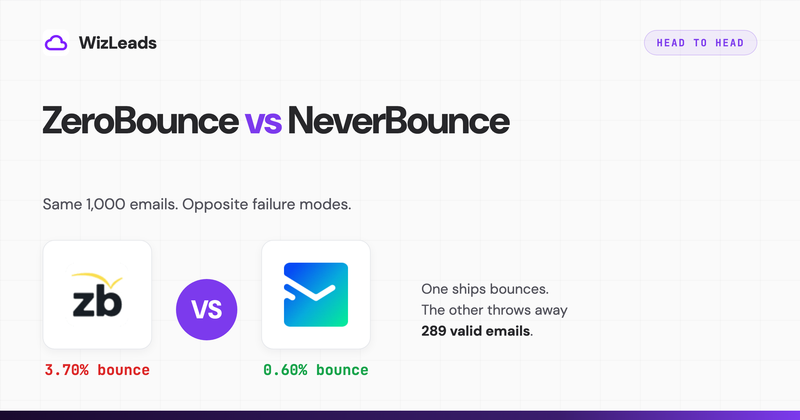

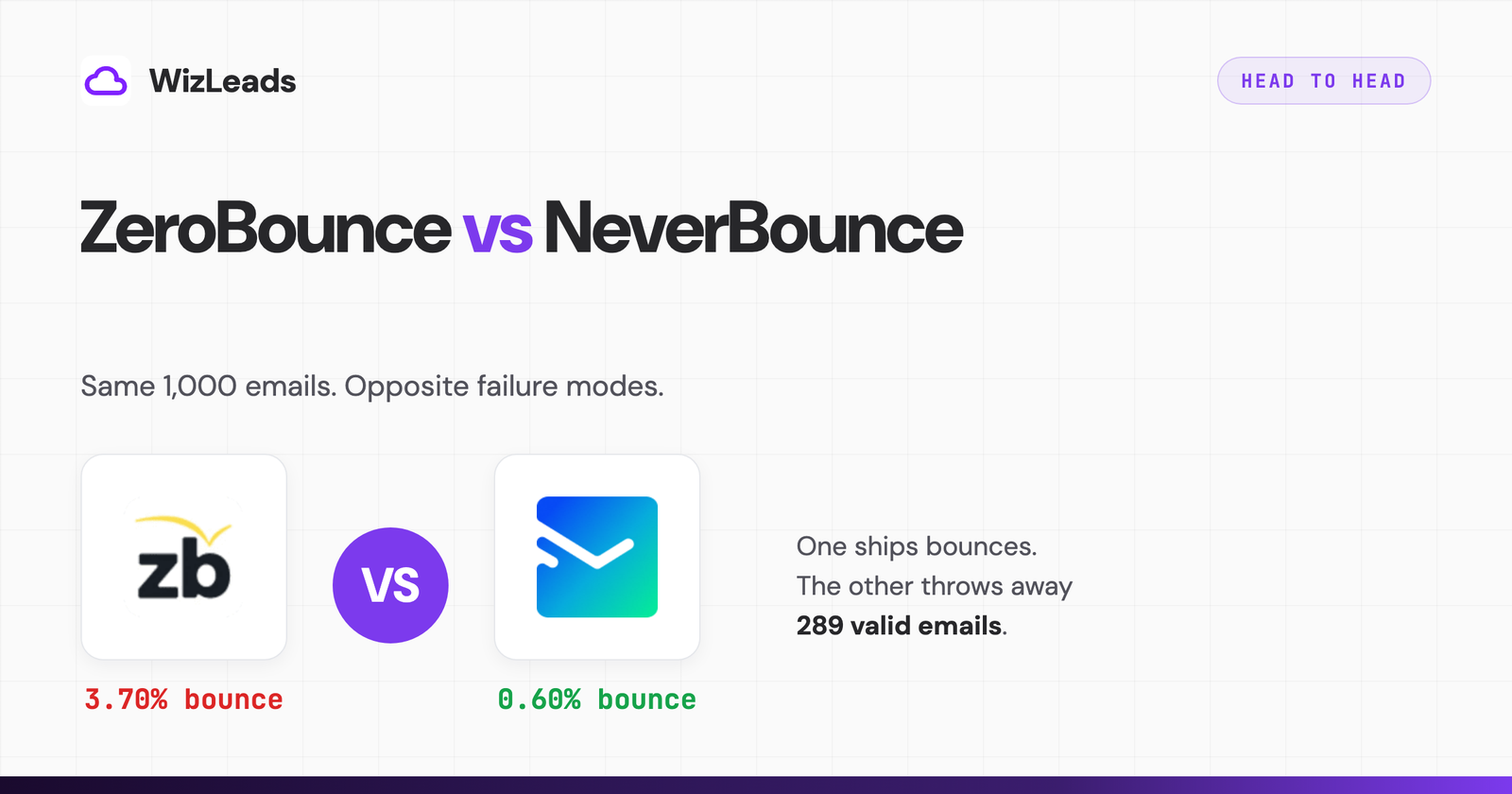
Each vendor publishes a comparison page about the other, and each one concludes that it wins. Neither page sends any email. So we ran the test that settles it: 1,000 real-estate decision-maker addresses pulled from Apollo, verified by both tools on the same day, then actually sent to, so the bounces could be counted instead of predicted.
The two tools failed in opposite directions. ZeroBounce approved 888 of the 1,000 and 33 of those bounced, a 3.72% bounce rate. NeverBounce approved 711 and 4 bounced, a 0.56% rate that it reached by rejecting 289 addresses. Which of those two failures your business can absorb is the entire decision, and no feature grid will answer it for you.
Head-to-head results
| Metric | ZeroBounce | NeverBounce |
|---|---|---|
| Classified valid | 888 | 711 |
| Bounces on send | 33 | 4 |
| Real bounce rate | 3.72% | 0.56% |
| Classified invalid | 112 | 289 |
| 10,000 credits, pay as you go | $129 | $50 |
| 10,000 per month, subscription | $99 | $49 |
ZeroBounce approved more addresses than any of the six verifiers in the test and shipped the most bounces. NeverBounce tied for the fewest bounces in the test and kept the smallest valid pool. When we sampled the 289 addresses NeverBounce rejected, most were working inboxes.
{{CARD:zerobounce-vs-neverbounce.card0.html}}
Plot both axes together and the shape of the problem becomes obvious. Bounce rate runs left to right, discarded leads run bottom to top, and each tool solves one axis by surrendering the other. The lower-left quadrant, where a verifier should live, sits empty of both of them.
What each failure mode costs you
Price the two failures in your own numbers and the choice usually resolves itself.
A 3.72% bounce rate is survivable on a dedicated domain with warmup running and a mailbox you can afford to burn. It is not survivable if you send from a Google Workspace tenant you also use for real business, or if your ESP enforces a hard bounce ceiling. Thirty-three bounces per thousand is the kind of number that gets a sending domain throttled before the sequence reaches step three.
The 289 rejections cost differently. If your leads run $0.20 to $2 each to source and enrich, NeverBounce threw away $30 to $300 of usable pipeline per thousand addresses to prevent 29 bounces. Agencies running one list across many clients tend to accept that trade. Teams working a finite named-account list almost never can, because the discarded records are not replaceable at any price.
Catch-all handling is where they actually disagree
Catch-all domains are the reason these two tools diverge at all. The domain accepts mail at the SMTP level for any address, so a standard probe cannot tell you whether the specific mailbox exists. Our list carried 212 catch-alls out of 1,000, which is normal for B2B and gets worse the larger your target accounts are.
ZeroBounce has changed its approach here, and the change is recent enough that our April 2026 numbers may predate part of it. ZeroBounce now resolves many catch-all addresses on Microsoft 365 and Google Workspace during standard validation rather than in a separate pass, by recognising platform signatures before probing rather than relying on the SMTP response. It reports that M365 catch-all classifications dropped from roughly 6 million a month to under 1,000 after the change. For whatever the method leaves unresolved there is Verify+, a free add-on that sends a real email to the address and reads the bounce, which ZeroBounce says lifts accuracy to 99.9% on catch-all, Yahoo, AOL and Verizon addresses.
Reading a missing bounce as proof of a live mailbox is the weak link, because enterprise mail systems routinely suppress non-delivery reports. Allegrow, itself a verifier and therefore not a neutral party, ran 10,000 addresses across 251 catch-all domains in July 2026 with 500 known-real professionals seeded inside. ZeroBounce standard found 467 of the 500. Verify+ moved that to 470 while pushing false positives from 9 to 25 out of 5,000 invented addresses, a rate of 0.5%, and it can take up to 48 hours. Treat it as vendor-run.
NeverBounce does not attempt resolution at any price. Catch-alls come back as Accept All (Unverifiable), one of five result codes alongside Valid, Invalid, Disposable and Unknown, and the decision returns to you. You pay for that non-answer: NeverBounce charges a credit for accept-all and unknown results the same as for a resolved one. Its documentation is more honest about this than most, stating that accept-all addresses are often valid and bounce at roughly half your list's invalid rate, with advice to send to them selectively rather than cut them. Operators who take that advice get a bigger list than our 711 and a bounce rate above 0.56%. Operators who drop everything that is not Valid get exactly what we measured. Which of those two you are decides how much the 289 gap costs you, and the catch-all email verification guide works through that call.
Pricing at 1,000, 10,000 and 100,000
Both vendors sell credits two ways, and the gap between them widens or narrows depending on which way you buy.
NeverBounce hands out 10 free credits at signup, enough to smoke-test the API and nothing more. ZeroBounce gives 100 a month.
ZeroBounce pay as you go has a 2,000-credit minimum at $39, which works out to $0.0195 per credit. The rate improves to $0.0138 at 5,000, $0.0129 at 10,000 ($129), $0.00998 at 50,000 and $0.00649 at 100,000 ($649). Unknown results are not billed, and ZeroBounce puts its 2025 unknown rate at 1.75%.
ZeroBounce ONE is $99 a month, or $79 a month billed annually, and includes 10,000 validations plus an allocation of 250 warmup seeds, one DMARC domain, 10 blacklist monitors, 100 inbox placement tests, 100 server tests, 10,000 email finder searches and 15% off additional pay-as-you-go credits. Unused validation credits roll over each month and ZeroBounce states credits never expire. The tests, monitors and finder searches do not roll over. A free tier gives 100 verifications a month on a business domain.
NeverBounce pay as you go starts at $8 per 1,000 credits, holds $0.008 through 5,000, then drops to $0.005 from 10,000 through 50,000 ($50 at 10,000), $0.004 at 100,000 ($400), $0.003 at 250,000 and $0.002 at 2 million. Credits expire 12 months after purchase, which is the clause worth reading twice before buying volume you will not burn inside a year.
NeverBounce Growth is $49 a month for up to 10,000 emails and adds CRM auto-sync, unlimited parallel list cleaning, AI lead scoring and 200 AI-selected leads a month. Duplicates are not charged. Enterprise is quoted rather than published, and NeverBounce positions it at 250,000 or more emails a month.
NeverBounce is cheaper at every published tier, roughly 60% less at 10,000 pay as you go and 38% less at 100,000. The subscription comparison is closer than it looks, because $99 on ZeroBounce is buying a deliverability suite and $49 on NeverBounce is buying verification with CRM plumbing attached. Compare them on verification alone and ZeroBounce loses on price. Compare them on what you would otherwise buy separately, and warmup plus DMARC plus inbox placement testing for $99 is a defensible line item.
One thing to check yourself: ZeroBounce's comparison page quotes a "NeverBounce Advanced Subscription" at $125 a month for 10,000. No such plan appears on NeverBounce's own pricing page today, which lists Growth at $49. Vendor comparison pages age badly, including in ways that flatter the vendor.
The parts that do not show up in a bounce rate
ZeroBounce is the stronger procurement story. It holds SOC 2 Type 2 (audited annually since March 2022), ISO/IEC 27001:2022, HIPAA with a BAA available, GDPR, CCPA, PCI DSS and Data Privacy Framework participation, runs its own hardware rather than public cloud, and deletes uploaded files within 30 days. It guarantees 99.6% accuracy in writing with a 5x refund formula. Founded in 2013 and now serving 600,000-plus customers, it lists 60-plus integrations for validation. If a security questionnaire stands between you and the purchase, this is the shorter path.
NeverBounce publishes a guarantee too, and it is worth reading before you rely on it. Rather than an accuracy percentage it promises that no more than 3 percent of your emails will bounce, refunding the difference above that. The exclusions do most of the work: the list has to be cleaned within 72 hours of mailing and hold at least 500 unique addresses, and the guarantee covers only the addresses NeverBounce itself called deliverable. Invalid, accept-all, unknown and disposable are all outside it, as are freemail domains like Gmail, Outlook and Yahoo, and anything the bounce can be attributed to your sending reputation. On the B2B lists this comparison is about, accept-all is precisely the category doing the damage, and it is the category the guarantee excludes.
NeverBounce has been a ZoomInfo property since DiscoverOrg acquired it on 5 March 2019, and that shows up in the details: the status page is ZoomInfo's, the privacy policy is ZoomInfo's, and support runs 9am to 6pm EST by chat and phone against ZeroBounce's 24/7 email desk. It counts 80-plus integrations, more than ZeroBounce, with native HubSpot, Mailchimp, Marketo and Eloqua connectors, published n8n blueprints, and a Sync feature that re-verifies connected lists automatically. It quotes 10,000 emails cleaned in about three minutes. The equivalent compliance certifications are not published on its own site in the way ZeroBounce publishes them, so ask before you assume parity.
Where our own tool landed on the same list
We build WizLeads, so read this section as a vendor talking and check it against the raw data rather than taking it on trust.
On the same 1,000 addresses, WizLeads classified 852 as valid and rejected 148, with 5 bounces on send, a 0.59% rate. That matches NeverBounce's bounce rate while keeping 141 more valid addresses, and comes in 36 approvals below ZeroBounce with 28 fewer bounces. The mechanism is catch-all resolution: rather than returning a catch-all flag or guessing, it classifies catch-all addresses as valid or invalid, and it flags security gateways such as Proofpoint, Mimecast and Barracuda that distort a standard SMTP check. Verification runs 0.5 credits per address, so the $39 Freelancer plan covers 20,000 addresses, about $20 per 10,000. The 10,000-credit plan is $39 a month and covers 20,000 verifications. New accounts get the first month for $1, and staying on afterwards holds a 20% early-adopter discount for the life of the account. See the plans.
Methodology, the other four verifiers and the raw per-tool numbers are in the email verification benchmark.
Which one to buy
If a bounce costs you more than a discarded lead, take NeverBounce. It produced the joint-lowest bounce rate in the test, it is cheaper at every published volume, and its CRM connectors are better. Budget for replacing the roughly 29% of your list it will refuse to clear, and calendar the 12-month credit expiry.
If you need the compliance paperwork, or you would otherwise buy warmup, DMARC monitoring and inbox placement testing separately, take ZeroBounce. Expect a higher real bounce rate on catch-all-heavy B2B lists than its 99.6% guarantee implies, run Verify+ knowing what it assumes, and re-test on your own list given how recently its Microsoft 365 handling changed.
If your lists are B2B, catch-all-heavy and expensive to build, neither shape fits well, because one hands you 33 bounces per thousand and the other hands back 289 addresses unresolved. Other options at that end of the market, including MillionVerifier and Debounce, sit in ZeroBounce alternatives and the ranked best email verification tools roundup.
FAQ
Is ZeroBounce or NeverBounce better?
They fail in opposite directions. ZeroBounce approved 888 and 33 bounced, a 3.72% rate. NeverBounce approved 711 and 4 bounced, a 0.56% rate, after rejecting 289 addresses. Choose on whether a bounce or a lost lead costs you more.
Which is cheaper, ZeroBounce or NeverBounce?
NeverBounce, at every published tier. Pay as you go at 10,000 credits is $0.005 against $0.0129, so $50 against $129. At 100,000 it is $0.004 against $0.00649. On subscriptions it is $49 a month against $99, though ZeroBounce ONE bundles warmup, DMARC and inbox placement testing into that price.
Do ZeroBounce or NeverBounce credits expire?
NeverBounce credits expire 12 months after purchase. ZeroBounce says unused validation credits roll over each month and never expire, although inbox tests, blacklist monitors and finder searches on ZeroBounce ONE do not roll over. ZeroBounce also does not charge for unknown results.
How do ZeroBounce and NeverBounce handle catch-all emails?
ZeroBounce now resolves many Microsoft 365 and Google Workspace catch-alls during standard validation and offers Verify+ free for the rest, which settles addresses by sending a real test email. NeverBounce returns Accept All (Unverifiable) and leaves the call to you, while advising in its own docs that those addresses are often valid.
What bounce rate did ZeroBounce and NeverBounce produce in real testing?
ZeroBounce 3.72% and NeverBounce 0.56%, measured by sending to every approved address on the same 1,000-email list in April 2026.