WizLeads


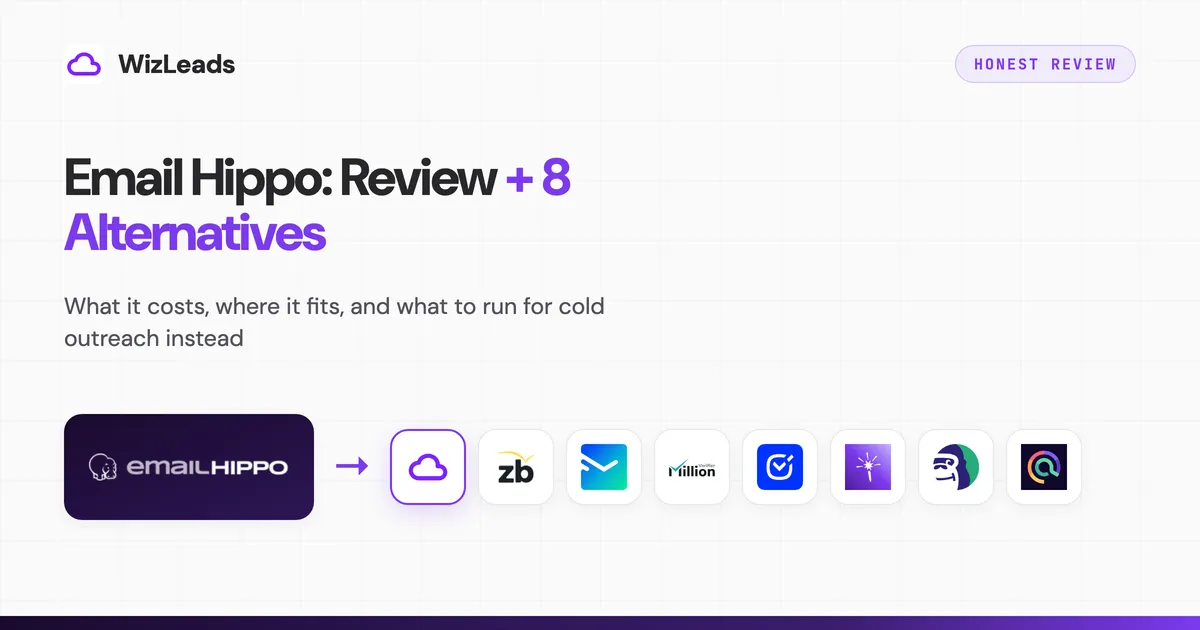
Most pages ranking for Email Hippo say its pricing is not published. That was true once. Today the company runs a public calculator on its pricing page, and the calculator reads from an API that returns every tier in USD, GBP and EUR. We pulled it, checked the numbers against the live calculator, and this review carries the whole ladder rather than a "starts from" figure.
One thing to settle before any of it means anything: Email Hippo was not one of the six tools in our send-tested benchmark. We verified 1,000 real B2B addresses with six verifiers and then mailed each tool's approved list to count actual bounces. Email Hippo was not in that round, so no bounce rate on this page belongs to it, and we are not going to imply one. Where measured data exists it is labelled. Where it does not, that is labelled too.
What Email Hippo actually sells
The brand covers five products, not the one most reviews describe. It is also younger than it looks: reviews variously date Email Hippo to 2000, 2009, 2015 or 2021, and the company's own material supports the first three. The brand launched in 2015, which is also when EMAIL HIPPO LIMITED was incorporated at Companies House. The earlier dates are lineage, a free email-checking widget in 2000 and a business the founders describe as fully fledged by 2009, rather than the company you would be buying from.
| Product | What it does | Entry price |
|---|---|---|
| CORE | Bulk CSV list cleaning, up to 500,000 addresses per file | $9.88/mo |
| MORE | Real-time verification API for signup forms and CRM writes | $9.88/mo |
| INSIGHT | MORE plus enrichment: subaddressing, dark web checks, marketing trust score, consumer versus business identification | $12.26/mo |
| ASSESS | INSIGHT plus fraud signals: Hippo risk score, domain age, IP and location, Tor exit node and blocklist detection | $14.63/mo |
| WHOIS | Domain age, ownership and registrar lookups | See pricing calculator |
CORE is the product a marketer means by "Email Hippo". MORE is the one a developer means. INSIGHT and ASSESS are where the company puts its real weight, and the feature lists show it: dark web link checks, Tor exit node detection, data centre detection, domain age analysis. Those are fraud-team tools, and they are the reason Email Hippo shows up in fraud-prevention directories as often as in email marketing roundups.
The API side is well built. MORE Edition 2 returns 74 data points per address, including a 0-to-10 Hippo Trust Score banded as low below 2.66, medium from 2.66 to 6.99 and high from 7 to 10. Email Hippo's terms commit to 99.99% uptime with service credits of 10% of the monthly fee for each percentage point below that. The company is ISO 27001 and ISO 9001 certified, processes data in the UK and EU, and is registered in England.
Where the offering thins out is integrations. The integrations page lists ten: Auth0, Firmao, Formstack, HubSpot, Microsoft Dynamics, OttoKit, Salesforce, Unbounce, WordPress and Zapier. Seven of those ten connect only through Zapier or a raw API call. HubSpot and Auth0 are the two with a code snippet option. If your plan was to drop Email Hippo into Salesforce or Dynamics natively, budget for Zapier or a developer.
Email Hippo pricing, every published tier
Subscription pricing for CORE and MORE is identical. Both start at $9.88 a month for 1,000 checks. Figures below are USD monthly, taken from the pricing API behind emailhippo.com/products/pricing on 8 September 2026.
| Checks per month | CORE / MORE | INSIGHT | ASSESS |
|---|---|---|---|
| 1,000 | $9.88 | $12.26 | $14.63 |
| 2,500 | $24.70 | $30.64 | $36.58 |
| 5,000 | $44.20 | $54.83 | $65.45 |
| 10,000 | $88.40 | $109.65 | $130.90 |
| 25,000 | $182.00 | $225.75 | $269.50 |
| 50,000 | $312.00 | $387.00 | $462.00 |
| 100,000 | $468.00 | $580.50 | $693.00 |
| 250,000 | $831.90 | $1,032.00 | $1,231.95 |
| 500,000 | $1,247.90 | $1,548.00 | $1,847.95 |
| 1,000,000 | $1,871.90 | $2,322.00 | $2,771.95 |
| 2,500,000 | $3,119.90 | $3,870.00 | sales only |
Three details that change what you actually pay.
Quota does not roll over. Email Hippo's own knowledge base is direct about it: a subscription is not the same as a credit, unused quota does not carry to the next month, and the counter resets on your billing date. If your list cleaning is lumpy, you are paying monthly for a peak you hit twice a year. Several competitors below sell credits that never expire, and for irregular workloads that difference is worth more than the headline rate.
Annual billing saves very little. CORE at 10,000 checks a month costs $1,018.35 paid annually against $1,060.80 paid monthly. That is $42.45, or 4.0%. Quarterly saves 2.0%. Most vendors discount annual plans by 15% to 20%, so there is little reason to lock in here.
Pay-as-you-go is banded, and the bands are not smooth. The rate for your band applies to your whole file, so the cost per address steps rather than tapers. Driving the vendor's own calculator produces this:
| File size | Pay-as-you-go cost |
|---|---|
| 1,000 | $10.00 |
| 2,500 | $24.70 |
| 2,501 | $19.51 |
| 5,000 | $39.00 |
| 5,001 | $44.21 |
| 10,000 | $88.40 |
| 10,001 | $62.41 |
| 25,000 | $156.00 |
| 50,000 | $260.00 |
| 100,000 | $312.00 |
Read the 10,000 and 10,001 rows again. Adding one address to a 10,000-row file drops the bill from $88.40 to $62.41. Splitting the same 10,000 addresses into two files of 5,000 costs $78.00. None of that is hidden, it falls out of banded whole-file pricing, but it does mean the sticker number for a round-number list is the worst price on the page. There is a $10 minimum transaction fee in each currency, which is why 1,000 addresses cost $10.00 rather than $9.88. Duplicates inside a file are not charged, and syntax failures are excluded before billing.
How Email Hippo decides an address is good
Syntax, then DNS and MX, then an SMTP conversation with the mailbox, with greylisting handled by revisiting deferred addresses later. Results come back under five primary codes: Ok, Bad, Unverifiable, RetryLater and None. Bad carries specific reasons, and they are unusually well documented: MailboxDoesNotExist, MailboxFull, NoMxServersFound, PossibleSpamTrapDetected, DomainIsInexistent.
The bucket that decides whether this tool suits you is Unverifiable, which covers six reasons: disposable domains, greylisting, unpredictable mail systems, unknown, none, and catch-all servers. On catch-all, the API documentation says: "The server is configured for catch all and responds to all email verifications with a status of Ok. ... Catch all configured servers cannot respond to requests for email address verification."
That is a fair and honest description of a hard problem, and it is also a design decision with a cost. Email Hippo tells you the door accepts everything. It does not tell you whether the specific person is behind it.
The catch-all bucket, in numbers
The sample we used for our verification test was 1,000 real-estate decision-maker addresses pulled from Apollo. 212 of them sat on catch-all domains, and a further 159, or 15.9%, sat behind Secure Email Gateways that answer SMTP probes on the domain's behalf. So on a normal B2B prospecting list, a verifier that flags catch-alls rather than resolving them hands back roughly a fifth of your list undecided.
You then choose between two bad options. Discard them and you throw away working inboxes at real cost per lead. Send to them and you are guessing with your sender reputation. Which verifiers can actually decide a catch-all, and how, is the subject of our catch-all verification guide.
For a signup form this barely matters, because a signup form gets one address at a time from someone who typed it deliberately, and a catch-all domain is a weak fraud signal in its own right. For a cold list of 10,000 scraped B2B contacts it matters more than any other single property of the tool.
What the free tier actually gets you
Two separate allowances, frequently confused. The web tool at tools.emailhippo.com allows a maximum of 100 verifications per day and shows a live usage counter, with no account required. Creating an account gives 100 free checks against the paid products, no credit card. Email Hippo also runs free standalone tools for disposable address detection, domain age, email extraction from text or a web page, and WHOIS lookups. The daily web tool is useful for spot checks. Neither allowance is enough to evaluate a list.
What Email Hippo users report
The public review base is small and dated, which is itself worth knowing before you weigh anyone's star rating. G2 shows 4.0 out of 5 from six reviews, every one of them written in 2018 or 2019. Capterra shows 4.6 out of 5 from thirteen reviews, most from 2021, with ease of use at 4.7, customer service at 4.6 and value for money at 4.5. Nineteen reviews across both, and the newest is from 2023.
Reading them rather than counting them, the praise clusters on three things: the CSV limit, since a single 500,000-row upload avoids the splitting that other tools force; support responsiveness, mentioned repeatedly and specifically; and documentation, which one CRM architect singled out as the reason he could interpret results properly.
The criticism clusters just as tightly. The interface reads dated, raised independently by reviewers in 2019 and 2021. Price comes up as "a bit too high" and "a tiny bit pricy" from reviewers who otherwise rated it five stars. And the recurring functional complaint is the undecided bucket: one reviewer describes "many of the not-sure results, particularly encountered with companies that uses random mail address usernames", another reports addresses that came back unverified and then bounced. A 2023 reviewer rated it three stars and said it failed to recognise most disposable domains, which is a single data point running against a documented feature, and we cannot test it either way.
Where Email Hippo fits
Choose it for signup-form validation and CRM hygiene, especially where a fraud angle exists. ASSESS and INSIGHT do things a pure verifier does not, the UK and EU data processing is a real procurement advantage for European teams, and the API documentation is above average for this category.
Skip it for cold outreach on scraped or purchased B2B lists. At $88.40 per 10,000 you are paying near the top of the market to be told that a fifth of your list cannot be decided, and the addresses it cannot decide are disproportionately the senior people you built the list for.
8 alternatives, ranked by measured bounce rate
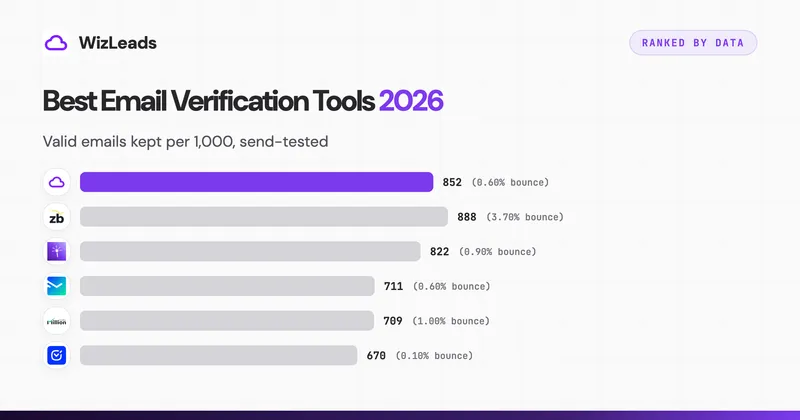
The criterion for this ranking is one number: of the addresses each tool approved, what share bounced when we actually sent to them. We verified the same 1,000 B2B addresses with six tools on the same day, mailed each tool's approved list, and counted. The full method and the raw data are in the 2026 verification benchmark.
Bounce rate alone rewards timidity, so every entry also carries what the tool kept out of 1,000. A verifier that rejects a third of your list can post a beautiful bounce rate and still cost you more than it saves. Two tools here were not in that send test, and they are marked as such and placed last rather than ranked on numbers we do not have.
Each entry follows the same four slots.
1. Debounce
Measured result: 0.15% bounce rate, 1 bounce, 670 of 1,000 kept, 330 rejected. What explains it: the most conservative approver in the test by a distance. When it is unsure it says no, which is why one address bounced and why a third of the list did not survive. Verified price: $25 per 10,000. Who it fits: shared-IP senders under a hard bounce SLA, where a rejected valid lead costs less than a bounce does.
2. NeverBounce
Measured result: 0.56% bounce rate, 4 bounces, 711 of 1,000 kept, 289 rejected. What explains it: the same trade as Debounce, slightly less severe. It rejected 289 addresses, and a meaningful share of those were working inboxes. Verified price: $50 per 10,000 pay-as-you-go, or $49 a month on the Growth plan. Credits expire after 12 months. Who it fits: teams cleaning warm CRM lists inside HubSpot, Salesforce or Mailchimp, where the native integrations save more time than the extra rejections cost.
3. WizLeads
Measured result: 0.59% bounce rate, 5 bounces, 852 of 1,000 kept, 148 rejected. This is our own product, so treat the claim as one to audit rather than accept, and the benchmark publishes the raw file for that purpose. What explains it: it classifies catch-all mailboxes as valid or invalid instead of returning them undecided, and flags Secure Email Gateway domains per address. NeverBounce reached a lower bounce rate by 0.03 points and kept 141 fewer addresses. Debounce reached it by 0.44 points and kept 182 fewer. Verified price: about $20 per 10,000. The $39 Freelancer plan carries 10,000 credits and verification costs 0.5 credits per address, so it covers 20,000 checks. After signup that plan is $1 for the first month, and continuing holds a 20% early-adopter discount for life. Who it fits: cold email operators working catch-all-heavy B2B lists, which is exactly the workload Email Hippo's Unverifiable bucket handles worst.
4. LeadMagic
Measured result: 0.85% bounce rate, 7 bounces, 822 of 1,000 kept, 178 rejected. What explains it: partial catch-all resolution, so it keeps far more than the conservative tools while staying under one percent. Verified price: $49.50 per 10,000. Who it fits: teams whose verification already happens inside an enrichment table. The native Clay integration means one fewer system to reconcile.
5. MillionVerifier
Measured result: 0.99% bounce rate, 7 bounces, 709 of 1,000 kept, 291 rejected. What explains it: it plays safe on ambiguity like Debounce and NeverBounce, without their bounce-rate payoff on this list. Verified price: $39 per 10,000. Credits do not expire. Who it fits: large marketing-list hygiene at low cost, where leads are cheap and a discarded valid address is not a painful loss.
6. ZeroBounce
Measured result: 3.72% bounce rate, 33 bounces, 888 of 1,000 kept, 112 rejected. What explains it: it approved more addresses than anything else in the test and paid for it, mostly on Google-hosted catch-all domains it marked valid. Verified price: $129 per 10,000 pay-as-you-go, or $99 a month on the ONE plan. 100 free verifications a month. Who it fits: enterprise procurement that needs the compliance paperwork, SOC 2 and HIPAA included. If that is why you are considering it, the switching options are in ZeroBounce alternatives.
7. Bouncer
Measured result: not in our send test. We publish no bounce rate for it. What explains it: on paper it is Email Hippo's closest sibling here, another European vendor built around data-protection posture, and it does not resolve catch-alls either. Verified price: $60 per 10,000. Who it fits: EU teams choosing on compliance grounds who want the same posture at a lower per-check rate than Email Hippo's $88.40.
8. Kickbox
Measured result: not in our send test. We publish no bounce rate for it. What explains it: it sells on deliverability reputation rather than price, with a proprietary Sendex score per address and roughly thirty integrations against Email Hippo's ten. Verified price: $70 per 10,000. Who it fits: high-volume ESP-adjacent senders who want a verifier their sending platform already recognises. Worth noting that Kickbox's own comparison page still tells readers Email Hippo does not publish pricing, which stopped being true.
The wider ranked list, including the tools that did not make this page, is in best email verification tools.
Price and fit at a glance
| Tool | Cost per 10,000 | Bounce rate measured | Kept of 1,000 | Catch-all handling |
|---|---|---|---|---|
| Email Hippo | $88.40 | not send-tested by us | n/a | flagged Unverifiable |
| Debounce | $25 | 0.15% | 670 | deep resolve costs extra credits |
| NeverBounce | $50 | 0.56% | 711 | flagged, not resolved |
| WizLeads | ~$20 | 0.59% | 852 | resolved to valid or invalid |
| LeadMagic | $49.50 | 0.85% | 822 | partial resolution |
| MillionVerifier | $39 | 0.99% | 709 | flagged, not charged |
| ZeroBounce | $129 | 3.72% | 888 | flagged, free send-test add-on |
| Bouncer | $60 | not send-tested by us | n/a | flagged, not resolved |
| Kickbox | $70 | not send-tested by us | n/a | flagged, not resolved |
The three comparisons buyers actually run
Email Hippo against ZeroBounce. Two premium-priced tools with the same catch-all posture, at $88.40 and $129 per 10,000 respectively. ZeroBounce brings heavier compliance certifications and a much larger integration catalogue; Email Hippo brings fraud enrichment through INSIGHT and ASSESS that ZeroBounce does not match. For a cold email workload, note that ZeroBounce is the one tool here we measured at 3.72%, so the compliance paperwork is not buying accuracy on catch-all-heavy lists.
Email Hippo against Bouncer. The European compliance pair. Bouncer is $60 per 10,000 against Email Hippo's $88.40 and sells credits that do not expire, against quota that resets monthly. Email Hippo counters with a longer operating history, the fraud product line and ISO 9001 alongside ISO 27001. Neither resolves catch-alls, and neither has published send-tested accuracy data. Price and credit expiry are the two differences you can actually verify before buying.
Email Hippo against WizLeads. These solve different problems and the pricing reflects it: $88.40 against roughly $20 for the same 10,000 addresses. Email Hippo flags the ambiguous cases and adds fraud signals around them; WizLeads decides them and does not do fraud signals at all. For a scraped B2B list going into a sequencer, the measured 852 kept at 0.59% is the argument. For screening signups on a consumer product, Email Hippo's ASSESS API does work WizLeads has no answer for, and pretending otherwise would be silly.
Moving a workload off Email Hippo
- Export suppression and do-not-verify lists first. Verdict history does not transfer between vendors, so anything you have manually marked is gone the moment you stop paying.
- Time the cancellation. Quota resets on your billing date and does not roll over, and downgrades apply at the end of the current period with no refund, so cancelling mid-cycle forfeits whatever you have left.
- Re-run your most recent Hippo-cleaned list through the replacement before trusting it live. The row that matters is the Unverifiable bucket. Against a resolver, most of that bucket comes back as a definite valid or invalid, and the size of that reclassification is the entire financial case for switching.
- Map the MORE, INSIGHT or ASSESS fields you consume before turning anything off. Trust score, risk score, dark web and Tor signals have no equivalent in a plain verifier. Running Email Hippo on the signup form and something else on campaign lists is a legitimate end state, not a failure to choose.
- Check the integration path. Most alternatives here expose a REST API with n8n, Make and Zapier patterns, so the swap is usually an endpoint, a key and a verdict-field mapping.
Testing this on your own list
Our numbers came from real-estate decision-maker data. Yours will differ, because catch-all share, Microsoft against Google mix and geography all move the result. The method transfers even when the numbers do not.
Take 200 leads from your actual ICP. Run them through Email Hippo and one alternative on the same day. Send to both approved lists from infrastructure you are willing to burn, and count what comes back. An afternoon of that beats every review on this query, this one included, because the only verdict that counts is the one the receiving server agrees with.
FAQ
What is Email Hippo used for?
Bulk CSV list cleaning through CORE, real-time verification through the MORE API, enrichment through INSIGHT, fraud scoring through ASSESS, and domain lookups through WHOIS. Strongest on signup validation and CRM data quality.
How much does Email Hippo cost?
$9.88 a month for 1,000 checks on CORE and MORE, $88.40 for 10,000, $468 for 100,000 and $3,119.90 for 2.5 million. INSIGHT starts at $12.26 and ASSESS at $14.63. Pay-as-you-go carries a $10 minimum transaction fee, and unused subscription quota does not roll over.
Does Email Hippo verify catch-all email addresses?
No. It detects them and returns them as Unverifiable with the reason ServerIsCatchAll. Its documentation states that catch-all configured servers cannot respond to verification requests. On B2B lists that leaves roughly a fifth of your addresses undecided.
Is Email Hippo accurate?
Email Hippo claims 99 percent accuracy on valid emails. That is its own figure, not a tested one, and it describes one classification rather than accuracy across valid, invalid and catch-all verdicts together. We cannot confirm it: Email Hippo was not one of the six tools in our send-tested benchmark, so we publish no bounce figure for it. Its public review base is 4.0 from six G2 reviews written in 2018 and 2019, and 4.6 from thirteen Capterra reviews mostly from 2021.
Does Email Hippo have a free tier?
Yes, two. The web tool allows a maximum of 100 verifications per day without an account. Signing up gives 100 free checks with no card required. Free disposable-detection, domain age, email extractor and WHOIS tools sit alongside them.
What is the best Email Hippo alternative for cold outreach?
A verifier that resolves catch-alls instead of flagging them. WizLeads kept 852 of 1,000 at a 0.59% bounce rate for about $20 per 10,000. Debounce and NeverBounce beat that bounce rate at 0.15% and 0.56%, and kept 670 and 711, which is the trade you are choosing between.