WizLeads


TL;DR
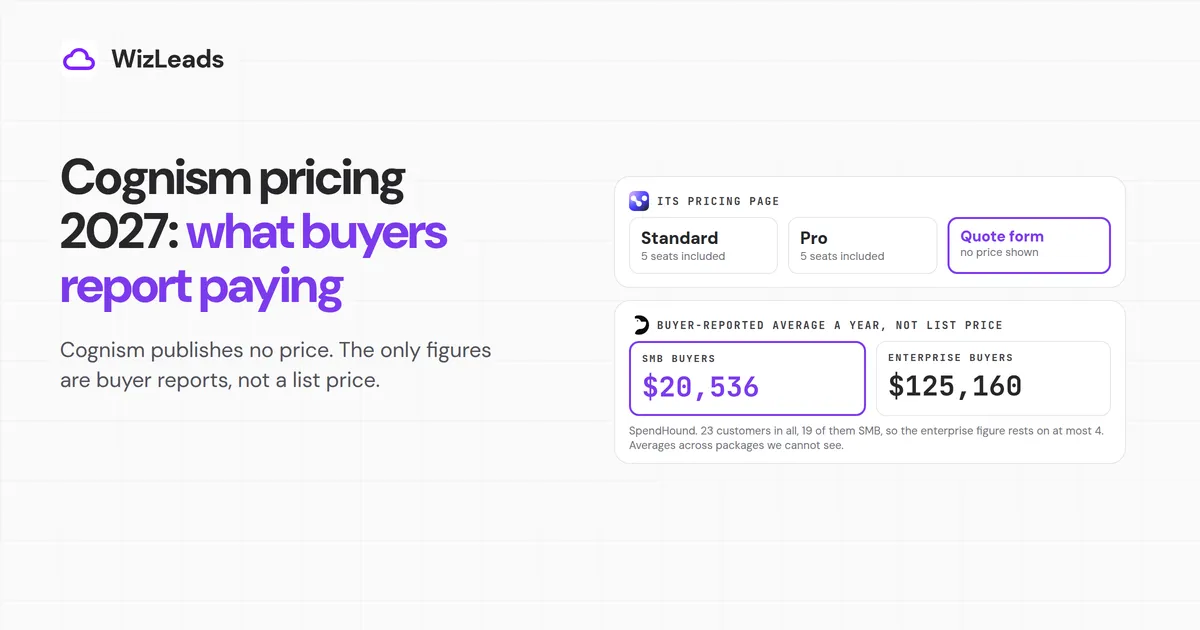
Cognism does not publish a price. Its pricing page shows two packages, Standard and Pro, with 5 seats each, and ends in a quote form. The only dollar figures we could open are buyer reports: SpendHound puts the average SMB buyer at $20,536 a year and the average enterprise buyer at $125,160, and the enterprise figure rests on at most 4 customers.
Standard includes 10,000 credits per user a year and Pro 12,000. Cognism's own pages disagree on how credits, the API and intent topics work. Get the credit rules into the order form before you sign.
Cognism is a sales prospecting platform. You spend credits to reveal contacts' emails and mobile numbers, and the package decides which filters and verification you get.
WizLeads, which publishes this blog, builds a lead scraper for Sales Navigator searches, so Table 4 puts its credit costs next to the costs of tools that publish prices.
What Cognism publishes on its pricing page
Cognism's pricing page shows two cards. Standard is "for teams that need core prospecting workflows" and Pro is "for teams that need advanced prospecting workflows". The buttons read "Talk to sales" and "Talk to an expert", and the page closes with "Get a personalised quote for your team."
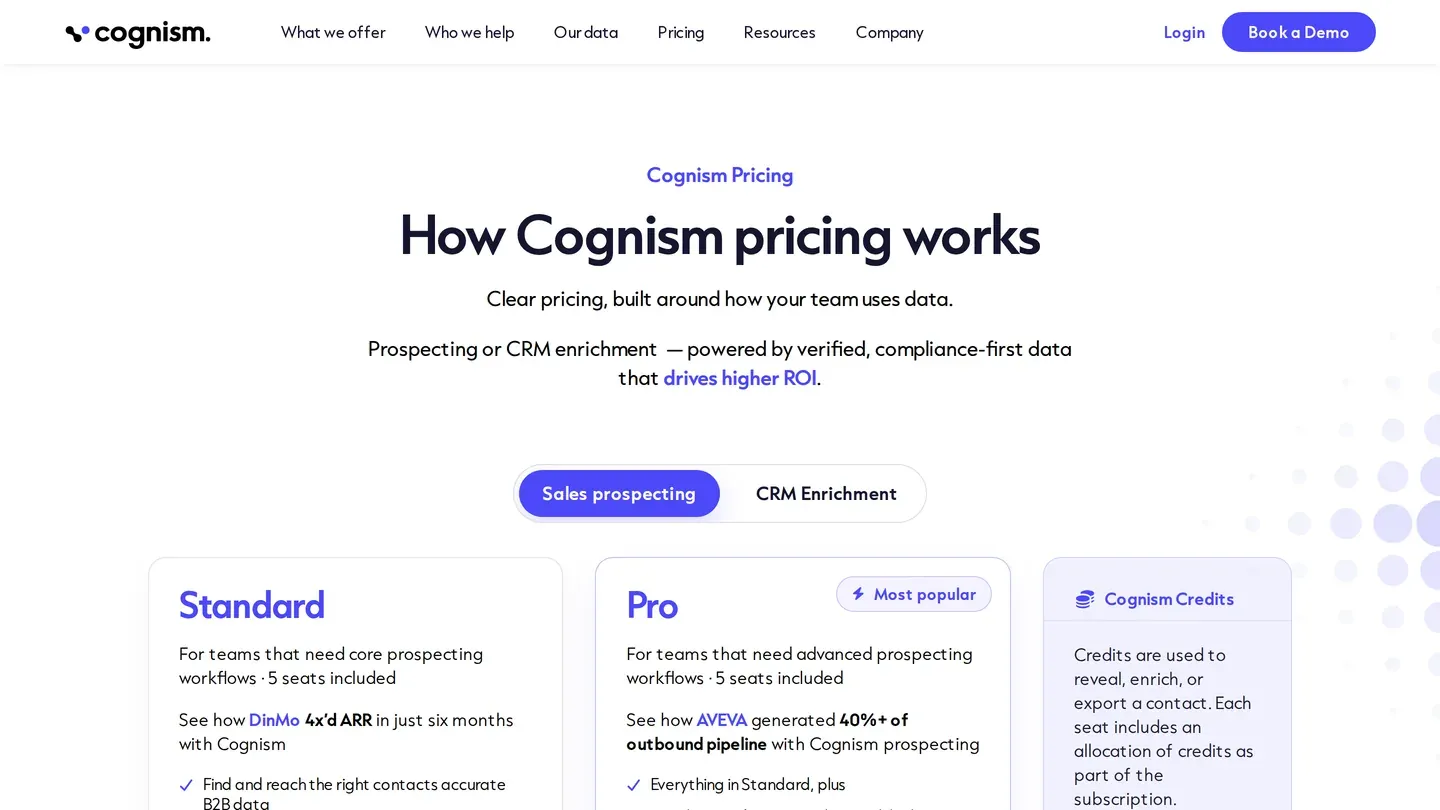
The page's source code holds no currency amount either. Renders for the US and GB show none, and neither do the German page at /de/preis or the French page at /fr/tarifs.
The pricing FAQ explains the gap: "Cognism pricing is tailored based on the product you need, your team setup and how you plan to use the platform." CRM Enrichment and Data-as-a-Service "are priced based on subscription structure, usage and delivery requirements". The Cognism homepage adds "we have no hidden cost associated with access to the platform", which still gives no number.
Cognism's own Kaspr comparison page calls its two tiers "Transparent pricing". The pricing page shows no price, so "transparent" can only mean that packages and allowances are described. Older guides still price "Platinum" and "Diamond", the two packages Cognism's archived pricing page listed in 2023 and 2024 (Wayback Machine captures from both years). The page now lists Standard and Pro.
Standard vs Pro: what each plan includes
Table 1 is built from the pricing page's cards, feature table and FAQ. The feature table marks each row with a tick or a cross in the HTML, and only three rows differ.
Table 1: Standard and Pro
| Feature | Standard | Pro |
|---|---|---|
| Seats included | 5 | 5 |
| Credits per user a year | 10,000 | 12,000 |
| Credits across 5 seats (our arithmetic) | 50,000 | 60,000 |
| Emails and mobiles | Yes | Yes |
| MCP and API access | Ticked | Ticked |
| SSO, CSV enrichment, account manager | Yes | Yes |
| Premium mobile filter | No | Yes |
| Mobile verification on demand | No | Yes |
| Intent data | No | Yes |
| CRM Enrichment | Add-on | Add-on |
| Price | "Talk to sales" | "Talk to an expert" |
Sources: the cards and feature table on the pricing page. The per-user credit figures come only from Cognism's Kaspr comparison page. The 5-seat rows multiply each allowance by 5. That assumes every included seat carries it, which Cognism does not state in one sentence.
Pro's card promises "higher-quality, accurate mobile data", "on-demand verification" and accounts "showing real buying intent". The pricing FAQ also credits Pro with "enhanced dashboards". The table does not list them, so ask what that covers. Neither price is public, so you cannot tell what Pro's extra 20% of credits per user costs.
How Cognism credits work
The pricing page defines the unit as "1 credit = 1 revealed contact", with "No charge for viewing previously revealed contacts". The same credits run "across the prospecting platform, Enrich, and API without extra cost".
Each seat "includes an allocation of credits as part of the subscription", and "Additional credits can be purchased at any point". The page gives no price for extra credits.
With seats and allowances but no fee, the Cognism price per user stays unknown.
Table 2 comes from Cognism's help centre and its API help article.
Table 2: What spends a Cognism credit
| Action | Credit cost |
|---|---|
| Reveal a contact in the platform or the Chrome extension (LinkedIn, Sales Navigator, Recruiter) | 1 |
| Save an unrevealed contact to a list | 1 |
| Export from search | Consumes a credit |
| CSV upload or CRM Enrichment | Consumes a credit |
| View a contact you already revealed | 0 |
| API Redeem | 1 per contact |
| API Search, API Enrich, redeeming companies | 0, per the API help |
The help centre's rule is "A contact will only consume a credit once per account, regardless of how many times it is viewed, exported, or accessed afterward." A credit is spent again if the contact changes jobs. The contradictions below show three versions of that trigger.
Admins can "Set a per-user credit limit. One limit applies to every user in the account" and choose whether it resets "either monthly or annually".
The API help names two credit models, "Companion credits (standard credits)" and "Bulk credits". Its preview limit is "Number of credits x preview multiplier". The default multiplier is 10, so 15,000 credits allow up to 150,000 previews.
Cognism's pages do not say whether unused credits roll over. Ask on the sales call.
Where Cognism contradicts itself
Each item below is a pair of Cognism statements that do not line up.
- The enrich meter. The pricing page says "Credits are used to reveal, enrich, or export a contact" and that the same credits run across Enrich. The API help says "Search and Enrich APIs do not consume credits". One is platform enrichment and the other is the Enrich API, but the pricing page uses one meter for both.
- The re-charge trigger. The pricing FAQ says "A credit is only used again if that contact changes jobs." The API help says a credit is consumed again if the contact's "Job title changes" or "Company changes". The CRM Enrichment block says credits are used again "when key details change, like a job move". A new title at the same company arguably triggers a charge under the API wording, and "changes jobs" does not say whether it counts.
- Where the API sits. The pricing page ticks MCP and API access on both Standard and Pro. The Kaspr comparison lists "API access" among what Pro adds to Standard.
- Intent topics. The pricing FAQ says administrators "can select up to 12 intent topics from a library of over 11,000 options". The Kaspr comparison says "12 core topics, with over 100 additional topics available".
- Do-not-call coverage. The Kaspr comparison says "TPS and DNC screening across 15 countries". The Diamond Data page says "cross-check data against 16 DNC lists globally". The unit differs, countries against lists.
- Phone-verified mobiles. The homepage says "All packages include contact and company data, including our phone-verified contacts", and the Kaspr comparison says Standard includes "phone-verified mobile numbers". The pricing table gives "Premium mobile filter" and "Mobile verification on demand" to Pro only. The pages do not say whether Standard's mobiles are phone-verified, so ask on the sales call.
- Credits per seat or per account. The English pricing page says each seat includes an allocation. The German and French pages say credits are pooled at account level ("kontoübergreifend gebündelt", "mutualisés au niveau de votre compte"). Both can be true, but the English page does not say pooled.
The pages do not settle which wording applies, so write the credit rules into your order form.
What buyers report paying
SpendHound's Cognism page splits buyers into SMB (50 to 1,000 employees) and enterprise (1,000 or more). It counts 23 Cognism customers in all. Its year-over-year line says the SMB average fell 25.07% "based on 19 SMB customers", which leaves at most 4 behind the enterprise average (our arithmetic).
SpendHound sells procurement help, and the page doubles as its pitch, so its data cannot be inspected. Treat the enterprise figure as a very small base.
Table 3: Buyer-reported annual spend, SpendHound, as of October 2026
| Tool | SMB average | Enterprise average | Customers behind the page |
|---|---|---|---|
| Cognism | $20,536 | $125,160 | 23 (19 SMB) |
| ZoomInfo | $48,724 | $226,925 | not recorded |
| Lusha | $4,519 | $58,905 | 63 |
| Apollo | $9,885 | $51,741 | not recorded |
The Cognism, ZoomInfo and Apollo figures sit on SpendHound's Cognism page. The Lusha figures and its 63 customers come from SpendHound's Lusha page. No seat count or package came with any figure, so each is spend per customer a year. ZoomInfo's SMB average is about 2.4 times Cognism's, from customer sets of different and partly unknown size.
ZoomInfo's platform plans are quote-only too. Our ZoomInfo pricing guide lists the buyer-reported medians beside its published GTM AI credit prices. The ZoomInfo alternatives guide sorts ten tools by the job each replaces.
Several ranking guides repeat a platform fee plus a per-user fee. Two different Vendr medians circulate too. We could open no source for any of them, and Vendr's Cognism page returns a 404.
The guides' five-user totals also charge per-user fees on seats that Cognism's cards say are included.
Add-ons: CRM Enrichment, intent and verification
No add-on has a published price. The pricing page says CRM Enrichment works "alongside our sales prospecting tool (Standard or Pro)" and is "Available as a standalone product". Its credits "are included in your subscription and used to enrich new records". "Ongoing maintenance is included."
Intent data is Pro only. Cognism uses Company Surge data from Bombora, one of the intent data providers in the market. The topic count differs between Cognism's pages, as the contradictions above show.
On-demand mobile verification is also Pro only. Cognism calls it "a premium feature" for submitting "high-priority prospects" for "advanced verification".
Cognism Diamond Data is its phone-verified data. The Diamond Data page says "we have a routine process in place that calls the numbers and confirms that it is the right person who picks up the phone". It also claims "10m+ phone-verified contacts globally". Cognism says to "expect to connect with your ideal contact every 8 dials".
The pages do not say how many credits a phone-verified mobile uses.
Cognism free trial, data sample and contract terms
Cognism has no free plan, so the nearest thing to a free trial is a data sample. Its Kaspr comparison says "Cognism does not offer a free plan like Kaspr" and points to "a free data sample". The data sample page is a form that says "We'll aim to send you the data sample back in 72 hours" and states no lead count. A Cognism search ad for "cognism pricing" carried a "25 Free Leads" link to that page, which is ad copy that the page itself does not repeat.
We found no subscription terms on cognism.com. The /customer-terms path returns a 404. The sitemap lists only the Preview (proof of concept) terms, a data processing agreement and a North America disclosure page.
Some third-party guides describe annual contracts with automatic renewal. We could not source that to Cognism.
Before you sign, ask for five things in writing: the contract length, the renewal notice period, any cap on price rises, the price of extra credits and seats, and whether credits roll over.
What the same jobs cost on tools that publish prices
Table 4 shows pro-rata unit costs, a price divided by its credits, for one email or one mobile. Each assumes you use every credit.
Table 4: Published prices and pro-rata unit costs (USD) as of October 2026
| Tool | Published price | What one credit buys | Unit cost |
|---|---|---|---|
| Lusha Pro, billed yearly | $52.45 a month for 7,200 credits a year, 2 seats included | Email 1 credit, phone 5 | $87.4 per 1,000 emails; $0.44 per phone |
| Apollo Basic, billed yearly | $49 per seat a month, 30,000 credits per seat a year | Email 1 credit, phone 8 | $19.60 per 1,000 emails; $0.16 per phone |
| ZoomInfo GTM AI | $0.45 down to $0.25 a data credit | One contact, company or intent record | $0.25 to $0.45 per record; mobile data Enterprise-only |
| RocketReach Essentials, billed yearly | $399 a year, 1,200 exports a year, email only | One export | $0.33 per export if all 1,200 are used |
| Kaspr Starter, monthly | $65 per user a month | 100 phone credits a month | Not computed |
| WizLeads Freelancer | $39 a month for 10,000 credits | Scrape 1 credit per lead (2 account-less), work email 3 per email found, mobile 100 per number found | $18.20 per 1,000 emails found with your account connected, $24.70 account-less, at a 60% find rate, scrape included; $0.39 per mobile found, scrape not included |
Sources: the Lusha, Apollo, RocketReach and Kaspr pricing pages, the ZoomInfo GTM AI pricing page at gtm.ai/pricing, all US prices, with our own arithmetic. WizLeads figures come from its plan list and API documentation.
Kaspr belongs to Cognism. Cognism's newsroom announced the acquisition on 27 April 2022, and the Kaspr comparison page says "Kaspr is part of Cognism". Our Kaspr alternatives guide prices its credits. Our Lusha pricing guide sets out the credit rules behind the Lusha row.
Our Cognism alternatives guide prices ten tools per mobile and per email. The Table 4 rows are not like for like: Lusha Pro includes two seats, Cognism's packages include five and a quote-only price, and WizLeads needs a Sales Navigator seat to start.
Where WizLeads fits
WizLeads fits when your list comes from a Sales Navigator search and you mainly need work emails. Scraping costs 1 credit per lead with your own account connected and 2 credits account-less. Misses on work emails are free, and a free tier gives 500 credits once.
You need a Sales Navigator search URL to start. WizLeads does not replace Cognism's phone-verified mobiles, do-not-call screening, intent data or CRM maintenance. A team that buys Cognism for those needs Cognism.