WizLeads


TL;DR
Hunter.io pricing runs $49, $149 or $299 a month on Starter, Growth and Scale, or $34, $104 and $209 a month billed yearly, with a Free plan at 50 credits a month and Enterprise by quote. One credit is one email found, a miss is free, and verifying an email costs half a credit, though accept-all results are still charged. Yearly billing saves about 30% but locks you in for 12 months with no refunds, and the Data Platform, Hunter's credits-only plan for API and bulk users, prices your whole quantity at the highest tier you reach, so round up before you buy. On WizLeads' Freelancer plan, the email finder works out at $11.70 per 1,000 found emails pro-rata, below Hunter Starter and Growth monthly but above Hunter's yearly Growth and Scale rates and its Data Platform from 50,000 credits.
The list prices are easy to copy, but the bill also depends on what a credit buys, which results are free, which of Hunter's two billing systems you are on, what happens to unused credits, and the Terms you accept at checkout. We quote the definitions word for word from Hunter's own pages, and every per-1,000 figure below is a pro-rata unit cost, a price divided by its credits.
Hunter.io plans and prices in October 2026
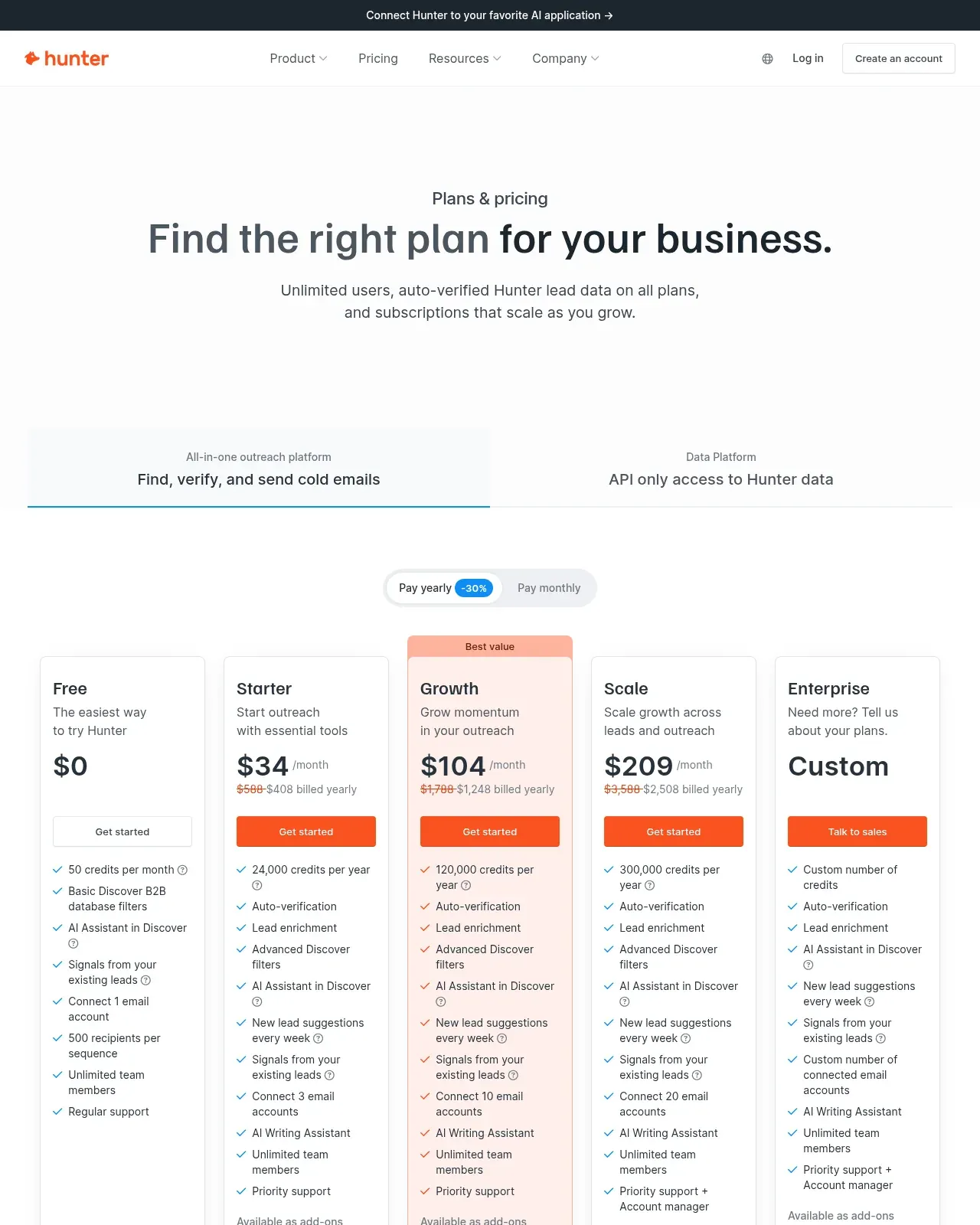
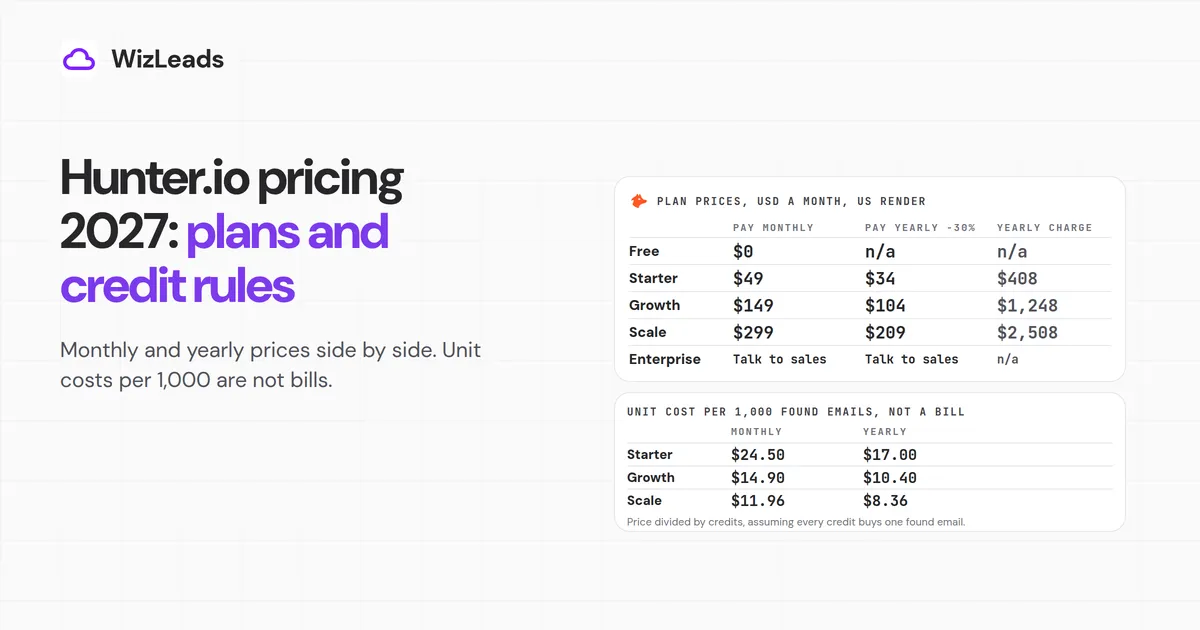
Source: Hunter pricing page, on yearly billing: Starter is $34 a month ($408 a year), Growth $104 ($1,248) and Scale $209 ($2,508).
Hunter's pricing page lists four public plans and an Enterprise tier with no price. Every figure in this table is US dollars from the US render as of October 2026, once with the "Pay monthly" toggle and once with "Pay yearly -30%".
| Plan | Monthly | Yearly, per month | Billed yearly | Credits | Unit cost per 1,000 found, monthly / yearly |
|---|---|---|---|---|---|
| Free | $0 | n/a | n/a | 50 a month | n/a |
| Starter | $49 | $34 | $408 | 2,000 a month or 24,000 a year | $24.50 / $17.00 |
| Growth | $149 | $104 | $1,248 | 10,000 a month or 120,000 a year | $14.90 / $10.40 |
| Scale | $299 | $209 | $2,508 | 25,000 a month or 300,000 a year | $11.96 / $8.36 |
| Enterprise | Talk to sales | Talk to sales | n/a | Custom | n/a |
The unit-cost column assumes every credit buys one found email, which is the best case. The toggle says "-30%". Recomputed against twelve monthly payments, the saving is 30.61% on Starter ($408 against $588), 30.20% on Growth ($1,248 against $1,788) and 30.10% on Scale ($2,508 against $3,588). In dollars that is $180, $540 and $1,080 a year.
Currency is geo-rendered, so the Hunter.io price you see depends on where you are. A German visitor sees the same numerals in euros, 49€ and 34€ for Starter, and the add-ons differ: custom domains start at 5.34€ there against $6.00 for a US visitor, per the same pricing page. Check which render you are looking at before you compare quotes.
The pricing page shows Scale's Signals allowance two ways, "Unlimited" in the desktop table and 10,000 in the stacked list, so ask Hunter before you buy Scale for Signals.
Is Hunter.io free? Only up to a point. The Hunter.io free plan is 50 credits a month across all tools, with API access. The credits reset each month and do not roll over, and the plan also includes one connected email account, 500 recipients per sequence and 30 AI Discover searches a month.
Per Hunter's monthly versus yearly article, "Hunter doesn't offer a traditional free trial on paid plans", so every account starts on Free.
Registered non-profits (501(c) status in the US) can get 30% off monthly plans, per Hunter's pricing FAQ, by emailing proof of status after signing up. The discount cannot be combined with other offers.
What one Hunter credit buys
What a Hunter.io credit buys depends on the tool. Hunter's pricing FAQ defines it three ways: "1 credit = 1 email found via Domain Search, Email Finder, or Bulk Email Finder", "1 credit = up to 10 emails found via Bulk Domain Search" and "0.5 credit = 1 email verified via Email Verifier or Bulk Email Verifier".
The same page says which lookups cost nothing. For the Email Finder: "1 credit is counted for each email found using the Email Finder. If the email address can't be found, it's free." For Domain Search: "If no emails are found, no credits are used." Hunter's Bulk Email Finder help article adds that "Search credits are only used for emails that are downloaded", with up to 50,000 addresses per file, depending on your plan.
One gap in Hunter's wording matters if your list is full of catch-all domains. The pricing FAQ charges per email found, while Hunter's credits help article says "No credits are used if Hunter can't find or verify an email". Neither page says what happens to a find that comes back with an accept-all or unknown status. We could not settle it from the public pages, so test it on the Free plan before you size a plan around it.
Repeat lookups are worded three ways: once per billing period in the pricing FAQ, "once per calendar month" in the Data Platform calculator, and billing period on monthly plans but calendar month on yearly ones in the help article. Bulk uploads, per that help article, "will always use credits", so rerunning a list through the bulk tools costs credits every time.
Hunter runs two billing systems. The All-in-one plans are the ones above. The Data Platform, covered further down, is a credits-only plan that meters differently. Hunter's pricing page labels it "API only access to Hunter data", while its Data Platform article also lists the bulk search, bulk email finder and verification tools.
| Action | All-in-one plans | Data Platform |
|---|---|---|
| Email verification | 0.5 credit per email, from the same pool | 1 Verification credit per email, a separate credit type |
| API enrichment endpoints | 0.2 credit per enriched email or domain | 1 Search credit per enriched email or domain |
The enrichment row comes from Hunter's credits help article. The Data Platform verification row comes from Hunter's verification billing article, which says to "use a separate Verification credit: 1 credit is used per email address instead of 0.5."
Domain Search is where Hunter's help centre disagrees with itself. Its credits help article gives the Data Platform 1 Search credit for up to 10 emails per domain, against 1 credit per email revealed on the All-in-one plans. Its FAQ on finding emails gives both plans 1 credit per email revealed in the app, and 1 credit per 1 to 10 emails through the Domain Search API. If most of your volume is Domain Search, ask Hunter which rule your plan uses.
Which verification results you pay for
That article is specific: "credits are only used when the verification returns a valid, invalid, or accept-all result." So valid, invalid and accept-all are charged. Unknown and disposable results are free, and the pricing FAQ adds "If we fail to verify, no credit is counted; in this case, the verification status returned is Unknown."
The charged accept-all result is the one to watch. A catch-all domain accepts mail for every address, so a verifier cannot say whether the mailbox exists and returns accept-all, which Hunter bills at the full 0.5 credit.
In our benchmark of 1,000 real-estate decision-maker emails sourced from Apollo (April 2026), 212 (21.2%) sat on catch-all domains. Accept-all answers on those 212 would cost 106 credits without settling whether the mailboxes exist.
The same help article says "all leads that you have previously verified will automatically benefit from monthly re-verification" at no extra cost on paid plans.
At 0.5 credit per check, as the "Email verified · 0.5 credit" line on Hunter's pricing page puts it, the pro-rata unit costs are below.
| Plan | Per 1,000 verifications, monthly | Per 1,000 verifications, yearly |
|---|---|---|
| Starter | $12.25 | $8.50 |
| Growth | $7.45 | $5.20 |
| Scale | $5.98 | $4.18 |
Monthly or yearly, and what happens to unused credits
Yearly billing also changes how credits behave. On a monthly plan, per Hunter's rollover article, "Unused credits do not carry over to the next month." On a yearly plan, the pricing page says "All credits are available upfront for the whole year", so 120,000 Growth credits can be gone by March.
| Credit type | When it expires |
|---|---|
| Monthly plan | Resets each cycle, no carry-over |
| Yearly plan | 12 months |
| Data Platform | 12 months |
| Credit packs | 3 months |
| Credits moved on a plan change | 3 months if the new plan is monthly, 12 if yearly or Data Platform |
When you change plan, the remaining credits move into an extra pack with the validity in the last row. You can switch from monthly to yearly straight away, but Hunter's plan-change article says the reverse is not possible, because "yearly plans have a 12-month commitment".
Monthly billing is the low-commitment way to try a paid plan. The pricing page says "You're free to take a subscription just for one month and cancel it when your work is done." Monthly plans can be paused for 1 to 3 months, and per Hunter's pause article the plan "resumes automatically with 30% off your first month."
Credit packs and Hunter's two price lists
Credit packs add credits to a paid plan for 3 months and are not sold on Free, Data Platform or Enterprise. The caps per purchase are 9,000 credits on Starter, 60,000 on Growth and 180,000 on Scale. Hunter's help centre gives two different price lists for them and does not say which is current.
| Starter | Growth | Scale | |
|---|---|---|---|
| Version A, 100 credits | $10 | $7.50 | $5 |
| Version A, 1,000 credits | $70 | $52.50 | $35 |
| Version A, 10,000 credits | $400 | $300 | $200 |
| Version B, the $10 minimum buys | 100 credits | 300 credits | 500 credits |
Version A is Hunter's credit packs article: "Credit packs start at 100 credits" as the minimum purchase on any plan.
Version B is its article on getting more credits, whose table lists Growth at €10 / $10 / £8 for a 300-credit minimum. The lists agree on Starter and disagree on Growth and Scale. Checkout needs an account, so we could not see which one it charges, and we use neither as the price. Version A also lists a $400 Starter price for 10,000 credits, above its own 9,000-credit cap per purchase on Starter.
Pro-rata, version A is $100, $75 and $50 per 1,000 credits at the 100-credit pack, $70, $52.50 and $35 at 1,000, and $40, $30 and $20 at 10,000. Version B's $10 minimum is $33.33 per 1,000 on Growth and $20.00 on Scale. Even Scale's $20 is above both of Scale's plan rates in the first table.
Packs work as a top-up for a plan you already pay for. If you need 10,000 credits in a month, one month of Growth covers it. Starter plus 8,000 extra credits at version A's 1,000-credit price ($70 per 1,000) is $49 plus $560, or $609, and at its 10,000-credit price ($40 per 1,000) it would be $49 plus $320, or $369.
Hunter says the price per credit falls as the pack grows and shows the exact price at checkout. Either way, both cost more than one month of Growth.
The Data Platform: API pricing and the tier cliffs
Hunter's pricing page also sells the Data Platform, which is where Hunter.io API pricing lives: a separate billing system for API users. Hunter's Data Platform article says "Each plan lasts 12 months and renews automatically unless canceled". It has no Sequences, Signals or credit packs, and Discover works through the API only.
You can buy search credits and verification credits together or separately, at least 1,000 of each type you choose, and they last 12 months from purchase. The default calculator view shows $61.00 USD for 1,000 search credits ($50) plus 1,000 verification credits ($11). The public calculator shows USD to a German visitor too, though Hunter's Data Platform article says accounts billed in euros or pounds see different prices.
The rate table embedded in the pricing page works as a cliff. The calculator prices the whole quantity at the rate of the highest threshold you reach, not tier by tier.
The page data lists nine thresholds: 1,000, 9,999, 19,999, 49,999, 149,999, 249,999, 499,999, 999,999 and 1,999,999 credits. Search credits cost $0.05, $0.0209, $0.0153, $0.0095, $0.0092, $0.0075, $0.0073, $0.0069 and $0.0056 each across those thresholds. Verification credits step from $0.011 down to $0.0028 at 999,999 credits and $0.0022 at 1,999,999. The calculator switches to Custom above 1,000,000, so no setting reaches that ninth row.
The bills below are computed from that rate table (quantity times the rate of the highest threshold reached); the calculator itself opens on the $61 default, so confirm your quantity there before you buy.
| Search credits | Bill (computed) | Per 1,000 |
|---|---|---|
| 1,000 | $50 | $50.00 |
| 9,000 | $450 | $50.00 |
| 10,000 | $209 | $20.90 |
| 49,000 | $749.70 | $15.30 |
| 50,000 | $475 | $9.50 |
| 1,000,000 | $6,900 | $6.90 |
| Verification credits | Bill (computed) | Per 1,000 |
|---|---|---|
| 1,000 | $11 | $11.00 |
| 10,000 | $110 | $11.00 |
| 50,000 | $370 | $7.40 |
| 150,000 | $690 | $4.60 |
| 1,000,000 | $2,800 | $2.80 |
In the search table, 1,000 extra credits cut the bill by $241 between 9,000 and 10,000 credits, and the same cliff sits between 49,000 and 50,000. Verification has the same step at 19,000 credits ($209) against 20,000 ($180). Round up to the next threshold before you check out.
Terms: refunds, renewal and price changes
Hunter's Terms of Service say "Upgrade fees are non-refundable" and that "your Upgrade subscription will automatically renew". Fee changes take effect on 30 days' notice, and cancellation takes effect at the end of the period.
Hunter's help article on cancelling early answers the partial-refund question with "No, we don't offer refunds." It gives access until the end of the period and says exceptions may be made for unauthorized charges. For a yearly plan that means a yearly Growth charge is not recoverable if you stop using it in month two. Data Platform plans renew automatically too, so set a reminder before month 12.
What 10,000 found emails a month costs on each route
Take a team that needs 10,000 found emails a month, or 120,000 a year. Each row uses Hunter's published prices as a pro-rata unit cost, assuming every credit buys a found email.
| Route | What you pay for 120,000 credits | Unit cost per 1,000 |
|---|---|---|
| Growth, paid monthly | $1,788 (12 x $149) | $14.90 |
| Growth, paid yearly | $1,248 up front | $10.40 |
| Data Platform search credits | $1,140 in one purchase (computed) | $9.50 |
| Scale, paid yearly (300,000 credits, more than the job needs) | $2,508 up front | $8.36 |
Among the Hunter routes in the table, the Data Platform is the cheapest bill for exactly 120,000 credits. Scale yearly has the lowest unit cost in the table because it buys 300,000 credits. The Data Platform has no Sequences or Signals, works through the API and the bulk tools, and bills all 120,000 credits at once.
For a single 10,000-email job, a month of Growth at $149 beats 10,000 Data Platform search credits at $209, and you can cancel after the month. The Data Platform's computed unit cost falls below Growth yearly's rate from 50,000 credits.
Where WizLeads fits
On the Freelancer plan, WizLeads' email finder is $39 for 10,000 credits. A work email costs 3 credits per email found with misses free, which is $11.70 per 1,000 found as a pro-rata unit cost, and Freelancer carries 3,333 finds a month. Verification is 0.5 credits per email, charged for every email processed regardless of the result, or $1.95 per 1,000. The free tier is 500 credits one time.
Hunter is cheaper per found email at several points on its pricing page: Growth yearly, Scale yearly and, by our computation, the Data Platform from 50,000 search credits. Hunter also leaves Unknown and disposable verifications free where WizLeads bills everything it processes, and renews 50 free credits every month.
WizLeads is cheaper per found email than Hunter Starter on either billing and Growth monthly. WizLeads' $1.95 per 1,000 verifications is below every Hunter verification rate in this guide, including the $2.20 per 1,000 in Hunter's page data that the calculator does not reach. The lowest rate the calculator shows is $2.80 at 1,000,000 Data Platform credits.
These unit costs say nothing about find rates, and a cheaper credit buys less if fewer lookups find something. The Hunter alternatives comparison looks at that find-rate side, and the roundup of email finder tools sets other finders' prices side by side.