WizLeads


TL;DR
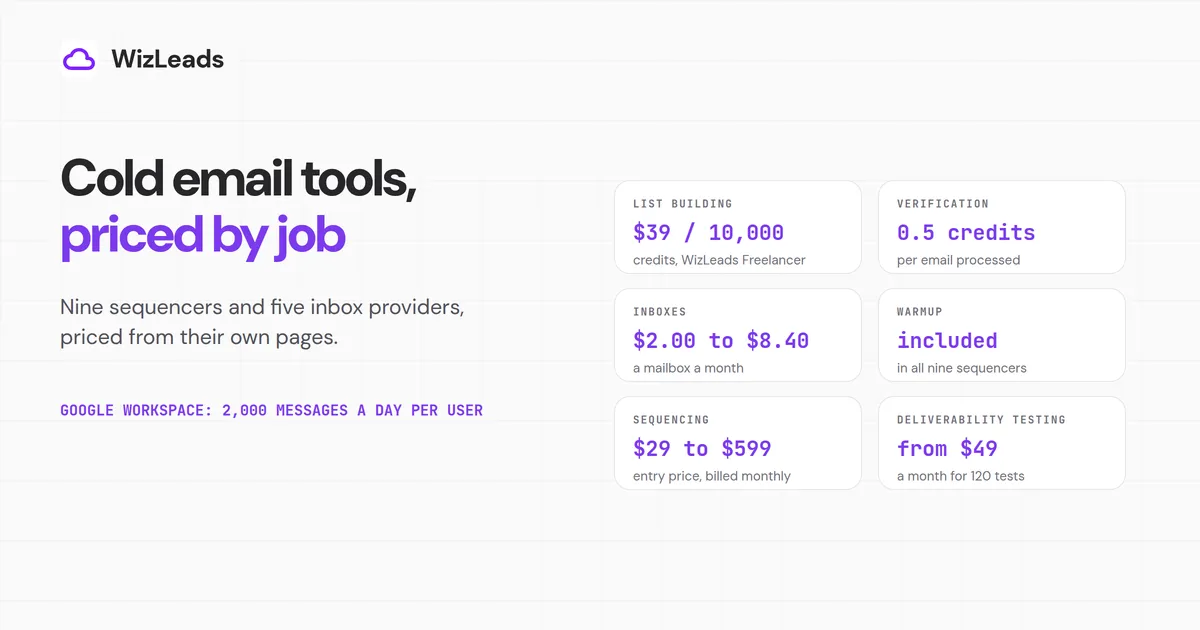
Cold email tools do six jobs: build the list, verify it, supply the mailboxes you send from, warm those mailboxes, run the sequences, and test where the mail lands. Of the nine sequencers priced here, Mailshake Starter is the cheapest paid plan, at $29 a month or $25 billed annually. lemlist and Email Bison price by volume ($69 for 50,000 emails and $599 for 500,000 a month), and Apollo puts a contact database in every seat from $65 a month. Every sequencer includes warmup on its paid plans.
Most guides cover only the sequencer, yet it now reaches into the other jobs: five of the nine sell mailboxes at a per-mailbox price, and seven sell "unlimited" mailboxes or senders on at least one plan. Each "unlimited" stops somewhere, and the table below says where. In a small stack the inboxes are the biggest bill, so the guide also sets Google's and Microsoft's own sending limits beside the inbox prices.
This guide prices nine sequencers and five inbox providers from their own pages, in identical slots.
The cold email stack at a glance
| Job | What it does | Tools in this guide | Where we go deeper |
|---|---|---|---|
| List building | People plus a work email for each | WizLeads | Sales Navigator scrapers compared |
| Verification | Removes addresses that will bounce | WizLeads; Mailshake and Woodpecker bundle it | Email verification tools |
| Inboxes | The Google or Microsoft mailboxes you send from | Google Workspace, Microsoft 365, WizMail, Zapmail, Primeforge | this guide |
| Warmup | Builds sending reputation on new mailboxes | included in all nine sequencers | this guide |
| Sequencing | Email sequence software that sends and follows up | Mailshake, Woodpecker, Smartlead, Saleshandy, Instantly, Reply.io, Apollo, lemlist, Email Bison | this guide |
| Deliverability testing | Shows which folder a campaign lands in | Smartlead SmartDelivery, Email Bison's EmailGuard integration | this guide |
How we chose these tools
We started from the pages that rank: the nine roundups for "cold email tools" we could read, eight organic results plus the Zapier roundup that Google's AI Overview cites. Seven of the nine come from vendors selling a tool in this category. Their main lists are mostly sequencers, with mailboxes and data in a side section at most.
- Sequencers: cold email platforms named in the main list of at least 6 of those 9 pages. Eight passed: lemlist (9 of 9), Instantly (8), Apollo, Saleshandy, Woodpecker and Reply.io (7 each), Smartlead and Mailshake (6 each). The ninth, Email Bison, appears on none of the nine. It is here because it is the sequencer we run our own campaigns on.
- Inbox providers: sell Google Workspace or Microsoft 365 mailboxes set up for cold email, with a per-mailbox price on their own page. Google and Microsoft direct are the baseline.
- List building and verification: one tool each, WizLeads, with our full comparisons for the rest.
Prices come from each vendor's own page, with both billing toggles where the page has them, as of October 2026. Sequencers run from lowest monthly-billed entry price to highest, and each fills the same six slots in the same order.
What Google and Microsoft allow per mailbox
Google Workspace lets each user send 2,000 messages a day, 1,500 through mail merge and 500 on a trial account, with caps of 3,000 external recipients and 2,000 unique external recipients a day (500 on a trial). All of these are counted over a rolling 24 hours (Google's sending-limits help page). Google adds that "Sending limits can change without notice", and if you exceed them, the account "might be suspended."
Exchange Online allows 10,000 recipients a day per user and 30 messages a minute (Microsoft's Exchange Online limits page). Above that sits a tenant-wide external recipient limit that "depends on the number of licenses a tenant has", capped at 5,000 external recipients a day on a trial tenant.
Those are ceilings. Forge, which sells Primeforge mailboxes, recommends far less on its pricing page: "sending 30 emails per mailbox per day (max 100) and using 2-3 mailboxes per domain". On that guidance, 900 emails a day takes 30 mailboxes across 10 to 15 domains.
Google's and Microsoft's bulk-sender rules are written for consumer inboxes. Google's sender guidelines ask every sender to Gmail for SPF or DKIM, valid PTR records and TLS. Above 5,000 messages a day to Gmail accounts, they add SPF and DKIM, DMARC (a policy of none is allowed), an aligned From domain and one-click unsubscribe for marketing and subscribed mail. Google's spam-rate guidance is to stay "below 0.10% and avoid ever reaching a spam rate of 0.30% or higher", a complaint metric, not a bounce threshold.
Google's sender-guidelines FAQ says the guidelines "don't apply to messages sent to Google Workspace accounts", and Microsoft's post on its high-volume sender rules covers "our consumer service, which is supporting hotmail.com live.com and outlook.com consumer domain addresses". If you send B2B into Workspace and Microsoft 365 tenants, treat both as hygiene guidance; neither company says it enforces them there.
Google says that from November 2025, non-compliant mail to Gmail meets "temporary and permanent rejections". Microsoft's post still says failing mail "will first be routed to Junk", but its 29 April 2025 update says Outlook.com rejects it from 5 May 2025, and strikes through the older paragraph about Junk routing.
US law applies to cold email as well. The FTC's CAN-SPAM compliance guide says "The law makes no exception for business-to-business email." So B2B cold email must avoid false or misleading header information. It must also include a valid physical postal address and honour an opt-out request within 10 business days.
The same guide puts the penalty at up to $53,088 for each separate email in violation. Other countries set their own rules.
Neither company publishes a bounce-rate threshold. The published figures come from sending platforms: Amazon SES says to "maintain a bounce rate below 2%", reviews an account at 5% and may pause sending at 10%, and Mailgun's Acceptable Use Policy sets bounces at 5% or less.
List building
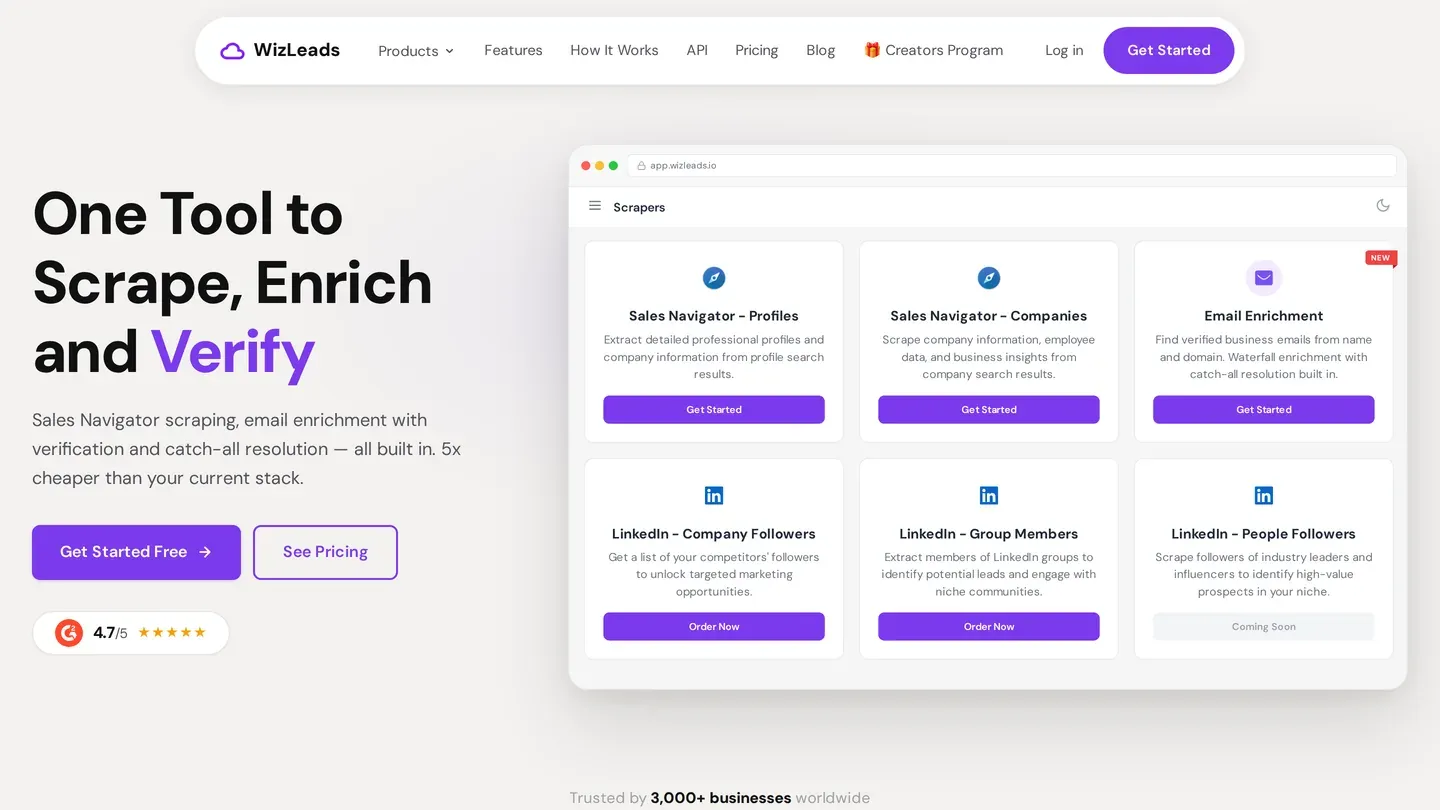
We build a scraper that turns Sales Navigator searches into lead lists, so WizLeads is the list-building tool here.
WizLeads
Source: WizLeads homepage.
- What it does: scrapes Sales Navigator searches into a lead list, finds a work email from a first name (or full name) and the company website, and verifies addresses. Account-less mode needs no Sales Navigator seat, but you still need a Sales Navigator search URL to start, so it does not replace Sales Navigator access.
- Price: Freelancer is $39 a month for 10,000 credits, and signup gives 500 free credits once. Scraping costs 1 credit a lead with your LinkedIn account connected and 2 account-less. A work email costs 3 credits when found and nothing on a miss, so Freelancer covers about 3,333 found emails, pro-rata. Plan on a find rate of 50 to 60 percent.
- Where it falls short: it scrapes only Sales Navigator: free LinkedIn search, posts and company employee pages are out. It needs the company website, and it does not find a work email from a LinkedIn profile URL. It sends nothing.
Eight of the nine cold outreach tools below sell or bundle lead data. Apollo has a shared credit pool, Saleshandy a lead finder (1 credit per verified email), Instantly its Credits and lemlist an enrichment add-on from $20 a month. Smartlead sells verified prospect emails ($59 a month on Base and Pro), Reply gives 50 live data credits a month, and Mailshake and Woodpecker include finder credits on their entry plans. If you build lists in Sales Navigator, the choice that matters most is whether a scraper runs on your own LinkedIn session, and our Sales Navigator scraper comparison sorts the tools by it.
Verification
Microsoft's post tells senders to "Remove invalid addresses regularly to reduce spam complaints, bounces, and wasted messages."
WizLeads
- What it does: checks each address and classifies catch-all emails as valid or invalid. Emails WizLeads finds are already checked, and the API reference says of them: "All emails are valid and catch-all verified."
- Price: 0.5 credits per email, and the WizLeads API reference says "Verify Email charges for every email processed, regardless of the result." The $39 Freelancer plan covers 20,000 verifications, a unit cost of $19.50 per 10,000.
- Where it falls short: it is not the cheapest verifier. Reoon lists 10,000 verifications at $11.90 on its own page and refunds unknown results, which WizLeads charges for. Our verification benchmark mailed every address at least one of six tools approved, from the same 1,000. WizLeads kept 852, and 0.59% of those bounced. DeBounce (0.15%) and NeverBounce (0.56%) bounced less, and rejected 330 and 289 addresses against 148 for WizLeads.
Mailshake includes unlimited email verification on all three plans, and Woodpecker lists unlimited verification, catch-alls included, at no charge. Smartlead and Reply sell verification as an add-on, Reply from $20 a month. Our verification tools comparison prices the rest of the verifiers.
Cold email infrastructure: where the inboxes come from
Every sequencer here sends through mailboxes you connect. You can buy them from Google or Microsoft directly, from a reseller that sets them up for cold email, or from the sequencer. Mailforge's own pricing page calls what it sells "shared email infrastructure", so it falls outside the rule. Each provider below fills the same five slots.
Google Workspace (direct)
- What you get: Business Starter accounts that you set up yourself, including the domain, SPF, DKIM and DMARC.
- Price per mailbox: $7 per user a month on the annual plan, or $8.40 on flexible billing, as shown to a US visitor (Google Workspace pricing).
- Billing terms: the $7 needs a 1-year commitment; the page says it saves 16%.
- Sending limit: 2,000 messages a day per user, 3,000 external recipients and 2,000 unique external recipients, as above.
- Where it falls short: tied with Microsoft for the highest per-mailbox price of the five providers here, and every setup step is yours.
Microsoft 365 (direct)
- What you get: Business Basic accounts on Exchange Online, set up by you.
- Price per mailbox: $7.00 per user a month paid yearly, or $8.40 on a monthly subscription, as shown to a US visitor (Microsoft 365 Business Basic).
- Billing terms: the yearly price is an annual subscription that auto-renews.
- Sending limit: 10,000 recipients a day per user and 30 messages a minute, under the tenant-wide external cap.
- Where it falls short: a trial tenant is capped at 5,000 external recipients a day, and the setup is yours.
WizMail
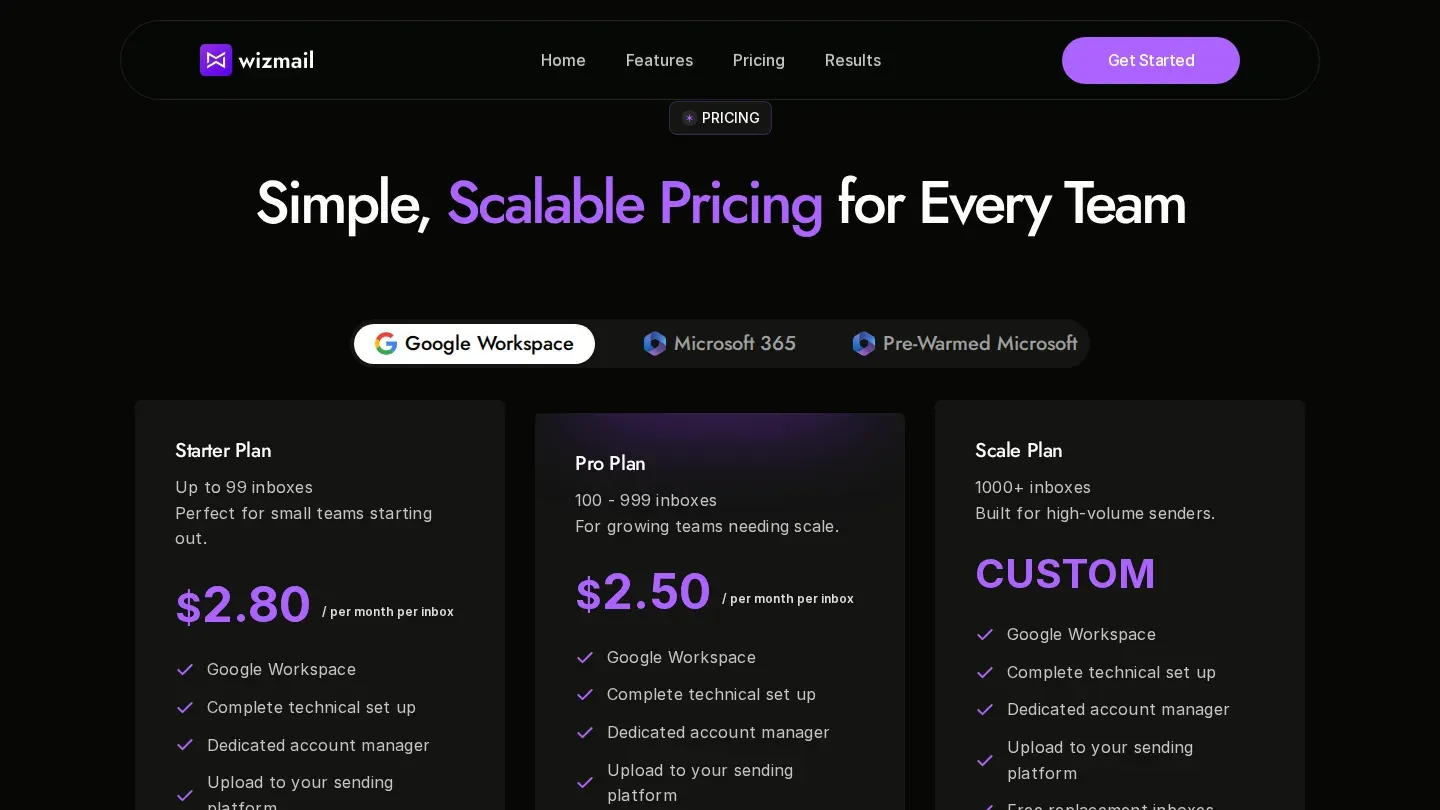
Source: WizMail pricing page, Google Workspace tab: $2.80 per inbox a month on Starter and $2.50 on Pro.
- What you get: WizMail comes from the same company as WizLeads. Google Workspace or Microsoft 365 inboxes, which WizMail warms up for you, with delivery typically in 24 to 48 hours. Every plan card lists "Complete technical set up", "Dedicated account manager", "Upload to your sending platform", "Free replacement inboxes" and "US IP address" (wizmail.io).
- Price per mailbox: Google Workspace is $2.80 per month per inbox on Starter (up to 99 inboxes), $2.50 on Pro (100 to 999) and custom on Scale (1,000+). Microsoft 365 is $2.50, $2.25 and $2.00 on the same tiers. Pre-warmed Microsoft inboxes, sold as "Microsoft 365 + Aged Domains", are $5.00, $4.50 and $4.00. They have been warming for months, so a campaign can start as soon as they are delivered.
- Billing terms: per inbox per month, tiered by count. The terms say "Refunds are not available except in cases where licenses have not been used."
- Sending limit: the Google Workspace or Microsoft 365 limits above.
- Where it falls short: Google inboxes are custom-priced above 1,000, and the page shows no pre-warmed Google tier. It sells inboxes only, so you still need a sequencer and a list.
Zapmail
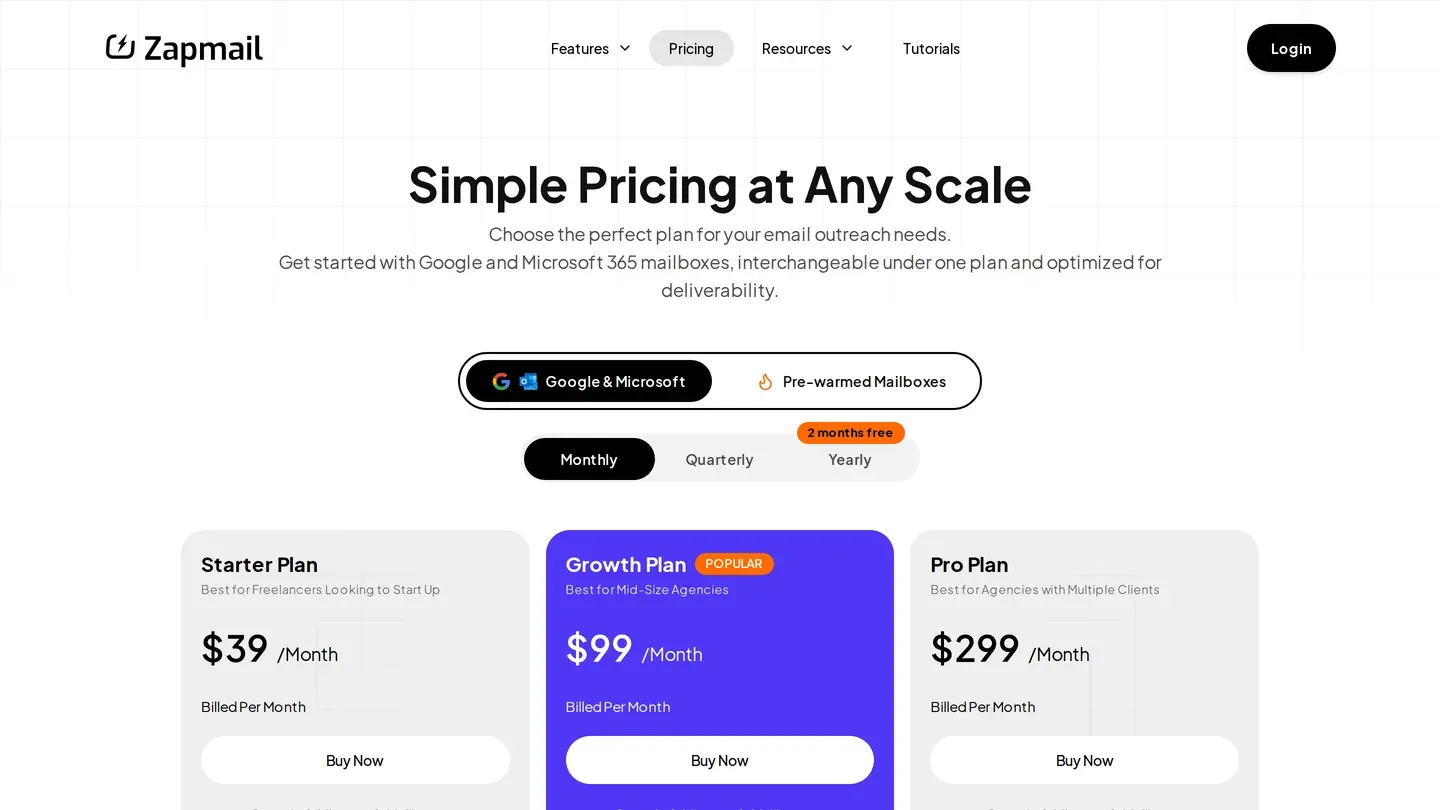
Source: Zapmail pricing page, on monthly billing: Starter is $39 a month, Growth $99 and Pro $299.
- What you get: Google and Microsoft 365 mailboxes sold in bundles; Zapmail's page says the two are "interchangeable under one plan". Smartlead's pricing page lists its SmartSenders Google and Outlook mailboxes as "Powered by Zapmail".
- Price per mailbox: Starter is $39 a month for 10 Google or Microsoft mailboxes, Growth $99 for 30 and Pro $299 for 100 (zapmail.ai): $3.90, $3.30 and $2.99 per included mailbox, pro-rata. Extra mailboxes cost $3.50, $3.25 and $3.00.
- Billing terms: monthly, quarterly or yearly (the yearly toggle says "Get 2 months free"); pre-warmed mailboxes are priced on a separate tab.
- Sending limit: Google Workspace's or Microsoft 365's, above.
- Where it falls short: the smallest bundle is 10 mailboxes, so a three-mailbox test pays for seven it does not use.
Primeforge
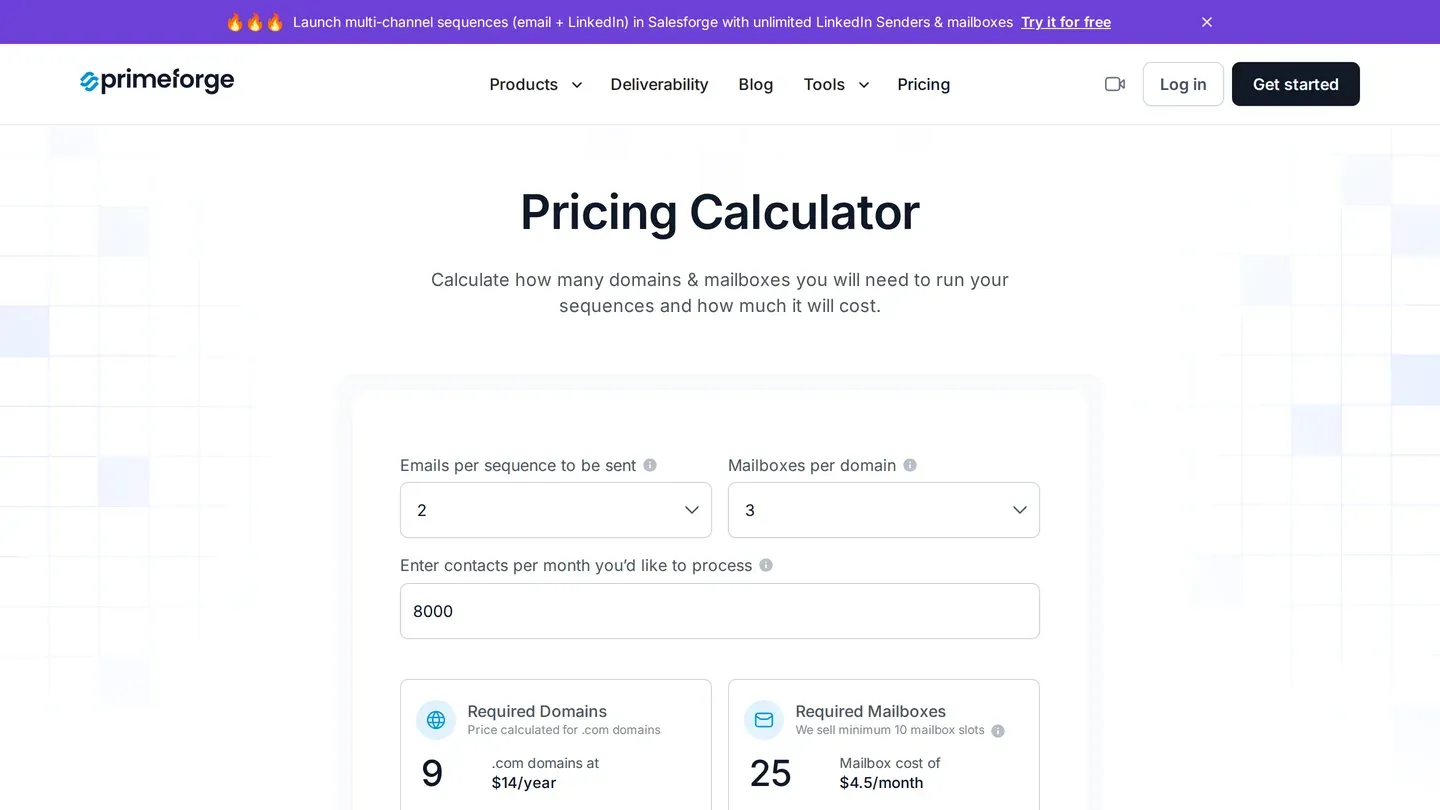
Source: Primeforge pricing page: the calculator's default of 25 mailbox slots, at $4.50 a mailbox a month.
- What you get: Google and Microsoft mailbox slots, listed on Mailforge's pricing page as its Google and Microsoft option.
- Price per mailbox: $4.50 a mailbox a month. The calculator's default of 25 slots comes to $113 a month billed monthly, or $94 a month billed yearly, about $3.76 a slot (primeforge.ai).
- Billing terms: "We sell minimum 10 mailbox slots"; .com domains are $14 a year.
- Sending limit: Google's or Microsoft's, plus Forge's own 30-a-day advice above.
- Where it falls short: on monthly billing it costs more per standard mailbox than Zapmail or WizMail, and its page does not say whether Google and Microsoft slots cost the same.
Mailboxes sold inside the sequencers
Five of the nine sequencers sell mailboxes at a per-mailbox price:
| Sequencer | Mailbox | Per mailbox a month | Domain |
|---|---|---|---|
| Saleshandy | Google Workspace, Microsoft o365 or Azure | $2.99 Annual Fixed, $3.49 Annual Flexi, $3.99 Quarterly | $14 a year; up to 5 mailboxes per domain |
| Smartlead (SmartSenders) | Google or Outlook, powered by Zapmail | $4.50; pre-warmed $9 | $13 a year; pre-warmed $18 |
| Instantly | Done-for-you Google account | $5; pre-warmed Google $10 | $15 a year |
| Reply.io | New mailbox | $5; pre-warmed $15 | from $6 a year; pre-warmed from $25 |
| Woodpecker | Google or Microsoft | $6 | about $1 a month, billed annually |
Saleshandy's Annual Flexi needs at least 25 mailboxes. Mailshake also sells "Ready to Use Mailboxes" at $12 a month; its mailbox page says that buys 1 domain and 5 email addresses, so it is not a per-mailbox price and is left out of the table.
Warmup comes with the sequencer
All nine cold email outreach tools in this guide bundle warmup, so a separate warmup subscription often duplicates one you already pay for.
| Sequencer | Warmup included | Limit |
|---|---|---|
| Mailshake | Unlimited email warmup | all plans |
| Woodpecker | 3 warm-ups included | extra warm-ups $5 a month per email account |
| Smartlead | "unlimited warmup", per its llms.txt file | every plan; the pricing page grades the warmup pool by plan |
| Saleshandy | Unlimited warm-up | daily warm-up volume set by plan |
| Instantly | "automated warmup" | all plans |
| Reply.io | Included per mailbox, via Mailtoaster.ai | per mailbox |
| Apollo | "Deliverability Suite & Email Warmup" | listed from Basic up |
| lemlist | "Email warm-up & Deliverability hub" | Email plan |
| Email Bison | "Private Email Warm-up" | base plan |
Validity says it launched Heatwave on 3 September 2026 as "a new email blocklist that identifies unethical cold email practices including artificial domain warming" (in its own announcement). We have not tested whether any warmup network above leads to a listing. The same announcement says a domain can be searched at lookup.validity.tools.
Cold email software: nine sequencers, priced
This is where cold email automation lives: the sequences, follow-ups and mailbox rotation.
| Sequencer | Billed on | Entry, monthly | Entry, billed annually (per month) | Where "unlimited" stops |
|---|---|---|---|---|
| Mailshake | Users | $29 | $25 | 1 address and 1,500 sends a month on Starter |
| Woodpecker | Emails sent a month | $39 (5,000 emails) | $26 ($312 a year) | 5,000 emails a month on the entry tier |
| Smartlead | Plan (sends and contacts) | $39 | $32.50 | 6,000 sends and 2,000 contacts on Base |
| Saleshandy | Plan, 1 user on Starter | $41 | $34 | rotation across 10 accounts on Starter |
| Instantly | Plan (emails and uploaded contacts) | $47 | $37.60 | 5,000 emails and 1,000 contacts on Growth |
| Reply.io | Active contacts, per user | $59 (1,000 contacts) | $49 | 25 mailboxes per 1,000 active contacts |
| Apollo | Seats | $65 | $49 | 1 mailbox and 250 sends a day on Basic |
| lemlist | Emails a month | $69 (50,000) | $55 | the volume tier |
| Email Bison | Emails a month | $599 (500,000) | none shown | 500,000 emails, then "monthly buckets" |
The cheapest cold email software here depends on how you pay. Apollo's Free plan costs nothing and includes 2 sequences, 1 mailbox and 250 sends a day, with warmup listed only from Basic up. Among paid plans, Mailshake Starter is the lowest on both billing terms.
1. Mailshake
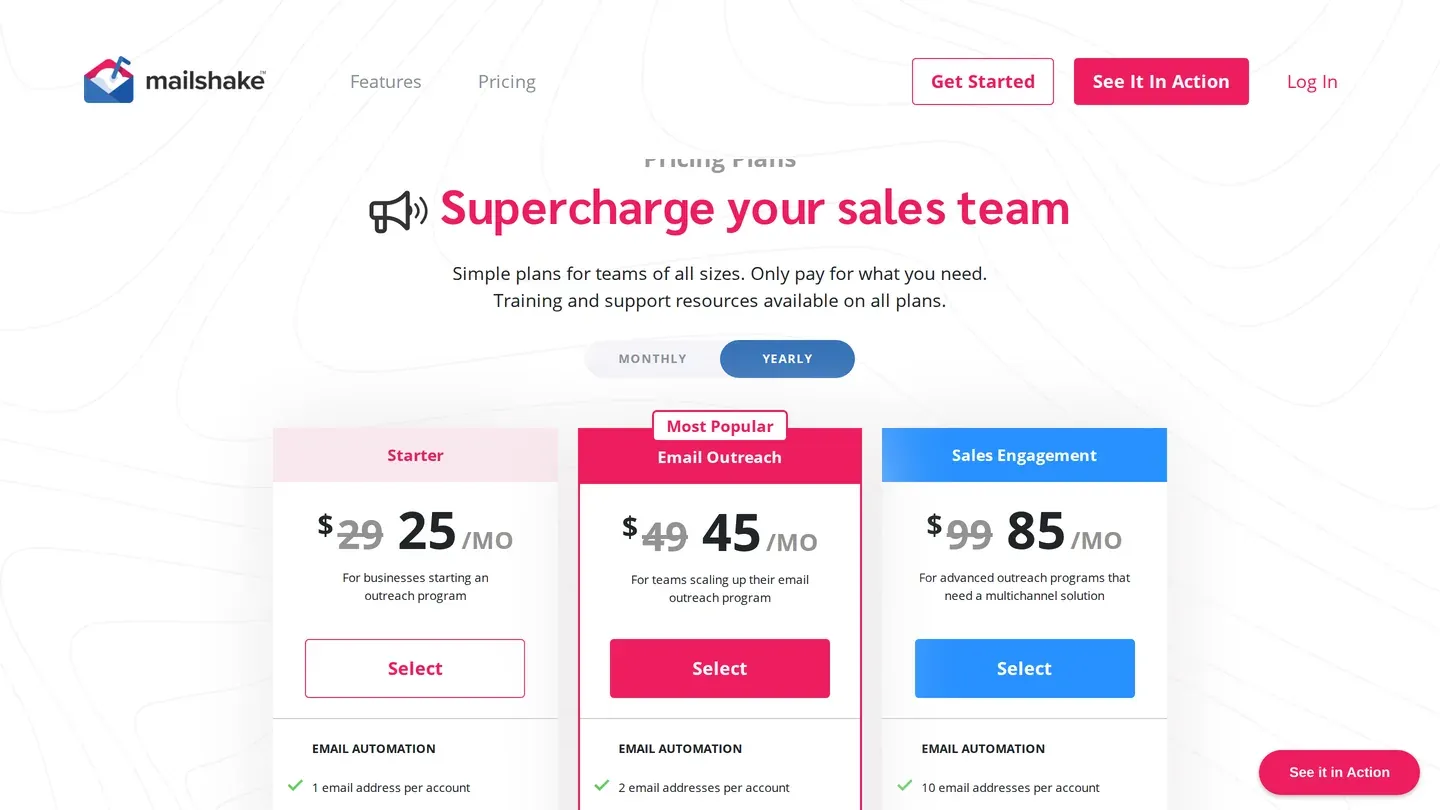
Source: Mailshake pricing page, on yearly billing: Starter is $25 a month, Email Outreach $45 and Sales Engagement $85.
- What it is for: email sequences for a small team, with a dialer on its top plan.
- Price: Starter $29 a month billed monthly or $25 billed yearly; Email Outreach $49 or $45; Sales Engagement $99 or $85 (mailshake.com). Billing "is based on how many users you purchase". There is no free trial; the FAQ says "we collect payment up front".
- "Unlimited" and its limit: Starter lists unlimited uploaded contacts, and all three plans include unlimited email warmup and email verification. Mailboxes are not unlimited.
- Warmup: unlimited, all plans.
- Sending limits: Starter allows 1 email address per account and 1,500 sends a month; Email Outreach has unlimited sends.
- Where it falls short: Mailshake contradicts itself on mailboxes. The plan cards give Email Outreach 2 email addresses per account and Sales Engagement 10, while the FAQ says "With each user you pay for, your team may connect 1 mail account."
2. Woodpecker
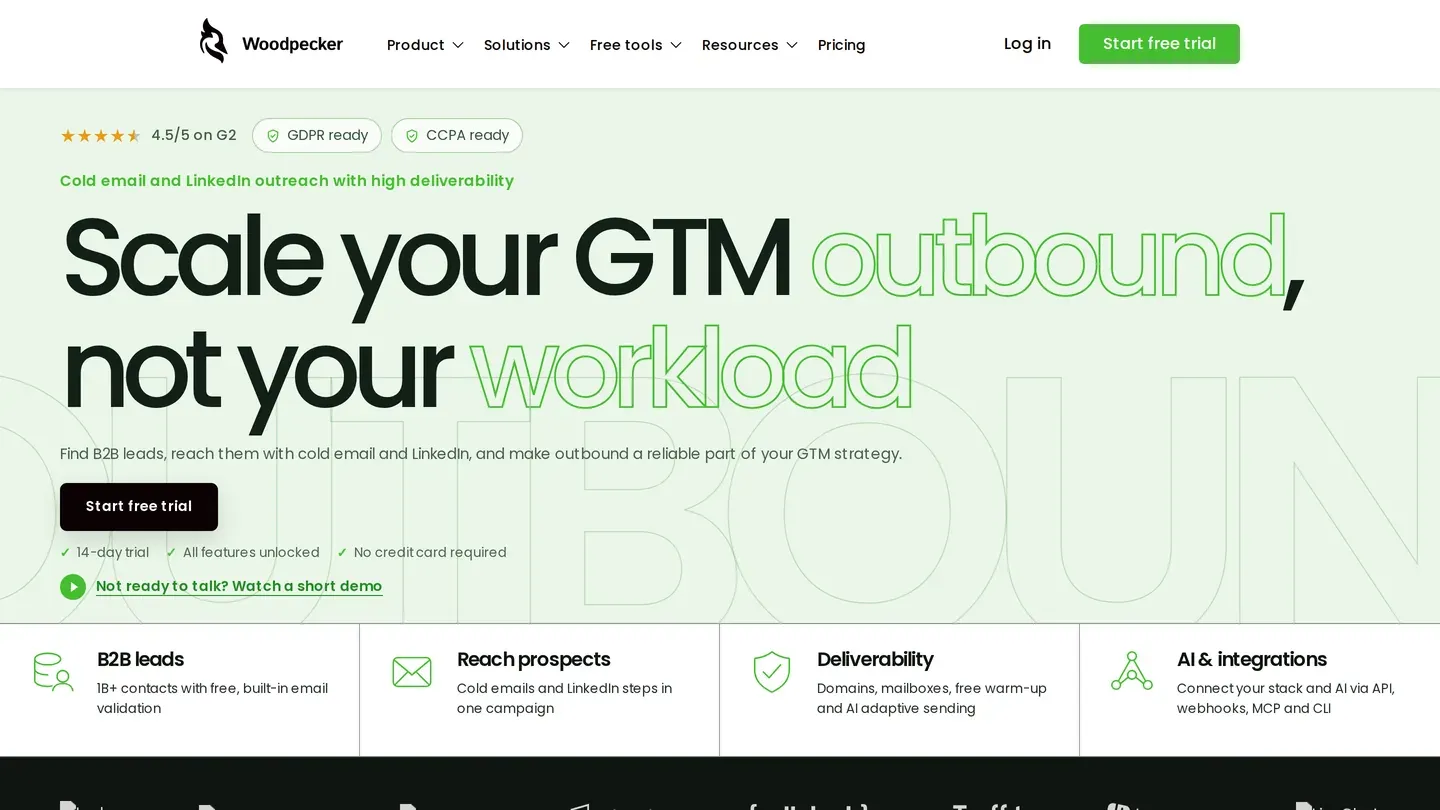
Source: Woodpecker homepage.
- What it is for: cold email billed by the emails you send, with contact storage, email accounts and team members all unlimited.
- Price: $39 a month, or $312 a year ($26 a month), for 5,000 emails sent (woodpecker.co). Higher tiers run from $79 a month for 50,000 emails to $999 for 1,000,000. The trial runs 14 days or 500 cold emails, whichever limit you reach first. 100 Lead Finder credits are included, and extra credits start at 500 for $10.
- "Unlimited" and its limit: contact storage, email accounts and team members are unlimited, and so is email verification, catch-alls included, at no charge. The cap is the emails sent.
- Warmup: 3 warm-ups included, then $5 a month per extra email account.
- Sending limits: 5,000 emails a month at entry. Google or Microsoft mailboxes are $6 a month each, and an add-on for integrations, the API and webhooks is $20 a month.
- Where it falls short: if you warm five mailboxes on the entry plan, two are extra at $5 a month each, which takes the bill from $39 to $49 a month.
3. Smartlead
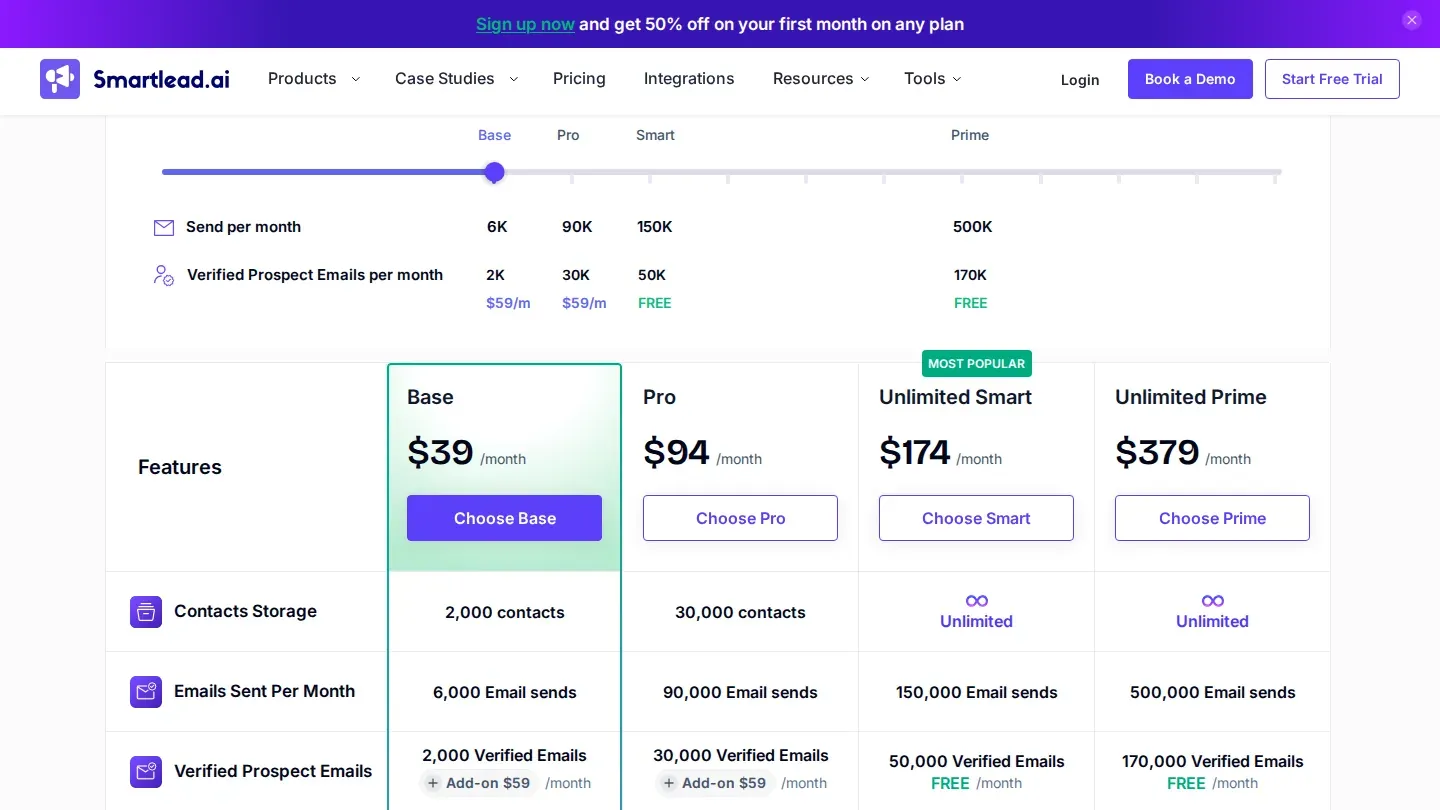
Source: Smartlead pricing page, on monthly billing: Base is $39 a month, Pro $94, Unlimited Smart $174 and Unlimited Prime $379.
- What it is for: high-volume sending across many mailboxes, with agency add-ons such as white-label client workspaces at $29 a month each.
- Price: Base $39 a month, Pro $94, Unlimited Smart $174 and Unlimited Prime $379, billed monthly; billed yearly, $32.50, $78.30, $144.50 and $314.60 a month, which the desktop plan cards round to $32, $78, $144 and $315 (smartlead.ai).
- "Unlimited" and its limit: "All Smartlead plans include unlimited email accounts at no extra cost." The caps are contacts and sends: a lead credit is "a unique email address (prospect) stored in your account", and an email credit is "each individual email sent across any campaign".
- Warmup: Smartlead's llms.txt file says "Every plan includes unlimited email accounts and unlimited warmup." The pricing page grades the warmup pool by plan: Foundation on Base, Growth on Pro and Premium above.
- Sending limits: Base carries 6,000 email sends and 2,000 contacts, Pro 90,000 and 30,000, and Unlimited Smart 150,000 sends with unlimited contacts.
- Where it falls short: Base stores 2,000 contacts, so a list larger than that starts at Pro ($94 a month). Placement tests and dedicated IPs (SmartServers, $39 per server a month) cost extra.
4. Saleshandy
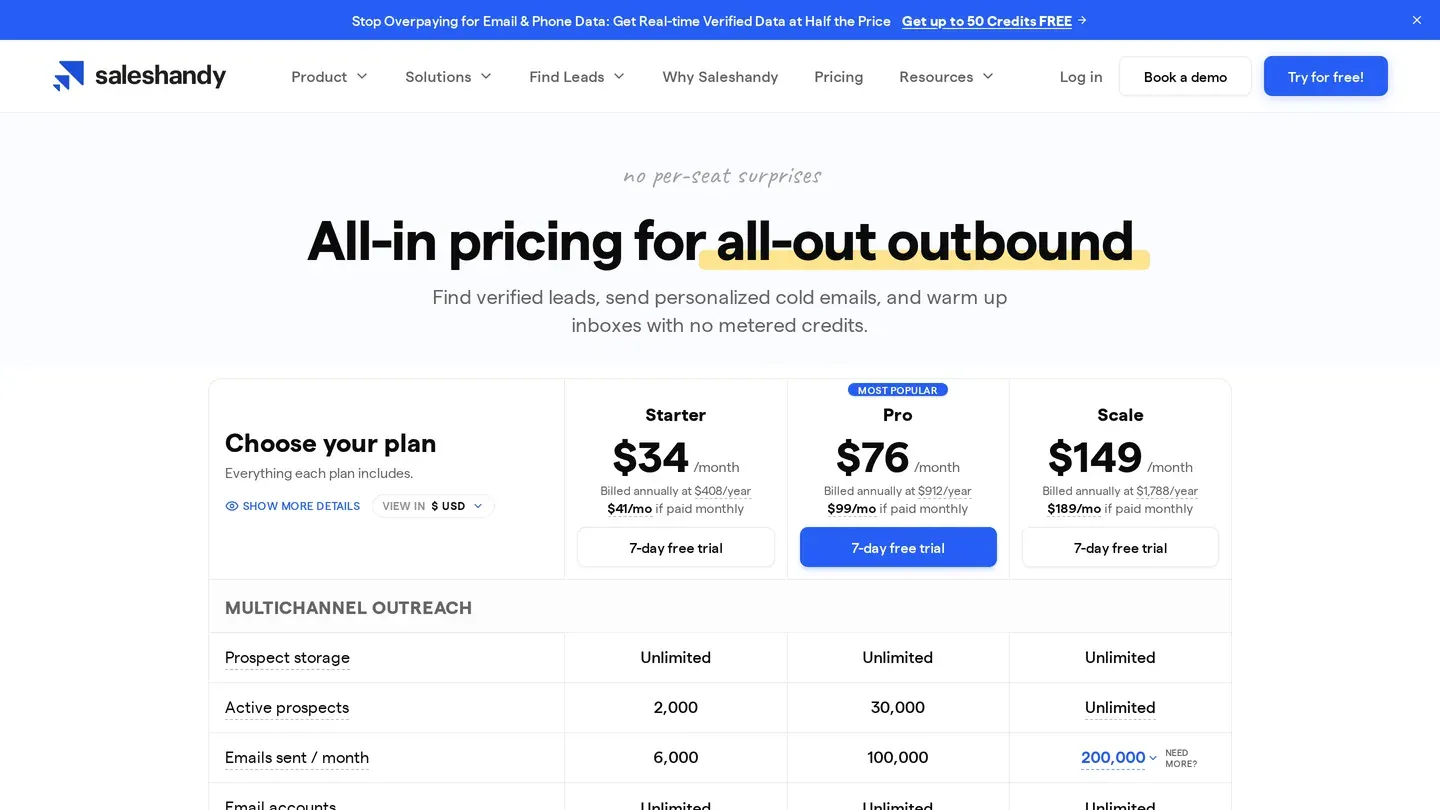
Source: Saleshandy pricing page, on annual billing: Starter is $34 a month ($408 a year), Pro $76 and Scale $149.
- What it is for: sequences with sender rotation across many mailboxes, plus a lead finder and its own mailbox add-on.
- Price: Starter $41 a month billed monthly, or $34 a month billed annually ($408 a year); Pro $99 or $76; Scale $189 or $149 (saleshandy.com). There is a 7-day free trial.
- "Unlimited" and its limit: email accounts are unlimited, with "no per-inbox fees", but sender rotation stops at 10 email accounts on Starter, 100 on Pro and 1,000 on Scale.
- Warmup: "Connect and warmup unlimited number of connected mailboxes at no extra cost. Daily warm-up sending limit as per your plan."
- Sending limits: 6,000 emails a month on Starter, 100,000 on Pro and 200,000 on Scale; active prospects 2,000, 30,000 and unlimited under fair use.
- Where it falls short: Starter has one user, so a team, or an agency rotating more than 10 accounts, starts at Pro ($99 monthly, $76 annually).
5. Instantly
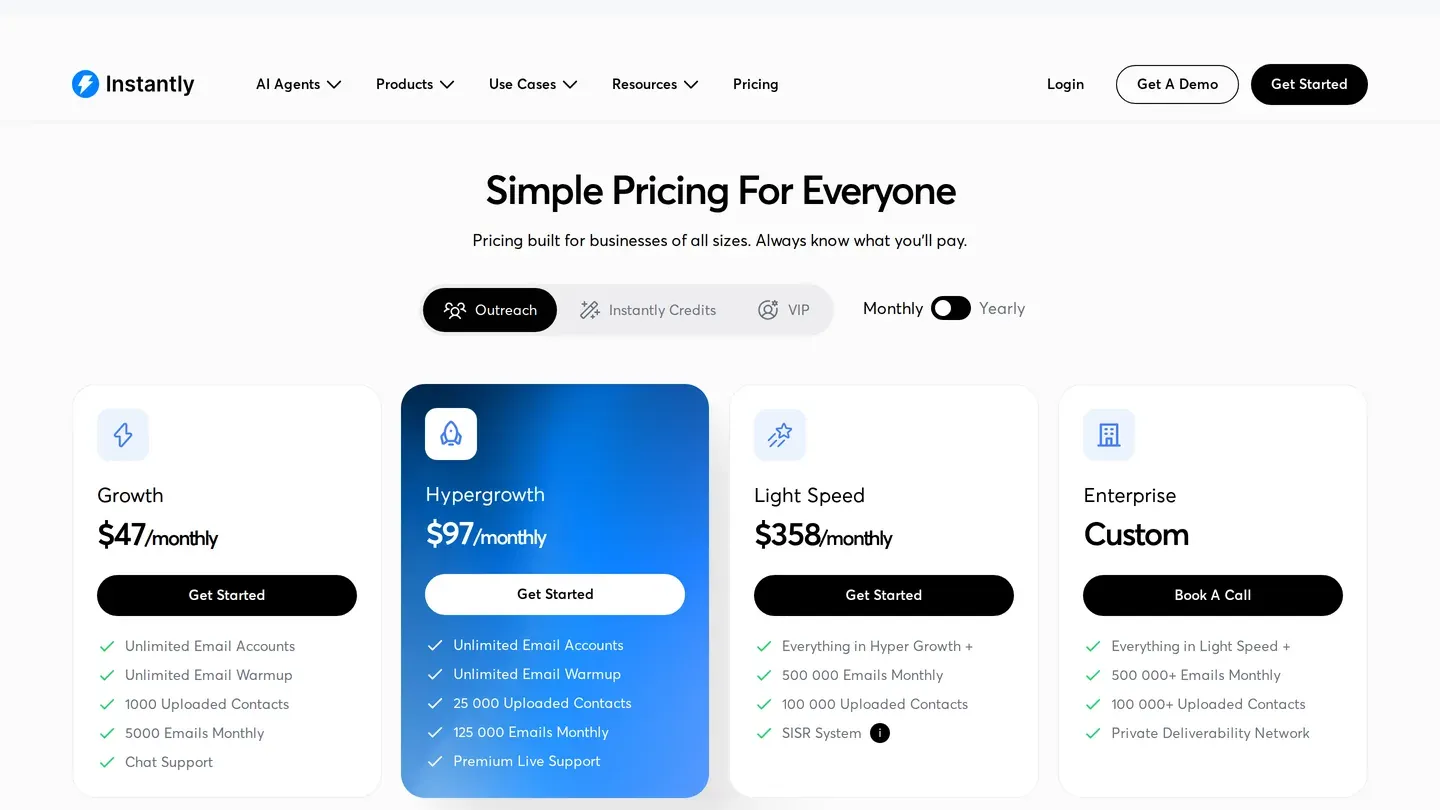
Source: Instantly pricing page, on monthly billing: Growth is $47 a month, Hypergrowth $97 and Light Speed $358.
- What it is for: sending from many mailboxes on a flat plan, with lead data sold as a separate subscription.
- Price: Growth $47 a month, Hypergrowth $97 and Light Speed $358, billed monthly (instantly.ai). The page's yearly block shows $37.60, $77.60 and $286.30 a month. The 14-day free trial needs no card and includes 250 uploaded contacts and 1,000 emails.
- "Unlimited" and its limit: "All plans include: unlimited email accounts, automated warmup". The caps are emails a month and uploaded contacts, with no overage: "users upgrade tiers rather than pay an overage charge."
- Warmup: automated, on every plan.
- Sending limits: Growth carries 5,000 emails a month and 1,000 uploaded contacts; Light Speed 500,000 and 100,000.
- Where it falls short: Instantly contradicts itself on Hypergrowth: both Outreach cards on its pricing page say 125,000 emails a month, while the Scale bundle card, the comparison table and an FAQ answer on the same page say 100,000. Instantly Credits for lead data "expire 2 months after purchase on monthly plans, or 1 year after purchase on annual plans, if unused."
6. Reply.io
Source: Reply.io homepage.
- What it is for: email sequences priced by active contacts, with a separate Multichannel plan.
- Price: the Email Volume plan at 1,000 active contacts is $59 per user a month billed monthly, or $49 billed annually; 5,000 contacts is $99 or $89 per user. The tiers run to 100,000 contacts at $999 monthly or $899 annually, with unlimited users (reply.io). Multichannel starts at $99 per user monthly, $89 annually.
- "Unlimited" and its limit: mailboxes show as unlimited under a Fair Usage Policy, which Reply's help article on existing limits sets at 25 mailboxes per 1,000 active contacts, up to 2,500 at 100,000. Multichannel includes 5 mailboxes billed monthly and 10 billed annually.
- Warmup: included for each mailbox, run through Mailtoaster.ai.
- Sending limits: the plan cap counts active contacts, and each mailbox sends at most 400 emails a day on paid plans. The pricing page counts an active contact as one you can send "1 first-step email and an unlimited number of follow-ups per month".
- Where it falls short: the pricing page and the limits article count active contacts differently. The article says a contact who gets a follow-up in a new billing month "will count as an Active Contact again", so a sequence that runs across two billing months can count one person twice.
7. Apollo
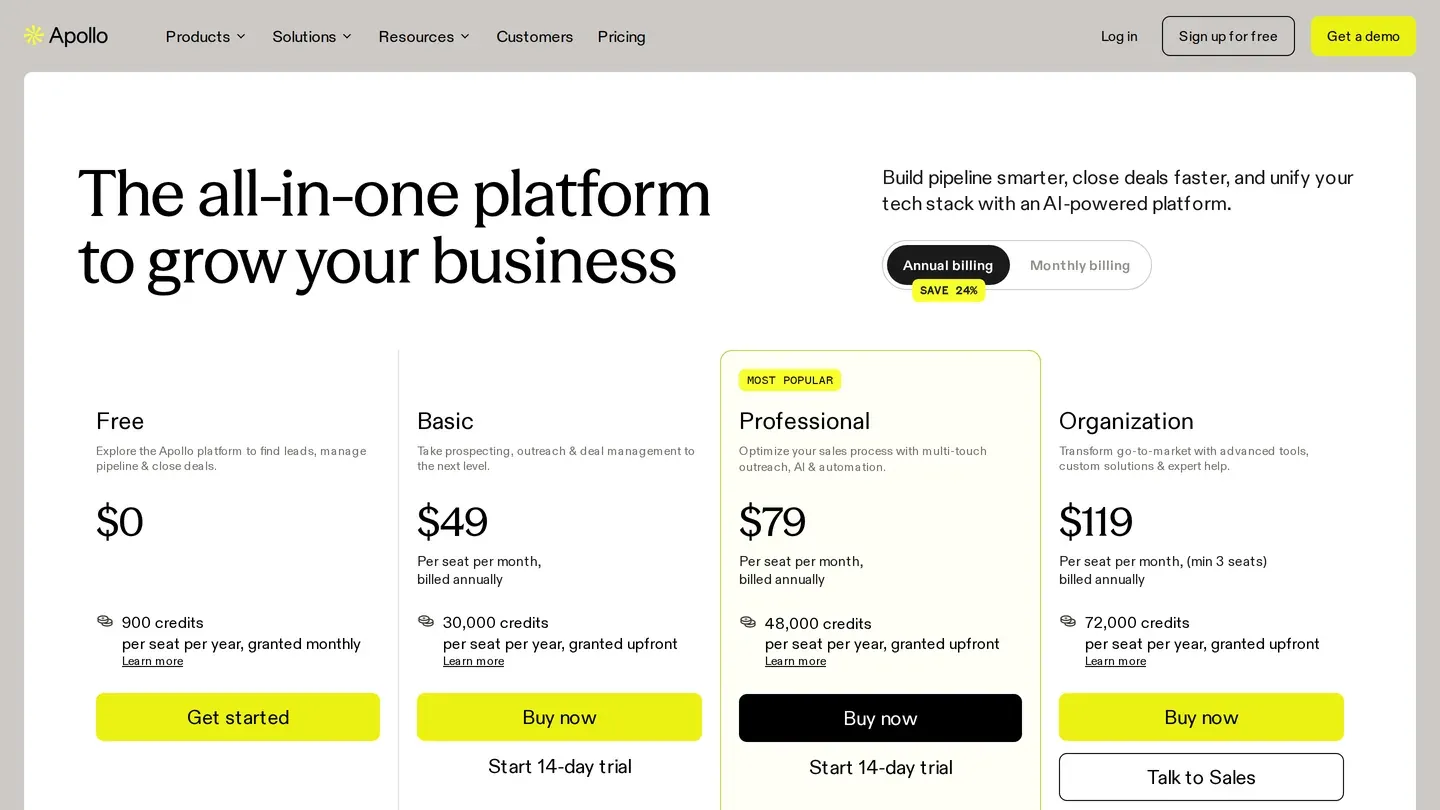
Source: Apollo pricing page, on annual billing: Basic is $49 per seat a month, Professional $79 and Organization $119.
- What it is for: a contact database, enrichment and sequencing under one per-seat plan.
- Price: Basic is $65 per seat a month billed monthly with 2,500 credits a month, or $49 billed annually with 30,000 credits a year upfront; Professional $99 or $79; Organization is $119 per seat a month billed annually, with a three-seat minimum, and the Monthly view lists it at $149, marked "Annual Only" (apollo.io). An email reveal costs 1 credit, and none is charged when no valid email is found.
- "Unlimited" and its limit: Professional connects "Unlimited Google and Microsoft mailboxes + 5 SMTP mailboxes per user" with unlimited daily sends.
- Warmup: "Deliverability Suite & Email Warmup", from Basic up.
- Sending limits: Free and Basic connect 1 mailbox per user and send 250 emails a day.
- Where it falls short: one mailbox on Basic means sending from several inboxes starts at Professional, $99 per seat billed monthly or $79 annually.
8. lemlist
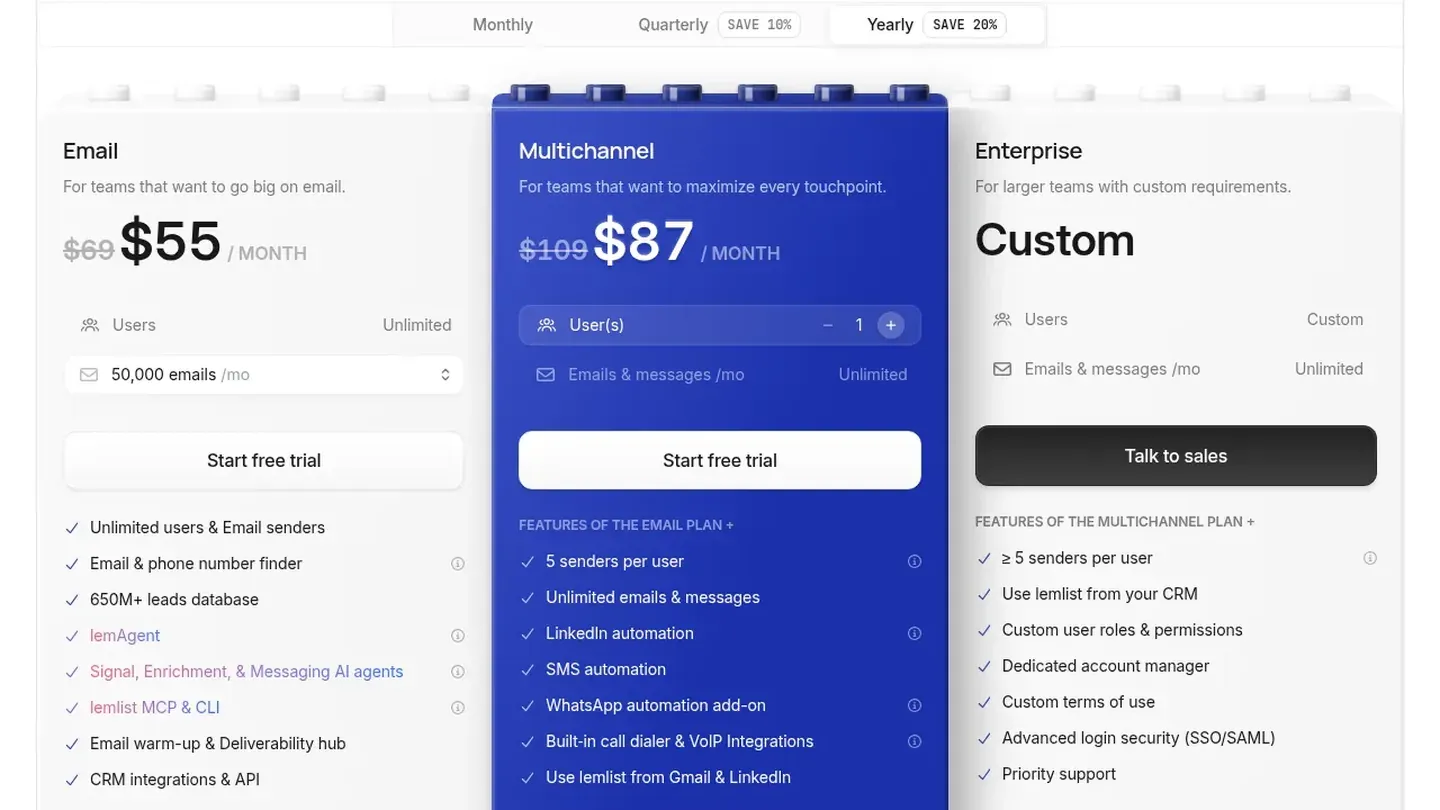
Source: lemlist pricing page, on yearly billing: the Email plan is $55 a month for 50,000 emails, against $69 billed monthly.
- What it is for: email sequences priced by monthly sending volume, with a Multichannel plan per user.
- Price: the Email plan is $69 a month billed monthly, or $55 billed yearly, for 50,000 emails a month; 100,000 is $89 or $71, 200,000 $159 or $127, 500,000 $359 or $287, and 1,000,000 $659 or $527 (lemlist.com). The page opens on yearly billing. The free trial runs 14 days.
- "Unlimited" and its limit: users and email senders are unlimited on the Email plan; the cap is the volume tier. Multichannel, at $109 a month or $87 yearly per user, has 5 senders per user.
- Warmup: included, as "Email warm-up & Deliverability hub".
- Sending limits: the tier you choose, 50,000 to 1,000,000 emails a month.
- Where it falls short: the smallest tier is 50,000 emails a month, so a small sender pays for volume it will not use. Lead data is an add-on from $20 a month.
9. Email Bison
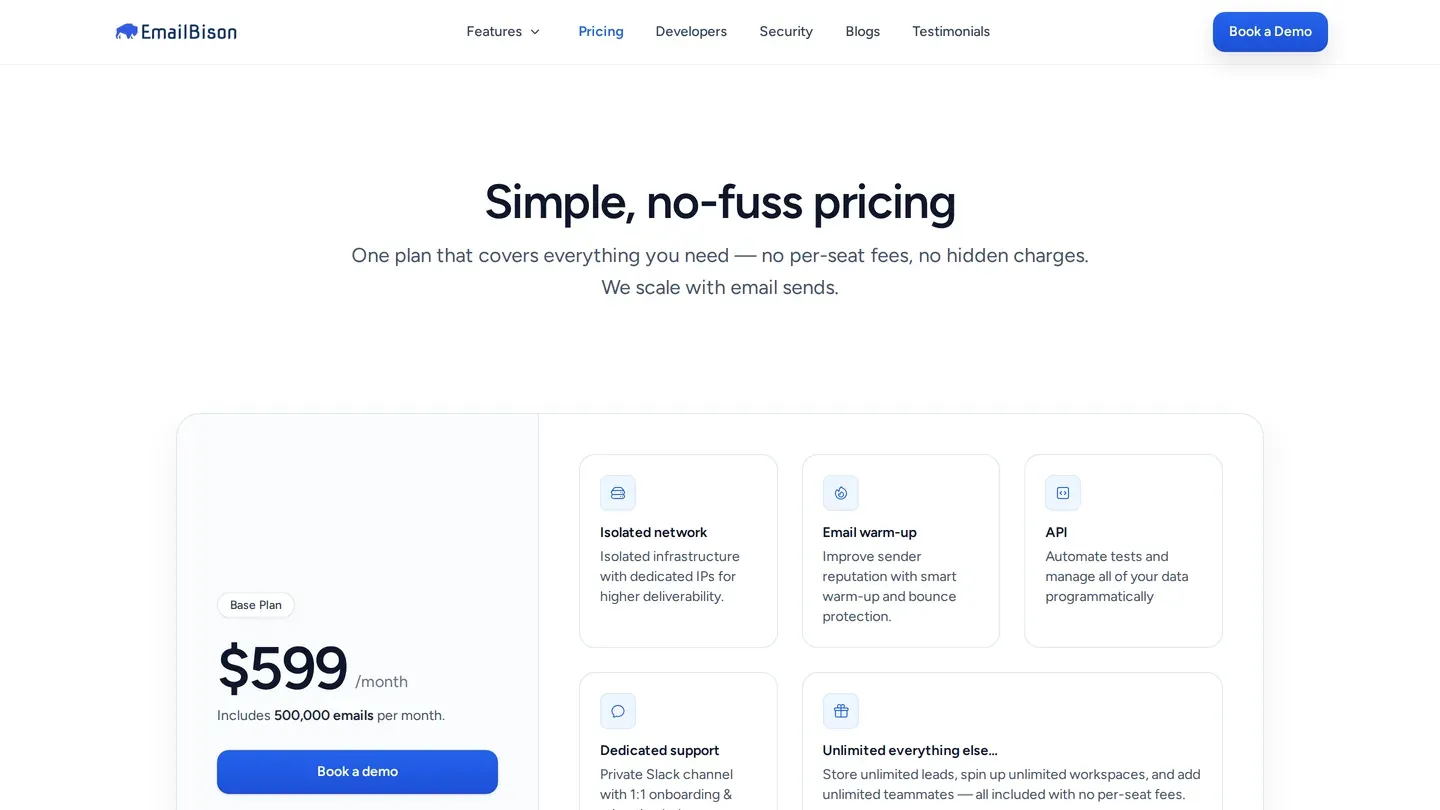
Source: Email Bison pricing page: $599 a month for 500,000 emails, with no per-seat fees.
- What it is for: the sequencer we run our own campaigns on, sold as one high-volume plan on "Isolated infrastructure with dedicated IPs".
- Price: one published plan, $599 a month including 500,000 emails a month, with no per-seat fees (emailbison.com). Beyond that you "Buy additional monthly buckets", although the same page also says "No add-ons"; it shows no price for the buckets and no annual price.
- "Unlimited" and its limit: leads, workspaces and teammates are unlimited. The site says teams can "connect and manage multiple sending inboxes within workspaces" without giving a number.
- Warmup: "Private Email Warm-up", described as "smart warm-up and bounce protection".
- Sending limits: 500,000 emails a month on the base plan.
- Where it falls short: it has the highest entry price of the nine, and none of the nine ranking lists names it.
Deliverability testing
Among the nine sequencers, Smartlead sells SmartDelivery from $49 a month for 120 campaign sequence tests, and Email Bison lists a native EmailGuard integration for inbox placement. For personal Gmail recipients, Google's Postmaster Tools reports the spam rate that its 0.10% guidance refers to. Our guide to email deliverability tools sorts placement tests, blocklist monitors and warmup tools by job.
Three stacks, priced
These are worked examples at the list prices above, billed monthly, without domains or the Sales Navigator subscription you build searches in. Every line is the bill for a whole plan, not a pro-rata share. Mailbox counts use Forge's 30 emails per mailbox a day over a 30-day month, and each contact gets four emails. The list line assumes a 60% find rate with your LinkedIn account connected: 1 credit per lead scraped plus 3 per email found, about 4.67 credits per contact.
| Testing the channel | Steady pipeline | Agency volume | |
|---|---|---|---|
| Inboxes | 5 Google Workspace, direct: $42.00 | 30 Smartlead SmartSenders: $135.00 | 100 Zapmail (Pro): $299.00 |
| Sending at 30 a mailbox | 150 a day, 4,500 a month | 900 a day, 27,000 a month | 3,000 a day, 90,000 a month |
| Contacts at four emails each | 1,125 a month | 6,750 a month | 22,500 a month |
| Sequencer | Saleshandy Starter: $41 (6,000 emails a month) | Smartlead Pro: $94 (90,000 sends) | lemlist Email, 100,000 emails: $89 |
| List and verification | WizLeads Freelancer: $39 (10,000 credits; needs 5,250) | WizLeads Agency: $99 (40,000 credits; needs 31,500) | WizLeads Kingpin: $499 (300,000 credits; needs 105,000) |
| Monthly total | $122.00 | $328.00 | $887.00 |
The inbox line is the largest item in the first two stacks. In the third, the list line is the largest, because no smaller WizLeads plan carries 105,000 credits. The bill is $499; pro-rata at Kingpin's rate, those 105,000 credits come to $174.65.
At three emails per contact, the steady column would need 42,000 credits, just over Agency's 40,000. The second stack adds domains at $13 a year each through SmartSenders. In the third, WizMail's Pro tier would put 100 Google inboxes at $250.00 and the total at $838.00.
Also considered
Snov.io is named on 5 of the 9 lists, GMass and Klenty on 4, Hunter and Salesforge on 3 (two of Salesforge's three are pages its own group publishes), QuickMail, SmartReach and Yesware on 2, and PlusVibe on 1. All fall below the six-list rule, so none is priced here.