WizLeads


TL;DR
- Pick MillionVerifier if you will verify 5,000 addresses or more, in one go or over time. Its pricing section lists packs from $39 for 10,000, less than NeverBounce's $40 for 5,000, and a pack costs less than NeverBounce pay as you go at every size from there up.
- Pick NeverBounce if you need a one-off 1,000 verifications and nothing after, or want its guidance on mailing accept-all addresses. Its pricing page sells 1,000 credits for $8, while MillionVerifier's standard packs start at $39 for 10,000.
- The test does not separate them. In our MillionVerifier vs NeverBounce send test, 7 of 709 approved addresses failed on send against 4 of 711.
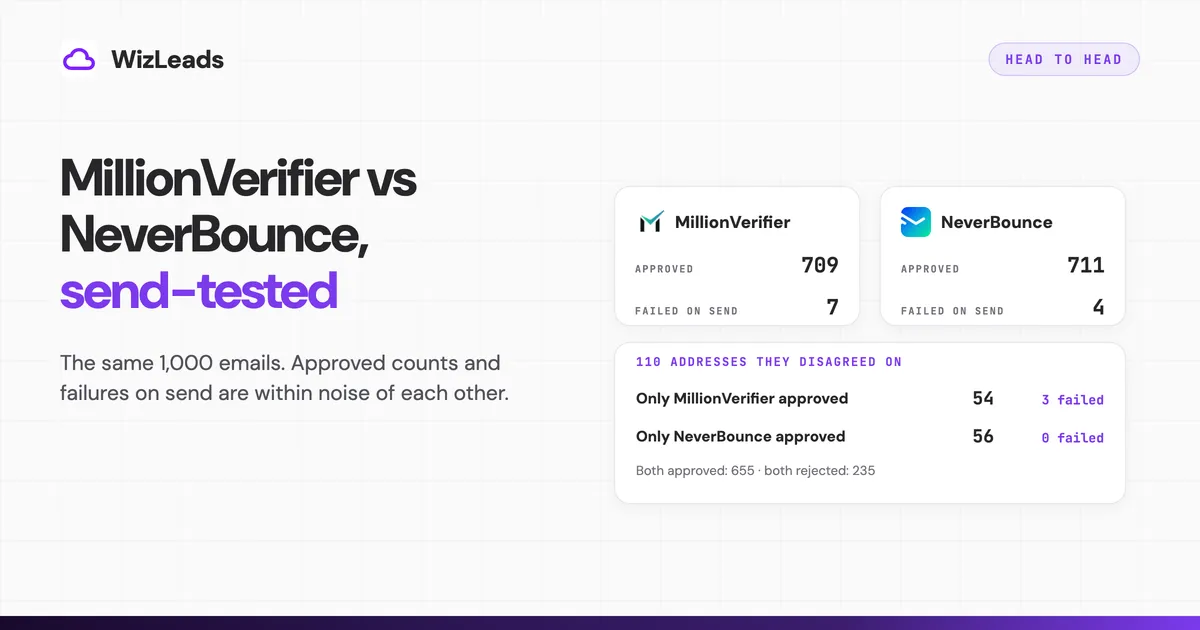
On the same 1,000 real-estate decision-maker emails sourced from Apollo, MillionVerifier approved 709 and NeverBounce approved 711. We mailed every address at least one of six tools approved. Seven of MillionVerifier's approvals failed on send and 4 of NeverBounce's, a tie within noise (Fisher exact p = 0.385). Six verifiers took part, including WizLeads' email verifier.
The totals match, so the tools differ somewhere else. They differ on 110 addresses, on price at each volume, and on the fine print about credits and guarantees. This post covers all three, with every cell of the disagreement table, the unfavourable ones too.
How we tested
The list was 1,000 real-estate decision-maker emails sourced from Apollo in April 2026, and six verifiers checked it within two hours on the same day. We then sent a plain-text message from a clean Google Workspace account to every address at least one tool approved. Over 72 hours we counted hard bounces and mailbox-does-not-exist responses. Either one is a failure on send in the tables below.
The failure rate is failures on send divided by the addresses a tool approved. Method and the other four tools are in the email verification benchmark.
One limit applies throughout. We measured how much each tool rejected, not how much of that was rejected wrongly. Addresses every tool rejected were not graded.
Head-to-head on the same list
| MillionVerifier | NeverBounce | |
|---|---|---|
| Approved | 709 | 711 |
| Failed on send | 7 | 4 |
| Failure rate on approved | 0.99% | 0.56% |
| Rejected | 291 | 289 |
| Flagged catch-all (inside rejected) | 170 | 137 |
| Unknown (inside rejected) | 18 | 79 |
| Invalid (inside rejected) | 102 | 72 |
| No result (inside rejected) | 1 | 1 |
Each tool approves about 71% of the list and rejects the rest. The catch-all, unknown and invalid rows are parts of the rejected row, not additions to it.
The 0.99% and 0.56% are 7 of 709 and 4 of 711. At this size that gap is noise, so neither number is a reason to buy.
The 110 addresses they disagreed on
The two tools agreed on 890 addresses: 655 both approved and 235 both rejected. They disagreed on 110. MillionVerifier alone approved 54 and NeverBounce alone approved 56. One of the two approved each of those 110, so we mailed all of them.
| NeverBounce approved | NeverBounce rejected | Total | |
|---|---|---|---|
| MillionVerifier approved | 655 (4 failed) | 54 (3 failed) | 709 (7 failed) |
| MillionVerifier rejected | 56 (0 failed) | 235 (see below) | 291 |
| Total | 711 (4 failed) | 289 | 1,000 |
The whole 7-against-4 gap sits in the two disagreement cells. The 655 addresses both tools approved produced 4 failures, 3 hard bounces and 1 mailbox-does-not-exist response, and those count against both tools. Of the 54 that only MillionVerifier approved, 3 failed, all hard bounces. Of the 56 that only NeverBounce approved, none did.
Three failures against none is still small. By Fisher exact test it is p = 0.115, so read it as what happened on this list and not as a rate to expect on yours.
The bottom-right cell is the one we cannot grade. Both tools rejected 235 addresses. We mailed 139 of them because another tool approved them, and 26 of those failed, which measures the other tools and says nothing about these two. The other 96 were approved by no tool, so they sit outside the send test and we make no claim about them.
What sat inside the 110
NeverBounce labelled the 54 that only MillionVerifier approved as follows, with failures on send in brackets:
- 45 unknown (1 failed)
- 5 catch-all (0 failed)
- 3 invalid (2 failed)
- 1 with no result (0 failed)
The 3 that NeverBounce called invalid are the unfavourable cell for MillionVerifier, because 2 of them bounced. Of the 45 unknowns, 38 sit behind a secure email gateway according to WizLeads' classifier: 27 Proofpoint, 10 Mimecast and 1 Barracuda. NeverBounce's help centre says unknown often comes from greylisting or security gateways. That fits, though the test does not isolate the cause.
MillionVerifier labelled the 56 that only NeverBounce approved like this:
- 46 catch_all (0 failed)
- 8 invalid (0 failed)
- 2 unknown (0 failed)
NeverBounce returned valid on 46 addresses MillionVerifier flagged catch_all, and none failed. MillionVerifier called 8 addresses invalid that NeverBounce approved, and none of those failed either. Of the 56, WizLeads flagged 49 as sitting on catch-all domains.
The full grid has MillionVerifier's status down the side and NeverBounce's result across the top. Every cell is an address count.
| MillionVerifier \ NeverBounce | valid | catchall | unknown | invalid | no result |
|---|---|---|---|---|---|
| ok | 655 | 5 | 45 | 3 | 1 |
| catch_all | 46 | 121 | 3 | 0 | 0 |
| unknown | 2 | 5 | 10 | 1 | 0 |
| invalid | 8 | 6 | 20 | 68 | 0 |
| no result | 0 | 0 | 1 | 0 | 0 |
Both tools flagged the same 121 addresses as catch-all. Failure counts appear only where one of the two approved the address, because elsewhere they would measure other tools. The cross-tab figures come from the raw sheet.
Gateways show where each tool is cautious. WizLeads flagged 159 of the 1,000 addresses as behind a secure email gateway. Of NeverBounce's 79 unknowns, 46 are on those addresses, against 2 of MillionVerifier's 18. If your list is full of Proofpoint and Mimecast domains, expect NeverBounce to hand more of them back as unknown.
How each tool treats catch-alls and unknowns
NeverBounce returns five result codes: valid, invalid, disposable, accept-all (unverifiable) and unknown. Its result-code help page calls accept-all a server setting and not a verdict on the address. It says those addresses are often valid and bounce at about half your list's invalid rate. That rule of thumb is NeverBounce's, and we did not measure it.
For senders whose provider requires bounces below 4%, it advises mailing accept-all addresses selectively instead of dropping them. Unknown, it says, means the server gave no definitive answer in time, and re-verifying later usually settles it. Under its definition of a credit, a re-verify on pay as you go costs another credit.
MillionVerifier's statuses on our list were ok, invalid, catch_all and unknown. Its help centre groups the last two as risky. It says to mail them only if they are real subscribers who signed up in the last two months, and not if they come from a purchased list or were collected from the internet.
Read literally, that rules the risky bucket out for cold outreach to a database export like ours. MillionVerifier's Terms are looser on the verifying step and allow addresses obtained from a data provider or broker. The help-centre advice is about whom you mail afterwards. NeverBounce's guidance lets you mail some of that bucket, and MillionVerifier's does not.
MillionVerifier: packs, credit life and free credits
MillionVerifier sells one-off credit packs, shown in its pricing section. The ladder runs from $39 for 10,000 credits through $59 for 25,000 and $89 for 50,000 to $8,499 for 50 million. There is no pack at 1,000 or 5,000, so its standard ladder starts at 10,000. So the 1,000 end of the price range below is NeverBounce's.
Its help centre says there are no monthly or annual plans and no custom credit amounts. An optional Auto Topup buys a pack for you when your balance falls below a threshold you set. Its announcement says MillionVerifier changed operator on 19 October 2026 and is now run by Southern Vector Limited, a New Zealand company. The same page says credits, prices and the guarantee did not change, and that PayPal is no longer available.
Credits do not expire. MillionVerifier's Terms say paid credits do not expire merely because time passes. They also say an account idle for 12 continuous months can be removed after at least one month's email notice, and that logging in does not count as use. Removal does not forfeit the credits, which stay on a recovery record until support restores them after ownership checks.
For free credits, the homepage offers 100 with no card. Its help centre lists three trial options for new accounts: 500 credits with a business email, up to 10,000 by connecting an integration, or 2,000 credits for $4.90. EverClean is a separate automated service that re-verifies a connected marketing list every day. It is not part of the packs above.
NeverBounce: pay as you go, Growth and what it is
NeverBounce's pricing page starts with pay-as-you-go credits at $8 for 1,000, rising to $4,000 for 2 million. Growth is a monthly subscription from $49 for up to 10,000 emails. Enterprise is quote-only, which the page says is typically for 250,000 or more emails a month.
Pay-as-you-go credits expire 12 months after purchase, and its Terms say 365 days. A new account gets 10 free credits.
Growth also bundles extras. Its card lists 200 new leads a month picked by AI, AI scoring and CRM auto-sync, so compare it with MillionVerifier's packs on verification alone and treat the rest as add-ons you may or may not use.
Is NeverBounce legit? It has a named corporate owner. DiscoverOrg announced the acquisition on 5 March 2019 in a press release now hosted by ZoomInfo. NeverBounce's Terms say the service is operated by ZoomInfo Technologies LLC d/b/a NeverBounce.
It also publishes a bounce guarantee with its conditions, covered below. In our test it approved 711 of 1,000 addresses and 4 failed on send, a 0.56% failure rate.
MillionVerifier vs NeverBounce pricing, 1,000 to 2 million
All prices are US dollars from each vendor's own pricing page. The two ladders do not start in the same place. NeverBounce's starts at 1,000 credits, and MillionVerifier's standard packs start at 10,000.
| Volume | MillionVerifier (one-off pack) | NeverBounce pay as you go | NeverBounce Growth (per month) |
|---|---|---|---|
| 1,000 | no pack | $8 | n/a |
| 5,000 | no pack | $40 | n/a |
| 10,000 | $39 | $50 | $49 |
| 25,000 | $59 | $125 | n/a |
| 50,000 | $89 | $250 | $99 |
| 100,000 | $149 | $400 | $159 |
| 250,000 | no pack | $750 | $249 |
| 500,000 | $299 | $1,500 | $499 |
| 1,000,000 | $449 | $2,500 | $999 |
| 2,000,000 | $799 | $4,000 | n/a |
Against pay as you go, a MillionVerifier pack costs less at every size from 10,000 up. NeverBounce costs 1.28 times as much at 10,000, 2.12 times at 25,000, 2.81 times at 50,000, 2.68 times at 100,000, 5.02 times at 500,000, 5.57 times at 1 million and 5.01 times at 2 million.
Growth narrows the gap to 1.26 times at 10,000, 1.11 times at 50,000 and 1.07 times at 100,000. But Growth is a monthly bill and a pack is one payment. Verifying 50,000 addresses every month costs $99 on Growth against $89 for a pack, and at 1 million it is $999 against $449.
Below 10,000 the ladders do not line up. Against MillionVerifier's standard packs, NeverBounce is cheaper for a one-off 1,000, at $8 against $39. At 5,000 it is $40 against $39, and the $39 pack buys 10,000. New MillionVerifier accounts also get trial credits, so a small first test can cost nothing.
What you are billed for
MillionVerifier takes one credit per email, then adds back credits for unknown and catch-all results as goodwill. You pay for ok and invalid results. NeverBounce defines one credit as one email verification and states no exception for unknown or accept-all results.
On our list that is a count of 811 MillionVerifier results in the buckets it bills (709 ok and 102 invalid) against 999 NeverBounce results. It is a count of credits, not a bill, and it assumes the add-back applies.
It may not. MillionVerifier's Terms call the favourable treatment of risky results a discretionary promotional programme, not a permanent feature, with a cash value of zero. They let it be withheld from customers who use scraping or fabricated data, or who cannot show a lawful source. Its help centre adds that accounts whose results regularly hold an outstandingly large number of unknown or invalid addresses lose the credit-back, which it says affects about 1% of users.
Our list is an Apollo export, and whether a list like that qualifies is MillionVerifier's call. The homepage offers a "Full refund on any email we can't verify with certainty" and says only MillionVerifier does. The help centre and Terms make that conditional.
Guarantees side by side
NeverBounce guarantees that no more than 3% of your emails will bounce and refunds the difference above that, per its guarantee page. The list must hold at least 500 unique addresses and be cleaned within 72 hours of mailing. You must send only to addresses it called valid, and Gmail, Hotmail, Outlook, AOL and Yahoo addresses are excluded. Bounces must come back marked invalid.
Its Terms also say no refunds or replacement credits are provided, so ask support how a claim is paid.
MillionVerifier's money-back guarantee refunds your most recent qualifying payment if more than 4% of its OK addresses hard bounced because the address did not exist. You must mail every OK address within 7 days, through a professional sender that gives you a hard and soft bounce breakdown. It covers files uploaded in the web app, and its Terms exclude API and one-by-one checks where it keeps too little data to verify a claim.
Its help page and Terms differ on sender access. The help page says you must let MillionVerifier log in to your sender account. The Terms say a password should not be shared where a secure export or delegated access works.
The homepage says MillionVerifier is "the only email verifier offering a real money-back guarantee", with "no small print, no gatekeeping". The help page says it applies under stated conditions only, and NeverBounce publishes a guarantee of its own.
Neither tool came near its threshold on our list, at 0.99% and 0.56%. The conditions decide whether a claim would succeed on yours.
Where WizLeads landed
WizLeads approved 852 of the 1,000 and rejected 148. Five of the approved failed on send, a 0.59% failure rate. NeverBounce's 0.56% is lower, and at this size the two are a tie within noise.
Three results go against WizLeads. Of the 7 addresses MillionVerifier approved that failed, WizLeads approved 4. Of NeverBounce's 4 failures, WizLeads approved 3. And of the 56 addresses only NeverBounce approved, WizLeads rejected 3, none of which failed.
WizLeads' Verify Email costs 0.5 credits for every email processed. The $39 Freelancer plan holds 10,000 credits, which covers 20,000 verifications, or $19.50 per 10,000 as a pro-rata unit cost and not a bill. That is under both tools at 10,000. MillionVerifier's $449 per million beats every WizLeads plan pro rata, including Kingpin quarterly at $599.50 per million.
Which one to buy
Four things decide it: how many addresses you buy at a time, what you pay for beyond usable results, what you do with the reject pile, and which fine print you can live with.
| MillionVerifier | NeverBounce | |
|---|---|---|
| Volume it suits | 5,000 or more in total (smallest standard pack 10,000 for $39) | a one-off 1,000 |
| What you pay for | ok and invalid; risky results added back at its discretion | one credit per verification; no exception stated for unknown or accept-all |
| Reject pile on our list | 170 catch_all, 18 unknown | 137 catchall, 79 unknown |
| Credit life | no expiry; an idle account can be removed, with credits restorable through support | pay-as-you-go credits expire after 12 months |
| Guarantee | above 4% hard bounces refunds your last payment | above 3% bounces refunds the difference |
If you will verify 5,000 or more addresses in total and mail only the ok bucket, MillionVerifier costs less, its credits do not expire, and the send test gives no reason to pay more. If you need a one-off 1,000, or want to mail accept-all addresses selectively, NeverBounce fits better, and you should put its 12-month expiry in your calendar.
If neither fits, four more tools took the same send test. Debounce had the fewest failures, and ZeroBounce approved the most. The comparison of 14 email verifiers sets every result beside its price.
FAQ
How does NeverBounce work?
You upload a list or send addresses through the API, and NeverBounce returns one of five result codes for each: valid, invalid, disposable, accept-all or unknown. It charges one credit per verification. On 1,000 real-estate decision-maker emails sourced from Apollo, it returned valid for 711, accept-all for 137, unknown for 79, invalid for 72 and no result for 1.
What are some alternatives to MillionVerifier?
Five other tools took the same test on 1,000 real-estate decision-maker emails sourced from Apollo. NeverBounce approved 711 and 4 failed on send, ZeroBounce 888 and 33, Debounce 670 and 1, LeadMagic 822 and 7, and WizLeads 852 and 5.