WizLeads


TL;DR
- Pick by how many catch-alls your list holds. MillionVerifier hands catch-alls back to you. ZeroBounce approves most of them, and some bounce.
- Nearly all of the gap on our list sits on catch-alls. Off them, the two tools failed 6 and 7 times on about 690 sends each.
- ZeroBounce costs more per pack. Its pay-as-you-go packs run 3.3 times MillionVerifier's at 10,000 credits, 4.4 times at 100,000 and 7.1 times at 1 million.
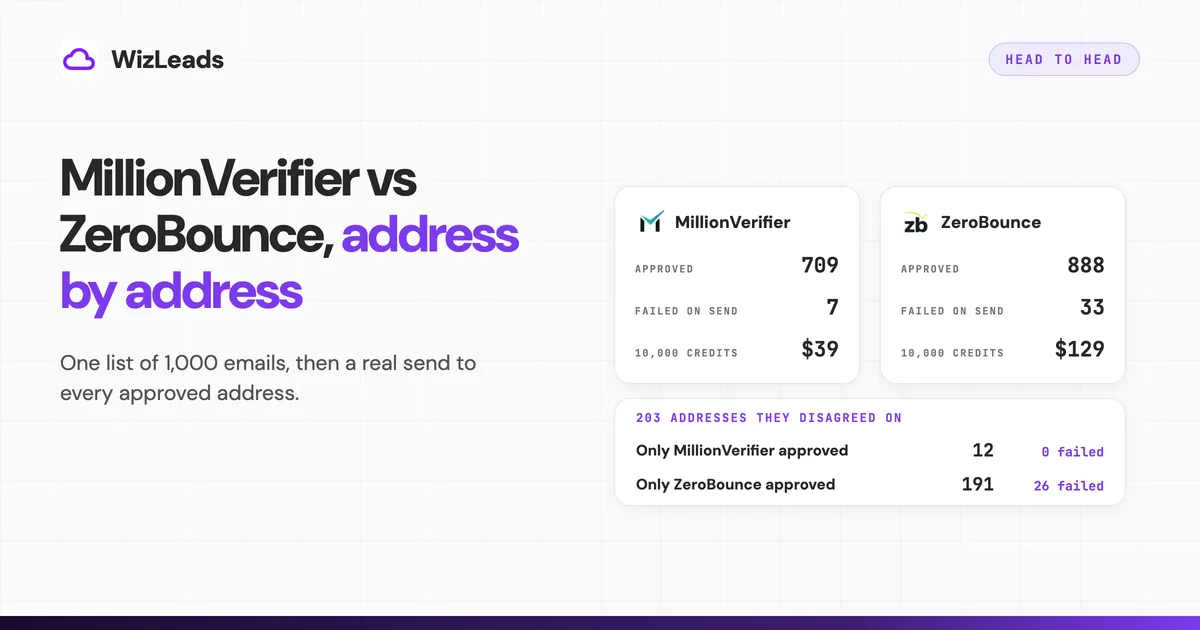
On 760 of the 788 addresses WizLeads' classifier did not flag as catch-all, MillionVerifier and ZeroBounce gave the same verdict. Nearly all of the gap sits on the other 212. Of the 191 addresses only ZeroBounce approved, 175 are flagged catch-alls, as are 25 of the 26 failures among them. Overall, MillionVerifier approved 709 and 7 failed on send, and ZeroBounce approved 888 and 33 failed.
Those counts come from one list of 1,000 real-estate decision-maker emails sourced from Apollo and checked by six verifiers, including the WizLeads verifier. Below is every cell of the MillionVerifier vs ZeroBounce comparison, the unfavourable ones too.
Price is the other half of the decision. Searchers type it as million verifier vs ZeroBounce or zerobounce vs millionverifier, and the answer is the same either way.
How we ran it
In April 2026 we pulled 1,000 real-estate decision-maker emails from Apollo and ran them through six verifiers on the same day. We sent a plain-text message from a clean Google Workspace account and counted hard bounces and mailbox-does-not-exist responses over 72 hours. Either one is a failure on send below. "Approved" means MillionVerifier returned ok or ZeroBounce returned valid.
We mailed only the addresses at least one tool approved; the 96 every tool rejected were never sent. So rejections are counts, never graded as right or wrong. The headline counts match our email verification benchmark, and the address-level cells here come from the raw data sheet behind it. It is one list, one send and one 72-hour window, so read small cells as counts, not rates.
Head-to-head results
| MillionVerifier | ZeroBounce | |
|---|---|---|
| Approved | 709 | 888 |
| Failed on send | 7 | 33 |
| Failure rate on approved | 0.99% | 3.72% |
| Rejected | 291 | 112 |
MillionVerifier's 291 rejections were 170 catch_all, 102 invalid, 18 unknown and one blank result. ZeroBounce's 112 were 90 invalid, 9 do_not_mail, 7 abuse, 5 unknown and one spamtrap. Those splits sit inside each total and are never added to it. ZeroBounce returned no catch-all status on any of the 1,000.
The 7 failures in the both-approved cell below count against both tools, so 7 and 33 are never added.
The 203 addresses they disagreed on
The tools agreed on 697 approvals and disagreed on 203. One of the two approved each of those 203, so every one was mailed.
| Cell | Addresses | Failed on send | No failure recorded |
|---|---|---|---|
| Both approved | 697 | 7 | 690 |
| Only MillionVerifier approved | 12 | 0 | 12 |
| Only ZeroBounce approved | 191 | 26 | 165 |
| of those 191, MillionVerifier said catch_all | 164 | 22 | 142 |
| of those 191, MillionVerifier said invalid | 18 | 4 | 14 |
| of those 191, MillionVerifier said unknown | 9 | 0 | 9 |
| Both rejected | 100 | not published | not published |
"No failure recorded" means no hard bounce and no mailbox-does-not-exist response in 72 hours. It does not prove a mailbox exists, least of all on a catch-all domain. The both-approved failures were 6 hard bounces and 1 mailbox-does-not-exist. The ZeroBounce-only failures were 12 hard bounces and 14 mailbox-does-not-exist.
The cells cut both ways. Start with the ones that hurt ZeroBounce. Of the 191 addresses only it approved, 26 failed, 13.61%. Of its 33 failures in total, 22 sat on addresses MillionVerifier had left as catch_all. Another 7 were on addresses both approved, and 4 on addresses MillionVerifier called invalid.
The cells that hurt MillionVerifier are the same 191 seen from the other side. 165 of them recorded no failure, including 142 of the 164 it called catch_all and 14 of the 18 it called invalid. The 9 it called unknown had none. The cells of 18 and 9 are counts, not evidence. We do not call the 14 false invalids: one send over 72 hours cannot show that.
In MillionVerifier's favour, all 7 of its failures were addresses ZeroBounce also approved, and none of the 12 it alone approved failed. ZeroBounce's verdicts on those 12 were 6 abuse, 5 do_not_mail and 1 unknown. Its status-code page defines abuse as known complainers and do_not_mail as role-based and similar addresses you should avoid emailing. Those are list-hygiene calls, so zero failures there does not show ZeroBounce was wrong.
The both-rejected cell of 100 holds the 96 never sent and 4 mailed only because another tool approved them. We publish no result for it.
It is a catch-all question
Split the same results by WizLeads' own catch-all flag and the gap shows up in one row. The flag comes from WizLeads' classifier, not an independent check. It left 24 addresses unclassified (8 unknown, 16 blank), and those sit in the 788.
| Segment | ZeroBounce approved / failed | MillionVerifier approved / failed |
|---|---|---|
| Not flagged catch-all (788) | 688 / 7 | 684 / 6 |
| Flagged catch-all (212) | 200 / 26 | 25 / 1 |
Source: WizLeads' catch-all flag and the benchmark's raw data sheet.
Off catch-alls, 7 failures on 688 sends is 1.02% and 6 on 684 is 0.88%, which at this size is the same result. Of the 788, the two tools agreed on 760 and split on 28 (16 only ZeroBounce approved, 12 only MillionVerifier approved). One of those 28 failed.
On the 212 flagged addresses, ZeroBounce approved 200 and 26 failed, 13.00%. MillionVerifier approved 25 and 1 failed, a count too small to turn into a rate. It returned catch_all on 169 of the 212, invalid on 11 and unknown on 7.
The two agreed on 25 approvals and 12 rejections there. ZeroBounce alone approved the other 175, and MillionVerifier alone approved none.
So the two tools make opposite bets on the same domains: ZeroBounce approves them and lets some bounce, while MillionVerifier hands the decision back to you.
We say nearly all of the gap, not all of it, because 1 of the 26 failures among the 191 addresses only ZeroBounce approved is off catch-alls.
ZeroBounce's own documents describe catch-alls two ways. Its status-code page calls them "impossible to validate without sending a real email and waiting for a bounce". Its catch-all guide says standard validation settles many catch-alls on Microsoft 365, Google Workspace and the big gateway platforms. The status page also lists accept_all, a valid sub-status for domains on ZeroBounce's allow-list, apart from the plain catch-all status. We cannot tell from our results whether any of the 200 carried it, so we draw no conclusion.
ZeroBounce also offers Verify+, a free optional add-on that it says sends an email during validation to check for bounces. Its catch-all validation page describes a slower second phase instead. We do not know whether either applied to our run.
MillionVerifier's 170 catch_all flags stayed unresolved in our run. It advertises a catch-all verifier: its catch-all service page says it resolves 30% to 40% of catch-alls into valid leads, and a help article on the beta promises an improvement of up to 70% to 80% in catch-all and business unknown results. Those are its claims, which we have not tested.
Choosing ZeroBounce over MillionVerifier here kept 179 more addresses (191 minus 12) and added 26 failures. What that costs depends on your setup. On a warmed, disposable domain that trade can pay. On a domain you also use for real business, or an ESP that enforces a hard bounce ceiling, 33 failures on 888 sends, 3.72%, is the number that matters. On a short list of named accounts, the addresses MillionVerifier withholds cannot be replaced, so send to its catch_all ones selectively.
MillionVerifier: packs, credit life and free credits
MillionVerifier sells one-off packs, listed in its pricing section: the smallest pack is 10,000 credits at $39. 100,000 costs $149 and 1 million costs $449. Its help centre says there are no monthly or annual plans and no custom amounts.
Credits do not expire. The help centre says so, and the Terms say paid credits do not expire merely because time passes. An account idle for 12 continuous months can be removed after a month's notice, and a login does not count as use. Removal does not forfeit the credits, which stay on a recovery record until support restores them after ownership checks.
The homepage offers 100 free credits with no card. The help centre lists other trial options: 500 credits with a business email, up to 10,000 through an integration, or 2,000 for $4.90.
MillionVerifier changed operator on 19 October 2026 and is now run by Southern Vector Limited, a New Zealand company. It says credits, prices and the guarantee did not change, and that PayPal is gone.
ZeroBounce: pay as you go, ONE and credit life
ZeroBounce sells pay-as-you-go credits and a monthly subscription, both shown on its pricing page. Pay as you go starts at $39 for 2,000 credits, its minimum. Then it runs to $129 for 10,000, $649 for 100,000 and $3,199 for 1 million. Packs of 2 million and up read "Please Contact Us". ZeroBounce ONE costs $99 a month for 10,000 credits, or $79 a month billed annually. The free tier is 100 validations a month on a business domain.
ZeroBounce charges one credit per validation and another to score an address. It does not charge for unknown results or for removing duplicates, but catch-all verdicts are charged like any other.
ZeroBounce's pages disagree on credit life. The pricing page lists "Credits never expire", but a tooltip beside it ties that to an active ZeroBounce ONE subscription and sends everyone else to the terms. The FAQ on the same page repeats the ONE condition and adds that expiration rules may apply. The Terms of Use say credits bought by customers who register after 1 June 2026 expire two years after the latest purchase. They never expire while ONE is active. The docs page on purchasing credits repeats that rule, and the billing FAQ shows the same "Credits never expire" line with the same ONE tooltip. The Terms are the binding text, and their expiry clause covers only customers who registered after 1 June 2026, so if your account is older, ask before you buy a large pack.
MillionVerifier pricing against ZeroBounce at 10K, 100K and 1M
These are US list prices in dollars. MillionVerifier is a one-off pack and ZeroBounce is pay as you go.
| Pack | MillionVerifier | per 1,000 | ZeroBounce | per 1,000 | ZeroBounce / MillionVerifier |
|---|---|---|---|---|---|
| 10,000 credits | $39 | $3.90 | $129 | $12.90 | 3.31x |
| 100,000 | $149 | $1.49 | $649 | $6.49 | 4.36x |
| 1,000,000 | $449 | $0.449 | $3,199 | $3.199 | 7.12x |
Source: each vendor's pricing page, as described in its section above.
The ladders start in different places. $39 buys 2,000 credits at ZeroBounce and 10,000 at MillionVerifier. ZeroBounce ONE at 10,000 is $99 a month, 2.5 times MillionVerifier's pack, or 2.0 times billed annually. It also bundles Email Finder searches, inbox and server tests, blacklist and DMARC monitoring and warmup, so it is a deliverability suite with verification attached. These are unit costs, not bills.
The meters differ as well. MillionVerifier deducts a credit per email, then adds credits back for unknown and catch-all results where its goodwill programme is available. Applied to our counts, that adds back 188 of 1,000 results (170 catch_all and 18 unknown). It bills 811 (709 ok and 102 invalid, with one blank result unassigned). ZeroBounce would bill 995, since its 5 unknowns are free. That is a count of credits, not a bill, and the add-back is discretionary.
Refunds, guarantees and the list-source fine print
Each row below is that vendor's own terms, not legal advice.
| MillionVerifier | ZeroBounce | |
|---|---|---|
| Unknown and catch-all results | Credited back at its discretion | Unknowns free; catch-all verdicts charged |
| Refund trigger | Last payment, above 4% hard bounces | 5% of cost per point below 99.6% accuracy |
| Where it applies | Web-app uploads only | Valid file only, hard bounces only |
| Lists from a third party | Terms allow them, if lawfully acquired | Guarantee excludes purchased lists |
Source: MillionVerifier's Terms and help centre; ZeroBounce's guarantee page and Terms of Use.
MillionVerifier. The money-back guarantee refunds your most recent qualifying payment if more than 4% of its OK addresses hard bounced because the address did not exist. You must mail every OK address within 7 days through a professional sender that gives a hard and soft bounce breakdown. Its help centre also says "hard bounce rate will be lower than 1% guaranteed", which sits oddly beside a 4% trigger.
MillionVerifier contradicts itself on the credit-back. Its homepage promises a "Full refund on any email we can't verify with certainty". Its help page says it does not charge for unknown and catch-all emails. Its Terms call the treatment a discretionary promotional goodwill programme, not a permanent feature. They say it can be withheld from customers who use scraping or fabricated data. The help centre adds that accounts whose results regularly contain an outstandingly large number of unknown or invalid addresses lose it, which it says affects 1% of users. Read the Terms before you count on it.
ZeroBounce. Its accuracy guarantee is 99.6%, or 96% on AOL, Yahoo and Office 365 with disabled accounts not counted. It refunds 5% of the validation cost for each point below. You must mail only the valid file within 72 hours, the list needs at least 1,000 emails and you export the SMTP bounce responses. The list must be one you collected, "not purchased from a 3rd party". Credits are otherwise final and non-refundable. A 30-day full refund covers only a first ZeroBounce ONE subscription, and only while usage stays within caps such as 500 validations and 5 inbox placement tests.
For a cold B2B export, the list-source rows matter more than the percentages. MillionVerifier's Terms allow addresses from a data provider, list owner or broker if you acquired them lawfully. Its help centre separately says to mail its risky results only if they are real, recent subscribers. ZeroBounce's Terms bar knowingly sending unsolicited email, including promotions. Check your own list against both before counting either promise as cover.
Where WizLeads landed on the same list
On the same 1,000 addresses WizLeads approved 852 and 5 failed on send, a 0.59% rate, with 148 rejected. That is the third-lowest rate of the six verifiers, behind Debounce and NeverBounce. Of the 191 only ZeroBounce approved, WizLeads approved 146 and 1 failed. It rejected the other 45, and 25 of those failed. It approved all 12 that only MillionVerifier approved, and none failed.
Two results go against WizLeads. Of the 45 it rejected from ZeroBounce's list, 20 recorded no failure. And 4 of its 5 failures were on addresses both MillionVerifier and ZeroBounce also approved.
Verify Email costs 0.5 credits for every email processed, whatever the result, unknowns included. WizLeads classifies catch-all emails as valid or invalid. The $39 Freelancer plan holds 10,000 credits, which covers 20,000 verifications, or $19.50 per 10,000 as a unit cost. That is below ZeroBounce's $129 and MillionVerifier's $39 for 10,000.
MillionVerifier costs less or lasts longer in three places. Its credits do not expire (an idle account can be removed, with its credits kept for restoring), where WizLeads credits roll over for one billing period. It adds back unknowns where WizLeads charges every email. And for 1 million verifications, which is 500,000 WizLeads credits, its $449 undercuts Kingpin's pro-rata unit cost of $831.67, worked out from the $499 monthly plan's 300,000 credits. That is a unit cost, not a bill: one month of Kingpin holds 300,000 credits, short of the 500,000 needed.
Which one to buy
In a zerobounce vs millionverifier choice, pick MillionVerifier if your list is mostly not catch-all, you buy in bursts, or you want credits that do not expire. On our list it matched ZeroBounce off catch-alls, and ZeroBounce's packs cost 3.3 to 7.1 times as much.
Pick ZeroBounce if you want the suite or a procurement story. Segment the catch-alls it approves, and decide in advance whether to send to them.
If your list is catch-all heavy and bought or scraped, neither shape fits cleanly. One lets catch-all failures through, 26 of 200 here. The other approved 25 of 212 and hands back the rest, and its credit-back may not cover your list source. Four more tools took the same send test, and the roundup of 14 email verifiers sets each result beside its price.
Before you buy volume, spend the free credits on each tool: 100 at MillionVerifier, 100 a month at ZeroBounce. Run a sample of your own list and count how many come back catch-all. That share decides which tool's mistake you will be paying for.
FAQ
What are some alternatives to MillionVerifier?
Five other tools took the same test on 1,000 real-estate decision-maker emails sourced from Apollo. ZeroBounce approved 888 and 33 failed on send, NeverBounce 711 and 4, Debounce 670 and 1, LeadMagic 822 and 7, and WizLeads 852 and 5. MillionVerifier approved 709 and 7 failed.
Is ZeroBounce safe?
ZeroBounce's own facts page lists SOC 2 Type 2 and ISO/IEC 27001:2022 certification, calls the service HIPAA-ready with a BAA available, and says uploaded files are deleted within 30 days. Those are ZeroBounce's claims, and we did not audit them. Safe for deliverability is a separate question: in our test 33 of the 888 addresses it approved failed on send. Its Terms also bar knowingly sending unsolicited email, including promotions, so check your list source first.