WizLeads
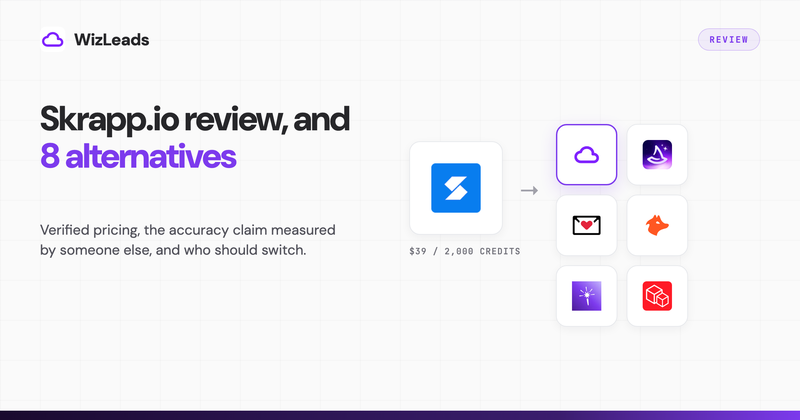

Skrapp.io is a LinkedIn email finder. Paid plans start at $39 a month for 2,000 credits, one credit buys one email returned as Valid or Catch-all, and a finder miss costs nothing, though the verifier bills every check, invalid results included. Skrapp's Fair Credit Policy tooltip claims catch-alls are not charged while its documentation and FAQ say they are; the documentation is what the billing follows. Skrapp advertises a 92 percent search success rate. The one public third-party test that includes it measured 49.4 percent verified coverage. This page covers what it costs today, what that accuracy gap does to your invoice, where Skrapp is still the cheaper option, and the eight tools worth moving to when it is not.
We build in this category. WizLeads is our product and it leads the comparison table below, so check that placement rather than take it. Every price here was read off the vendor's own pricing page on 8 September 2026, which matters because most posts on this topic still cost Skrapp out at $49 for 1,000 credits or $299 for 50,000, neither of which is a plan Skrapp sells.
What Skrapp.io actually does
Skrapp sells five things off one credit balance. The Skrapp email finder, which takes a name and a company domain and returns an address. Browser extensions covering four surfaces: LinkedIn Basic, Sales Navigator, LinkedIn Recruiter and company websites. A Lead Finder search over a claimed 200 million B2B contacts and 40 million company profiles. A bulk Data Enrichment upload for a CSV you already hold. And an Email Verifier for single addresses or lists.
All four extension surfaces are on every tier including Free, which is wider coverage than most finders offer at any price. Search is metered separately, by the day rather than by the credit: Free gets 10 people searches a day at 10 results each, Professional 20 a day at 100, Enterprise 150 a day at 400, with company searches running 5, 10 and 150 and AI-assisted searches 3, 5 and 30 on the same tiers. At the bottom of the ladder, that 200 million contact database is a lookup you pull a few dozen rows out of per day rather than a list source you can work through.
What Skrapp costs today
| Plan | Monthly | Credits | Seats |
|---|---|---|---|
| Free | $0 | 50 | 1 |
| Professional | $39 | 2,000 | 2 |
| Professional | $99 | 5,000 | 5 |
| Professional | $129 | 10,000 | 8 |
| Professional | $199 | 25,000 | 8 |
| Enterprise | $349 | 50,000 | 15 |
| Enterprise | $599 | 100,000 | 15 |
| Enterprise | $999 | 250,000 | 30 |
| Enterprise | $1,499 | 500,000 | 30 |
Paid allowances are per month, and Skrapp's own card labels them that way. The free 50 is shown without a monthly label. Annual billing takes 25 percent off every tier, so $39 becomes $29 a month and $349 becomes $262. Credits roll over on Professional and Enterprise, a team shares one pool, and credits survive cancellation.
Four things in that table explain most of the switching. Catch-all results are billable, so a share of every invoice buys addresses on domains that accept mail for everyone and confirm nothing about the mailbox behind them. The free tier cannot export a list, which puts a serious evaluation at $39 minimum.
The other two are structural. API access, SSO and a dedicated account manager sit on Enterprise, so a developer workflow costs $349 a month before you find a single address. And the unit price hardly moves at small volume: $39 for 2,000 credits is $19.50 per 1,000 emails while $99 for 5,000 is $19.80, so the larger plan is fractionally worse per email until the 10,000 tier drops it to $12.90. Skrapp's feature comparison lists no phone or mobile product at all.
Where catch-alls are a large share of the bill, either the finder resolves them before charging you or a second pass has to.
Skrapp's accuracy claim, measured by someone else
Skrapp's homepage states a 92 percent average email search success rate and 97 percent verification accuracy, and its product pages carry 98 and 99 percent claims for the verifier. Most alternatives posts repeat the 92 percent, then undercut it without a source.
Anymail Finder ran 14 email finders against the same 5,000 B2B contacts from Sales Navigator across the US, UK, France and Germany on 19 June 2026, and had every returned address rechecked by BounceBan, ZeroBounce and MillionVerifier on a two-of-three consensus. One carve-out matters here: the 36 percent of contacts sitting on catch-all domains were adjudicated separately rather than by that panel, and catch-all handling is exactly where Skrapp's credit model bites. Skrapp came out at 49.4 percent verified coverage with a 17.5 percent false-positive rate, second worst of the 14 on false positives.
Anymail Finder competes with Skrapp and ranked itself first, which is a real conflict, weighed against publishing the anonymised dataset and keeping its own engine out of the scoring. It also says plainly that nothing was mailed, so a failed address there is one three verifiers rejected rather than one that bounced. Against Skrapp's credit model, that 17.5 percent means roughly one returned address in six failed the verifier panel and cost you a credit anyway.
How these eight were picked and priced
Anyone shopping for a Skrapp.io alternative is really shopping on two numbers, plus a third where someone else has published one.
The first is our own find rate. We ran the same 1,000 B2B leads through seven enrichment providers and counted how many came back as emails a verification pass then confirmed valid: WizLeads 670, Wiza 671 found of which 633 held up, Findymail 587, Kitt 517, LeadMagic 464, IcyPeas 418, Prospeo 259. A 2.6x spread on identical input, with the methodology in the email enrichment benchmark. Skrapp was not in it, and we will not invent a number for a tool we did not test.
The second is cost: 10,000 verified emails inside one month, on the cheapest monthly plan from that vendor that covers it, contact list already in hand. Enrichment only, no scraping credits, no annual discounts, one seat.
The third column carries Anymail Finder's figures where its benchmark covers a tool ours does not. Different sample, different verifiers, so read the two as two opinions rather than one scale.
| Tool | Our 1,000-lead test | Anymail Finder, 5,000 contacts | 10,000 emails, cheapest monthly plan | Per 1,000 |
|---|---|---|---|---|
| Skrapp (baseline) | not tested | 49.4% coverage, 17.5% false positives | $129, Professional 10K | $12.90 |
| WizLeads | 670 valid | not tested | $99, Agency | $9.90 |
| Wiza | 633 valid of 671 found | not tested | $1,524, Email plus overage | $152.40 |
| Findymail | 587 valid | 70.9% coverage, 3.3% false positives | $249, Business | $24.90 |
| LeadMagic | 464 valid | not tested | $249, Growth | $24.90 |
| Prospeo | 259 valid | 45.2% coverage, 3.7% false positives | $249, Pro | $24.90 |
| Hunter | not tested | 57.6% coverage, 9.3% false positives | $149, Growth | $14.90 |
| Snov.io | not tested | 46.1% coverage, 15.2% false positives | $189, Pro M | $18.90 |
| Evaboot | not tested | not tested | $299, 20,000 credits | $29.90 |
Cost per 1,000 tells you what you pay for the emails a tool finds. Coverage tells you how much of your list it reaches at all, and the false-positive rate tells you how much of what comes back will bounce. Prospeo is priced at $24.90 per 1,000 and returned 259 valid emails from our 1,000 leads, so the same list costs more and arrives three quarters empty.
1. WizLeads
What it is: a cloud Sales Navigator scraper with email enrichment and verification on one credit pool, run on our infrastructure, with an account-less mode so exports never use your own LinkedIn session. REST API and bulk CSV on every plan.
Find rate: 670 verified-valid emails from 1,000 leads, the highest in our benchmark.
Price: Freelancer $39 for 10,000 credits, Agency $99 for 40,000, Kingpin $499 for 300,000. Enrichment is 3 credits per email actually found, verification included and nothing for a miss, so 10,000 emails is 30,000 credits and fits inside Agency at $9.90 per 1,000. Verification alone is 0.5 credits, making the $39 plan 20,000 verifications.
Limitation: scraping the list costs a separate credit per lead, 2 account-less, so an end-to-end Sales Navigator run costs more than the figure above. Smart link splitting, which handles LinkedIn's 2,500-result cap, needs Agency or above.
Fits: operators and agencies who want list building and enrichment on one balance, and anyone who does not want a scraper acting as their LinkedIn account. First month is $1, then a flat 20 percent off for life. Start on the $39 plan.
2. Wiza
What it is: a prospecting platform selling emails and mobiles as separate reveal types, with CSV import, AI research fields and CRM sync. Since 19 August 2026 its Chrome extension no longer bulk-exports from LinkedIn, Sales Navigator or Recruiter search, list or company pages, on any account or plan, so lists now come from Wiza's own Prospect search, a CSV of LinkedIn URLs, or a CRM import.
Find rate: 671 emails from 1,000 leads, 633 valid and 38 not. Highest raw discovery in our benchmark, 5.7 percent of returns invalid.
Price: the monthly Email plan is $99 per user for 500 valid emails then $0.15 each, so 10,000 emails in a month costs $1,524. The annual Email plan is $83 a month per user, billed $990 a year, unlimited email reveals, 2,500 exports a month.
Limitation: the economics only work annually, and that export cap means the annual plan cannot deliver 10,000 emails in one month at any price. Pricing is per user, so three people pay three times.
Fits: teams on annual budgets running steady mid-volume prospecting who also want mobile numbers.
3. Findymail
What it is: an email and phone finder that verifies at the moment of request rather than serving from a stored database, with a Chrome extension, bulk CSV finder, Google Sheets add-on, reverse lookup and free API access on every plan.
Find rate: 587 verified-valid from 1,000 leads in our test, third of seven. Anymail Finder put it at 70.9 percent coverage with 3.3 percent false positives.
Price: Basic $49 for 1,000 finder credits, Starter $99 for 5,000, Business $249 for 15,000, up to $849 for 100,000, every tier adding an equal number of verifier credits. A 10,000-email month needs Business at $24.90 per 1,000. Phone numbers cost 10 credits, non-EU only.
Limitation: nothing sits between $99 and $249, so a 10,000-email month lands in the gap and leaves 5,000 credits unused. Rollover is capped at twice the monthly allowance.
Fits: senders who care more about bounce rate than unit price, especially where the list is heavy on catch-all domains other finders refuse to return.
4. LeadMagic
What it is: a pay-per-result enrichment API with 15 or more endpoints on one credit pool, reachable through CSV, REST, a terminal client and a hosted MCP server, covering emails, mobiles, company search and job change detection.
Find rate: 464 verified-valid from 1,000 leads. Not in the Anymail Finder benchmark.
Price: Basic $49.99 for 2,000 credits, Essential $99 for 5,000, Growth $249 for 20,000, up to Ultimate $849 for 100,000. Email Finder is 1 credit per valid email, validation 0.25, a mobile 5, charged only on success. A 10,000-email month needs Growth at $24.90 per 1,000.
Limitation: 464 is well behind the top of the table, so a list enriched here reaches campaign with more than half of it unusable. Rollover, search and export all start at Essential, leaving Basic as an API key rather than a working plan.
Fits: engineering-led teams wiring enrichment into a pipeline or an agent, where the API surface matters more than raw find rate.
5. Prospeo
What it is: a prospecting database whose filter count rises with the tier, 28 on Free and 41 on Pro, with intent topics, AI lookalikes, a Chrome extension, CRM sync on higher tiers and a public API, exporting firmographics and 30 or more extra fields alongside the email.
Find rate: 259 verified-valid from 1,000 leads in our test, last of seven. Anymail Finder measured 45.2 percent coverage at a clean 3.7 percent false-positive rate, so both tests agree the returns are trustworthy and both agree there are few of them.
Price: Free gives 100 credits a month, then Starter $49 for 2,000, Growth $99 for 5,000 and Pro $249 for 15,000, all per user per month. One credit buys one verified business email, a mobile costs 10, misses are free. A 10,000-email month needs Pro at $24.90 per 1,000.
Limitation: Prospeo's own pages disagree on rollover. Its pricing page, loaded from different countries on 18 September 2026, said both "do NOT roll over" and "unused credits roll over", and its help centre says they "do not carry over", so budget as if an unused month is lost. Pricing is per seat, and the coverage means a much larger input list for the same output.
Fits: teams that want database search and enrichment in one product and will judge it on filter depth.
6. Hunter
What it is: the oldest name here and closer to an outreach platform than a finder, with Domain Search, Email Finder, Email Verifier, a lead database, sequences, TechLookup, an API and a Google Sheets add-on.
Find rate: not in our benchmark. Anymail Finder measured 57.6 percent coverage and a 9.3 percent false-positive rate, ahead of Skrapp on both.
Price: Free is 50 credits a month, Starter $49 for 2,000, Growth $149 for 10,000, Scale $299, with 30 percent off annually. One credit buys one email found, a verification costs half a credit, a lookup that finds nothing is free, and Bulk Domain Search returns up to 10 emails per credit. A 10,000-email month needs Growth at $14.90 per 1,000.
Limitation: on Skrapp vs Hunter at matched volumes Skrapp wins on price at both ends, $39 against $49 for 2,000 credits and $129 against $149 for 10,000. Hunter also charges for every result including catch-alls, so the billing objection that pushes people off Skrapp applies here too.
Fits: teams already sending through Hunter's sequences, and anyone prospecting from a company list, where Bulk Domain Search does the work at a tenth of the credit cost.
7. Snov.io
What it is: an outreach suite rather than a finder, pairing an email finder and 7-tier verifier with multichannel campaigns, warmup, a placement checker, a sales CRM and unlimited team seats on every paid plan.
Find rate: not in our benchmark. Anymail Finder measured 46.1 percent coverage and a 15.2 percent false-positive rate, close to Skrapp on both.
Price: Starter $39 for 1,000 credits, Pro S $99 for 5,000, Pro M $189 for 20,000, up to Ultra $738 for 100,000, with 25 percent off annually. One credit covers one prospect saved, one email found or one email verified. A 10,000-email month needs Pro M at $18.90 per 1,000. LinkedIn automation adds $69 a month per account slot.
Limitation: verification is included when the finder returns an address, so a found email costs one credit, but running Snov.io's standalone Verifier on it later draws a second credit from the same balance (Snov.io). Starter works out at $39 per 1,000 emails, which is mid-table rather than cheap: Wiza's Email plan is $198 per 1,000, Evaboot's slider starts at $90 and Findymail's Basic at $49. Recipients are metered apart from credits, so one can run out while the other sits unused.
Fits: operators collapsing a finder, a verifier, a sequencer and a warmup tool into one bill.
8. Evaboot
What it is: a Sales Navigator export tool first and an email finder second, whose Chrome extension turns a search into a cleaned CSV, drops rows that do not match your filters, then finds and verifies emails on the ones you keep.
Find rate: not tested by us and not in the Anymail Finder benchmark, the one row here with no independent number attached to it.
Price: one slider from $9 for 100 credits to $1,699 for 200,000, with $99 at 4,000, $299 at 20,000 and $499 at 50,000, and two months off yearly. A lead exported costs 1 credit and an email found and verified costs another, so a delivered lead with its email is 2 credits and a miss is free. Ten thousand emails alone needs the 20,000-credit tier at $29.90 per 1,000.
Limitation: that $299 covers emails only. Exporting the roughly 16,700 leads you search through to land 10,000 emails costs a credit each on top, pushing a real end-to-end month onto the $499 tier. Evaboot also needs your own Sales Navigator seat, runs through your own LinkedIn session, and its own FAQ confirms LinkedIn's 2,500-result ceiling per search, which is the constraint we worked through in Evaboot alternatives and in exporting leads from Sales Navigator.
Fits: people whose real problem is list quality rather than email quality, where Sales Navigator returns rows that do not match the filters.
When Skrapp is still the right call
At $129 for 10,000 emails Skrapp undercuts seven of the eight tools above, and WizLeads at $99 is the only one it does not. Its four extension surfaces stay live on the free tier. Between 10,000 and 25,000 emails a month, with catch-alls you are happy to resolve elsewhere and no need for API access, the cost argument for moving is thin.
The case weakens in three places. Below 10,000 credits a month you pay close to $19.50 per 1,000 whichever small plan you pick. Above it, API access begins at the $349 Enterprise tier. And a 17.5 percent false-positive rate on a model that charges for catch-alls means part of every invoice buys addresses you then pay a verifier to throw away.
That reasoning only applies if what you want is a better finder.
How to test a replacement in an afternoon
Take 200 contacts whose emails you have already confirmed, spread across the domain types you actually sell into rather than 200 large-cap logos. Strip the emails, keep the names and companies, and run the same file through Skrapp and two candidates on their free tiers. Count how many addresses each returned, how many match the email you already had, and how many are catch-alls. That last number is the difference between a find rate and a usable find rate, and no vendor claim measures it. No Skrapp review settles it for your domains either, this one included, which is why the shortlist should end on your data rather than on this table.
FAQ
What is Skrapp.io?
Skrapp.io is a B2B email finder and lead database. It runs browser extensions on four surfaces, LinkedIn Basic, Sales Navigator, LinkedIn Recruiter and company websites, alongside a name-plus-domain Email Finder, a Lead Finder search over a claimed 200 million contacts and 40 million company profiles, bulk CSV enrichment and an email verifier. One credit buys one email returned as Valid or Catch-all, and a finder miss is free. Verification bills differently: Skrapp's API documentation charges one credit per verification including invalid results, so the two meters do not behave the same way. Paid plans start at $39 a month for 2,000 credits, checked on skrapp.io/pricing on 8 September 2026. Skrapp sells no phone or mobile data at any tier.
What is the best Skrapp alternative?
It depends which Skrapp limit is hurting. For the most verified-valid emails per 1,000 leads, WizLeads returned 670 in our own enrichment benchmark, ahead of Wiza on 633 and Findymail on 587. For the cheapest 10,000-email month, WizLeads at $99 and Hunter at $149. To replace a finder and a sequencer at once, Snov.io. For Sales Navigator exports where the list is the problem rather than the emails, Evaboot.
How much does Skrapp cost in 2026?
Skrapp pricing is a free tier with 50 credits and no list exports, Professional at $39 for 2,000 credits a month, $99 for 5,000, $129 for 10,000 and $199 for 25,000, then Enterprise at $349 for 50,000, $599 for 100,000, $999 for 250,000 and $1,499 for 500,000. Annual billing takes 25 percent off. One credit buys one email returned as Valid or Catch-all, or one verification. Checked on skrapp.io/pricing, 8 September 2026.
How accurate is Skrapp?
Skrapp's own site states a 92 percent email search success rate and 97 percent verification accuracy. The one public third-party test that includes Skrapp, Anymail Finder's June 2026 benchmark of 14 finders on the same 5,000 B2B contacts, measured 49.4 percent verified coverage and a 17.5 percent false-positive rate, second worst of the 14. Anymail Finder competes with Skrapp and ranked itself first, though it published its dataset and had every returned address rechecked by BounceBan, ZeroBounce and MillionVerifier.
Is there a free alternative to Skrapp?
Several Skrapp competitors run a permanent free tier, all sized for evaluation rather than campaigns. Hunter gives 50 credits a month, Prospeo 100, Snov.io 50 credits and 100 recipients on a renewable trial, Wiza 20 valid emails and 5 phone numbers, and Findymail 10 credits on signup. Skrapp's own free tier is 50 credits and cannot export a list.
Why do people look for Skrapp alternatives?
Four things sit in Skrapp's own published terms. Catch-all results are billed as deliverable, so you pay for addresses that still need resolving. The free tier cannot export a list, so evaluation at volume means paying first. API access, SSO and a dedicated account manager start on Enterprise at $349 a month. And the unit price barely moves at small volume: $39 for 2,000 credits is $19.50 per 1,000 emails, while $99 for 5,000 is $19.80. Skrapp also sells no phone data.
Skrapp vs Hunter: which is cheaper?
Skrapp, at every shared volume. A 10,000-email month is $129 on Skrapp Professional against $149 on Hunter Growth, and 2,000 credits is $39 against $49. Hunter charges half a credit for a verification where Skrapp charges a full one, and its Bulk Domain Search returns up to 10 emails per credit, so a company-first workflow reverses the result. In Anymail Finder's benchmark Hunter reached 57.6 percent coverage against Skrapp's 49.4 percent.