WizLeads


TL;DR
- Verdict: Apollo fits one login for search, sequencing, dialing and light enrichment at low volume. It is a weaker fit if you need a large, clean cold list.
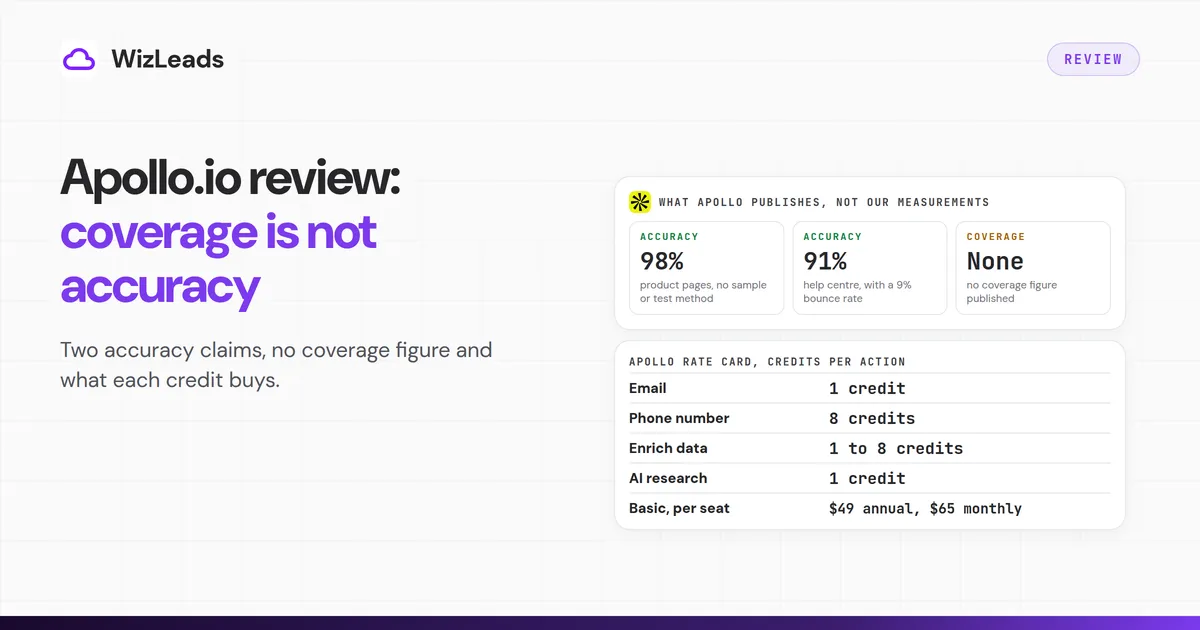
- Accuracy: Apollo's product pages claim 98% email accuracy. Its help centre says 91% and a 9% bounce rate. Apollo publishes no coverage figure and no test method for either number.
- Cost and exit: credits expire at the end of each billing cycle. Apollo's Terms call payments nonrefundable and let Apollo change the fee at renewal.
- Our data: six verifiers each rejected between 112 and 330 of 1,000 addresses we exported from Apollo.
- Do this: pilot one segment and verify every address before you send.
Is Apollo.io worth it? For low-volume prospecting from one login, yes, but test it first if you need a large cold list. Apollo's product pages claim 98% email accuracy, its help centre says 91% with a 9% bounce rate, and it publishes no coverage number. Pilot one segment, then verify the addresses before you send.
This Apollo.io review is for a buyer or a renewer who wants to know what Apollo does well and where it stops. Of the six ranking review articles we read, none sets Apollo's own accuracy figures side by side, and none reads its Terms or privacy policy.
We read Apollo's pricing page, help centre, Terms of Service and privacy policy. We also use data from a test we ran on an Apollo export. WizLeads, a cloud tool that exports Sales Navigator searches, gets one short paragraph near the end, taken from its docs.
What is Apollo, and what does it cost?
Apollo sells a contact database, an email sequencer, a dialer and enrichment under one login. Its B2B data page claims 240M+ contacts, 30M+ companies and 2M+ data contributors. Its free Email Finder tool page claims 128 million emails and 35 million companies. The database size depends on the page you read. The paid plan cards list a Deliverability Suite and Email Warmup. Apollo also says phone numbers are verified in real time when you request them.
Basic costs $49 per seat per month billed annually or $65 per seat per month billed monthly, per Apollo's pricing page, and Apollo's pricing in full lists every plan.
Credits are pooled across the team, so one seat can spend what another leaves.
What accuracy does Apollo claim, and what does it leave out?
Apollo's product and help pages give two accuracy figures for email. Its B2B data page and its Email Finder tool page claim 98% from a seven-step verification process. The help article How Apollo Verifies Emails says Apollo-verified emails have an accuracy rate of 91% and mentions Apollo's 9% bounce rate.
The 98% sits in an "Accurate data" card on the Email Finder tool page.
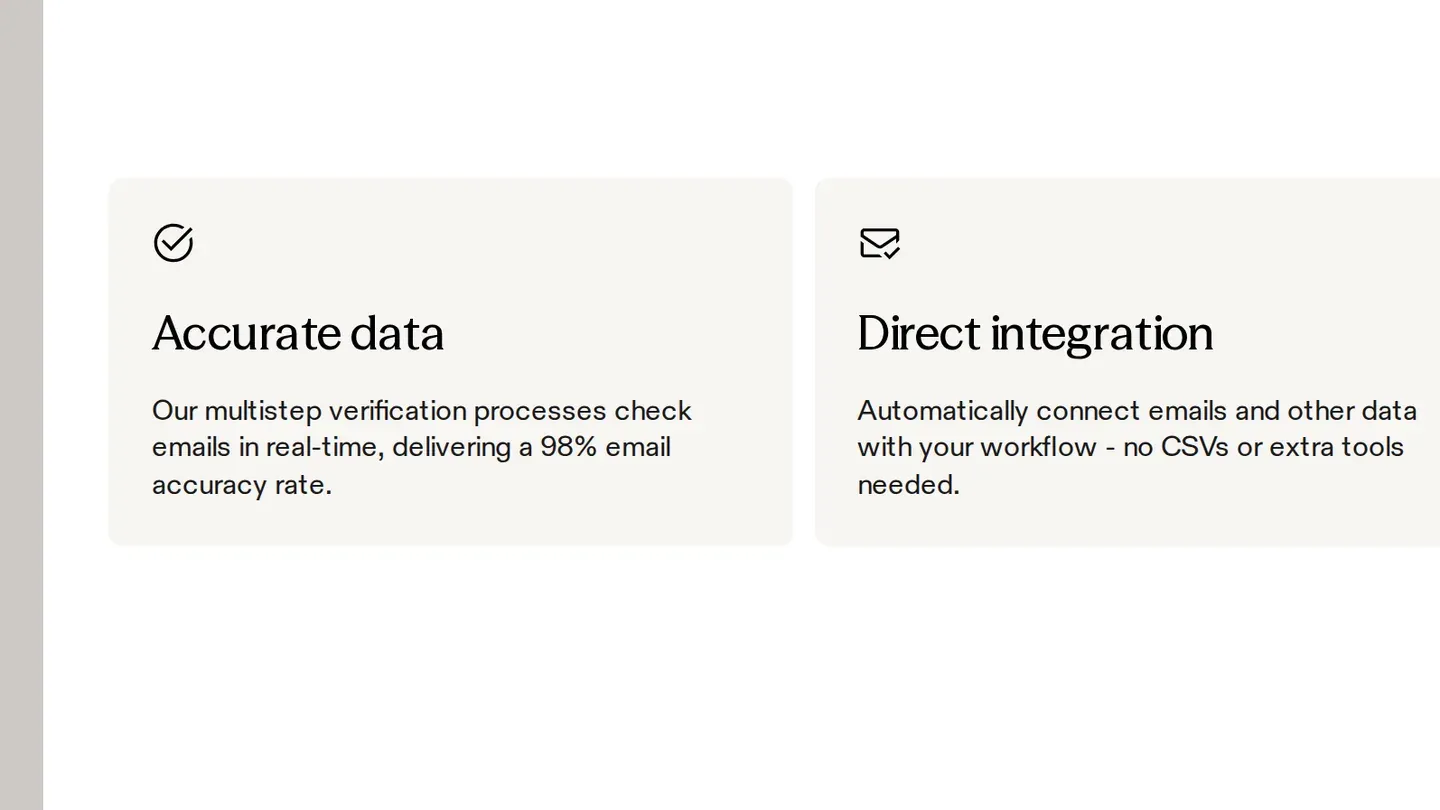
The help centre ties the 91% to Apollo-verified emails. Its status table also lists Unverified, Update required, Unavailable, User-managed and Catch-all statuses, so the Verified filter matters. None of those pages gives a sample size or a test method. The headline and the help-centre figure sit seven points apart. On 1,000 emails, that is 70 more wrong addresses (our arithmetic). Our Apollo email finder review lists every page's figure, so we do not rebuild that table here.
The 9% bounce rate sits above a line Apollo draws itself. Apollo's Data Overview help article says a bounce rate of 8% or higher calls for immediate action to protect your sending domain. That is arithmetic on two Apollo pages, not a measurement.
None of the figures says how many of your contacts come back with an email at all. Accuracy covers the addresses you receive. Coverage is how many contacts get one. The Data Overview says coverage depends on your criteria and the fastest check is to run the search.
Apollo says it does not single-source its data. The Data Overview names four inputs: a contributor network, Apollo's own engagement data on replies and bounces, public data crawling and third-party providers. Records refresh on signals and monthly across the database.
Free, Basic and Professional accounts share data with the contributor network by default, per Apollo's data-sharing article. Your connected mailbox, calendar, CRM or CSV can feed it.
One more claim matters here. Apollo's help centre says you don't need a third-party verification tool. It adds that many such tools flag valid, Apollo-verified emails as unverifiable because they sit on catch-all domains. We cannot grade that claim, and the next section explains why.
What did our Apollo export show?
The 1,000 addresses in the email verification benchmark were US real-estate decision-maker emails exported from Apollo in April 2026. That test graded six verification tools, not Apollo. It gives you no Apollo accuracy rate, no coverage rate and no find rate. Apollo was not one of the finders in our enrichment benchmark either.
What the export does show is how far verifiers disagree on Apollo's output. We mailed only the 904 addresses at least one tool approved. The other 96 were approved by none and never mailed. Of the 904, 601 were approved by all six tools, and 1 of those 601 failed in the send.
| Tool | Approved | Rejected | Failed in the send, of approved |
|---|---|---|---|
| ZeroBounce | 888 | 112 | 33 |
| WizLeads | 852 | 148 | 5 |
| LeadMagic | 822 | 178 | 7 |
| NeverBounce | 711 | 289 | 4 |
| MillionVerifier | 709 | 291 | 7 |
| DeBounce | 670 | 330 | 1 |
Each tool rejected between 112 and 330 of the same 1,000 addresses. A single verifier's verdict on Apollo data is not the last word, and a rejection is not graded right or wrong. An address one tool rejected may have been mailed on another tool's approval. That is also why we cannot confirm or dispute Apollo's catch-all claim.
Which credits and limits catch buyers out?
Apollo's rate card charges 1 credit per email, 8 per phone number, 1 to 8 per enrichment and 1 per AI research run. The US dialer costs 1 credit per 30 seconds, and the international dialer varies by region.
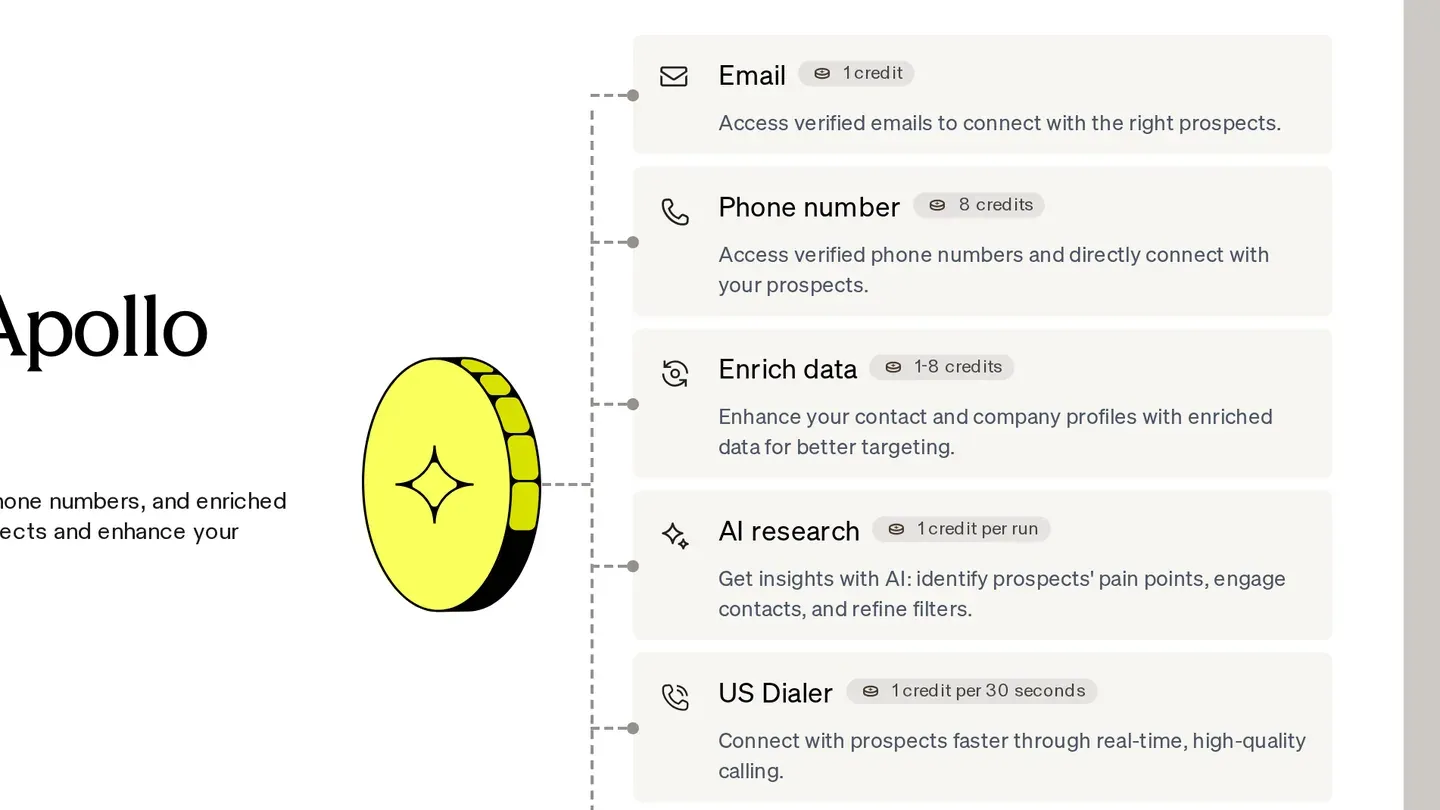
The Understand Email Statuses article sets the rules for emails. A verified email costs 1 credit. If it bounces within 30 days, Apollo refunds the credit, which is a credit back and not cash. A catch-all address that Apollo verifies also costs 1 credit. A contact with no known valid email costs nothing.
Exports follow a separate rule. Apollo's help centre says exporting saved contacts to a CSV uses no credits. Each net-new person with a verified email uses 1 credit. It adds that export credits may only apply to certain plans or legacy configurations.
Expiry decides how much of a plan you can use. Apollo grants credits upfront at the start of each billing cycle, and unused credits expire at the end. That covers plan credits and purchased add-on credits alike. On an annual plan, Apollo grants the whole year at the start, so Basic's 30,000 can be spent at any pace. On a monthly plan, the 2,500 expire each month.
Add-on credits come from a slider in the app. They are charged at once and renew each cycle until removed. The public pricing page shows no dollar rate beside the slider, and a reduction takes effect at the next cycle.
Record selection is capped at 25 on Free, 1,000 on Basic, 2,500 on Professional and 10,000 on Organization. Free and Basic send 250 emails a day from one mailbox per user.
Waterfall enrichment appears on the paid plan cards. Apollo's overview page says each source that returns data charges credits and the run does not stop at the first result. Its setup guide lets an admin end the run when any result is found. Check that setting before you switch it on.
The Free plan is where Apollo's pages disagree. The pricing page shows 900 credits per seat a year on its annual view and 75 a month on its monthly view. Apollo's main Email Finder page, a separate page from the free tool page shown above, says 50 email credits a month, or 600 a year. We cannot say which is current, so check your own account. The Free plan card also lists "Prospecting, Gmail & Salesforce Extensions", so the Chrome extension is included, with credits as the limit.
The pricing page disagrees with itself too. Its FAQ says entry-level plans give you unlimited email addresses for your contacts, while its rate card charges 1 credit per email.
Which terms and privacy lines should you read first?
These are Apollo's words, and we draw no legal conclusions from them. Apollo's Terms of Service carry a Last Updated date of August 10, 2026.
- Subscriptions are non-cancelable during the term and payments are nonrefundable, with no refunds for partially used services. Apollo may, at its sole discretion, offer a refund, discount or other consideration.
- A subscription renews for an equal term unless you give written notice of non-renewal at least 30 days before it ends. For self-serve accounts, the term is the billing cycle.
- Apollo reserves the right to change the Subscription Fee when a term expires. Fees are based on credits purchased, not on usage.
- Seats may not be decreased during a term. Apollo may alter fees, including its credit conversion policies, at any time.
- Data is provided "as is" and "as available".
- Disclosing the results of any Platform or program benchmark tests to third parties needs Apollo's prior written consent.
- Certain disputes go to binding arbitration, with a 45-day right to opt out by written notice.
Apollo's pricing FAQ says monthly plans are pay month-to-month, cancel anytime, and that cancellations take effect at the end of your current plan term. The help centre agrees: Apollo schedules your cancellation for the end of the current billing cycle. Downgrades take effect at once with no refund for unused time. The pricing FAQ applies that to seat-count downgrades too, while the Terms say seats may not be decreased during a term. Annual plans cannot downgrade mid-cycle, and a switch to Free leaves you one seat.
Privacy deserves a read too. Apollo's privacy policy says Apollo sells personal information in its Contributor Database to customers for B2B sales, marketing and recruiting. It says anyone can opt out through the Privacy Center Removal Page or by email, and that Apollo may keep a minimum suppression record. Apollo says its practices follow GDPR, CCPA and SOC 2 standards.
Your side of that is in Apollo's removal-requests article. It tells you to remove records you can confidently identify unless you have an independent legal basis to keep them. The list sits in Settings under Removal requests, and Apollo suggests exporting it about every 30 days. Its Data Overview says records you already accessed or stored remain your responsibility.
Is Apollo.io legit? What reviewers say
Apollo is a real, heavily reviewed product with published prices, and its Terms name ZenLeads Inc. as the contracting company, doing business as Apollo.io.
G2 shows 4.7 out of 5 from 9,850 reviews, with 86% five-star and 1% one-star. Capterra shows 4.5 from 398. Its sub-scores are ease of use 4.5, value for money 4.4 and customer service 4.2.
Trustpilot rates Apollo "Average" at 3.1 from 1,378 reviews. Its summary says most reviewers were somewhat happy and mentions the large database, while some found the interface clunky, struggled to get technical help and hit unexpected account restrictions. Trustpilot shows that Apollo replied to 5% of negative reviews.
Capterra's own summary tags the pricing structure as complex and restrictive. Apollo's pricing page cites 4.7 from 9,690 reviews, an older count than G2's.
We did not read the reviews one by one, so we cannot say what drives the gap between 4.7 and 3.1. These are marketplace aggregates, and the counts move daily.
Practitioner threads add anecdotes. In r/gtmengineering, a two-year user says connect rates fell from about 15% to about 8% in six months. They add that half the emails now bounce and credits burn faster. In r/SaaS, a commenter rates Apollo's email data above its direct dials and calls the free tier useful for testing an ICP. Both are single accounts, and vendors reply in these threads too.
How do you test Apollo on your own list?
A 300-contact pilot tells you more than any vendor figure. The trial runs 14 days on Basic or Professional and includes 75 credits, per the pricing page, so 300 emails at 1 credit each need a paid month. Apollo's trial article adds caps of 25 selected records, 20 phone numbers and 60 dialer minutes, with 10 minutes per call. Organization has no trial.
- Pick one segment you would actually buy and pull about 300 contacts.
- Log three counts: contacts asked for, addresses Apollo returned and addresses you sent to.
- Run every returned address through a second verifier you trust and record how many it rejects.
- Send the survivors in small batches from a secondary domain and log hard bounces.
- If an Apollo-verified email bounces within 30 days, check that the credit came back.
If you buy monthly for the pilot, set a cancellation reminder the day you pay. The Terms ask for 30 days' notice, and the help centre says cancellation lands at the end of the cycle.
Who should use Apollo, and who should skip it?
Use Apollo if you want search, sequencing and dialing in one login. It suits low volume, a defined list of ideal customers and a team that will verify before sending. The Free plan's monthly credits are enough to sample a segment before you pay, though the 300-contact pilot below needs a paid month.
If your reps lean on phone numbers, budget 8 credits each. Email, phone and dialer minutes all draw on the same credit pool.
Skip it if the job is a large, clean cold list. Accuracy is a vendor claim of 91% to 98% with no published sample or test method, and Apollo publishes no coverage number. Skip it too if you need a clean exit. Credits expire each cycle, payments are nonrefundable and the fee can change at renewal.
WizLeads suits a narrower job. Per its docs and rate card, it scrapes Sales Navigator searches at 1 credit per lead on a connected account or 2 account-less. It finds work emails at 3 credits per found email and phone numbers at 100 credits per found number, with nothing charged for a miss. Freelancer lists at $39 a month for 10,000 credits. The rate card plans on an email find rate of 50 to 60% of leads, which is an estimate and not a measured rate.
Your next step is the pilot above. Run it on one segment, count your own bounces and renew or cancel on those numbers. To set Apollo's email step against other finders first, our email finder tools comparison prices 13 of them per email.