WizLeads


TL;DR
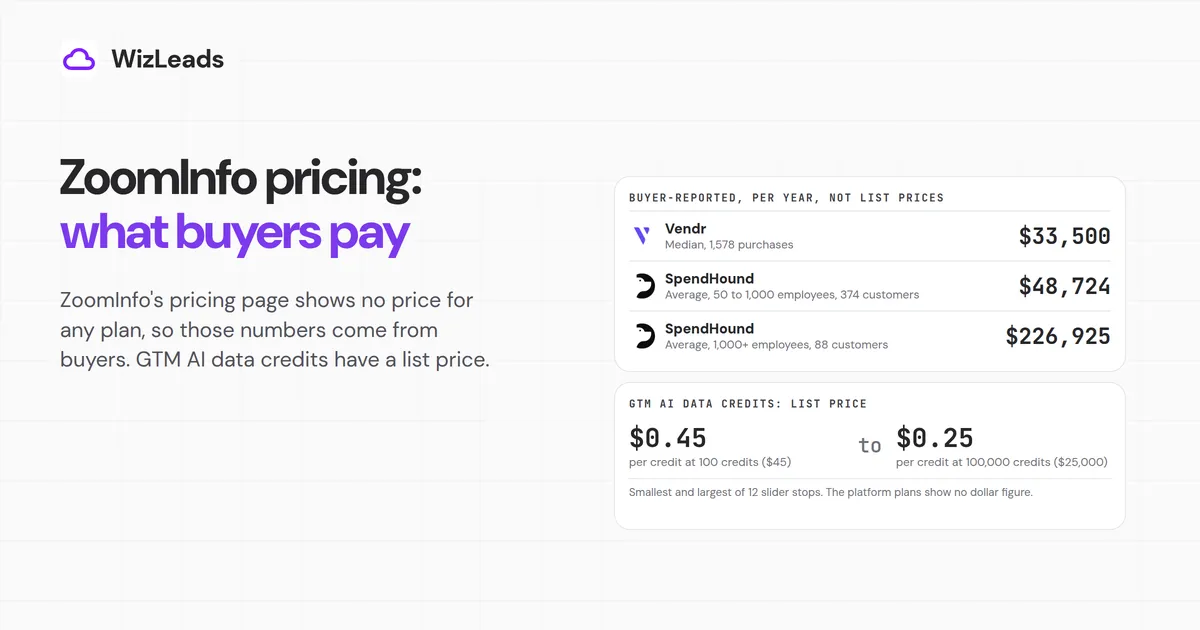
ZoomInfo pricing for its platform plans is quote-only: the pricing page shows no dollar figure for any plan. Buyers tell Vendr they pay $33,500 a year at the median, and ZoomInfo's GTM AI product lists data credits at $0.25 to $0.45 each. ZoomInfo's SEC filing says it intends to add a lower platform fee plus pre-paid credits. Check the credit rules and the contract terms as well as the price.
How much does ZoomInfo cost? ZoomInfo's pricing page shows no price for any plan, so the number comes from buyers. Vendr's marketplace reports a median of $33,500 a year from buyer data. Of the ZoomInfo pages this guide cites, only GTM AI's carries a price list, with data credits at $0.25 to $0.45 and AI credits at $0.05.
A ZoomInfo cost estimate has three parts: the packages you buy, the credits you can export and the contract you sign. ZoomInfo's pages cover each part in pieces, and in places they contradict each other. This guide puts the pieces side by side and names the page behind each one.
Every buyer figure is labelled buyer-reported and names its base. Where ZoomInfo's pages disagree, both sides are shown.
What ZoomInfo's pricing page shows
ZoomInfo's pricing page shows no dollar figure on any plan, and ZoomInfo serves it in two versions. One lists six packages: three are sales plans (ZoomInfo Professional, Copilot Advanced and Copilot Enterprise) with "Start free trial" buttons, and three are marketing plans (Marketing Demand, ABM Lite and ABM Enterprise) with "Get a demo" buttons.
The other version groups its offers into nine use cases, with "Free trial" or "Talk to sales" buttons. Both versions carry a pricing request form at the top.
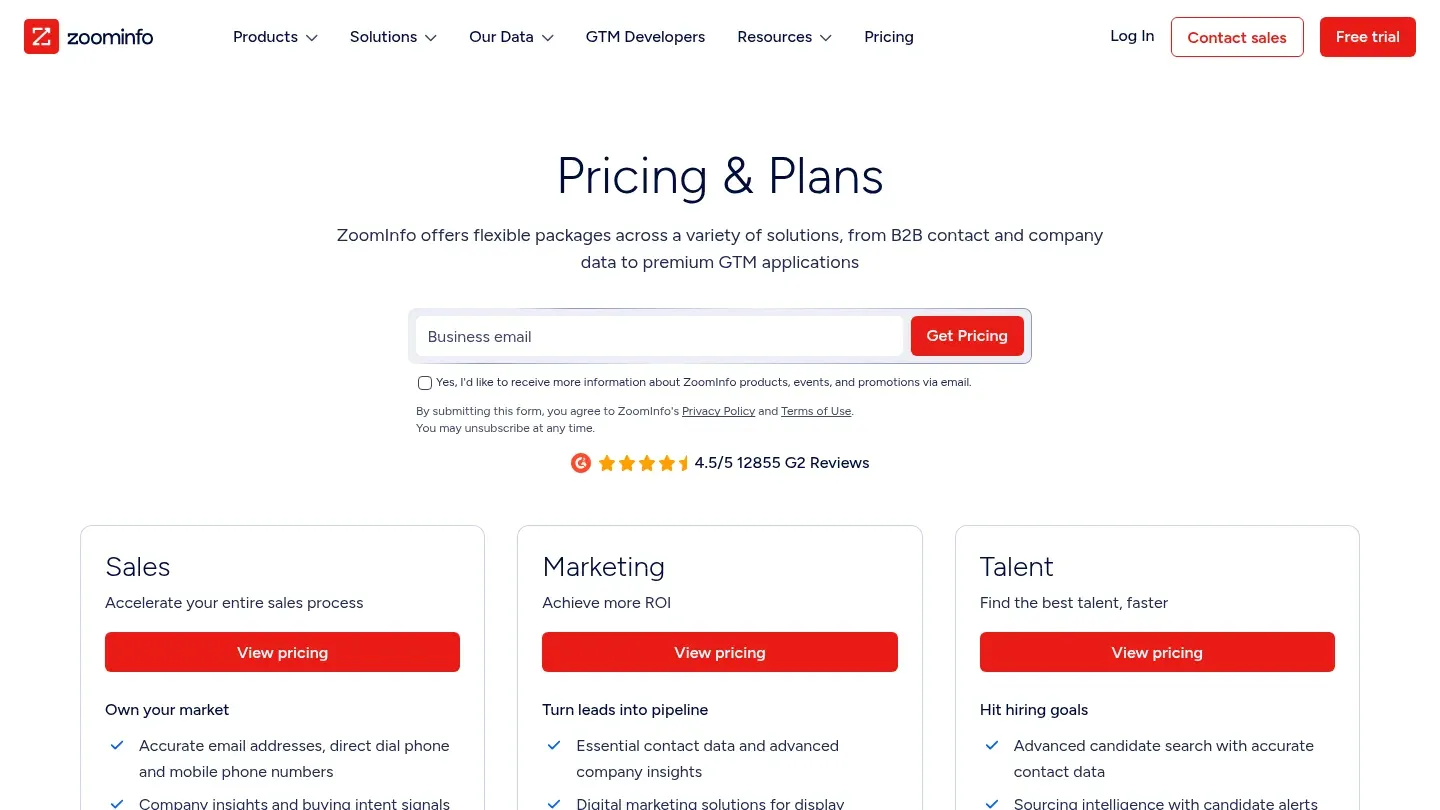
The page names three price drivers: the features you pick, how many licenses you buy and how many credits you use. A credit is spent when a user exports a profile: "Each export costs one credit." Another line says "The cost of ZoomInfo credits is based on the depth of information a customer requires". The page does not say how depth changes the price of a credit.
The page's FAQ says a package includes "a predetermined number of monthly credits". On the package version, the three sales plans give no number, and two marketing plans name an allowance: 75K included credits on Marketing Demand and 150K on ABM Enterprise. Integrations "typically have a base cost" and need "a minimum purchase of bulk credits", with no amounts shown.
On payment, the page says "Our sales team will work with you on payment frequency and options." ZoomInfo's pricing FAQ says its pricing "does not start at $15,000", an answer to claims by other vendors. It names no starting price of its own. Section 5.2 of ZoomInfo's License Terms (version May 1, 2025) treats the agreement's business terms, "including, but not limited to, pricing and access", as ZoomInfo's Confidential Information.
ZoomInfo's one price list: GTM AI credits
GTM AI is ZoomInfo's data product for API, MCP and CLI use, and its pricing page is the one ZoomInfo page this guide found that prints a price. A data credit is "one company, contact, or intent record enriched or exported with ZoomInfo data." The page calls GTM AI "an additional access surface" and "not a replacement plan". Existing customers keep their credit allocations across it.
The page loads on 5,000 credits at $1,900, which is $0.38 a credit. The price per credit falls as the spend tier rises. This table shows all 12 slider stops in US dollars at list price.
| Credits | List price | Per credit | Spend tier |
|---|---|---|---|
| 100 | $45 | $0.45 | base |
| 500 | $215 | $0.43 | $50 |
| 1,000 | $410 | $0.41 | $250 |
| 2,500 | $950 | $0.38 | $1,000 |
| 5,000 (page default) | $1,900 | $0.38 | $1,000 |
| 7,500 | $2,850 | $0.38 | $1,000 |
| 10,000 | $3,800 | $0.38 | $1,000 |
| 15,000 | $4,800 | $0.32 | $5,000 |
| 20,000 | $6,400 | $0.32 | $5,000 |
| 30,000 | $8,700 | $0.29 | $9,000 |
| 50,000 | $14,500 | $0.29 | $9,000 |
| 100,000 | $25,000 | $0.25 | $25,000 |
Source: GTM AI's pricing page, slider set to each stop. Each total equals credits times the per-credit rate. Above 100,000 credits the page says to talk to sales.
At the default rate, 1,000 records cost $380 (our arithmetic). AI credits are a separate meter at a flat $0.05 each, so 2,000 cost $100. The page's "from $20" pay-as-you-go line matches the 400-credit AI pack, and the smallest data pack is 100 credits at $45. A new account gets 1,000 data credits and 1,000 AI credits once, with no card, and search, lookup and find similar never cost credits.
The first data-credit purchase gets 70% off as a "limited-time offer for new signups". That turns 5,000 credits from $1,900 into $570 (our arithmetic), so it is a promotion and not the list price. Mobile phone data and annual volume pricing sit in the Enterprise packages.
GTM AI's page also contradicts itself twice. The first is about expiry. Under the calculator it says "Credits never expire while your account is active". Its FAQ says "Credits expire 12 months after they are granted, whether free or purchased."
The second is about records. The headline says a record is "Charged once per record per year". The FAQ calls Records Under Management "an Enterprise benefit". GTM AI's credits docs describe the 12-month window without naming a tier.
What buyers report paying for ZoomInfo
With no platform price on the page, buyers' own figures are the next evidence. Vendr's ZoomInfo page reports a median of $33,500 a year from 1,578 purchases, all buyer-reported, with a low of $7,247 and a high of $156,032. That median is about $2,792 a month (our arithmetic). Vendr's guide on the page says it was last updated in February 2026.
Vendr's page also contradicts itself. Its header reads "$33,500 Avg Contract Value" on "1012 Deals handled", while the body says "Median buyer pays $33,500 per year" over 1,578 purchases. One label says average and the other says median, and the counts differ by 566, so the base is unsettled. This guide uses the body's wording.
SpendHound's ZoomInfo page lists averages instead: $48,724 a year for companies with 50 to 1,000 employees and $226,925 for companies with 1,000 or more. Its 462 ZoomInfo customers split into 374 SMB and 88 enterprise customers, so the enterprise average rests on 88 contracts. An average and a median are different measures, so we do not subtract one from the other.
One buyer in an r/sales thread wrote, "our current deal is 12 months for $17,500 on the advanced+ package", ahead of a renewal. That is one deal, not a typical price. Another commenter in the same thread said ZoomInfo let them pay $1,000 a month on a $12,000 deal.
Neither marketplace shows the seats, credits or modules behind a contract. A $33,500 deal could be a few heavy exporters or a larger team with light use. Vendr's guide says ZoomInfo contracts often include annual price escalation, typically 5 to 10%.
The table lists each ZoomInfo price figure above and what kind of number it is.
| Figure | What it is | Base | Page |
|---|---|---|---|
| No price for any plan | Published | Both page versions | ZoomInfo's pricing page |
| $0.25 to $0.45 per data credit | Published list price | 12 slider stops | GTM AI's pricing page |
| $33,500 a year | Buyer-reported median | 1,578 purchases | Vendr's ZoomInfo page |
| $48,724 and $226,925 a year | Buyer-reported averages | 374 SMB and 88 enterprise customers | SpendHound's ZoomInfo page |
| $17,500 for 12 months | One buyer's current deal, before renewal | One deal | The buyer's post quoted above |
Where ZoomInfo says pricing is heading
ZoomInfo's 10-Q for the quarter ended June 30, 2026 says the company intends, from the third quarter of 2026, to move part of its per-seat subscription revenue to a hybrid model. The model pairs a smaller yearly platform fee with data credits bought in advance, and existing customers are expected to convert mostly as they renew.
The filing also says ZoomInfo expects most customers to move at similar price points, with some paying less and some more. The Vendr and SpendHound figures above were gathered while the seat packages were the model, and neither page says whether any contract used the hybrid. The filing says "intend", and the pricing page shows no hybrid price.
ZoomInfo pricing per user
ZoomInfo's pricing FAQ says "ZoomInfo uses a seat-based pricing model", with cost set by the number of users who access the platform. The same page lists the factors behind a monthly cost: seats, data access, products and add-ons, integrations, contract length and volume discounts. The 10-Q adds that contracts are priced on functionality, the number of users and the amount of data a customer integrates.
The pricing page shows no dollar figure for a seat, and on the package version the three sales plans state no credit allowance. Per-user cost is one input to a quote. The packages, the credits and the term are the others.
What a ZoomInfo credit buys
ZoomInfo credits come in three types. The help centre says "There are three types of credits: Monthly Credits, Bulk Credits, and AI Action Credits." Its Overview of Credits article charges one credit for each exported record. The table sums up what the article says about each type.
| Credit type | Who holds it | End of period |
|---|---|---|
| Monthly | Individual users on the Advanced+, Elite+, Copilot Advanced and Copilot Enterprise packages | Refresh on the first of each month; "can not be rolled over or transferred to other users" |
| Bulk | Shared across the organization | "expire at the end of your contract term and will not roll over" |
| AI Action | AI features in GTM Studio and the ZoomInfo MCP | The rollover sentence names monthly and bulk credits only |
Source: ZoomInfo's Overview of Credits help article. When a user runs out of monthly credits, the article says more are drawn from the bulk pool. Neither monthly nor bulk credits roll over, so unused credits are lost at the end of the month or the term.
Once a record is exported, ZoomInfo's help centre says it can usually be exported again for 365 days without another credit. The window starts at the first export and does not reset. For user-level records the Overview of Credits article warns that "if User A and User B both export the same record, two credits will be charged."
GTM AI's credits docs track a record across the whole organization for 12 months. That applies to accounts that get Records Under Management, which the pricing FAQ limits to Enterprise. On those accounts, the same record can cost one credit on GTM AI and two when two users export it on the platform.
Contract terms and ZoomInfo auto renewal
The table below summarizes ZoomInfo's own documents. It is not legal advice.
| Term | What the document says | Document |
|---|---|---|
| Length | Typically one to three years and non-cancelable; 53% of contracts by annualized value are multi-year | ZoomInfo's 10-Q |
| Cancellation | "The Agreement is not cancellable" until it expires or ends under its terms | License Terms, section 3.1 |
| Billing | Billed in advance, annually, semi-annually or quarterly; fees due on execution of the Ordering Document | 10-Q; License Terms, section 4.1 |
| Early exit | Either side may end it for a material breach not remedied within 21 days of written notice, or by mutual agreement; if ZoomInfo ends it for your material breach, fees for the rest of the term fall due; if you end it for ZoomInfo's uncured material breach, pre-paid fees are refunded pro rata | License Terms, sections 3.2 and 3.3 |
| Auto-renewal opt-out | Through the Billing Portal at least 60 days before the renewal date; administrators only; cannot be re-enabled | ZoomInfo's help article on opting out of auto-renewal (May 9, 2025) |
| After expiry | You may "continue to use Licensed Materials obtained during the Term subject to the terms of this Agreement" | License Terms, section 3.3.1 |
Billing frequency is negotiable. ZoomInfo's pricing page leaves payment frequency to a talk with sales, and the 10-Q describes billing in advance as the usual pattern.
The opt-out article applies to accounts enrolled in auto-renewal, and those accounts get email notices of upcoming renewal dates. The current License Terms leave the term, "together with any period of extension", to the Ordering Document, so the order form is where renewal terms sit.
The 2021 License Terms, still hosted at a dated page, extended the term automatically from 60 days before it ended. The extension ran for the longer of the initial term or one year, at "the annualized amount" of the fee "plus 10% of such fee, plus any applied discount". Those are the 2021 terms, and the current version, dated May 1, 2025, has no automatic-extension clause of its own.
ZoomInfo Lite and the free trial
ZoomInfo Lite is the free tier. ZoomInfo's sign-up article says new users "will receive 10 free credits that can be used to reveal contact data", and each reveal uses one credit. Members who join the ZoomInfo Community get a monthly credit allotment on top, and the help centre states no number for it.
The trial is a separate offer. ZoomInfo's free-trial page says it "typically offers a 7-day free trial for new users", with no credit card. Trial length and terms may vary by promotion, company size or industry, whether you work with a sales rep, and the package. GTM AI is a third route, with the 1,000 data credits and 1,000 AI credits at signup.
If your job is work emails
Some buyers need only work emails for a list they already hold. That is a different product from a ZoomInfo seat or a GTM AI record. The numbers below set two meters side by side and do not treat them as equivalent.
WizLeads' Find Work Email API returns a work email from a first name and a company website. It costs 3 credits per email found and nothing for a miss, and Verify Email costs 0.5 credit for every email processed. On WizLeads' homepage, Freelancer is $39 a month for 10,000 credits and Agency is $99 for 40,000.
WizLeads also sells top-up credits at $5 per 1,000 to accounts on an active plan. As unit costs, 1,000 work emails found come to $11.70 on Freelancer, about $7.43 on Agency and $15 on top-up credits.
GTM AI's default tier works out to $380 per 1,000 records. A record there is a company, contact or intent record, so it is a different unit from one work email found. WizLeads' scraping side starts from a Sales Navigator search, so a Sales Navigator seat is a separate cost.
Before you ask for a quote
ZoomInfo's pages leave several answers to the order form. It should say whether the quote follows the seat packages or the hybrid model. It should give the monthly and bulk credits that come with it, and say whether records are tracked per user or for the organization. It should also state the renewal date, the 60-day opt-out date and the billing schedule.
Divide the quote by the credits your team will really export, and compare that price per record with what you pay today.
Set the quote beside the prices of ZoomInfo alternatives before you sign.