WizLeads


EmailListVerify is cheap per credit. Its API docs list four statuses as free (unknown, antispam_system, smtp_protocol and invalid_syntax, each marked "No credits are deducted"). ok_for_all, its catch-all label, is not on that list, so a catch-all result is billed unless EmailListVerify says otherwise, and the docs never state that charge in terms. Either way the result is a label, not a verdict, and on a B2B list it is the part you cannot mail with confidence.
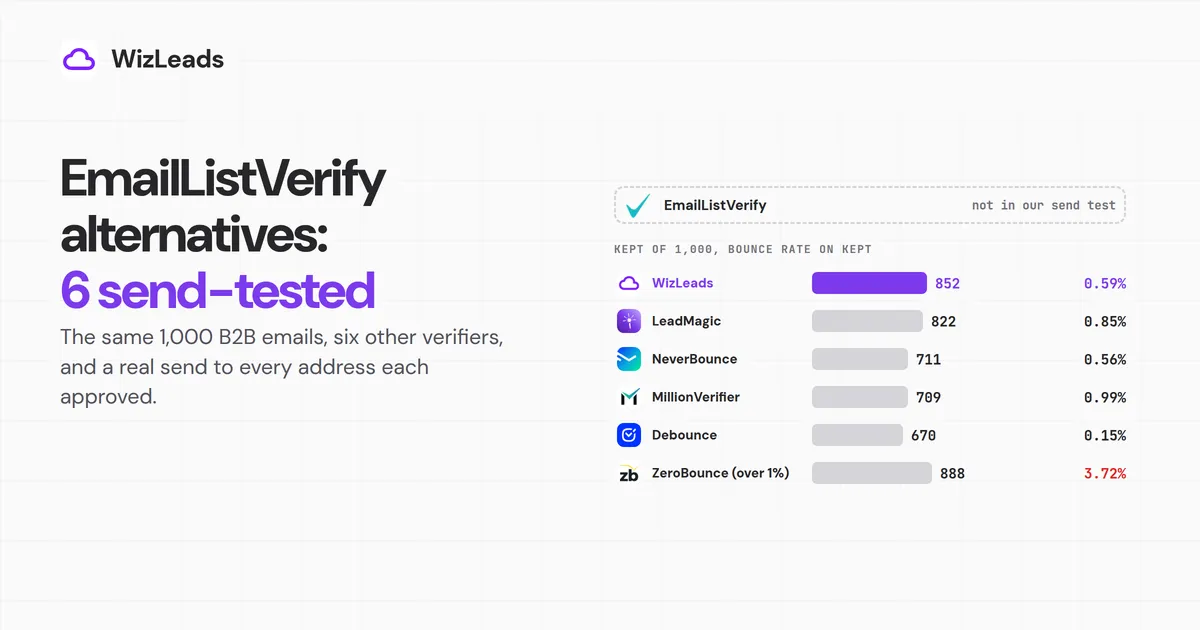
EmailListVerify was not in our send test, so we have no bounce data on it and will not guess. We ran the same 1,000 B2B addresses through six other verifiers and mailed everything each one approved. Five stayed under a 1% bounce rate: WizLeads (852 addresses kept), LeadMagic (822), NeverBounce (711), MillionVerifier (709) and Debounce (670).
EmailListVerify prices below are the US render of its pricing page. Its pay-as-you-go prices change with visitor location, as the next section explains.
EmailListVerify pricing today
The pricing page is a calculator with a pay-as-you-go tab, whose packs never expire, and a monthly-plans tab. We typed each volume into it to read the price. The per-1,000 columns and the saving are our division.
| Credits | Pay as you go | Per 1,000 | Monthly plan | Per 1,000 | Plan saving |
|---|---|---|---|---|---|
| 1,000 | $6.99 | $6.99 | none listed | n/a | n/a |
| 5,000 | $24.99 | $5.00 | none listed | n/a | n/a |
| 10,000 | $27.99 | $2.80 | $25 (Starter) | $2.50 | 10.7% |
| 25,000 | $58 | $2.32 | $49 (Pro) | $1.96 | 15.5% |
| 50,000 | $119 | $2.38 | none listed | n/a | n/a |
| 100,000 | $199 | $1.99 | $149 (Business) | $1.49 | 25.1% |
| 250,000 | $276 | $1.10 | none listed | n/a | n/a |
| 500,000 | $356 | $0.71 | none listed | n/a | n/a |
| 1,000,000 | $474 | $0.47 | none listed | n/a | n/a |
Source: emaillistverify.com/pricing, US render in USD, read in November 2026. Above 1,000,000 credits the page shows a custom quote ("Talk to our team about volume pricing"), so we list no price for 2,500,000 or more. Enterprise is custom. The Pro and Business plans also double and multiply by five the API rate limits and cut Deep Scan from 3 credits to 2.
Prices depend on where you load the page. Loaded from Germany, the same page showed 1,000 credits at EUR 5, and a plain curl saw the same euro figures. The page's structured data labels those euro numbers as USD. A US visitor sees $6.99. Truelist's comparison page prices EmailListVerify at $199 for 50,000 credits and $349 for 100,000. The US page we saw showed $119 and $199.
One pack costs more per credit than the one below it. The 50,000 pack is $2.38 per 1,000 against $2.32 for 25,000, and two 25,000 packs ($116) cost less than one 50,000 ($119).
The plan saving is stated as a ceiling. The pricing page says monthly plans "save up to 25%". Against the US prices, the three plans save 10.7% at 10,000 credits, 15.5% at 25,000 and 25.1% at 100,000.
Free credits are stated two ways too. The pricing page and homepage offer 100 free verifications on signup. The email validator page says a free account gives 100 free verifications every month. We could not tell which governs.
What EmailListVerify charges for
The API documentation is the only place we found the free statuses listed.
| Result | Credits |
|---|---|
| ok, email_disabled, dead_server, invalid_mx, disposable, spamtrap | Billed: 1 credit, or 2 on High quality in bulk and emailJobs |
| ok_for_all | Not on the free list, so billed by exclusion; the docs state no charge in terms |
| unknown, antispam_system, smtp_protocol, invalid_syntax | 0 ("No credits are deducted") |
| Deep Scan re-check of unresolved results | 3 per re-verified email (2 on Pro and Business), once per list |
| Duplicates in a bulk file | 0 (bulk bills "valid and unique emails") |
| Email finder | 5 per email found |
Source: api.emaillistverify.com/api-doc and the pricing FAQ. The finder is 5 credits per email found at medium confidence or higher, and 10 through the API with a domain only.
Bulk verification has two quality levels. Standard costs 1 credit per email. High costs 2 and, per the docs, is a slower, more thorough check that can take up to 30 minutes of delay. It exists to cut statuses that are free anyway. Deep Scan then re-verifies the unresolved results of a finished list once, at 3 credits per re-verified email (2 on the Pro and Business plans), and only unresolved emails are charged. The docs give unknown and antispam_system as Deep Scan's examples. We found no step in them that resolves ok_for_all.
The docs define ok_for_all as a domain that accepts all mail, where incoming messages "may or may not bounce back". That is a label and not a verdict, and the label is the hard part of catch-all verification.
Why teams look for an EmailListVerify alternative
Catch-alls come back as a label and are not on the free list. In our list, WizLeads' classifier read 212 of 1,000 addresses as catch-all (21.2%). On a list shaped like that, 2,120 of every 10,000 addresses sit behind domains that accept anything. We did not test EmailListVerify, so we cannot say how many it would label ok_for_all. The docs do not exempt them, so each ok_for_all result is billed unless EmailListVerify says otherwise, and the label still leaves keep-or-drop to you. Our guide to how verifiers name and bill each result shows how other tools treat the same label.
Subscription credits reset. The API docs say credit usage is refreshed at the start of each billing period. The credits endpoint says daily credits "are accessible solely during the active subscription period". The docs call them daily credits while the pricing page sells "credits / mo.", so the naming is inconsistent, but the behaviour is the same in both: subscription credits do not carry over. The pricing FAQ says unused plan credits expire on the billing date, and that pay-as-you-go credits never expire.
Refunds are narrow. EmailListVerify's Terms, last updated 30 July 2025, give consumers in the EEA and UK a 14-day withdrawal right, with a pro-rata deduction for services used. After that, credits are "generally non-refundable", with a carve-out for a service that is defective or not as described. Those are consumer terms. For other buyers the Terms we read state only that auto top-up credits are non-refundable after the withdrawal period. Monthly subscriptions are non-refundable except for service credits when an outage runs past 2 cumulative hours in a month. Annual subscriptions cancelled within 30 days of renewal get a pro-rata refund. The Terms we read contain no bounce or accuracy guarantee. They also bar using the website to send unsolicited commercial communications, bar using the services for unlawful data mining or email harvesting, "including creating or enriching contact lists without a lawful basis", and bar unsolicited marketing "in breach of applicable anti-spam laws". Verifying addresses you collected lawfully is permitted. Read that against how you source your list; it is the vendor's wording, not a legal opinion.
Accuracy is stated several ways. If you are reading an EmailListVerify review for an accuracy figure, note that the vendor gives several. The pricing and bulk FAQ says 97% accurate. The homepage and the validator page say 99% verification accuracy, and the homepage adds "over 99.7%" after the first list delivery. None of those is a result we measured.
EmailListVerify API limits
Rate limits per endpoint: verifyEmail and verifyEmailDetailed allow 10 requests per second at 1 credit each, the asynchronous single-address emailJobs endpoint allows 100 per second, and file upload and findContact allow 5. Files can be csv, txt or xlsx, up to 100 MB and 1,000,000 rows. The API docs say 5 lists verify at once by default, while the pricing page gives 4 on Starter, 6 on Pro and 10 on Business. The Pro plan doubles the API rate limits and Business multiplies them by 5. The pricing FAQ claims more than 100,000 verifications per hour per customer.
One thing to check before you code an integration. The marketing API page shows a sample response with status, score and accept_all fields. The docs' detailed schema returns result, internalResult, isRole and isFree, and the plain verifyEmail call returns text. Build against the docs, not the sample.
How we tested the five alternatives
The email verification benchmark list was 1,000 decision-maker emails at US real-estate agencies, exported from Apollo in April 2026. All six tools got the identical CSV on the same day, within a two-hour window. We sent a plain-text message from a clean Google Workspace account to every address each tool approved and counted hard bounces and mailbox-does-not-exist responses over 72 hours. EmailListVerify was not one of the six.
Two limits travel with every number below. We mailed every address at least one tool approved, so the test counts rejections, not wrong rejections. And at 1,000 addresses the five low-bounce tools are statistically indistinguishable: 4 bounces against 7 is noise. Only ZeroBounce's 33 stands apart.
We rank on one criterion, stated before the results: the most addresses kept while bouncing under 1%. We chose it after the test, and ranking by lowest bounce rate would put Debounce first.
Results: five alternatives and ZeroBounce on one list
| Rank | Tool | Kept | Bounced | Bounce rate | Rejected | Catch-alls in our run |
|---|---|---|---|---|---|---|
| 1 | WizLeads | 852 | 5 | 0.59% | 148 | verdict returned |
| 2 | LeadMagic | 822 | 7 | 0.85% | 178 | verdict returned |
| 3 | NeverBounce | 711 | 4 | 0.56% | 289 | 137 flagged (not placed against the 289) |
| 4 | MillionVerifier | 709 | 7 | 0.99% | 291 | 170 flagged |
| 5 | Debounce | 670 | 1 | 0.15% | 330 | 201 flagged |
| n/a | ZeroBounce (over 1%) | 888 | 33 | 3.72% | 112 | verdict returned |
Source: our send test, figures as published on the benchmark page. Bounce rate is bounces divided by the addresses that tool kept. Kept plus rejected is 1,000 for every tool. The benchmark page does not place NeverBounce's 137 flags against its 289 rejections. Debounce's paid catch-all check was not run, and MillionVerifier flags catch-alls without saying whether they are valid or invalid, so their flags stay unresolved.
Debounce (0.15%) and NeverBounce (0.56%) both bounced less than WizLeads (0.59%), and they rejected 330 and 289 addresses against WizLeads' 148.
The numbers split three ways. Grade on bounce rate alone and Debounce and NeverBounce had the lowest rates (0.15% and 0.56%), at the cost of the most rejections. Grade on addresses you can still mail and WizLeads and LeadMagic kept the most under 1%, both with a verdict on catch-alls. Grade on the bill for a one-off 10,000 and Debounce ($25) lists lowest of the five, then WizLeads and MillionVerifier ($39 each). WizLeads' $19.50 is a pro-rata unit cost, reached only if you use the plan's 20,000 verifications.
The five EmailListVerify alternatives, ranked
Each tool gets the same four slots in the same order: result, price and meter, catch-all handling, and where it falls short. Prices come from each vendor's own pages.
1. WizLeads
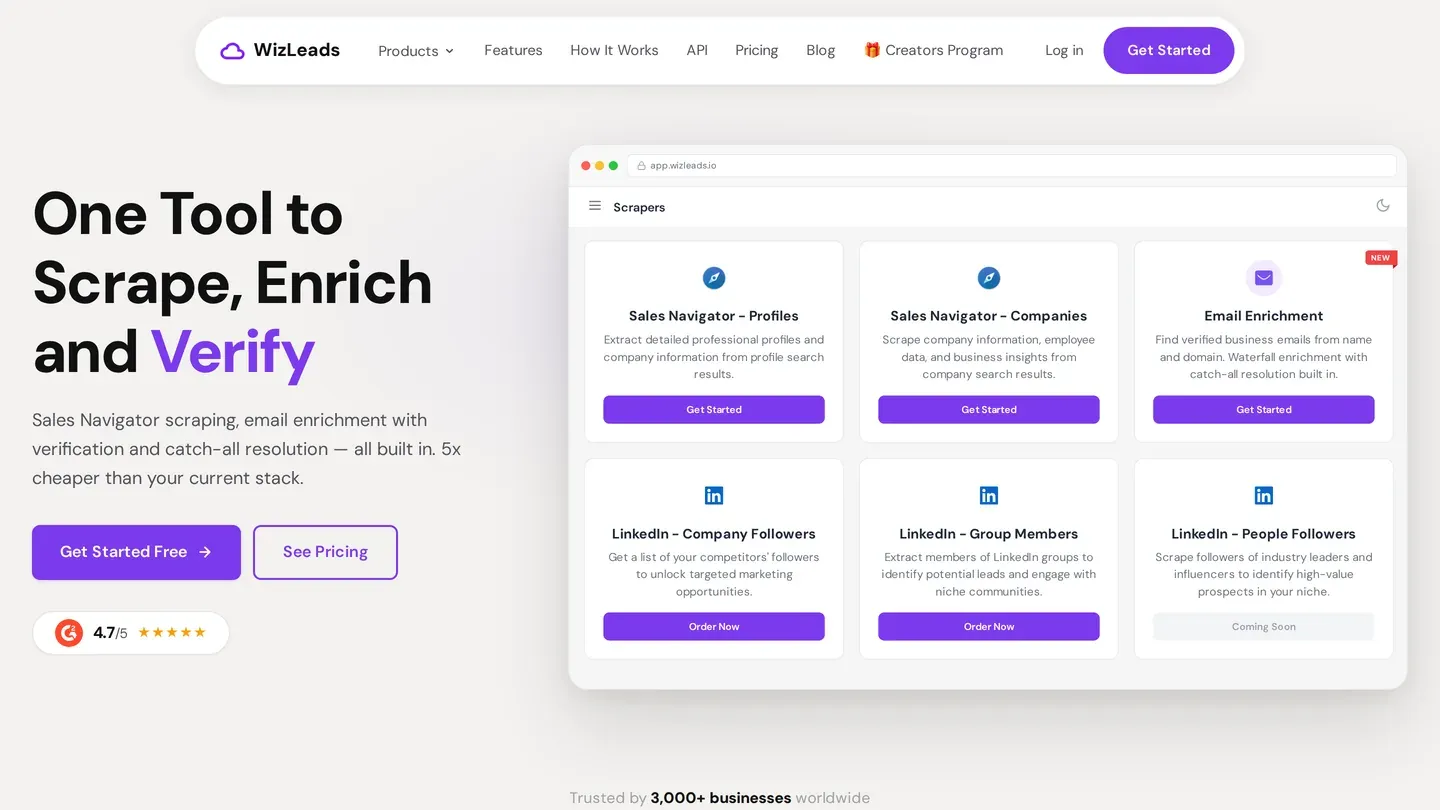
Source: WizLeads homepage.
Result. 852 kept, 5 bounced (0.59%), 148 rejected. The most kept of the five tools under 1%.
Price and meter. Verification costs 0.5 credits per email, charged for every email processed whatever the result. The Freelancer plan is $39 a month for 10,000 credits, which is 20,000 verifications: $19.50 per 10,000 as a pro-rata unit cost, against a $39 bill. New accounts get 500 free credits once, enough for 1,000 verifications.
Catch-alls. WizLeads classifies catch-all emails as valid or invalid, and in our run it returned a verdict on them.
Falls short. Unknown results are billed, and unused credits roll over for one billing period where EmailListVerify's pay-as-you-go credits never expire. A one-off 10,000 costs $39 on Freelancer against $27.99 for an EmailListVerify pack. Reoon and Truelist list cheaper at 10,000, and at a million EmailListVerify's pay-as-you-go pack undercuts WizLeads' Kingpin quarterly pro-rata (numbers below). If your bounce rate on addresses WizLeads marked valid passes 2%, it refunds 100% of your credits, subject to an email infrastructure diagnosis. That is a credit refund, not cash.
2. LeadMagic
Source: LeadMagic homepage.
Result. 822 kept, 7 bounced (0.85%), 178 rejected.
Price and meter. Essential is $99 a month for 5,000 credits. A validation costs 0.25 credits, so that covers 20,000 validations: $49.50 per 10,000 pro-rata, billed as $99.
Catch-alls. It returned a verdict on catch-alls, as WizLeads did. On misses, LeadMagic's pricing page says "Failed lookups are free", and its Terms, rewritten on 19 October 2026, defer to the pricing page on what each action costs.
Falls short. The entry bill is $99, and $49.50 per 10,000 is about 2.5 times WizLeads at the same entry tier and about twice EmailListVerify's $25 subscription.
3. NeverBounce
Source: NeverBounce homepage.
Result. 711 kept, 4 bounced (0.56%), 289 rejected. Of those 289, 79 came back unknown.
Price and meter. Pay as you go is $50 for 10,000, and the monthly Growth plan is $49 for up to 10,000. Its billing help says 1 credit per verification and states no exception for unknown or accept-all results.
Catch-alls. It flagged 137 addresses as catch-all without a verdict.
Falls short. It rejected 289 addresses, nearly twice WizLeads' 148. Pay-as-you-go credits expire after 12 months, and at a million credits the pack is $2,500 against EmailListVerify's $474.
4. MillionVerifier
Source: MillionVerifier homepage.
Result. 709 kept, 7 bounced (0.99%), 291 rejected. The shape is close to NeverBounce's.
Price and meter. $39 for 10,000 and $449 for a million, as one-off packs. It bills good and bad results only.
Catch-alls. In our April run it flagged 170 addresses as catch_all, inside its 291 rejections, with no verdict. Its homepage now advertises catch-all verification "at no extra cost", which we have not tested. It credits back unknown and catch-all results, but its Terms call that "a discretionary promotional goodwill programme, not a permanent feature". A help-centre article withdraws it from accounts whose results regularly hold an outstandingly large number of unknown or invalid addresses. The homepage calls it a "Full refund on any risky email".
Falls short. 291 rejections, 170 catch-alls left unresolved in our run, and a free-risky rule that depends on how your results look. If you verify scraped lists, read that help-centre article first.
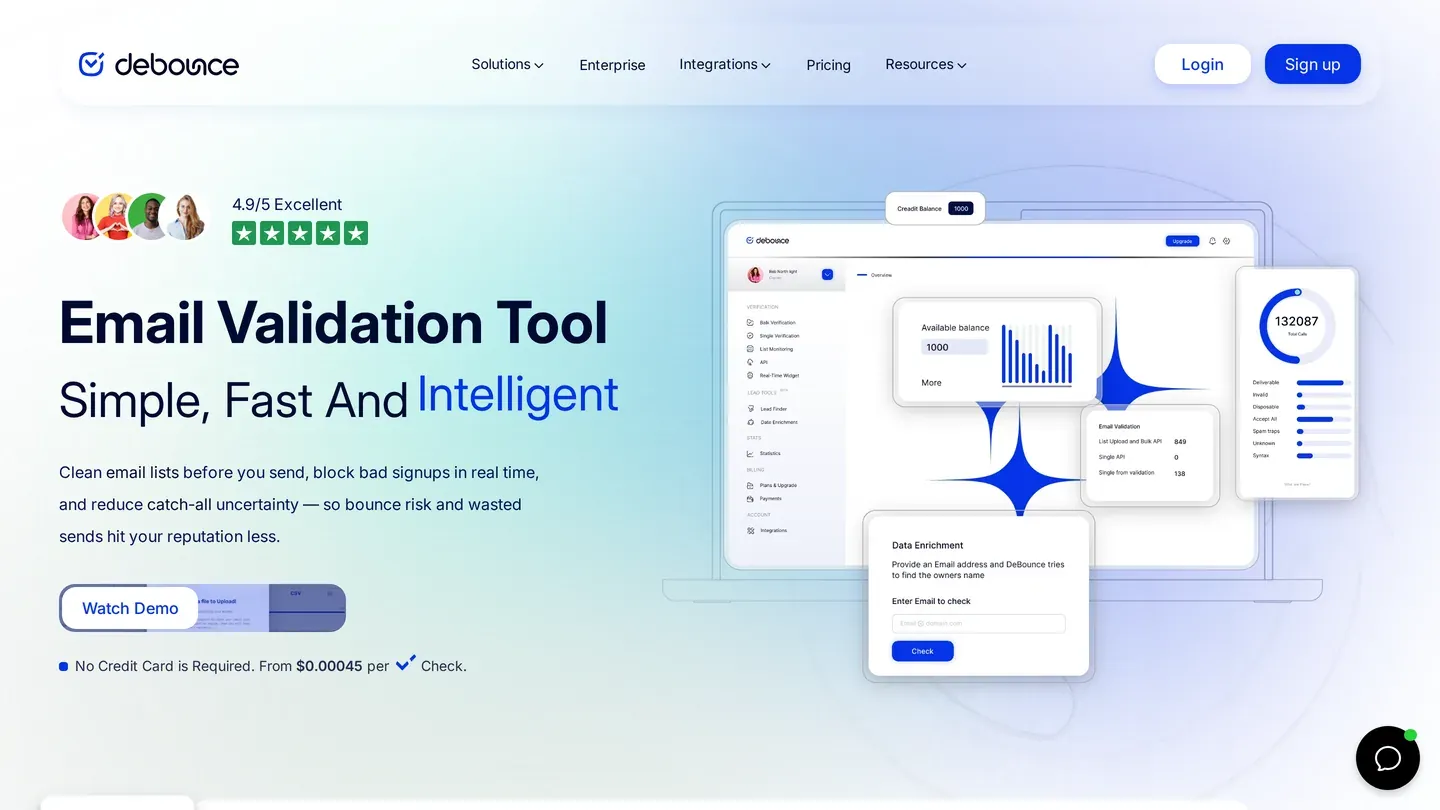
5. Debounce
Source: Debounce homepage.
Result. 670 kept, 1 bounced (0.15%), 330 rejected. The lowest bounce rate in the test and the most rejections, a third of the list.
Price and meter. $25 for 10,000 pay as you go, and $750 for a million.
Catch-alls. The standard check leaves them unresolved, and its 201 Accept All flags sit inside the 330 rejections. Resolving a catch-all costs 10 more credits, 11 in total, per its help centre.
Falls short. On a list shaped like ours, where WizLeads' classifier read 21.2% as catch-all, resolving them adds 21,200 credits for every 10,000 addresses, 31,200 in all, over three times the credits of a standard check.
What about ZeroBounce?
ZeroBounce kept the most addresses, 888, and 33 of them bounced (3.72%), so it fails the criterion and sits outside the five. It starts at $39 for 2,000 credits pay as you go. Unknown results are free. Its Verify+ step reclassifies catch-alls by sending a real test email, and its own documentation calls Verify+ optional and free.
Cheaper but untested: Reoon and Truelist
Two verifiers list below WizLeads at 10,000, and we have no send data on either. Reoon sells instant credits at $11.90 for 10,000, and Truelist lists $14 for 10,000, $90 for 100,000 and $700 for a million. Both undercut EmailListVerify's $27.99 pack and its $25 subscription, and both bills sit below WizLeads' $39 for a one-off 10,000. Reoon bills catch-all results and refunds unknowns. A lower price is a fair reason to test them.
Prices at 10,000 and 1,000,000
| Tool | Bill for a one-off 10,000 | Unit cost per 10,000 (pro-rata) | 1,000,000 | Send-tested |
|---|---|---|---|---|
| Reoon | $11.90 | n/a | $972 | no |
| Truelist | $14 | n/a | $700 | no |
| Debounce | $25 | n/a | $750 | yes |
| EmailListVerify, Starter plan | $25 | n/a | no plan price listed | no |
| EmailListVerify, pay as you go | $27.99 | n/a | $474 | no |
| WizLeads (Freelancer) | $39 | $19.50 | $1,199 per quarter, carries 2,000,000 (pro-rata $599.50 per million) | yes |
| MillionVerifier | $39 | n/a | $449 | yes |
| NeverBounce, pay as you go | $50 | n/a | $2,500 | yes |
| LeadMagic (Essential) | $99 | $49.50 | not priced here | yes |
| ZeroBounce | $129 (minimum purchase $39 for 2,000) | n/a | $3,199 | yes |
Source: each vendor's pricing page, US prices, read in November 2026. Subscriptions are monthly commitments and the other rows are one-off packs, so the columns are not like for like. "Pro-rata" is a unit cost spread over the volume a plan carries, not a bill. Kingpin monthly pro-rata at a million is $831.67.
For a one-off 10,000, EmailListVerify is cheaper than WizLeads: $27.99 for a pack or $25 on the subscription, against $39 for the Freelancer plan. WizLeads' $19.50 is a pro-rata unit cost that you only reach by using the plan's 20,000 verifications a month. At a million, as unit costs, EmailListVerify's $474 pay-as-you-go pack sits below WizLeads' $599.50 quarterly pro-rata and its $831.67 monthly one, and MillionVerifier's $449 sits below all three. The bills differ: Kingpin quarterly is $1,199 and carries 2,000,000 verifications. The argument for switching is what the credit buys: a verdict on catch-alls and bounce data from a list we mailed.
EmailListVerify against Debounce on a huge list
At a million credits EmailListVerify's pay-as-you-go pack is $474 on the US render of its calculator, against $750 at Debounce. EmailListVerify takes up to 1,000,000 rows and 100 MB in one file. Debounce's API docs cap a list at 200,000 emails and 20 MB, allow one active bulk job per account and queue the rest.
Neither resolves catch-alls for free. EmailListVerify's docs do not exempt ok_for_all from billing and we found no step that resolves it, while Debounce charges 10 more credits per catch-all. At our list's 21.2% catch-all share, resolving a million addresses would take about 3.12 million Debounce credits.
When to stay on EmailListVerify
Stay if your lists are consumer-grade, mostly Gmail, Outlook and similar mailboxes, where catch-alls are a small share and the ok_for_all problem barely shows up. Stay if you verify millions a month on a quoted plan and already have your own catch-all rule. Stay if your volume is lumpy, because pay-as-you-go credits never expire and WizLeads' roll over for only one billing period. We cannot say how it scores on your list.
How to test an alternative on your own list
- Run one identical CSV through EmailListVerify and two or three alternatives on the same day. Best email verification tools has a longer shortlist.
- Record each tool's kept count, how it labelled catch-all addresses, and what it charged for them.
- Send only to each tool's approved addresses from a clean sender and count hard bounces over 72 hours.
- Compare kept counts at similar bounce rates. On 1,000 addresses a gap of a few bounces is noise.
- For EmailListVerify specifically, count how many results come back
ok_for_all, check your credit balance to see whether they were charged, and decide what to do with them. The docs leave resolving them to you.
The free allowances cover step one: EmailListVerify gives 100 verifications, and WizLeads' 500 free credits cover 1,000 if you open a free account.