WizLeads


TL;DR
- Pick DeBounce below about 318,000 credits. It is the cheaper way to buy any amount from 5,000 to 318,000 credits, and the 5 addresses it called invalid that MillionVerifier approved all hard-bounced.
- Pick MillionVerifier above that line, or for a bought list. Its 500,000 pack is $299 against DeBounce's $450, and its Terms allow lists from a data provider where DeBounce's guarantee excludes purchased ones.
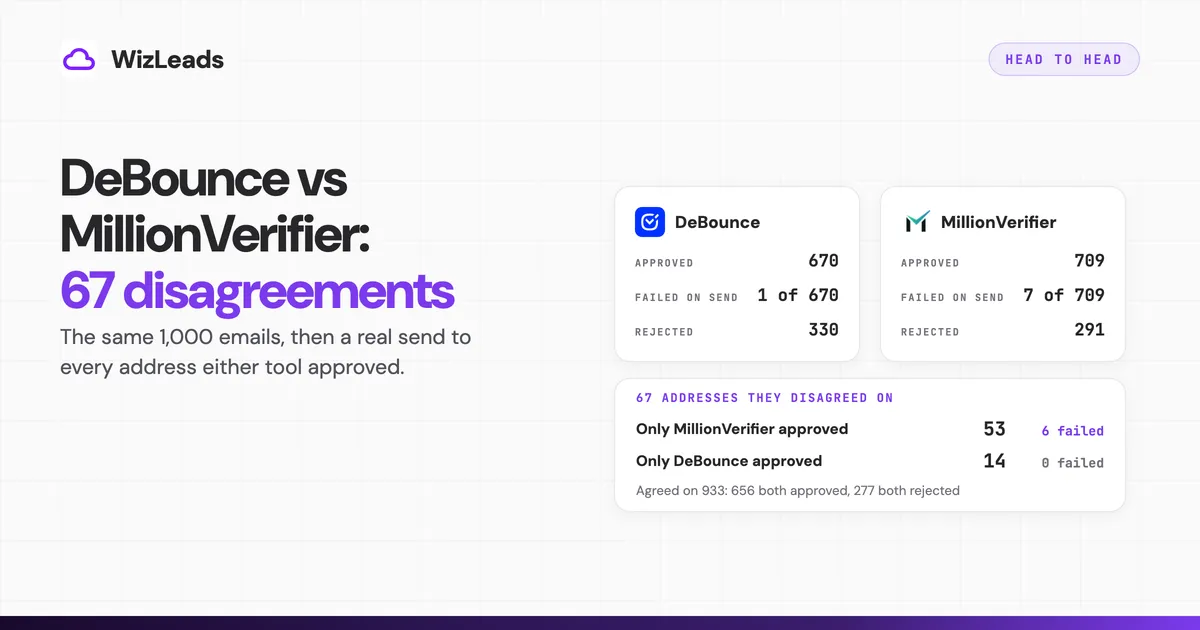
- The whole contest is 67 addresses. The two tools agreed on 933 of 1,000, and the totals (670 approved with 1 failure, 709 approved with 7) are a gap this sample cannot call real.
In our send test on the same 1,000 real-estate emails, DeBounce and MillionVerifier agreed on 933 and split on 67. The 5 addresses DeBounce called invalid and MillionVerifier approved all hard-bounced. DeBounce held back 47 addresses as Accept All or Unreachable that MillionVerifier approved, and 46 of them recorded no failure in 72 hours.
The totals leave the choice open. DeBounce approved 670 and 1 failed on send. MillionVerifier approved 709 and 7 failed. MillionVerifier vs DeBounce therefore comes down to your volume and your list, since their terms treat bought lists differently.
Six verifiers took the test, including WizLeads' email verifier. One of the two tools approved each of the 67 split addresses, so we mailed every one. Below is every cell, the unfavourable ones too, then prices and fine print.
How we ran it
In April 2026 we exported 1,000 real-estate decision-maker emails from Apollo and ran them through six verifiers on the same day. We sent a plain-text message from a clean Google Workspace account and counted hard bounces and mailbox-does-not-exist responses over 72 hours. Either one is a failure on send below. "Approved" means DeBounce returned Deliverable or MillionVerifier returned ok.
We mailed only the addresses at least one tool approved; the 96 every tool rejected were never sent. So rejections are counts, never graded as right or wrong. The headline counts match our email verification benchmark, and the address-level cells here come from the raw data sheet behind it.
Two limits shape the rest. We ran DeBounce's standard check, not its paid catch-all step, and MillionVerifier flags catch-alls without saying whether they are valid or invalid, so its 170 catch_all flags stayed unresolved in our run. It is also one list, one send and one 72-hour window, so read small cells as counts, not rates.
Head-to-head on our list
| DeBounce | MillionVerifier | |
|---|---|---|
| Approved | 670 | 709 |
| Failed on send | 1 | 7 |
| Failure rate on approved | 0.15% | 0.99% |
| Rejected | 330 | 291 |
| Rejected as unresolved catch-all | 201 (Accept All) | 170 (catch_all) |
| Rejected as invalid | 90 (Bounce) | 102 (invalid) |
| Rejected as unknown | 36 (Unreachable) | 18 (unknown) |
| Rejected, other | 1 Spamtrap, 2 no result | 1 no result |
The last four rows are subsets of the rejected row, not additions to it. DeBounce rejected 39 more addresses than MillionVerifier: 31 more as catch-all, 18 more as unknown and 2 more in the other bucket, offset by 12 fewer called invalid.
Where the two tools agreed
They agreed on 933 addresses: 656 that both approved and 277 that both rejected. The 656 produced 1 failure, a hard bounce on a Microsoft-hosted address that WizLeads' classifier does not flag as catch-all. It counts against both tools equally.
The 277 are the cell we do not grade. Another tool approved 181 of them, so those were mailed. The other 96 were approved by no tool and never sent. We publish no result for either group.
Inside that agreement sit most of the catch-alls. DeBounce called 201 addresses Accept All and MillionVerifier called 170 catch_all, and 165 are the same addresses, all in the 277 both rejected. DeBounce's help centre describes Accept-All as a domain-wide setting with no definitive way to say whether an address is valid, and neither tool resolved those 165 for us, so that bucket needs a separate step.
The 67 addresses they split on
| MillionVerifier approved | MillionVerifier rejected | Total | |
|---|---|---|---|
| DeBounce approved | 656 (1 failed) | 14 (0 failed) | 670 (1 failed) |
| DeBounce rejected | 53 (6 failed) | 277 (not graded) | 330 |
| Total | 709 (7 failed) | 291 | 1,000 |
Six of MillionVerifier's seven failures sit in the 53 only it approved: 5 hard bounces and 1 mailbox-does-not-exist. The next two tables show how each tool rated the addresses only the other approved.
| Only MillionVerifier approved (53) | Addresses (failed) |
|---|---|
| DeBounce called Accept All | 24 (1) |
| DeBounce called Unreachable | 23 (0) |
| DeBounce called Bounce | 5 (5) |
| No DeBounce result | 1 (0) |
| Only DeBounce approved (14) | Addresses (failed) |
|---|---|
| MillionVerifier called invalid | 9 (0) |
| MillionVerifier called unknown | 4 (0) |
| MillionVerifier called catch_all | 1 (0) |
The cell that counts against MillionVerifier is the smallest. DeBounce's Bounce is its invalid verdict, and MillionVerifier approved 5 of those addresses. All 5 hard-bounced, which makes them 5 of MillionVerifier's 7 failures. By WizLeads' classifier none was on a catch-all domain, and one, a Proofpoint address, sat behind a gateway. Five addresses is an anecdote, so we give the count and not a rate.
The cell that counts against DeBounce is the largest. It held back 47 addresses as Accept All or Unreachable that MillionVerifier approved, and 46 of them recorded no failure in 72 hours. A clean 72-hour send does not prove an address is deliverable.
In the third cell, none of the 14 addresses only DeBounce approved failed. That includes the 9 MillionVerifier called invalid, which we do not call false invalids, because one send over 72 hours cannot show that.
Six failures against none (6 of 53 against 0 of 14) is also a gap this sample cannot call real.
Where the failures and the approvals fell
MillionVerifier approved 25 addresses on flagged catch-all domains against 4 for DeBounce. That is 21 of the 39-address gap in approvals (709 against 670), but the failures behind the gap sit elsewhere. The flag comes from WizLeads' classifier, not an independent check, and it left 24 addresses unclassified (8 unknown, 16 blank), which sit in the 788.
| Segment | Addresses | DeBounce approved (failed) | MillionVerifier approved (failed) |
|---|---|---|---|
| Flagged catch-all | 212 | 4 (0) | 25 (1) |
| Not flagged catch-all | 788 | 666 (1) | 684 (6) |
| Behind a secure email gateway | 159 | 60 (0) | 78 (1) |
The gateway row cuts across the first two, so do not add 212 and 159. Six of MillionVerifier's seven failures were on the 788 addresses not flagged as catch-all, which is where the failure gap lives.
The approvals are where MillionVerifier was bolder. The 24 Accept All addresses it approved were all on flagged catch-all domains, and 19 were Microsoft-hosted. Of the 23 Unreachable addresses it approved, 19 sat behind Mimecast. DeBounce's help centre says it returns Unknown after checking up to three times, which fits a Mimecast domain that will not answer, though our test does not isolate the cause. If your list is full of Mimecast and Microsoft catch-all domains, expect DeBounce to hand you more addresses to decide on and MillionVerifier fewer.
DeBounce: the slider, the meter and credit life
DeBounce sells pay-as-you-go credits, and its pricing page is a slider from 5,000 to 5 million credits, not a fixed ladder.
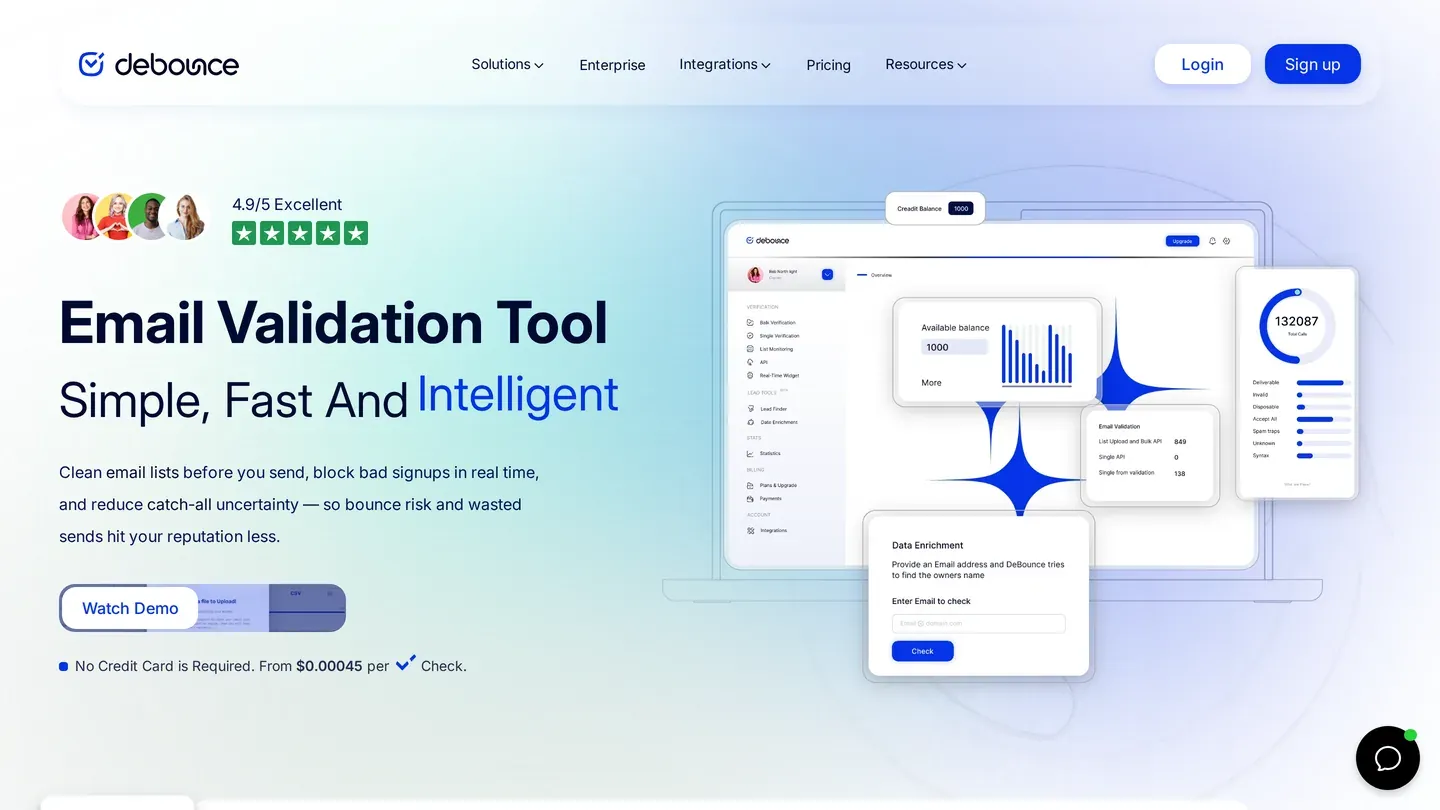
The slider moves in steps of 1,000 credits and prices any amount between two preset sizes on a straight line. Above 5 million the card says to contact support, and it says prices include taxes and fees. It also carries a Monthly switch that shows prices 8% lower and states no terms, so we priced pay as you go only.
DeBounce charges 1 credit per standard validation, and duplicates are removed at no extra cost. The optional catch-all step is where its pages disagree. Its billing article gives the cost as "10 credits per email" in its definition and summary, and as "10 additional credits per email" in its process list. The pricing card says "10 credits per validation". So the step costs either 10 credits or 11 in total for each catch-all address, and we cannot tell you which.
The same article says only emails detected as catch-all are eligible, while the catch-all page says the step verifies "catch-all and unknown emails". That page claims 95% accuracy for catch-all emails. It is DeBounce's claim, and we did not run the step.
Unknowns are unclear too. The billing article lists Unknown among the results of the 1-credit check, but the validation-credit article says "You will not pay for the Unknown statuses" under its lead-finder heading. We count them as billed.
DeBounce says credits never expire, on its pricing card and in its help centre, with no qualifier. Its Terms have no inactivity clause, but they let DeBounce disable an account at its sole discretion without prior notice. You get 100 free credits once per account, with no card.
MillionVerifier: packs, credit life and the new operator
MillionVerifier sells one-off packs, listed in its pricing section. The smallest is 10,000 credits for $39, and the packs run on to 50 million credits for $8,499.
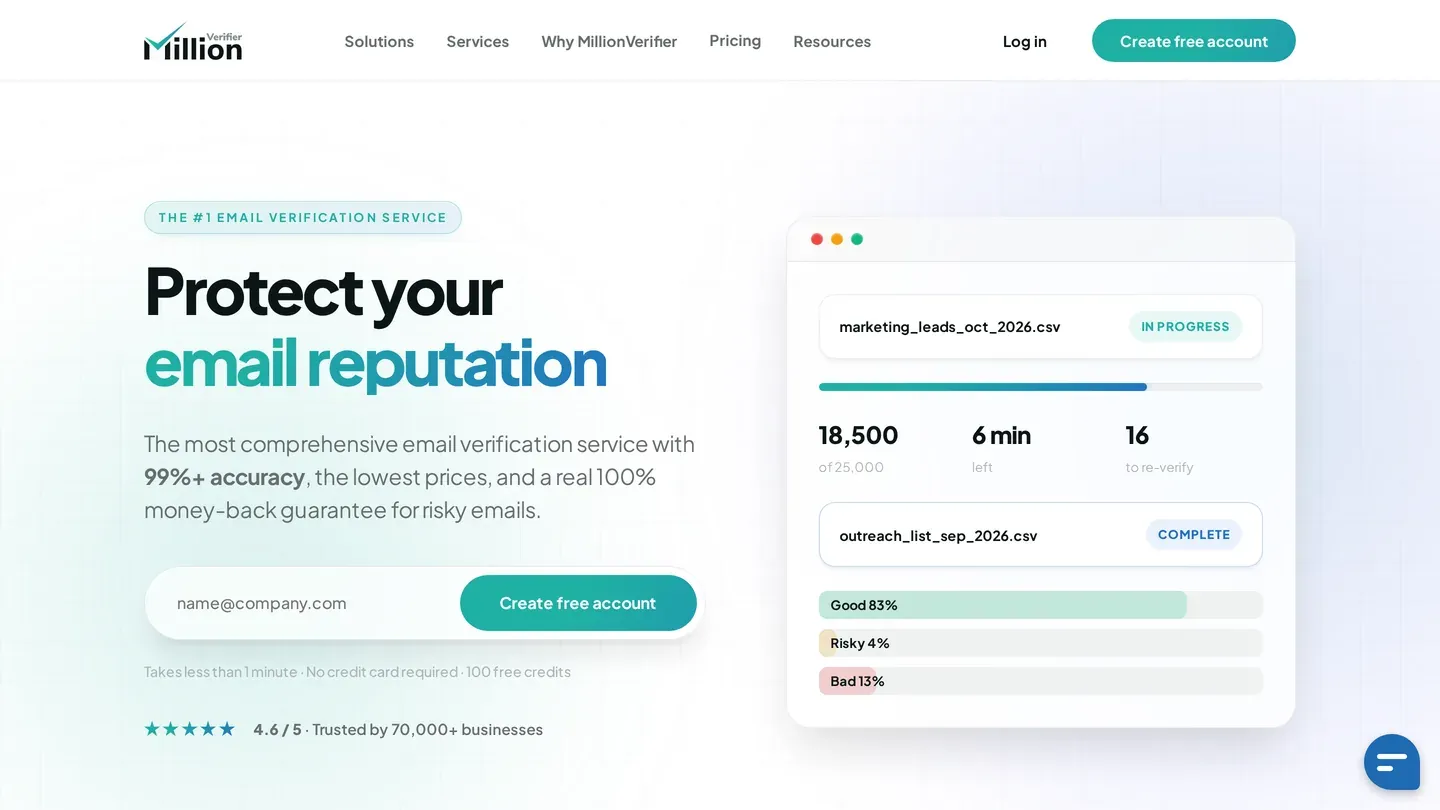
Its help centre says there are no monthly or annual plans, you cannot buy a custom number of credits, and packs are fixed and cannot be combined. To add credits you buy another pack. Nothing is sold between the 100,000 pack ($149) and the 500,000 pack ($299). Its Terms say prices exclude GST, VAT and similar taxes, where DeBounce's card says its prices include them.
The homepage says credits never expire, with no qualifier. The Terms add one. An account idle for 12 continuous months can be removed after a month's notice, and a login does not count as activity. Removal does not forfeit the credits, which stay on a recovery record until support restores them. The homepage offers 100 free credits with no card, and a help article lists other trial options.
MillionVerifier changed operator on 19 October 2026. Its Terms now name Southern Vector Limited, a New Zealand company, as the service provider. Its blog post on the change says credits, prices and the guarantee did not change, and that PayPal is gone.
MillionVerifier also advertises a catch-all verifier. Its service page says it resolves 30% to 40% of catch-alls into valid leads for one credit. A help article on the beta promises an improvement of up to 70% to 80% in catch-all and business unknown results. These are two claims on two pages, and we have tested neither.
DeBounce pricing vs MillionVerifier pricing, 5,000 to 5 million
All prices are US dollars from each vendor's pricing page. DeBounce is the pay-as-you-go card and MillionVerifier is the one-off pack.
| Volume | DeBounce pay as you go | MillionVerifier pack | Cheaper, and by how much |
|---|---|---|---|
| 5,000 | $15 (minimum) | not sold | DeBounce, only seller |
| 10,000 | $25 | $39 (smallest) | DeBounce, 1.56x |
| 25,000 | $45 | $59 | DeBounce, 1.31x |
| 50,000 | $75 | $89 | DeBounce, 1.19x |
| 100,000 | $135 | $149 | DeBounce, 1.10x |
| 200,000 | $200 | not sold | DeBounce, only seller |
| 500,000 | $450 | $299 | MillionVerifier, 1.51x |
| 1,000,000 | $750 | $449 | MillionVerifier, 1.67x |
| 2,000,000 | $1,300 | $799 | MillionVerifier, 1.63x |
| 5,000,000 | $2,200 | $1,599 | MillionVerifier, 1.38x |
The multiple is the dearer price divided by the cheaper one, so 1.56x means the dearer tool costs 1.56 times as much. At 200,000 credits MillionVerifier has no pack, and two 100,000 packs cost $298.
The crossover compares the cheapest way to buy a given number of credits at each vendor, not cost per credit. MillionVerifier sells nothing between its 100,000 pack ($149) and its 500,000 pack ($299). DeBounce prices any amount in 1,000-credit steps, on a straight line between its 200,000 tier ($200) and its 500,000 tier ($450). For N credits in that range, that line is $200 plus (N minus 200,000) divided by 1,200. Set it equal to $299 and N is 318,800. On the slider, DeBounce is cheaper through 318,000 credits ($298.33) and dearer from 319,000 ($299.17).
One caveat moves that line: DeBounce's Monthly switch would shift it, and we did not price it. MillionVerifier's welcome promotion adds 5% to 15% more credits to packs from 50,000 up in a new account's first week, 10% on the 500,000 pack, which we did not price either. It leaves the $299 line where it is but makes each pack go further.
What you are billed for on a list like ours
On our 1,000 addresses, as unit arithmetic and not a bill:
- DeBounce, standard check: 1,000 credits.
- DeBounce, with the catch-all step on its 201 Accept All results: 3,010 credits if the step is 10 additional credits (1,000 plus 2,010), or 2,809 if "10 credits per email" is the whole charge for those addresses (799 plus 2,010).
- MillionVerifier, if the credit-back applies: 811 credits, which is the 709 ok and 102 invalid results. The 170 catch_all and 18 unknown results are credited back. We treat its one row with no result as unbilled, since the sheet does not say. If the credit-back is withheld, the bill is 1,000 credits.
At the 10,000-credit rates that is $2.50 for DeBounce's standard check and $3.16 for MillionVerifier. At the 100,000 rates it is $1.35 and $1.21.
MillionVerifier describes its credit-back three ways. Its help centre says it "doesn't charge you" for unknown and catch-all emails. Its Terms say a credit is deducted and a new promotional goodwill credit may then be added, under a programme they call discretionary and not a permanent feature. They allow it to be withheld for scraping or fabricated data, or when you cannot show where a list came from.
The homepage promises a "Full refund on any email we can't verify with certainty", though the Terms give those credits a cash value of zero. The help centre says accounts whose results regularly hold an outstandingly large number of unknown or invalid addresses lose the credit-back, about 1% of users. Read the Terms before you count on it.
Guarantees and list-source terms
| DeBounce | MillionVerifier | |
|---|---|---|
| Refund trigger | Credits added below its accuracy threshold; all your money back above 8% bounces | Last payment back if more than 4% of OK addresses hard-bounce |
| Conditions | Opt-in list you collected; at least 1,000 addresses sent within 48 hours; feedback form within 30 days | Web-app uploads only; every OK address mailed within 7 days through a professional sender |
| Lists from a third party | Guarantee excludes purchased lists | Terms allow them if acquired and used lawfully; source evidence may be requested |
| Uploaded files kept | 7 days (retention policy) or one month (Terms) | Normally deleted after 30 days (Terms) |
Source: each vendor's guarantee page, help centre and Terms.
DeBounce states its thresholds inconsistently. Its homepage says 97% where the guarantee page and help article say 97.5% or better. The guarantee page promises 95%+ on Microsoft accounts and 98%+ on everything else. Its worked example uses 97%+ for all other aspects. The help article lists 96%+ on AOL, Yahoo and Office 365.
MillionVerifier's help centre says you must allow it to log in to your email sender account to review a claim. Its Terms say a password should not be shared where a secure export is available. Its help centre also says "hard bounce rate will be lower than 1% guaranteed" beside a refund that starts at 4%.
Neither tool came near its trigger on our list: 1 failure on 670 sends for DeBounce and 7 on 709 for MillionVerifier. So the conditions decide whether a claim on your list would succeed. If your list comes from a data provider, DeBounce's opt-in exclusion matters first. Its help centre warns that Accept All and Unknown addresses from purchased lists are likely to perform poorly. MillionVerifier's Terms add that buying, renting or licensing a list does not by itself establish lawful use.
Where WizLeads landed on the same list
WizLeads approved 852 of the 1,000, rejected 148, and 5 of the approved failed on send, a 0.59% rate. That is the third-lowest of the six verifiers, behind DeBounce (0.15%) and NeverBounce (0.56%). DeBounce beats WizLeads on this measure, 1 of 670 against 5 of 852.
Inside this pair's cells, the unfavourable one first. Of the 5 addresses DeBounce called Bounce that MillionVerifier approved, WizLeads approved 3, and all 3 failed. They are 3 of its 5 failures. The favourable cells: of the 47 Accept All and Unreachable addresses MillionVerifier approved, WizLeads approved 45 and none failed. Of the 14 only DeBounce approved, it approved 11 with no failures. Of the 656 both approved, it approved 653, with the one shared failure.
Verify Email costs 0.5 credits per email, charged for every email processed whatever the result. It returns valid, invalid, unknown or error plus a catch-all flag, and WizLeads classifies catch-all emails as valid or invalid. The Freelancer plan is $39 a month for 10,000 credits, which covers 20,000 verifications, or $19.50 per 10,000 as a unit cost. That is below both rivals at 10,000 ($25 and $39).
At 1 million verifications, which is 500,000 WizLeads credits, DeBounce's $750 and MillionVerifier's $449 both undercut Kingpin's pro-rata unit cost of $831.67. That figure comes from the $499 monthly plan's 300,000 credits. That is a unit cost, not a bill: one month of Kingpin holds 300,000 credits, short of the 500,000 needed. On expiry both rivals beat WizLeads, whose credits roll over for one billing period.
Which one to buy
Three things decide it: how many credits you buy at a time, where the list came from, and which billing rules you can live with.
| DeBounce | MillionVerifier | |
|---|---|---|
| Volume it suits | 5,000 up to about 318,000 credits per purchase | the 500,000 pack and up |
| List source | guarantee covers opt-in lists you collected | Terms allow third-party lists, lawful use required |
| What you pay for | every standard check; catch-all step 10 credits or 10 more | ok and invalid; risky results credited back at its discretion |
| Where it differed in our send test | 5 addresses it called invalid bounced when MillionVerifier approved them | 46 of the 47 addresses DeBounce held back recorded no failure |
If you buy under about 318,000 credits at a time, pick DeBounce. It costs less, and on this list the 5 addresses it called invalid that MillionVerifier approved all hard-bounced. If you buy the 500,000 pack or more, or your list comes from a data provider and you want terms that allow it, pick MillionVerifier. Be ready to show where the list came from, and review its approvals on Mimecast and Microsoft catch-all domains yourself.
A DeBounce review in one line: the cheaper tool below about 318,000 credits, and the one that rejected the most addresses in our test, 330 against 291. A MillionVerifier review in one line: the cheaper tool at volume, with a credit-back its Terms call discretionary.
Before you buy volume, spend the 100 free credits on each tool and run a sample of your own list. If neither tool fits that sample, the email verifier comparison lists 14 verifiers, 6 of them send-tested.