WizLeads


TL;DR
NeverBounce is the reference in our test. Five alternatives were send-tested beside it on the same 1,000 real-estate decision-maker emails from Apollo, and three more are priced only.
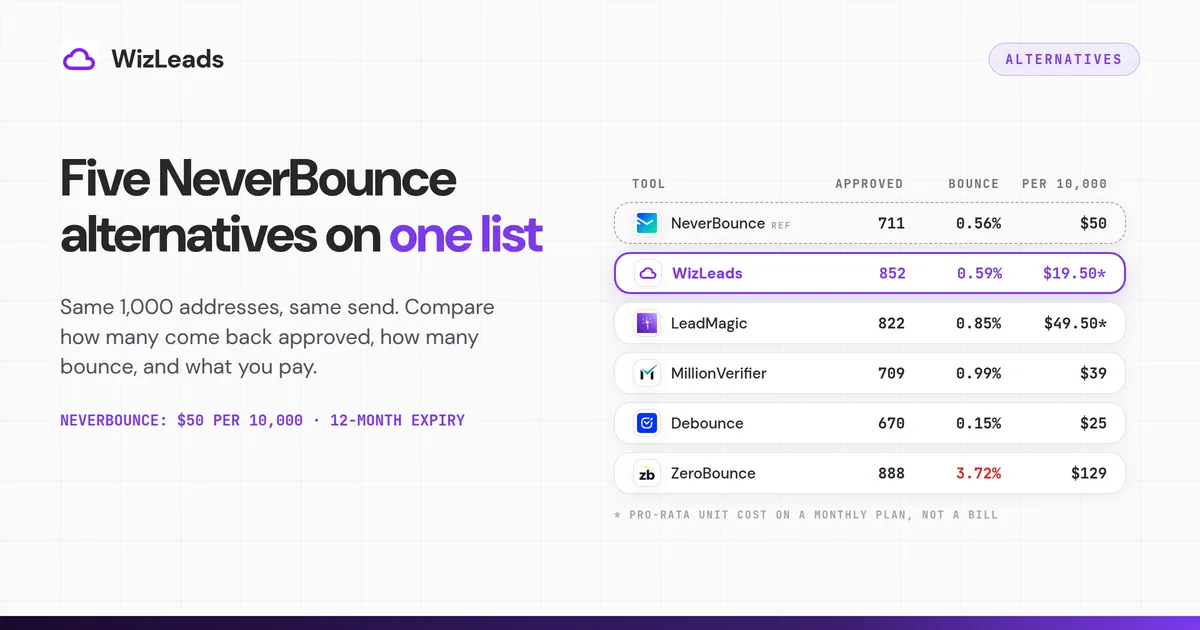
- NeverBounce (reference): 711 approved, 0.56% bounce, $50 per 10,000, pay-as-you-go credits expire after 12 months.
- WizLeads: 852 approved at 0.59%, the most of the four alternatives under 1% bounce, at a $19.50 unit cost per 10,000.
- LeadMagic: 822 approved at 0.85%, with unknown results free.
- MillionVerifier: 709 approved at 0.99%, $39 per 10,000.
- Debounce: the lowest bounce rate of the six tools (0.15%) and the most rejections (330).
- ZeroBounce: 888 approved, the most of the six, and the only bounce rate over 1% (3.72%).
- Reoon, Truelist, OrbiSearch: lower pack prices than NeverBounce at 10,000, with no send test.
Prices are from each vendor's pricing page; WizLeads' and LeadMagic's are unit costs on their plans.
NeverBounce approved 711 of our 1,000 test emails, and 4 bounced (0.56%). Only Debounce bounced less (0.15%), and WizLeads' email checker bounced 0.59% on 852 approved. The alternatives otherwise change how many addresses come back approved, what you pay for results a tool cannot resolve, and how long your credits last.
An alternative can change three things NeverBounce leaves you with: how much of a B2B list comes back catch-all or unknown, what you pay at your volume, and credits that expire after 12 months, which a team that cleans a list twice a year may never use up.
The five alternatives follow one rule. Among those that kept bounces under 1%, the most approved addresses come first, then the one tool over 1%. The tools under 1% are too close on bounce rate to rank, so approvals separate them. NeverBounce is the reference row, not a ranked entry.
How we tested the six verifiers
In April 2026 we exported 1,000 real-estate decision-maker emails from Apollo. All six verifiers got the identical CSV on the same day, inside two hours. We sent a plain-text message from a clean Google Workspace account and counted hard bounces and mailbox-does-not-exist responses over 72 hours. Soft bounces that resolved inside the window were not counted.
We mailed only the addresses at least one tool approved; the 96 every tool rejected were never sent. So rejections are counts, never graded as right or wrong. The email verification benchmark holds the method and the data, and our raw benchmark sheet holds every address-level cell used below.
| Tool | Approved | Bounced | Bounce rate | Rejected |
|---|---|---|---|---|
| NeverBounce (reference) | 711 | 4 | 0.56% | 289 |
| WizLeads | 852 | 5 | 0.59% | 148 |
| LeadMagic | 822 | 7 | 0.85% | 178 |
| MillionVerifier | 709 | 7 | 0.99% | 291 |
| Debounce | 670 | 1 | 0.15% | 330 |
| ZeroBounce | 888 | 33 | 3.72% | 112 |
Bounce rate is bounces divided by the addresses a tool approved. Approved plus rejected is 1,000 for every tool, and each tool's unknown and catch-all results sit inside its rejected count. NeverBounce's 289 rejections were 137 catch-all, 79 unknown, 72 invalid and 1 with no result.
At 1,000 addresses the five low-bounce tools are statistically indistinguishable: the difference between 4 bounces and 7 is noise, and only ZeroBounce's 33 separates. It is also one list, in one vertical, from one month.
NeverBounce against WizLeads, address by address
NeverBounce and WizLeads agreed on 843 addresses, 703 that both approved and 140 that both rejected. They split on the other 157, and one of the two approved each of those, so we mailed all 157. Every cell is below, the unfavorable ones too.
| NeverBounce result | WizLeads result | Addresses | Failed on send |
|---|---|---|---|
| Approved | Approved | 703 | 3 |
| Approved | Rejected | 8 | 1 |
| Catch-all or unknown | Approved | 145 | 0 |
| Invalid | Approved | 3 | 2 |
| No result | Approved | 1 | 0 |
| Rejected | Rejected | 140 | No result published |
A failure is a hard bounce or a mailbox-does-not-exist reply. The 145 are 93 that NeverBounce flagged catch-all and 52 it flagged unknown, out of 216 it left unresolved (137 catch-all and 79 unknown). WizLeads approved all 145, and none failed. Those counts are subsets of NeverBounce's rejections, not additions to them.
NeverBounce called 3 addresses invalid that WizLeads approved, and 2 of them failed. NeverBounce approved 8 that WizLeads rejected, and 1 of them failed: a mailbox-does-not-exist reply, not a hard bounce.
We publish no send result for the 140 both tools rejected. Rejections are counts, not graded. Every cell here is small, so read it as a count, not a rate.
Where NeverBounce gets expensive
NeverBounce's result-codes help page lists five codes (valid, invalid, disposable, accept all and unknown) and marks accept all and unknown "use caution", and those two are where a B2B list gets expensive. A catch-all domain accepts mail for any address, so a standard SMTP check cannot tell a real mailbox from a made-up one. NeverBounce calls accept all a domain-wide setting and says catch-alls bounce at about half your list's invalid rate, which leaves the send-or-skip call with you.
On our list, 216 of NeverBounce's 289 rejections were catch-all or unknown, a bucket you settle separately.
For unknown results the same page says the mail server gave no definite answer in time, and to re-verify first. Re-verifying is where the meter bites. NeverBounce's billing help sets 1 credit per verification and states no exception, so a second check reads as another credit. Pay-as-you-go credits also expire 12 months after purchase.
The five send-tested NeverBounce alternatives
Each tool gets the same four slots: what it did on our list, what it costs and what you are billed for, how long credits last, and who it fits.
1. WizLeads: the most approvals of the alternatives under 1% bounce
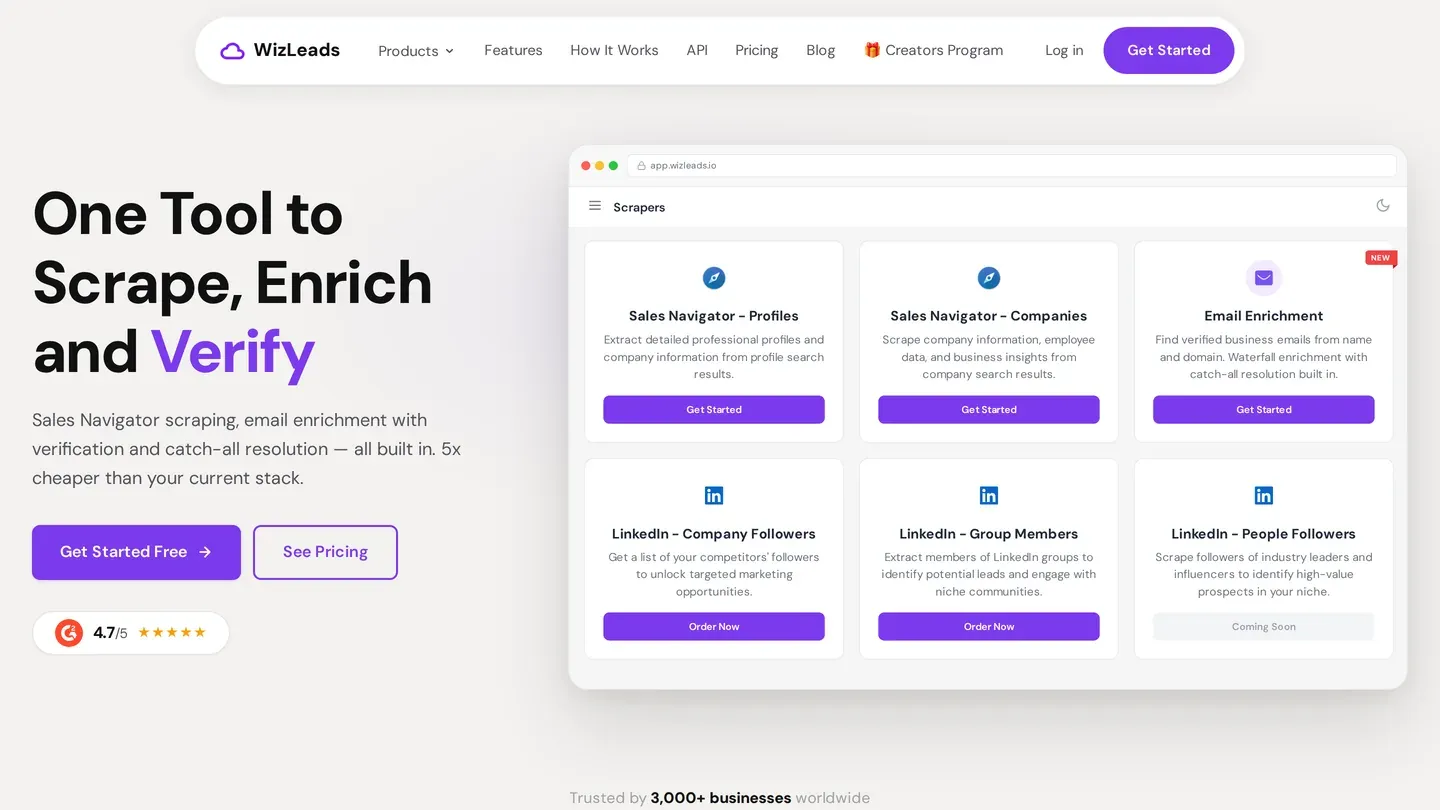
WizLeads approved 852, 5 bounced (0.59%), and it rejected 148. That is 141 more approvals than NeverBounce and 141 fewer rejections. NeverBounce (0.56%) and Debounce (0.15%) both bounced less than WizLeads. WizLeads flags catch-all addresses and also gives each one a valid or invalid verdict. 95 of the 145 in the cell above carried its catch-all flag.
Verify Email costs 0.5 credits for every email processed, whatever the result, so unknown results are billed too. Freelancer is $39 a month for 10,000 credits, which covers 20,000 verifications. That is $19.50 per 10,000 as a unit cost, though a 10,000-address job still bills $39. Kingpin is $499 a month for 300,000 credits, a unit cost of $831.67 per 1,000,000 verifications.
Credits roll over for one billing period, a month on monthly plans and a quarter on quarterly ones. If the bounce rate exceeds 2% on emails WizLeads marked valid, it refunds 100% of the credits, subject to an email infrastructure diagnosis. That is credits, not cash.
It fits teams that verify B2B lists every month. A team that cleans one list twice a year gets less from credits that roll over for only one period.
2. LeadMagic: 822 approved, with unknown results free
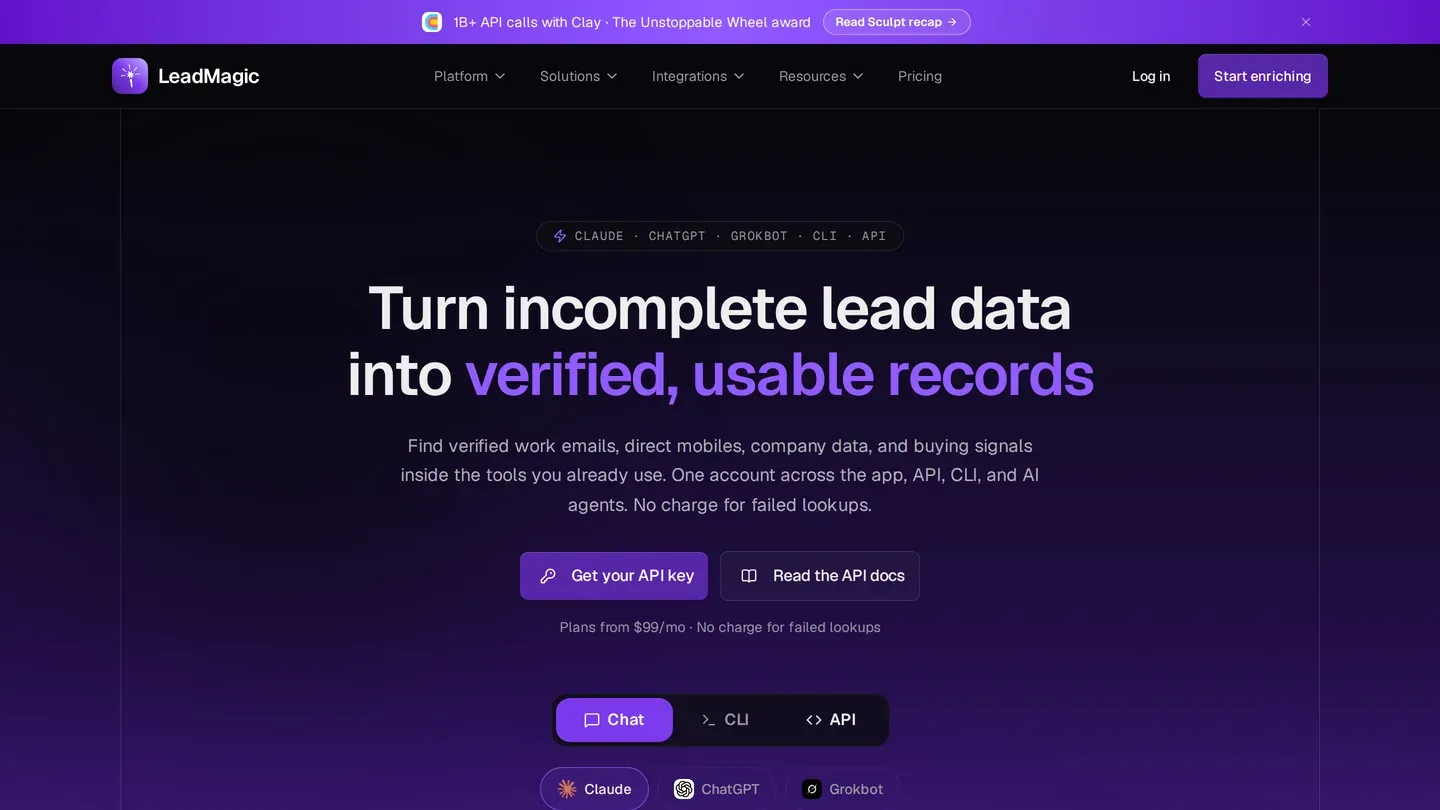
LeadMagic approved 822, 7 bounced (0.85%), and it rejected 178. Its validation page says catch-all addresses are checked individually when possible, and inconclusive ones stay Unknown.
On LeadMagic's pricing page, Essential is $99 a month for 5,000 credits. A validation costs 0.25 credits per definitive answer, and unknown results are free. If every result is definitive, that covers 20,000 validations, a unit cost of $49.50 per 10,000. That is about 2.5 times WizLeads' $19.50 unit cost at entry tiers, and level with NeverBounce's $50.
Ultimate is $849 a month for 100,000 credits, a $21.23 unit cost per 10,000.
Monthly plans keep credits up to twice the monthly allotment, and annual credits do not roll over. There are no free credits, and payments are non-refundable except where the law requires or a signed agreement says otherwise. It fits teams already spending LeadMagic credits on finding emails, where validation comes out of the same pool.
3. MillionVerifier: 709 approved, and one-time packs
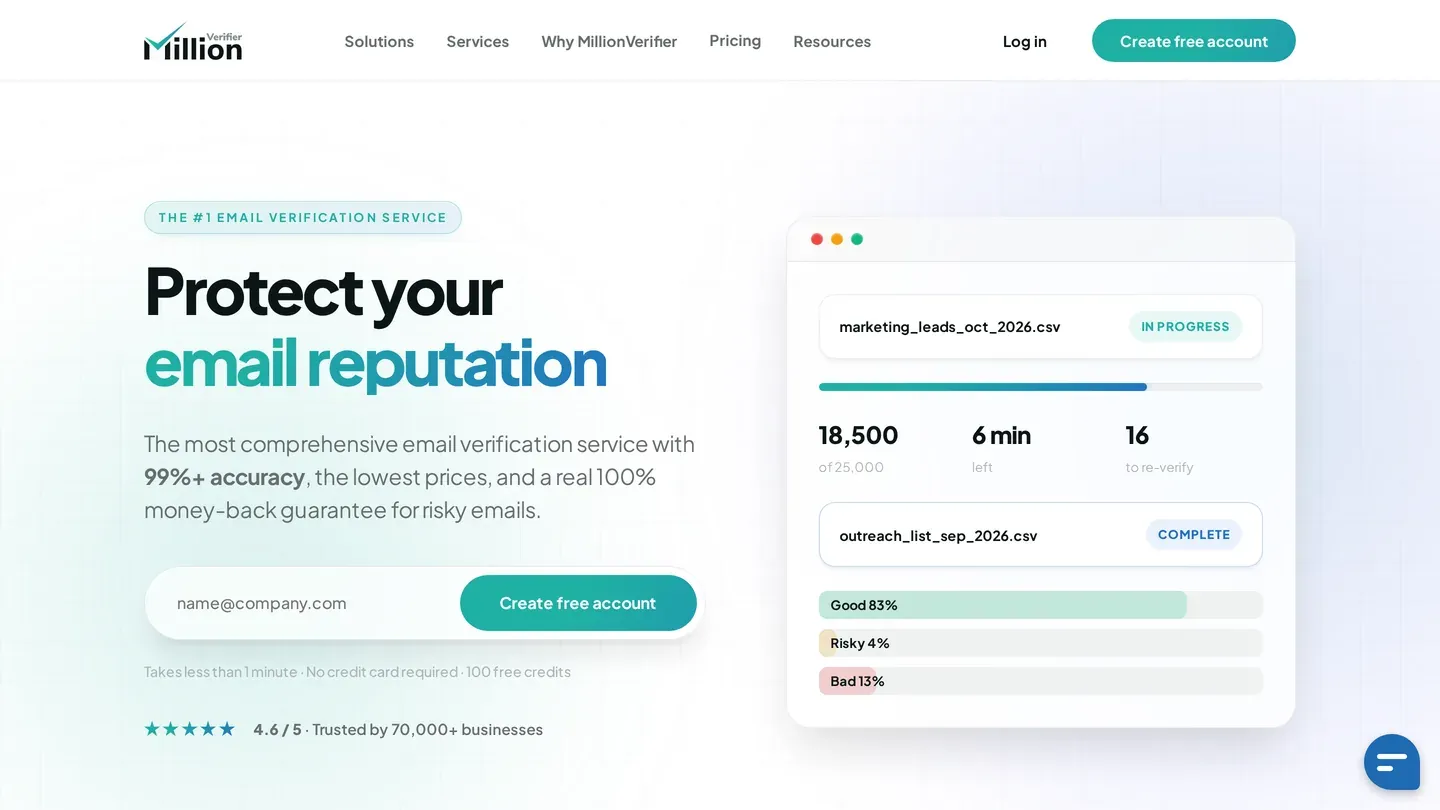
MillionVerifier approved 709, 7 bounced (0.99%), and it rejected 291. That is two fewer approvals than NeverBounce and three more bounces. MillionVerifier flags catch-alls without saying whether they are valid or invalid; its 170 catch_all flags stayed unresolved in our run. They sit inside the 291.
Its service page claims it resolves 30% to 40% of catch-alls, and a beta help page claims up to a 70% to 80% improvement. We tested neither.
MillionVerifier's pricing section sells one-time packs: $39 for 10,000, $149 for 100,000 and $449 for 1,000,000, with no pack below 10,000. Its help centre also lists a new-account trial of 2,000 credits for $4.90. Its homepage says credits never expire, while its Terms say they do not expire merely because time passes. An account idle for 12 continuous months may be removed after one month's notice, and removal does not forfeit the credits.
Unknown and catch-all results are a goodwill program. It deducts a credit per email, then may add credits back. The homepage promises a "Full refund on any email we can't verify with certainty", and its Terms call the program "discretionary". It fits occasional cleaning of very large lists.
4. Debounce: the lowest bounce rate of the six tools, and the most rejections
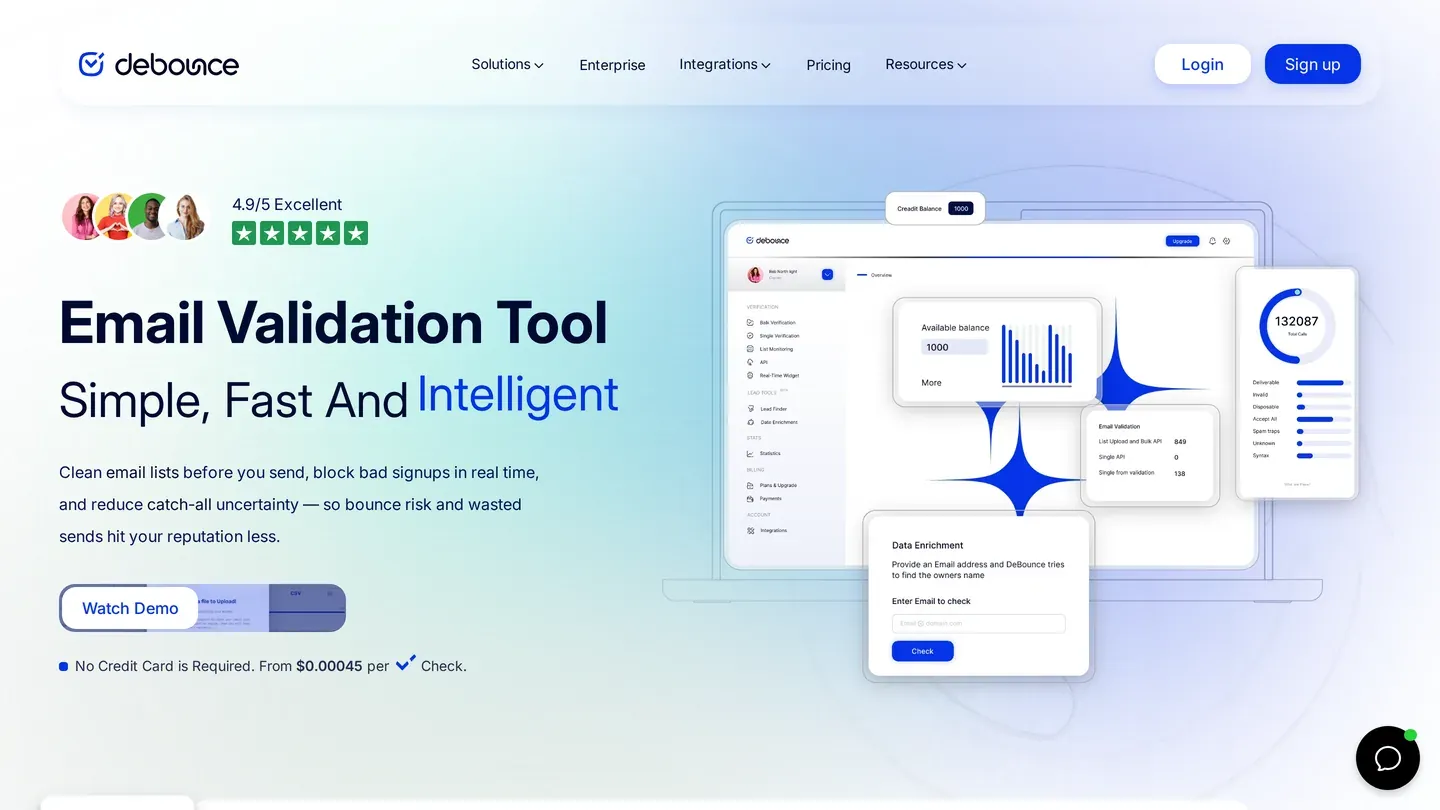
Debounce approved 670, 1 bounced (0.15%), and it rejected 330, a third of the list. Of those, 201 were flagged Accept All. We ran its standard check, not its paid catch-all step, so those flags stayed unresolved by design.
Debounce's pricing page starts at $15 for 5,000 credits, then $25 for 10,000, $135 for 100,000 and $750 for 1,000,000. Its homepage headline, "From $0.00045 per Check", sits at the top of the ladder: the largest tier, $2,200 for 5,000,000, works out to $0.00044. A standard check costs 1 credit, per its billing help. The catch-all step is priced two ways: the pricing page says 10 credits per validation, and the help centre says 10 additional, so 10 or 11 in total.
Purchased credits never expire, though its Terms let it disable an account at its sole discretion. New accounts get 100 free credits.
Its guarantee promises 97.5% or better deliverability, while its homepage says 97%. The guarantee asks for an opt-in list you collected, not one bought from a third party, so read it against how your list was sourced. Debounce fits senders who care most about bounce rate and can live with rejecting a third of a list.
5. ZeroBounce: the most approvals of the six, and the only bounce rate over 1%
ZeroBounce approved 888, 33 bounced (3.72%), and it rejected 112. That is 177 more approvals than NeverBounce and 29 more bounces.
ZeroBounce's pricing page sells pay as you go from $39 for 2,000 credits. It lists $129 for 10,000, $649 for 100,000 and $3,199 for 1,000,000, and ZeroBounce ONE starts at $99 a month. Unknown results are never charged, and its Freemium plan gives 100 free verifications a month when you sign up with a business domain. Verify+, an optional add-on, runs catch-all validation, and some catch-alls may then become valid or invalid while the rest stay catch-all.
The pricing page says credits never expire, with a tooltip that limits this to an active ZeroBounce ONE subscription. Its Terms add a two-year expiry for customers who registered after 1 June 2026, and pay-as-you-go purchases are final and non-refundable. It fits teams that want the most addresses approved and will score or re-check them before sending.
Cheaper than NeverBounce at 10,000, but not send-tested
These three undercut NeverBounce's $50 at 10,000 and are the other NeverBounce competitors we priced. None was in our test, so their prices come with no bounce data.
Reoon: the lowest pack price at 10,000
Reoon's email verifier page lists $11.90 for 10,000 credits, $116.40 for 100,000 and $972 for 1,000,000. Credits never expire. One successful verification costs one credit, anything except unknown, and unknown results are refunded automatically.
It gives 20 free credits a day, up to 600 a month. The lead holds at 10,000 only: at 100,000 Truelist and OrbiSearch are lower.
Truelist: the second-lowest pack price at 10,000
Truelist's pricing page charges $14 for 10,000, $90 for 100,000 and $700 for 1,000,000. A standard check costs 1 credit per email with a definitive verdict. Enhanced catch-all resolution costs 3 credits, applied only where the standard check returns unknown. Credits never expire.
OrbiSearch: below MillionVerifier from 10,000 up
OrbiSearch's pricing page charges 0.2 credits per validation. Packs run $30 for 10,000 validations, $103 for 100,000 and $311 for 1,000,000, which is below MillionVerifier at every size from 10,000 up. Credits never expire, and 100 free credits equal 500 validations.
NeverBounce pricing next to the alternatives
| Tool | 10,000 | 100,000 | 1,000,000 | Send-tested |
|---|---|---|---|---|
| WizLeads, Kingpin monthly* | $8.32 | $83.17 | $831.67 | Yes |
| Reoon | $11.90 | $116.40 | $972 | No |
| Truelist | $14 | $90 | $700 | No |
| WizLeads, Freelancer* | $19.50 | $195 | $1,950 | Yes |
| LeadMagic, Ultimate* | $21.23 | $212.25 | $2,122.50 | Yes |
| Debounce | $25 | $135 | $750 | Yes |
| OrbiSearch | $30 | $103 | $311 | No |
| MillionVerifier | $39 | $149 | $449 | Yes |
| LeadMagic, Essential* | $49.50 | $495 | $4,950 | Yes |
| NeverBounce | $50 | $400 | $2,500 | Yes |
| ZeroBounce | $129 | $649 | $3,199 | Yes |
*Unit costs, not bills: each plan's monthly price spread pro rata over the verifications its credits buy. Each starred row bills the full plan price: $499 for Kingpin (600,000 verifications a month), $39 for Freelancer (20,000), $849 for LeadMagic Ultimate (400,000) and $99 for Essential (20,000). Where a column is larger than that, the figure spans more than one month. Every other row is a pack price.
At 10,000, NeverBounce's $50 is 2.6 times WizLeads' $19.50 unit cost and about the same as LeadMagic Essential's unit cost. Only ZeroBounce is dearer. At 100,000, NeverBounce's $400 beats only LeadMagic Essential and ZeroBounce. At 1,000,000, its $2,500 beats the same two and is about 5.6 times MillionVerifier's $449.
Small jobs are the exception. NeverBounce's $8 for 1,000 credits is the smallest repeatable purchase of the six send-tested tools (MillionVerifier's help centre lists a new-account trial of 2,000 credits for $4.90). Debounce starts at $15 for 5,000, ZeroBounce at $39 for 2,000, MillionVerifier at $39 for 10,000, WizLeads at a $39 plan and LeadMagic at $99 a month.
NeverBounce review: what it costs, what is free and what the guarantee covers
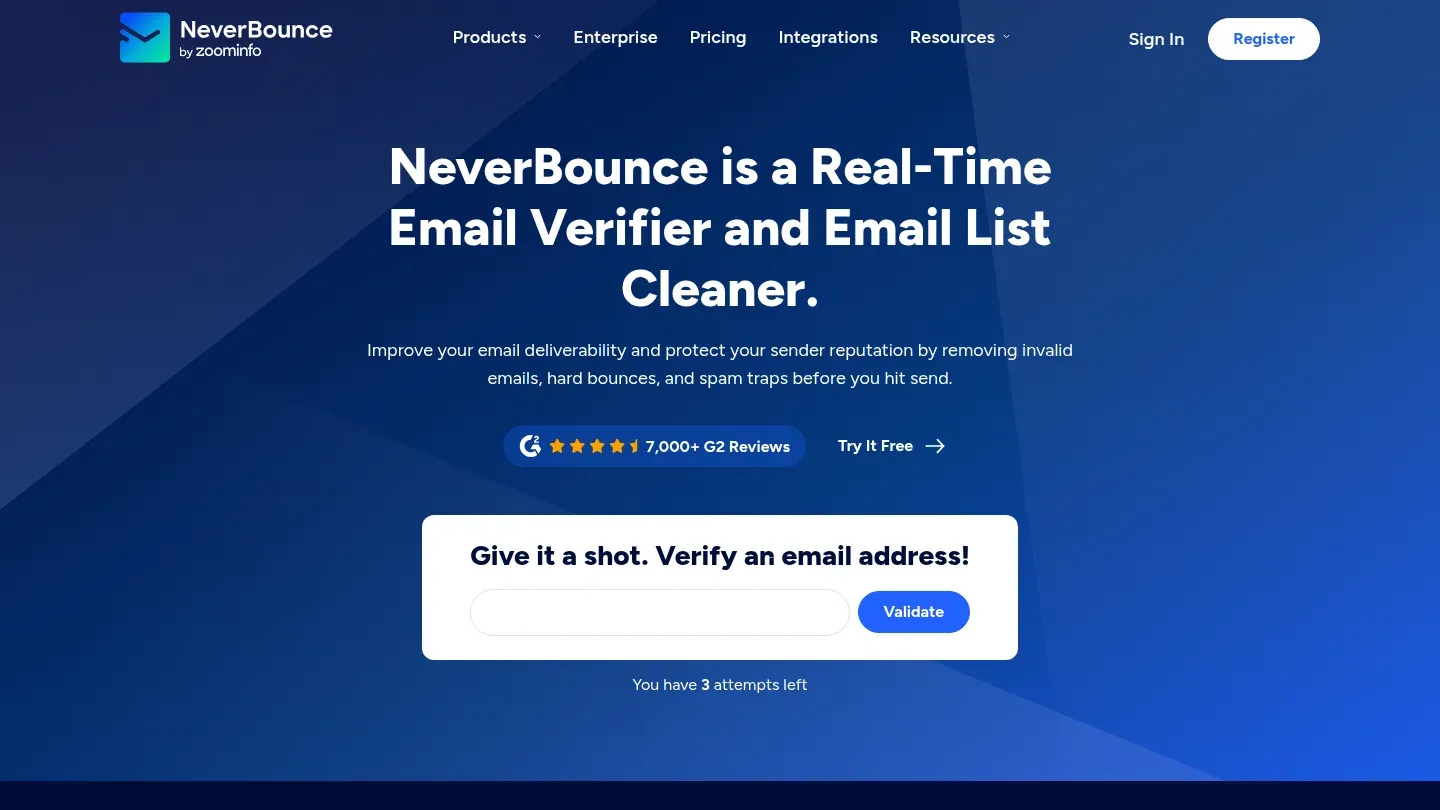
NeverBounce pricing comes in two forms, per its pricing page: pay-as-you-go credits that get cheaper with volume, and Growth, a monthly subscription sized by volume. Both spend 1 credit per verification.
| Volume | Pay as you go (one-time) | Growth (monthly) |
|---|---|---|
| 1,000 | $8 | $49 tier (up to 10,000) |
| 10,000 | $50 | $49 |
| 100,000 | $400 | $159 |
| 1,000,000 | $2,500 | $999 |
Pay-as-you-go credits expire 12 months after purchase, and its Terms say each credit is valid for 365 days with no replacement credits or refunds. Growth bills only new, unique emails, and duplicates are free. The Growth card also lists AI-picked leads and AI scoring, so it is not a verification-only plan. Enterprise is custom, pitched at 250,000 or more emails a month.
NeverBounce free credits are stated three ways. Its signup page and billing help give 10 on registration, and until you add a payment method the bulk API is restricted. Another help article says free credits go to anyone who books a demo with its sales team, with a card on file, and its homepage promises "free list analysis and free test credits".
The guarantee promises no more than 3% of your emails will bounce and refunds the difference above that. The conditions narrow it.
The list needs at least 500 unique addresses, mailed within 72 hours of cleaning. Only addresses marked deliverable count, so invalid, accept all, unknown and disposable results are out, as are freemail domains such as Gmail, Outlook and Yahoo, and bounces put down to sender reputation or technical issues. Its Terms say there are no refunds, while the guarantee page says it refunds the difference.
It is a bounce ceiling, not an accuracy score. NeverBounce's homepage says it will "Deliver up to 99.9% of your emails with confidence" and its signup page says "Ensure 99% Email Accuracy". Neither compares with a bounce rate measured on send.
When to stay on NeverBounce
Your list is opt-in or cheap to rebuild. NeverBounce's 0.56% was the second-lowest bounce rate in our test, at $50 per 10,000. Re-engagement files and newsletter lists fit.
You verify small batches. Its $8 for 1,000 credits is the smallest pack you can buy again and again among the six tools we send-tested.
Your verification lives inside other software. Its homepage lists wrappers for cURL, NodeJS, PHP, Python, Ruby, Go, Java and .NET, and shows both "80+" and "over 85" integrations. If you already buy ZoomInfo data, its Terms name ZoomInfo Technologies LLC as the operator, so one vendor covers both.
If rejections or expiry are why you are leaving, run 1,000 addresses from your own list through NeverBounce and one alternative on the same day. Send to what each approves, count the failures over 72 hours, and compare approved counts at similar bounce rates. If none of the five fits, the best email verification tools list ranks 14 verifiers, and any of them can go into the same sample.